
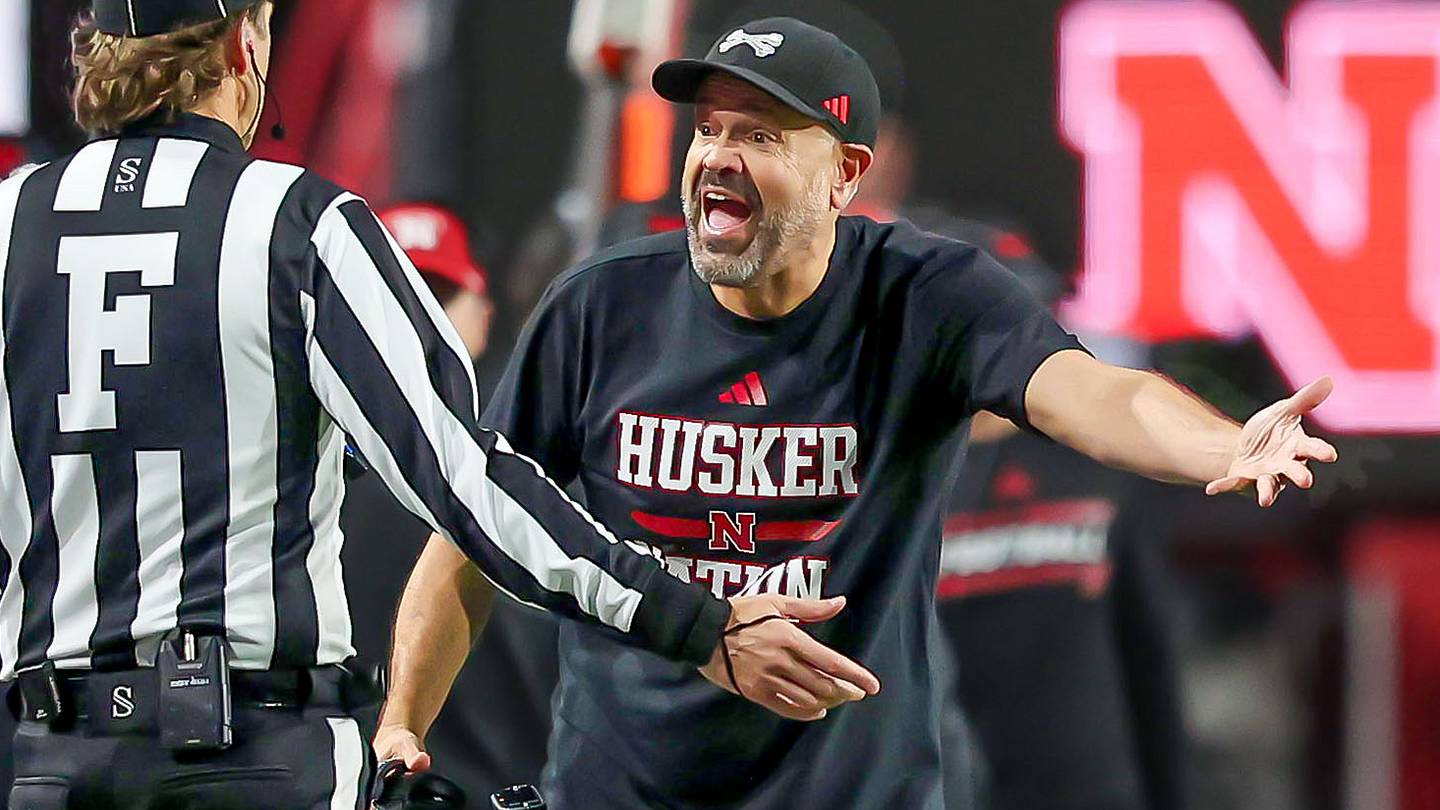
Matt Rhule’s living on borrowed time.
With their backs against the wall and facing yet another must-win game, the Huskers fell on their faces. Again.
This was different, though. This wasn’t a must-win in the sense that Nebraska needed a victory to stay in playoff contention. How unbelievable is it that was actually the narrative only a few weeks ago?
No, this was a must-win in the sense that Nebraska needed to show its head coach was the right person for the job. That he could turn the corner, regain momentum and actually maintain it. Build on the progress he’s made during his first four seasons.
Instead, Nebraska went into Champaign on Friday night and lost 24-13 to Illinois, dropping its fourth consecutive game after starting the season 5-0.
The Huskers were plagued by penalties, missed opportunities, questionable play-calling, execution issues on offense and costly special teams mistakes.
Heck, you could insert the name of just about any conference opponent they’ve faced this year and that headline would work. Come to think of it, that’s pretty much been the narrative for almost the entirety of Rhule’s tenure.
The offense continues to look undisciplined and unfocused. The special teams are dreadful. Nebraska can’t seem to play complementary football, and it’s taking its toll on the only unit that shouldn’t be embarrassed by how it’s performed this season.
Rob Aurich’s defense has done more than enough to give Nebraska opportunities to win games throughout the season. I firmly believe the Blackshirts are a top-10-caliber unit and have played championship-level football for long stretches.
Against Illinois, however, they finally seemed to reach their limit.

Illinois wide receiver Collin Dixon stiff-arms Nebraska cornerback Andrew Marshall. | IMAGN IMAGES via Reuters Connect
The defense played well for much of the game, but as it became increasingly clear the offense wasn’t going to hold up its end of the bargain — again — the Blackshirts seemed to start pressing themselves. Players appeared to be trying to do too much, and the unit looked out of sorts after linebacker Owen Chambliss left the game in the third quarter with a shoulder injury.
The Blackshirts surrendered a season-high 24 points and allowed 376 yards, the second most they’ve given up this season. There were coverage breakdowns and explosive plays allowed that simply shouldn’t happen against a defense this talented.
But asking a defense to continually compensate for mistakes elsewhere is an unsustainable way to win football games.
And that’s what Nebraska has been doing.
The Huskers have now scored just 54 points during their four-game losing streak, averaging 13.5 points per contest. That’s after averaging 43.6 points during their five-game winning streak to begin the season.
The offense that looked so promising against inferior competition has been exposed by better defenses. Nebraska has spent the last month demonstrating that having talented players and being able to consistently put those players in positions to succeed are two entirely different things.
The most frustrating part is that this team has been good enough to win games it’s somehow managed to lose.
Consider the statistical improbability of Nebraska’s three consecutive losses to Indiana, Oregon and Washington.
According to reported ESPN in-game win probabilities, the Huskers’ chances of winning reached 88.2% against Indiana and 85.4% against Oregon. Against Washington, Nebraska still had a 94.4% chance of winning immediately before the Huskies converted a fourth-and-18 with less than two minutes remaining.
Using those three figures, the mathematical probability of losing all three games, assuming each outcome was independent, was approximately 0.0965%.

A Nebraska watches a near-certain win turn into a loss against Washington. | IMAGN IMAGES via Reuters Connect
That’s roughly one chance in 1,036. Yet somehow, Matt Rhule’s Huskers managed to lose all three. Think about just how extraordinary the sequence of collapses has been.
This isn’t simply a matter of facing difficult competition. It’s a team repeatedly failing to finish games it has put itself in position to win.
The losses have come through a combination of questionable coaching decisions, mental lapses, untimely penalties, poor execution and an offense that struggles to make adjustments when opponents counter its initial game plan.
Nebraska has wasted opportunities every season to capitalize on momentum and turn a corner as a program. They’ve shot themselves in the foot countless times.
And there’s no indication Rhule has figured out how to fix it. Or that he ever will.
His teams have suffered second-half collapses to their seasons in all four years he’s been in Lincoln. Regardless of the preseason expectations, he’s managed to give fans a glimmer of hope and then catastrophically disappoint them as the calendar turns toward November.
The numbers are difficult to ignore.
Rhule is now 2-11 in November at Nebraska. His teams are a combined 4-18 after reaching five wins in a season.
Think about that.
Those numbers paint a picture of a program that can build momentum but can’t sustain it. A program that routinely puts itself in position to accomplish something meaningful before finding ways to squander the opportunity.
At some point, you have to stop viewing these collapses as unfortunate circumstances and start recognizing them as a defining characteristic of the program under its current head coach.
We’re approaching that point. Frankly, I think we’re already there.
And it’s becoming increasingly difficult to trust Matt Rhule to be the guy who finally gets Nebraska over the hump.

Nebraska offensive coordinator Dana Holgorsen | Kenny Larabee, KLIN
During his Monday press conference, Rhule defended offensive coordinator Dana Holgorsen amid mounting criticism of Nebraska’s struggling offense. “Dana Holgorsen is one of the best offensive minds of our generation,” Rhule declared.
Okay. So why, after three consecutive losses, was one of the biggest adjustments Nebraska could come up with to move that brilliant offensive mind upstairs into the coaches’ box to call plays? Rhule said the move was initially Holgorsen’s suggestion, even though Holgorsen has long preferred calling plays from the sidelines.
The following day, during his Tuesday press conference, Holgorsen confirmed that preference. He told reporters he likes interacting directly with his players, looking them in the eye and being able to work through issues with them between possessions.
Nevertheless, he agreed to move upstairs, explaining that the change could provide a calmer environment and potentially help Nebraska find a few more points.
Predictably, it didn’t make any difference.
Let’s face it, Nebraska’s offensive problems are far more substantial than where its coordinator sits during games.
Holgorsen is in the final year of the two-year, $2.4 million contract he signed in December 2024, with no publicly announced extension beyond this season. I expect him to be gone the day after Nebraska’s final regular-season game against Iowa.
I’ve already written extensively about why I believe Rhule needs to move on from Holgorsen. His offense has become stagnant, and he hasn’t demonstrated an ability to consistently scheme answers against quality Big Ten defenses.
Not only does Holgorsen need to go, but so do special teams coaches Brett Maher and Nick Humphrey. Heck, outside of Geep Wade and EJ Barthel, the entire offensive staff should be sharpening their résumés.
It’s fair to question whether giving Rhule another offseason to make adjustments is going to produce a different result when he’s already had several opportunities to figure things out.

Nebraska head coach Matt Rhule | Kenny Larabee, KLIN
This past offseason was already conducted the way you’d expect Rhule to approach this coming one if he somehow escapes athletic director Troy Dannen’s firing squad. He made significant changes to his staff, upgraded the roster through the transfer portal, brought in a new defensive coordinator and worked to address areas that had held the team back in previous seasons.
The program appeared organized, focused and ready to take another step forward.
Then we experienced Groundhog Day.
I famously loved the Matt Rhule hire for Nebraska. Heck, when Scott Frost was fired and I put together a series of five articles discussing potential replacements over the following several weeks, Rhule was in that top group.
I thought he was exactly the kind of coach Nebraska needed. And to be fair, he’s done a lot of really good things in Lincoln.
He rebuilt the program after Frost burned it to its foundation and has significantly raised its floor.
I think he’s outstanding at putting infrastructure in place and admire what he’s done in Lincoln in that regard.
He hired Pat Stewart, a proven football mind with an outstanding résumé, to be his general manager. His extended 21st-century staff is constructed nicely, and the various departments operate efficiently and are extremely organized when it comes to their specific jobs and objectives.
I love Corey Campbell’s strength and conditioning philosophy, and Kristin Coggin is one of the most respected nutritionists in the country.
Rhule has done a tremendous job surrounding the football program with people who understand their responsibilities and are equipped to perform them at a high level.
He says all the right things. He works his tail off promoting the football program, the athletic department and the entire university.

Matt Rhule and athletic director Troy Dannen before the Nebraska-Illinois game Friday night. | IMAGN IMAGES via Reuters Connect
You couldn’t ask for a better steward for the program.
The players genuinely love him, too.
Unlike previous failed regimes under Bill Callahan, Mike Riley and Scott Frost, this team hasn’t appeared to lose faith in its head coach. The players believe in Rhule and seem genuinely invested in what he’s trying to accomplish.
That’s important, and it shouldn’t be minimized.
But this is a bottom-line business.
Being an outstanding ambassador for the university, creating a positive culture and assembling an impressive support structure are all valuable qualities. They’re just not enough if they don’t translate into winning football games.
Nebraska is in much better shape as a program than it was when Rhule inherited the mess Frost left behind. The question is whether he’s capable of taking the next step.
After almost four years, the evidence is becoming increasingly difficult to defend. And I’m done trying.
Nebraska is not a program that lacks the resources to compete at the highest level of college football.
The Huskers’ $165 million Osborne Legacy Complex stands among the finest football facilities in the country. Following this season, the university is set to begin major construction on a $600 million renovation of Memorial Stadium, an investment that further demonstrates its commitment to remaining among college football’s premier programs.
Then there’s the fan support.
Despite more than two decades of frustration and disappointment, Nebraska’s passionate fan base has continued to support the program at a level few schools can match.
Despite more than two decades of frustration and disappointment, Nebraska’s passionate fan base has continued to support the program at a level few schools can match.

Nebraska fans cheer as Mekhi Nelson scores against Ohio in September. | IMAGN IMAGES via Reuters Connect
The Huskers have sold out an NCAA-record 416 consecutive home games, a streak dating back to November 3, 1962.
The financial investment is equally impressive.
According to an October investigation by the Flatwater Free Press, Nebraska’s annual football operating budget has more than doubled in three years, climbing to approximately $71 million and ranking 12th among 68 major-conference programs.
That doesn’t include the significant investments being made in player compensation through revenue sharing and NIL opportunities.
The Athletic estimated Nebraska’s 2026 football roster budget at between $31 million and $35 million, placing the Huskers among the Big Ten’s upper tier of spenders.
Nebraska has the facilities, financial resources, administrative commitment and fan support necessary to compete at a championship level.
There aren’t many programs in America that can check all those boxes.
Which raises an obvious question: At what point does that investment need to start producing results on the field? Rhule is approaching the end of his fourth season in Lincoln with a 24-23 overall record and a 12-21 mark in Big Ten play.
The Huskers have made progress in several areas, but that progress has yet to produce anything resembling championship contention.
A program committing this level of resources isn’t doing so with the expectation of hovering around .500 and occasionally celebrating a seven-win season. The goal is to compete for conference championships and eventually College Football Playoff berths.
Nebraska has demonstrated that it’s willing to invest whatever is necessary to give its football program a chance to succeed. At some point, it’s reasonable to expect the results to reflect that commitment.
The resources are in place. The support is there. The talent is there.
The question is whether Matt Rhule is capable of turning those advantages into the kind of sustained success Nebraska has spent so much money trying to recapture.
 WIN $2KIN TICKETS
 WIN $2KIN TICKETS

Athletic director Troy Dannen | Kenny Larabee, KLIN
I’m no longer convinced he can.
Which brings us to Athletic Director Troy Dannen. What does he do?
There aren’t many decisions an athletic director can make that carry more financial, organizational and long-term ramifications than firing a head football coach.
In Dannen’s case, those considerations are particularly complicated.
Rhule signed a two-year contract extension in October 2025 that runs through the 2032 season. The agreement guarantees him 90% of his remaining base salary if Nebraska terminates his employment without cause.
Based on the published salary schedule, firing Rhule at the end of the 2026 calendar year would create an estimated obligation of approximately $63.9 million before any applicable offsets. That doesn’t include his substantial on- and off-the-field coaching and support staff, either.
And don’t forget Nebraska will need to spend another small fortune hiring a replacement and assembling a new staff.
It’s not simply a matter of whether Dannen believes Rhule is the right coach moving forward.
He has to determine whether making a change is financially feasible and whether there’s someone available who gives Nebraska a better chance of succeeding.
There’s also the tremendous damage a coaching change would almost certainly do to the roster and recruiting class.
Nebraska has never really suffered the kind of player exodus under Rhule that we’ve seen at many other programs since NIL and the transfer portal reshaped college football.
There have been a few players leave who the staff would have preferred to keep, sure, but nothing approaching the widespread departures we’ve seen elsewhere. That stability has been one of Rhule’s biggest accomplishments.
Make no mistake, however: A coaching change would likely result in the decimation of this roster.
And that’s particularly concerning because I believe this is the most talented Nebraska team in at least a decade and one of the more talented rosters in the Big Ten. Which also points to why Rhule is probably not the right person for this job if he hasn’t parlayed that into more wins.
When you have one of the nation’s best defenses, one of the most dynamic quarterbacks in your conference and a roster with this much talent, yet you’re sitting at 5-4, that’s a big red flag. No pun intended.

Matt Rhule with 2027 quarterback Trae Taylor. | @Qb6Trae on X
The situation surrounding Nebraska’s 2027 recruiting class is equally troubling.
It’s shaping up to be one of the program’s best high school classes since Bill Callahan’s 2005 group, which formed the backbone of Bo Pelini’s best teams.
The current class features four top-100 prospects, something Nebraska hasn’t accomplished since that famed 2005 haul.
Watching that class potentially fall apart would be painful. It would also feel awfully familiar.
Bill Callahan’s 2008 recruiting class was once ranked as high as seventh nationally before the uncertainty surrounding his future during the 2007 season started an exodus.
That class included eventual first-round NFL draft picks Blaine Gabbert and Riley Reiff, along with future NFL players Trevor Robinson, Jonas Gray and Keelan Johnson. It also included six other players who received all-conference honors.
Those were the kinds of players who could have helped form the foundation of another talented Nebraska team. Instead, they ended up playing elsewhere after Callahan’s program fell off a cliff and he lost his job.
There’s a real possibility Nebraska could watch history repeat itself nearly 20 years later.
With the freedom of players to leave without consequence, there’s no guarantee keeping Rhule prevents the same thing from happening next offseason if he can somehow keep that group together come signing day in December.
If the Huskers finish the season 5-7 or 6-6, how confident will recruits and their families be that Rhule is going to remain their head coach beyond 2027?
Keeping Rhule for another year might prevent the immediate disruption of a coaching change, but it could also create a different set of problems.
Unless the wheels completely fall off — though you can certainly argue they already have — and his highly regarded recruiting class begins breaking apart, I think Rhule could actually get a fifth season. It would certainly come with a direct understanding from Troy Dannen that it’s playoffs or bust.
The problem is that Rhule would be squarely on the hot seat, and that would make his job even tougher this offseason.
Good luck hiring a well-respected offensive coordinator to replace Holgorsen when that coach knows he might be looking for another job in a year.
And good luck keeping Rob Aurich on staff. His stock is on fire.
He’s going to be one of the hottest defensive coordinators in the country this offseason.

Nebraska defensive coordinator Rob Aurich. | Kenny Larabee, KLIN
It was already going to be difficult to keep him, but what’s stopping him from finding a better job on his own terms this December instead of dealing with the uncertainty that would come from sticking around in 2027?
Aurich has done outstanding work with the Blackshirts, and losing him would create another significant challenge for Rhule. The uncertainty surrounding his future could influence both the assistants he wants to retain and the replacements he’d like to hire.
That’s a difficult position for a program trying to make major changes while simultaneously convincing recruits, transfers and coaches that everything is moving in the right direction.
And that’s before considering the possibility that a coaching change becomes necessary next November anyway.
Is giving Rhule one more season really the best decision if Dannen ultimately doesn’t believe he’s capable of getting Nebraska into championship contention? Or would it simply delay the inevitable?
If I’m Troy Dannen, I’m already having back-channel conversations to determine what my options might be.
I’m testing the waters with my biggest donors to see whether they’d be willing to help absorb the financial implications of firing Rhule if it meant replacing him with someone universally viewed as a can’t-miss replacement.
Two names quickly come to mind that Dannen needs to find out whether or not the Nebraska job moves the needle for them: Bob Chesney and James Franklin.

Bob Chesney has the UCLA Bruins rolling in his first season. | IMAGN IMAGES via Reuters Connect
Chesney has built an impressive résumé and in his first season at UCLA, currently has the Bruins ranked No. 5 and sitting at 8-0 for the first time since 2005.
Franklin is in his first season at Virginia Tech after his long tenure at Penn State ended in September 2025. Franklin is a proven program builder with extensive Big Ten experience. He finished with a 104-45 record with the Nittany Lions, which included six 10-win seasons and five top-10 AP finishes.
I’m making both of them tell me no first and foremost if I’m Dannen.
I’d also be trying to determine which established coaches might realistically be interested in the job.
Would Nebraska try to pull a sitting Power Four coach?
Kalani Sitake at BYU, Kenny Dillingham at Arizona State, Rhett Lashlee at SMU, Willie Fritz at Houston and Clark Lea at Vanderbilt are all names worth evaluating.
Jake Dickert at Wake Forest and Manny Diaz at Duke have Power Four experience, as does Bret Bielema, who’s built two Big Ten programs into the kind of teams Nebraska has been trying to become ever since Bo Pelini was fired.
What would it take to pull those coaches away from their current school? Would they even be interested? Would Dannen find one of them appealing enough to justify the enormous financial commitment?
Then there are successful coaches outside the Power Four. Coaches much more attainable, obviously, but who also carry more risk because of the weight and expectations at a Power Four school — particularly one in the Big Ten or SEC. For every Curt Cignetti, there’s a Billy Napier.
Jason Eck at New Mexico, Charles Huff at Memphis, Spencer Danielson at Boise State, Jeff Traylor at UTSA and Jamey Chadwell at Liberty have all done work worthy of consideration.
Would donors be comfortable paying Rhule roughly $64 million to go away if the replacement were a prominent Group of Six coach?
How about UNLV’s Dan Mullen, who enjoyed a successful nine-year run at Mississippi State before his four-year stint at Florida ended poorly despite a strong start? He’s revived his career at UNLV.
What about the aforementioned Billy Napier, who was one of the hottest Group of Five coaches in the country before struggling with his first Power Four opportunity at Florida? Napier has James Madison off to a promising start in his first year. Is it too soon to give him another crack at a major program? He’ll probably get another opportunity somewhere, but is he too risky for Nebraska at this point?
Would Dannen be willing to trust an accomplished coordinator instead? That’s an even bigger risk.
There are offensive minds like Indiana’s Mike Shanahan, Notre Dame’s Mike Denbrock and Georgia’s Mike Bobo, along with defensive coaches such as Indiana’s Bryant Haines, Georgia’s Glenn Schumann and Ohio State’s Matt Patricia. Any of them move the needle?
I’m not suggesting every one of those coaches would be interested in Nebraska, or that all of them would necessarily be good fits.
That’s the point of doing the work behind the scenes.
Dannen needs to establish which candidates are realistic, which ones fit Nebraska’s needs and which ones have the kind of résumé and vision that would justify taking on Rhule’s enormous financial obligation.
He also needs to determine how much support there would be from the people who would likely have to help finance such a move.
It’s entirely possible those conversations would convince Dannen that giving Rhule another season is the smartest option.
But it’s also possible they would reveal a better alternative that Nebraska can’t afford to ignore.
Either way, he needs to know. And he needs to know before the regular season ends.

Bo Pelini on the sideline at Wisconsin in 2014. | IMAGN IMAGES via Reuters Connect
None of this changes the fact that Nebraska is a much more attractive job today than it was when Rhule arrived, and unlike when Nebraska fired a nine-win coach like Bo Pelini, potential candidates would understand why a change was made.
There will be plenty of attractive candidates interested in a program with Nebraska’s advantages.
Troy Dannen just needs to be sure that the next coach, whenever that decision is made, is the right fit. Not just someone with an impressive résumé or a reputation as a great recruiter.
He needs to be a cultural fit. Someone who understands the kind of fishbowl he’s stepping into and, more importantly, accepts it.
He needs to have a vision. He needs to lead and inspire.
He needs to have a clear coaching philosophy on offense and defense that fits the Big Ten, and then recruit, coach, develop, game plan and execute according to those philosophies.
He needs to be able to adapt to the ever-changing landscape of college football.
The truth is, Matt Rhule checks some of those boxes.
Just not enough.
And that’s what makes this situation so frustrating.
I genuinely like Rhule. I respect the work he’s put into rebuilding Nebraska’s program, and I admire the way he’s embraced the university and everything that comes with being its head football coach.
His players love him. His staff believes in him. He’s done a lot of good things that will benefit this program long after he’s gone, whenever that might be.
But he hasn’t figured out how to consistently win the games that matter. He hasn’t figured out how to keep his teams from collapsing when the pressure mounts. He hasn’t figured out how to take the momentum he’s generated and turn it into sustained success.
And after four years, it’s fair to wonder whether he ever will.
Perhaps Rhule will find himself back at Baylor, which ironically fired Dave Aranda on October 25 — the man hired to replace him after Rhule left Waco for the Carolina Panthers in 2020.
Perhaps he’ll use the substantial money he’s earned during his last two coaching stops and ride off into the sunset? Maybe he’ll take his personality and join ESPN or Fox as a studio analyst?
Or perhaps he gets another season at Nebraska and finally proves he can accomplish what he’s been promising since he arrived.
Part of me would like to see that happen. But my intuition tells me it wouldn’t work out anyway.
Troy Dannen will likely say all the right things publicly and allow the remainder of the season to play itself out.
Perhaps he should. Perhaps Rhule deserves the opportunity to try to salvage the season.

Matt Rhule and Troy Dannen after the 2026 game against North Dakota. | IMAGN IMAGES via Reuters Connect
But behind the scenes, Dannen has a lot of logistics to figure out. He needs to get his ducks in a row so he can act quickly if he determines a change is necessary.
He also needs to consider how Rhule’s uncertain future might affect fundraising efforts for the substantial Memorial Stadium renovations. Convincing major donors to contribute hundreds of millions of dollars while the football program appears to be coming apart isn’t exactly an ideal situation.
The final three games will provide Rhule another opportunity to demonstrate that he can regain control of the program.
Unfortunately, there’s little reason to believe this team is suddenly going to find the answers that have eluded it throughout his tenure.
With Rutgers, Ohio State and Iowa remaining, Nebraska is staring down the barrel of missing a bowl game after opening the season 5-0.
It’s inconceivable, yet, here we are.
This season, like the three previous ones, has become another collection of missed opportunities. Nebraska has been habitually two steps forward, two steps back under Matt Rhule.
The program should be better by now. At some point, you have to accept that the coach who’s brought Nebraska this far might not be capable of taking it any further.
I think we’ve reached that point. It’s going to get ugly in Lincoln. Unfortunately, it’s nothing Husker fans haven’t been through before.
Several times.
And far too often.
Stay up to date on all things Huskers by bookmarking Nebraska Cornhuskers On SI, following us on Twitter/X, and visiting HuskerMax.com daily.
 Add us as a preferred source on GoogleFollow