
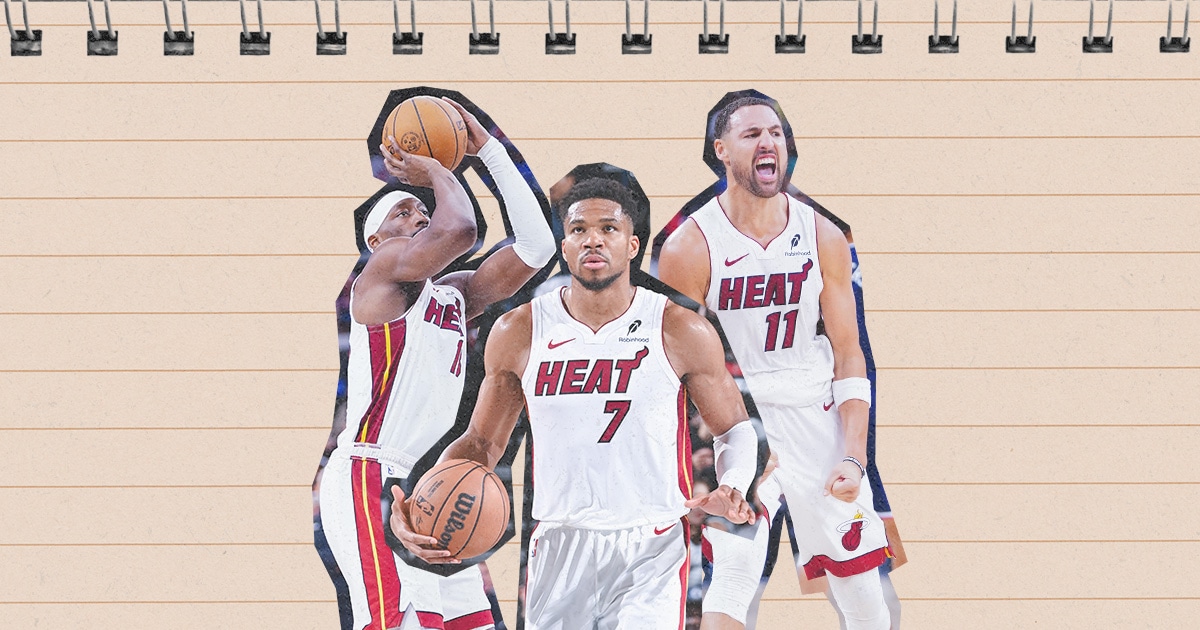
The Miami HEAT are 3-6, tied for No. 9 in the Eastern Conference sitting No. 20 in Offensive Rating and No. 26 in Defensive Rating. With two games left on their road trip out west, here’s what we’ve been noting and noticing.
Miami may currently be sitting No. 26 on defense, but there’s quite a bit going on under the surface which implies a reality that they’re significantly better than that.
Let’s begin with the basics, and that’s Miami’s defensive priorities. Here’s Erik Spoelstra speaking out his defense on Media Day.
“Even though the game has changed and evolved, the tenets and most important things still remain the same. You have to win the paint, you got to dominate the paint, you got to dominate the areas at the rim first and foremost.”
Throughout the years and all the different rosters, Spoelstra’s philosophy hasn’t changed much. They build the defense inside-out, focused on cutting off driving lanes and limiting paint touches first by filling the gaps and forming a shell around the paint. Only with the interior water shut off are defenders then asked to double up and close out, body to body, to shooters.
Judging within that context, Miami has been, at the very least, solid. They’re allowing the sixth-fewest points in the paint per 100 possessions, just 43.7 per game, and the third fewest rim attempts per 100. They’re allowing the same percentage at the rim, about 65 percent, as they did last year when they finished Top 10 by that measure, they just happen to be sitting No. 15 at the moment, in a big group with a bunch of other teams. They’re No. 7 in defensive rebounding rate, having cleaned up a messy first week on the boards, and sit in the Top 10 in limited both second-chance and fast-break points. They’re also No. 6 in paint touches allowed per 100, per Genius Sports, having cut about three from last season’s averages, while allowing the fifth-fewest drives per 100 possessions.
It may not be perfect, but Miami’s defensive priority, the paint and the rim, is mostly healthy. Certainly healthy enough to put them on target for a Top 10 defense if they clean up some of the details as Spoelstra teams tend to do.
So where are the problems? There are two main areas here, and one of them is not entirely within their control.
First, what that can directly improve, is that they’re both losing cutters – teams are scoring 1.24 points per paint touch on them, seventh highest in the league – and have the third-highest blowby rate in the league, 34.7 percent of their drives allowed classified as blowby’s according to Genius Sports.
Put simply, when they lose containment, they’ve been punished severely for it, and they’re losing containment more often than usual. That’s not inherently unusual for a Spoelstra team. In 2021-22, Miami’s best defensive season in recent years, they had the third-highest blowby rate in the league and were only about average in terms of efficiency allowed on paint touches. The HEAT prioritize deterrence, and when there’s a crack in their shell teams tend to burst through it. Still, a little cleaning up along the margins, tracking drives better into the paint when the ball does get a half step ahead, stopping an extra cutter or two a game, filling the gaps quicker when the ball swings to the weakside, all of that will go a long way.
The second area is where there’s a little more luck involved. Miami has allowed the ninth-lowest Shot Quality – a metric from Genius Sports which tracks shot location, contest level and shot type – in the league, even better than that before they struggled against Luka Doncic on Monday, but have allowed an effective field-goal percentage 4.79 points higher than expected. Not only is that by far the highest mark in the league, it’s nearly four times higher than the highest mark all of last season, +1.25 for the Sacramento Kings. In fact, only nine teams in the league even allowed a worse percentage than expected at all.
It’s even worse from three, teams shooting 40.4 percent from deep on them, highest in the league, and 6.4 effective field goal points over expected efficiency, also a high water mark – triple that of the worst, or unluckiest, number last season.
And as a cherry on top of their bad luck cake, Miami is also allowing 13.9 percentage points worse on mid-range jumpers than their fourth-lowest Shot Quality on those shots would imply – again quadruple the worst differential form last year. Not nearly as damaging as the threes, as teams attempt far fewer mid-range looks overall, but still a number that should come way down.
There was a similar effect in the final stretch of last season as Miami got sandblasted on jumpers as they dropped from a Top 5 defense to No. 13 by the end of the marathon. Did that entirely absolve that team of responsibility? Hardly. Every team goes through tough stretches like this – sometimes you hardly notice them because they happen in late December – but the length of the stretch can be influence. The same can be said for this group.
But for now, we’re only nine games into the season and it takes time for all these small-sample size numbers to normalize. We’re not saying Miami has analytically been one of the best defenses in the league. Ultimately, you’re only as good as your results, and teams can influence luck in either direction with consistency and execution. If you want teams to make fewer jumpers on you, you better make sure you deserve it. This year Miami hasn’t always deserved it. It’s one thing to get beat by stepback jumpers from Anthony Edwards or Luka Doncic, another thing entirely to give up a shot off the dribble because a defender wasn’t up to touch at the level of the screen, or because someone got crushed by a screen and nobody called a switch to take the ball.
The reality is that with closer to average shooting numbers against them, Miami has probably been closer to an average defense overall than they are the No. 26 ranked unit. That’s not where they want to get to – many of our projections for this group hinged on them being a Top 5 at the highest end, but no lower than No. 10 – but it would put them within shouting distance of a much, much healthier range if they tighten the screws.
So, as usual, many things can be true. Miami’s priority is limiting the paint, and they’ve been good to very good in that area, but not yet great. They’ve been strong in the margins, and except for a couple off nights against the Clippers and Warriors, they aren’t feeding teams a ton of live-ball turnovers going the other way. And they’ve been getting killed on jumpers from just about everywhere, which can be bad luck but does not excuse some of the coverage breakdowns and miscommunications that have led to open looks.
Perhaps it’s best to end with this. To borrow a line Spoelstra has used often over the years, teams need to feel this defense more. There have been moments, a fourth quarter in Charlotte, a second half against the Clippers or first half against the Warriors, when they’ve cranked up the pressure and suffocated the opposing side. That gear is there, clearly, but no team can defend in fifth gear all the time, either. Part of succeeding in the regular season is your foundation being healthy enough to find success in cruise control, too, for getting through a four-minute stretch without giving up so much that you’re suddenly left playing from behind all night.
The HEAT aren’t there yet. Shooting luck will turn, eventually, and that alone can make things look much better. In the meantime, there’s plenty they do control that can be fixed – and Spoelstra teams tend to fix them.
The good news through the first few weeks of the season is that Miami’s offense has been solid, and perhaps better than expected if, like us, you expected some growing pains along the way.
That may sound odd to say about a team that currently sits No. 19 in Offensive Rating, but there are some important splits at play here. As expected, Miami is one of the fastest teams in the league, No. 3 in pace and No. 5 in transition frequency, the same range they were in last season after Spoelstra switched over to a new offensive system. But, also like last season, they have not been a very efficient transition team, No. 18 in transition points per play (via Cleaningtheglass.com) last year and No. 20 this year. That creates a bit of a contradiction, doing something that you are only so-so at a ton, but transition possessions are still far more efficient than anything in the halfcourt so it’s not a huge deal.
In the halfcourt, though, they’re No. 8, and were as high as No. 3 before their loss to the Warriors. Pretty good, for a team shooting just 33 percent from three and No. 24 in offensive rebound rate.
The question, then, is what are they doing well and is it sustainable? Because if you can pair a high-level halfcourt offense with a very good defense, as that side of the floor comes along, you’re cooking with oil.
There’s no shortage of willing passers with this group, as Miami has the third-highest assist rate in the league. Giannis Antetokounmpo’s playmaking off the defensive attention he draws has unlocked passes – especially skips to the weakside corner – that Miami hasn’t had consistently in years, and Davion Mitchell’s assist percentage has surged to No. 13, sandwiched between LeBron James and Draymond Green. As such, they’re forcing the second-most closeouts in the league. They’re also taking advantage of Antetokounmpo’s passing in the post, where in a league that rarely uses post-ups, Miami is No. 2 behind Denver (and Nikola Jokic) with about seven post-ups per 100 possessions.
Antetokounmpo, of course, leads the league in just about everything related to paint scoring, offering about as strong an offensive foundation, at least in terms of building a statistical profile, as possible. They’ve been punishing smaller teams in the middle of the floor, or at least they were until putting up 32 paint points against a smart Warriors group (on a back-to-back after playing the Clippers into overtime) that built a wall better than anyone else Miami has seen this season so far.
There are some yellow flags. Miami is shooting well above expectations in the upper paint region, though that should be balanced out by better three-point shooting in time. They’re only No. 21 in rim attempts per 100 possessions, right about where they were last season, and their drives are way down. Last year they averaged the most drives in the league per 100 possessions, 59.2. This year that number has fallen to 42.5, down to No. 23. Nothing worth drawing big, sweeping conclusions about yet – and they are No. 5 in drive efficiency, so the inverse of their transition game in a sense – but certainly of interest given that they’re running an offense still just as focused on getting downhill.
On that note, there was that one interesting game against Atlanta where they ran 57 pick-and-rolls, 10 more than they used in any game last season, with Mitchell and Pelle Larsson calling up Antetokounmpo and Adebayo for nearly the entire fourth quarter. The question then was if that was a one-game blip or a significant shift, and since then Miami is still only using about 30 on-ball screens per 100 possessions, a bit more than before but still far and away the fewest in the league.
Regardless of whether they use a bunch of pick-and-roll or not, this is still an offense designed to get the ball going downhill, create paint touches and open threes. Considering how inconsistent the shooting has been to this point, and that they’re No. 26 in free-throw percentage, they’re doing pretty well for themselves. Not perfect, and not even great yet, but on time and on target for early November given all the new pieces in play.
While with the defense it’s pretty clear where they have room for improvement and a little better luck, we’re still in collecting information mode with the offense. Ahead of schedule? A little, yes, but we also need to see them against a greater variety of opponents. No story to tell here quite yet.
THE GIANNIS-BAM CONNECTION
There are two buckets of questions this team will be answering throughout the season. The first, larger bucket is most of what we’ve been talking about, everything Miami will want to get, or keep, on track in order to put together enough wins to get up and over the Play-In Tournament come April.
The second bucket is smaller and more specialized, but arguably far more important. That’s the contender bucket. What does this team need to do, to find, in order to maximize their chances of winning multiple postseason series in a row? That may seem far off given everything happening in the moment, but you don’t exactly have the luxury of time when you have a star the quality of Antetokounmpo on your team. When you have a player who can and will receive, at minimum, a good chunk of MVP votes, you’re trying to win a title and will be held to that standard.
All that being said, the question of fit between Antetokounmpo and Adebayo belongs in that secondary bucket. They will spend much of the season, and possibly even next season – it took Dwyane Wade and LeBron James a full year, if not more, to find their own right balance, despite making the NBA Finals in the interim on the sheer strength of talent – figuring out the best ways to maximize one another on the court. Miami has quite a bit of low hanging fruit in front of them that can right the ship in the near term, but getting your two best players into a space where they aren’t just existing together, but actively making each other better, is how you become a 16-win threat.
It’ll be tricky, too. Barring a dramatic shooting surge from either player that greases the wheels a considerable amount, you can’t just flip a switch and make this work, not with two players who function in many of the same spaces. Antetokounmpo described their on-court spacing as two magnets with the same polarity that can’t get too close to one another as they move around the floor. Pelle Larsson put it a little differently.
“[Giannis] and Bam have to have this great partnership of not being too close to each other, kind of having a rubber band, with tension, between them at all times kind of like Kel’el [Ware] and Bam last year.”
You don’t want Adebayo dragging his defender, who at the moment is not going to track Adebayo all the way out to the arc, into Antetokounmpo’s driving lanes, and vice versa. But you do want them looking for one another, too, any option erased from the board one less thing defenses have to think about. So far, when the two have been on the court together Miami has an Offensive Rating of 113.1, just a tick above league average in the early going.
The trick with big-to-big relationships like this, particularly with two willing passers, is in the timing, in hitting small windows when the defense shifts for a split second, when they can use their size and vision to create advantageous moments that don’t require swinging the ball to another teammate for proper triangulation.
It looks a little like this.
Through nine games, there have been five assists going from Adebayo to Antetokounmpo, three from Antetokounmpo to Adebayo. Of those eight total assists, half of them have been passes into the paint or otherwise for rim attempts.
Should we expect a drastic surge? Probably not. Even Marc Gasol and Zach Randolph, one of the premier big-to-big pairings of the past two decades, only averaged a couple of assists between one another per 100 possessions and that was in an era with far more post-up, high-low play.
But there can be more regular interplay between Miami’s stars as they get used to tendencies and instincts. That’ll require proper shooting and spacing around them, of course, and movement off the ball to create those windows of space and time to capture. Does it have to be one of the premier two-man games in the league? Not at all, it just has to be a consistent threat for this team to approach its goals in the long term.
-After Antetokounmpo, leading the league with 82 rim attempts, the next two on the team are Adebayo, with 35, and Mitchell, with 22.
-Both Antetokounmpo (52.5 percent allowed) and Adebayo (52.4 percent) have had great starts to the season as rim protectors. This system remains about rim deterrence overall, but that pair has been cleaning things up on the back end.
-Miami led the league in isolations per 100 possessions last year at about 35. They’re No. 3 this season, down to 22.8, but have been more efficient overall on those plays.
-Larsson isn’t taking a ton of threes, fewer than last season when pace adjusted, but after a good shooting night against the Warriors he’s up to 40 percent from deep. Small sample, but that remains one of the biggest swing skills on the team, especially if Larsson is going to have the ball in his hands for pick-and-rolls a little more often, with some teams choosing to go under screens on him. Curiously, Larsson’s usage rate is slightly down from last season while his assist rate is about the same.
-They still aren’t using a ton of handoffs, but Miami’s handoff rate has doubled from last year, with the majority of that increase due to having Klay Thompson on the team as he’s been paired with both Adebayo and Antetokounmpo in the handoff game.
-Thompson’s game-winner against the Clippers was a clever design from Spoelstra, forcing a slower Brook Lopez into position where he might have to switch out onto Thompson and close out, and now both former Warriors have game winners for Miami after Andrew Wiggins’ buzzer-beating lob against the Cleveland Cavaliers last year.
-Did Thompson’s shot remind anyone else of a shot Ray Allen hit in that same left corner against Denver in his first few weeks with the team back in 2012?
-Miami is switching the second most screens in the league, but so far Brooklyn has been by far the switchiest team, averaging 10 more switches per 100 possessions than the HEAT. We didn’t talk too much about coverages in the section about defense above in part because there has been no clear “best” coverage for this group yet. They’re still in the process of getting the foundation firmly set.
-Ryan Conwell is averaging 18 minutes a night over his last three games and is shooting 40 percent from three on limited attempts. Still very early, but he’s holding up on defense even when Miami goes to heavy ball pressure, and clearly Spoelstra sees something there that he trusts. There’s a bit of a myth going around in recent years that Spoelstra doesn’t play his rookies, but he’s always played guys when they’re ready to play.