
Explain how edge inference differs from cloud-dependent computing in artificial intelligence. Why…
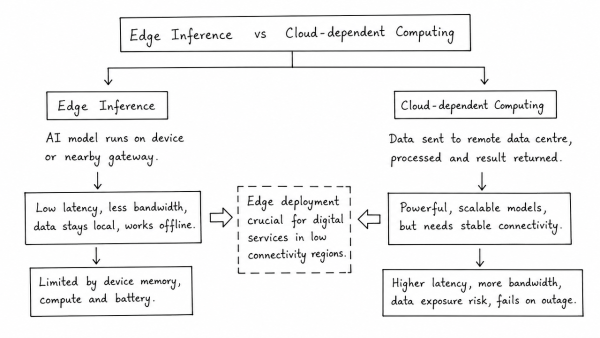
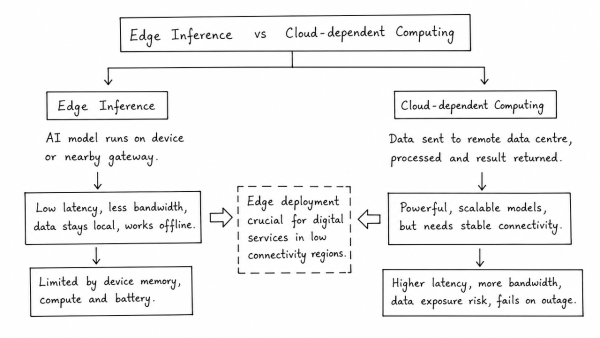
Edge inference runs an AI model on a device or nearby gateway, close to where data are generated. Cloud-dependent computing sends data to remote data centres for processing and returns the result. The distinction is local execution versus centralised, network-mediated execution.
Key differences
Edge inference reduces latency and bandwidth use, keeps sensitive data local, and can continue during outages. However, device memory, processing power and battery limit model size.
Cloud computing can use powerful, scalable hardware and larger models, but depends on stable connectivity, adds transmission delay and may expose data in transit.
Value in low-connectivity regions
Offline-capable services support rural clinics, crop diagnosis and public services when networks fail.
Less data transfer lowers bandwidth costs and supports battery-powered devices where power is scarce.
Local, rapid decisions assist time-critical care, farming and disaster response; local processing can also strengthen trust.
A practical hybrid model can synchronise updates when connectivity returns.
Originally written on
November 7, 2026
and last modified on
November 7, 2026.