
SEATTLE – The winter of their discontent will come at 11:59 p.m. on Dec. 1 when the collective bargaining agreement between the Major League Baseball owners and the MLB Players Association expires.
As part of their “negotiating” strategy, the owners will enforce a lockout of the MLBPA, effectively bringing all offseason activity to a halt and extinguishing baseball’s hot stove until a new agreement can be reached.
The looming lockout and the subsequent transaction freeze gives all 30 teams a compressed window to make their teams better until the bitter labor strife is solved.
If deadlines truly spur action, then the next three and half weeks could feature a frenzy of free-agent signings.
It’s why the annual MLB General Managers meetings will be the hub of this truncated offseason, serving as the conduit for the expected jump in transactions activity. The three-day event begins Monday in Las Vegas at Aria Resort and Casino.
With the more heralded MLB Winter Meetings, which are held in early December, slated to be canceled due to the lockout, the GM Meetings represent the only time where the front offices from all 30 teams, along with top player agents, will all be together in the same vicinity before the lockout.
“They certainly take on a greater importance than in years past,” said a MLB executive.
Traditionally, the GM meetings have served as the initial phase for trade discussions and free-agent negotiations, later culminating in signings in the weeks or months that followed.
But there is a belief that teams will arrive in Vegas having already had preliminary discussions for free agents and trades, knowing there is a deadline.
“I expect it to be very busy knowing what’s ahead,” the executive said. “I think a lot of players will want to get signed before the lockout and teams will want to make moves based on the current CBA.”
There is a precedent for this situation.
In November 2021, the GM Meetings were held in Carlsbad, Calif., with another Dec. 2 lockout on the horizon.
The meetings featured only two major free-agent signings – Andrew Heaney on a one-year, $8.5 million contract to the Dodgers and Eduardo Rodríguez signing a 5-year, $77 million contract with the Tigers – and a handful of small trades.
But those meetings were the precursor to hot stove chaos that followed days later, which included major contract extension, several trades and teams signing free agents to a combined $1.7 billion in contracts in the days leading up to the deadline. The deals included:
• Corey Seager: 10 years, $325 million (Texas Rangers)
• Marcus Semien: 7 years, $175 million (Texas Rangers)
• Max Scherzer: 3 years, $130 million (New York Mets)
• Robbie Ray: 5 years, $115 million (Seattle Mariners)
• Kevin Gausman: 5 years, $110 million (Toronto Blue Jays)
• Javier Báez: 6 years, $140 million (Detroit Tigers)
Once the lockout ended on March 10, 2022, there was another frenzy of signings and trades made during an abbreviated spring training. One of the takeaways from that offseason was how many free agents lamented the uncertainty and inconvenience that came with signing after the lockout. Several free agents
This year’s free agent class, which is led by pitchers Tarik Skubal and Sonny Gray and outfielder Randy Arozarena, isn’t quite like that loaded class in 2021-22 that also featured Freddie Freeman, Carlos Correa, Freddie Freeman, Kris Bryant, Kyle Schwarber, Trevor Story and others.
There is some debate as to whether midlevel free agents, which dominate this class, opt for stability by signing early instead of waiting out a market that will be interrupted. The structure of baseball’s salary system could be vastly changed in the CBA.
Would someone like Arozarena want to sign with an East Coast team like the Red Sox or Phillies early in the process? Or will his agent Scott Boras push to maximize his market after the lockout?
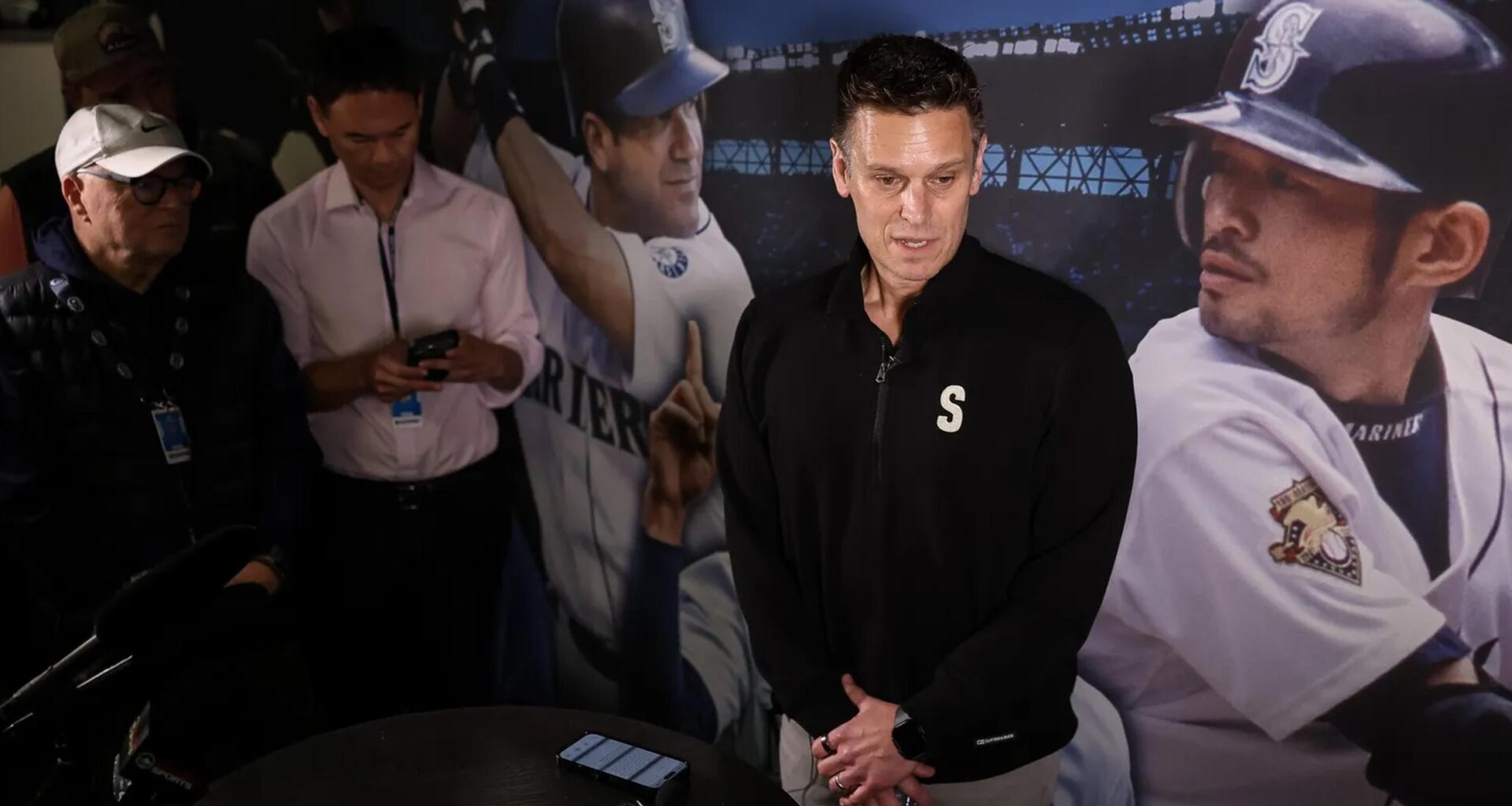
The Mariners enter the GM meetings having just hired Jason Kanzler to replace Dan Wilson as their manager, a search process that took up much of their time since the season ended.
But that didn’t preclude Jerry Dipoto, Mariners president of baseball, from starting to work on his offseason plan. There are many obvious needs to bolster a roster that was expected to repeat as division winners only to woefully underachieve in the 2026 season, finishing with a dismal 76-86 record.
They must address the expected loss of Arozarena, who was their best hitter last season. Seattle offered Arozarena the qualifying offer of 1-year, $23.15 million for 2027, but he’s expected to reject it and head to the free agent market.
While the Mariners could use Brendan Donovan to play left field the bulk of the time, they are still losing an impact hitter from the middle of their lineup. Replacing Arozarena’s production won’t be simple.
“We have enough flexibility among our players that we can look at different things to get the type of offensive lineup impact that we’re looking for,” Dipoto said.
A right-handed hitter that could provide some impact in the lineup is ideal, but not readily available.
They also need to upgrade their talent at third base. With Donovan playing only 39 games in 2026 due to multiple injuries, the Mariners were forced to use a combination of utility players and borderline big leaguers to fill the spot for most of the season.
They also need to add a veteran infielder that is above average defensively at shortstop to serve as a bench player or as an interim fill-in if Colt Emerson’s recovery from season-ending wrist surgery delays his return.
Seattle must also add some depth to a bullpen that was riddled by injuries and poor performances last season. Ideally, they would add at least two established relievers to their projected bullpen.
Obviously, all of these needs won’t be filled via free agency. The Mariners haven’t been a team to invest heavily in free agent talent under Dipoto due to philosophy and payroll limitations. While they are expected to have flexibility with their payroll budget, the free agent class doesn’t offer perfect fits for all of their needs.
To access talent needed to improve their roster, the Mariners will likely need to trade talent off their major league roster instead of minor league prospects.
In past offseasons, Dipoto has been reluctant to trade from his starting rotation. But with former top prospect Kade Anderson now slated for an opening day roster spot and right-hander Ryan Sloan, who takes over as Seattle’s top prospect, expected to debut at some point in 2027, the Mariners have enough surplus to feel open and willing to trade either George Kirby or Emerson Hancock.
“Our starting pitching is our starting pitching,” Dipoto said. “We will have a homegrown starting rotation, whether we have six of them or five of them remains to be seen.”
Would one of those pitchers plus a prospect like infielder Felnin Celesten or young slugger Laz Montes land Seattle an established left fielder or third baseman?
Dipoto has traditionally been aggressive in making deals early in the offseason. The Mariners traded for Adam Frazier and signed Ray leading up to the lockout in 2021.
“You know we can’t really think about the CBA,” Dipoto said. “We have to approach this like 2027 starts in mid-February for us. We’re looking to build out our roster. We are going to have a very busy October and November. Markets will open, and we, like we always are, will be very aggressive in trying to go out and fill the holes that we have, and try to find those final pieces.”