
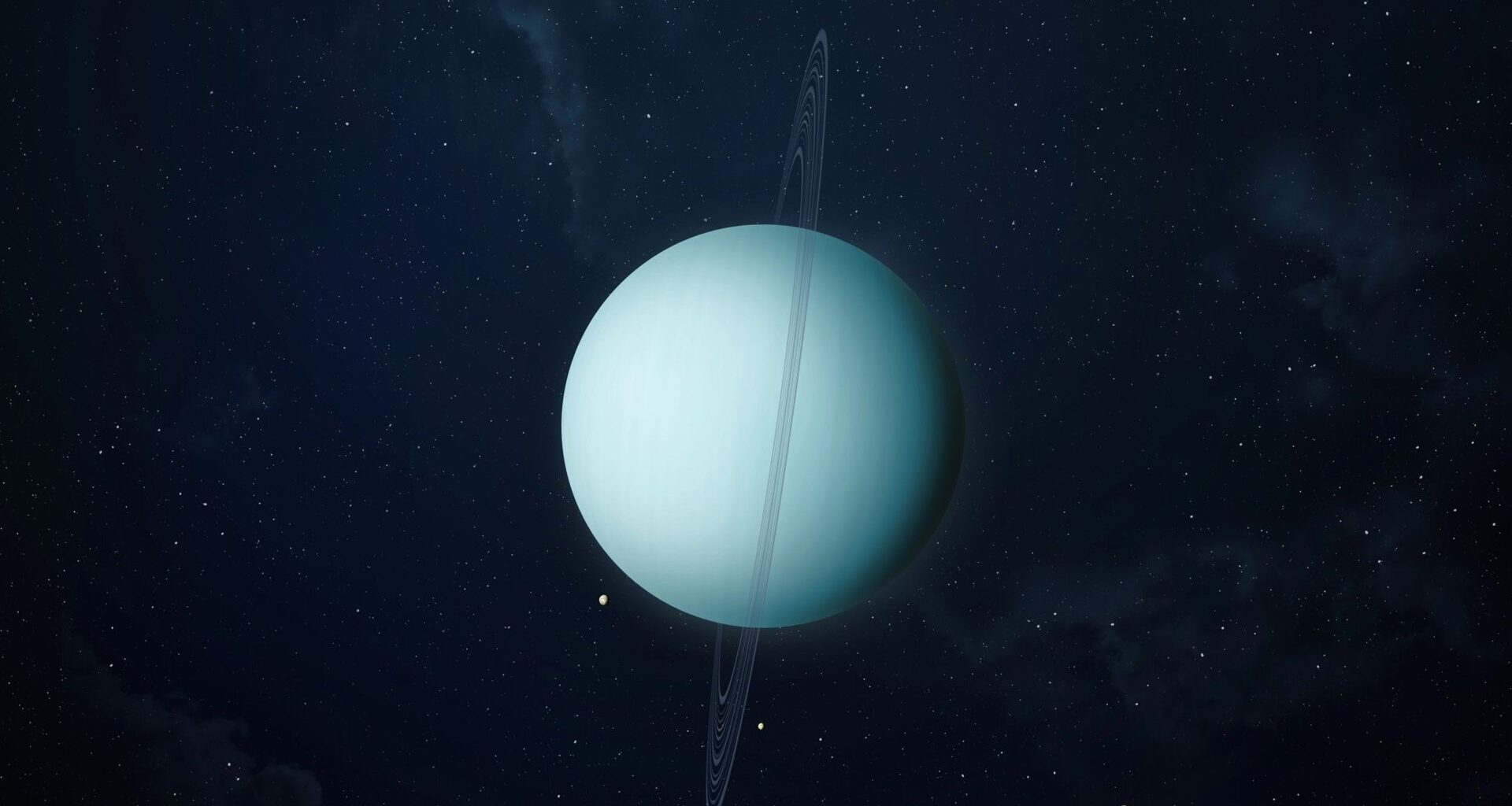
Models of the deep chemistry of Uranus and Neptune find far more oxygen inside Neptune, a sign the two grew from different parts of the disk.
Uranus and Neptune are similar in size and are both known as ice giants. But new model estimates suggest Neptune’s deep atmosphere contains a much higher proportion of oxygen than Uranus’s.
The researchers calculate that the two planets’ carbon-to-oxygen ratios differ enough that each may have grown from a different part of the disk that built the solar system.
Tom Briand of Aix-Marseille Université in France led the work.
His co-authors include Olivier Mousis of the Southwest Research Institute in Boulder, Colorado, who served as a co-advisor on Briand’s doctorate.
“Uranus and Neptune may resemble twins today, but their chemistry is telling us that they are more like cousins with very different histories,” Mousis said.
Why the deep oxygen is hidden
Voyager 2 flew past Uranus in 1986 and Neptune in 1989, and no spacecraft has been back. Telescopes see only the top of each atmosphere.
Most of the oxygen on both ice giants is in water, and water condenses into clouds at pressures hundreds of times higher than sea level on Earth.
Even the probe NASA is planning for Uranus would likely sample the atmosphere down to about ten times sea-level pressure.
So the team used a stand-in. Carbon monoxide forms in the hot depths, where it stays in balance with water, and rising gas carries it upward faster than chemistry can destroy it.
The amount near the top is therefore a record of how much oxygen there is far below, a method also used on Jupiter.
On Neptune, that carbon monoxide has been known since the 1990s and measured at about 0.2 parts per million.
On Uranus, the ALMA telescope array in Chile only confirmed it in the lower atmosphere in observations from 2022 and 2024.
The team’s own reading of the 2022 data gives about 5.6 parts per billion, roughly 35 times less than Neptune.
Neptune holds far more oxygen
Briand’s team extended a model of the deep chemistry so that it changes with latitude, because a fast-spinning planet mixes its atmosphere more vigorously at the equator than near the poles.
They then asked how much oxygen each planet needs down deep to produce the carbon monoxide seen at the top.
For Uranus, the answer came out at roughly 60 to 180 times the Sun’s proportion of oxygen, depending on latitude. For Neptune it was about 220 to 340 times.
Uncertainty in the chemical reaction rates shifted those ranges by about a tenth at most.
Both figures are estimates from a model, and the biggest unknown is how vigorously each atmosphere mixes.
The team wrote that the equator, where mixing is strongest, is probably the best guide to the planet as a whole.
What the ratios suggest
Carbon is easier to estimate. Methane carries most of it, and methane has been measured in the upper atmosphere of both planets.
Divide carbon by oxygen, and Uranus’s ratio runs from 0.06 to 0.52, while Neptune’s runs from 0.02 to 0.12.
At the top of its range, Uranus’s ratio is close to the Sun’s. Neptune’s falls well below the Sun’s at every latitude.
The two ranges overlap between 0.06 and 0.12, so the team can’t rule out that both planets share one value.
Uranus and Neptune probably never grew into gas giants like Jupiter and Saturn, the authors wrote.
So the heavy elements each planet is made of came mostly from icy pebbles rather than from gas. That makes the ice’s carbon-to-oxygen ratio the number to match.
Neptune may have moved outward
Mousis’s disk model follows gas and ice through the first million years of the solar system.
As the disk cooled, each compound froze at its own distance from the young Sun: carbon dioxide first, then methane, then carbon monoxide farthest out.
Where each one froze set how much carbon the local ice carried compared with water.
Both planets now orbit at about 20 to 30 times Earth’s distance from the Sun, and in the model the ice out there has close to the Sun’s carbon-to-oxygen ratio. That fits Uranus. It doesn’t fit Neptune.
Neptune’s low ratio does fit ice that formed much closer in, near the distance where water froze but carbon stayed as gas.
The authors suggest Neptune grew there and migrated outward.
“Neptune’s chemistry is difficult to reconcile with the idea that it formed where we see it today, pulling from the same reservoir of cosmic materials as Uranus,” Mousis said.
Why the formation story remains uncertain
The disk model carries assumptions of its own, including how carbon was split among its molecules at the start and how turbulent the disk was. Either one moves the freezing lines. It also assumes that nothing after formation changed the planets’ carbon relative to oxygen.
The result depends on the equator being the right guide, too. If Uranus mixes less than Neptune, its ratio drops toward the shared range, and the two planets could have formed from similar material after all.
Further atmospheric measurements could help narrow the possibilities. Briand’s team wrote that its latitude maps could help choose where a Uranus probe should enter the atmosphere.
NASA’s Uranus Orbiter and Probe is a mission concept that the 2023 to 2032 planetary science decadal survey ranked as a high priority.
Mousis said it is expected to launch sometime in the next decade. Even then, estimating the oxygen hidden far below the clouds would still require models.
The full study was published in the journal Astronomy & Astrophysics.
—–
Like what you read? Subscribe to our newsletter for engaging articles, exclusive content, and the latest updates.
Check us out on EarthSnap, a free app brought to you by Eric Ralls and Earth.com.
—–