
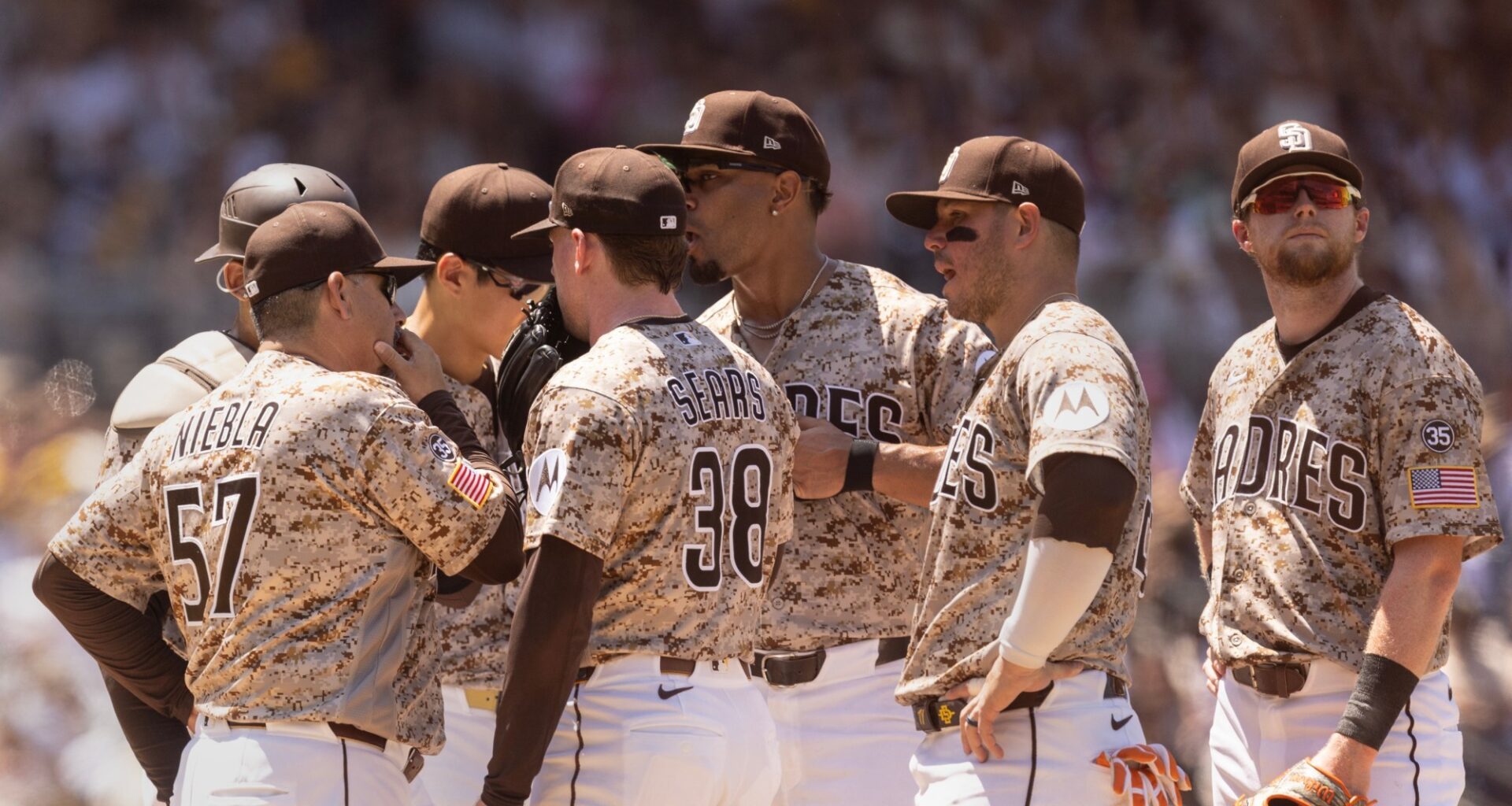
The Padres desperately need starting pitching. Lots of it.
Quantity and quality.
That is what they made known at the general managers meetings this past week in Las Vegas.
Even to agents who had no starting pitchers on the market this winter and who the Padres were feeling out regarding an outfielder or reliever, the team’s representatives set the table by making it clear that filling out their rotation was the No.1 priority.
They showed some level of interest in virtually every starting pitcher on the market.
From Tarik Skubal on down. From Matthew Boyd to Shota Imanaga to Dustin May to Kaima Taira.
Rather than list the starters whose representatives the Padres talked to, suffice it to say there is hardly a starting pitcher they are not considering.
This need has been evident for months.
What is remarkable is that the Padres are finally going to address it and how well they have fared without having seriously addressed it in recent years.
The Padres have not significantly invested in their starting rotation since 2023, instead supplementing what they had with creative contracts, pieces off the scrap heap, leaning heavily on their bullpen and the machinations of pitching coach Ruben Niebla and others.
This has led to them going from sixth in the major leagues in starter ERA and 13th in innings by starting pitchers from 2020 through 2023 to 15th in ERA and 23rd in innings the past three seasons.
That simply does not usually translate into the kind of success the Padres are chasing.
The gambit has not been because Padres president of baseball operations A.J. Preller has been attempting to reinvent the wheel via his own free will. It has been because of budget limitations necessitated by the economic realities of ownership uncertainty and previous heavy spending.
The constraints have been bad enough that Preller practically trips over the torrent of words he uses to meander down a diplomatic path.
“The last three years, really, since, you know, since Peter (Seidler) passed, it’s been, in terms of our budget and our payroll, it’s been pretty much — haven’t had a ton of ability to go add on the free-agent market,” Preller said this week at the general managers meetings in Las Vegas. “You know, we were able to line up with Michael King last year, but a big part of that was what Yu Darvish did. He knew he probably wasn’t going to be able to pitch this past season and wanted to give us the opportunity to go spend money elsewhere. Kind of unheard of.
“But I think for us, the last three years have been more about making our money work for us and finding some players that are hungry that might maybe overperform the contracts that we gave them. That part doesn’t change. You’re always looking for players that you feel like are gonna outperform what we’re paying them and guys that go out and overachieve. But hopefully (the ability to spend more money on players) just opens up some other doors and avenues that we haven’t had in the last three years.”
The Padres have other needs.
There is a good chance they will lose reliever Adrian Morejón, and Preller believes that no matter how good the rotation is, the bullpen must be a strength. Alpine native Alex Vesia is an option.
The Padres were interested in right-hander Evan Phillips, but balked at anything like the three-year, $35 million deal he got from the Braves on Thursday.
And they believe they must strengthen their offensive core. To that end, they have expressed interest in Seiya Suzuki, Teruaki Sato and Jazz Chisholm Jr., among others.
This will be costly. But even if they commit to Sato or Suzuki for nine figures over five or six years, the Padres are going to be compelled to invest more in their 2027 rotation than anywhere else.
Here are the reasons why:
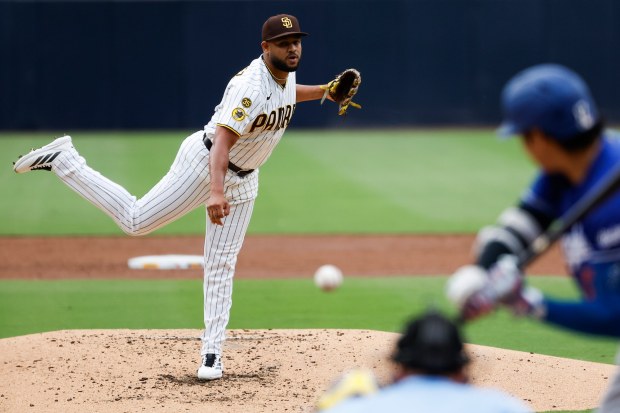 Randy Vásquez #98 of the San Diego Padres pitches against Shohei Ohtani #17 of the Los Angeles Dodgers during the third inning at Petco Park on Saturday, June 27, 2026 in San Diego, California. (Meg McLaughlin / The San Diego Union-Tribune)
They have to
This is essentially a start-over.
“You always need pitching,” Preller said. “That’s always a conversation. I think the situation, though, sometimes with pitching is that pitching can be volatile, too. So I think the idea that we have a little bit of a blank canvas and have some flexibility, I think we see that as an opportunity.
“There is some good pitching available on the market. We have some good pitchers that we like … that are coming back for us. Ultimately, every year we talk about (how) you’ve got to be willing to kind of revamp your pitching staff. This offseason will be no different. And we’ll have some opportunity this offseason to build the staff that we feel like is a championship staff through free agency, trades and continuing to develop some of the guys we currently have.”
What the Padres currently have as rotation candidates: Randy Vásquez, JP Sears, Joe Musgrove and Darvish.
The first two are back-end starters. The second two are veterans with questions about how much they will pitch (Musgrove) and whether they will pitch at all (Darvish).
The Padres believe they have three young minor leaguers that can be part of their rotation by 2028 or ‘29. Coleman Borthwick, Kruz Schoolcraft and/or Lan-Hong Su could help control costs in a few seasons.
For now, though, they are dependent on finding outside help
“We’re going to need multiples,” Preller said. “You always need a lot of pitching. There’s a lot of different ways to go about it, both starting pitching and bullpen. That’s our job the next couple weeks — to put a strong pitching staff back on the field.”
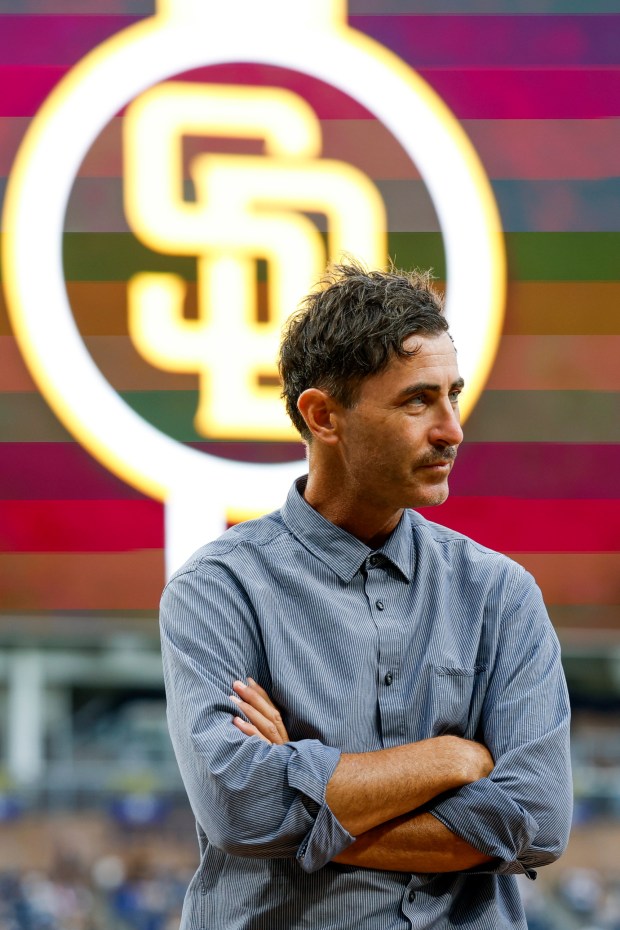 San Diego Padres President of baseball operations A.J. Preller looks on before the game against the Colorado Rockies at Petco Park on Thursday, April 9, 2026 in San Diego, California. (Meg McLaughlin / The San Diego Union-Tribune)
It starts at the start
The Padres were 66-5 when leading after six innings, 73-2 when leading after seven and 77-1 when leading after eight.
Their bullpen ERA ranks third in the major leagues since 2024 and No. 1 since the ‘24 trade deadline, when they added three impact relievers.
That is a formula Preller believes in and will attempt to continue. Other teams have appeared to latch on to the blueprint of developing depth at the back end.
What the Brewers’ bullpen did this postseason and what the Dodgers’ bullpen did en route to their ‘24 World Series win have only reinforced the pursuit of super ‘pens. That was, in fact, one takeaway by a few baseball people in Las Vegas after it was announced what the Braves paid Phillips.
The rise of an army of rocket-armed relievers across MLB has coincided with starting pitchers averaging just five innings per game, down a full inning from 2011. That has diminished the perception of the value of starting pitchers.
But to think that way is risky.
The Padres are the outlier.
They ranked 27th in innings pitched by starters last season and 21st in starter ERA.
Their 752 ⅔ innings from their starting pitchers in 2026, which included the innings thrown by openers in the 15 games in which a relief pitcher started, were fewer than every playoff team except the White Sox. The Padres’ 4.42 starter ERA was worse than all playoff teams except the White Sox and Astros. Both those teams scored more runs than the Padres, the White Sox significantly so. Even with the White Sox ranking 30th in starting innings pitched, the other 11 playoff teams besides the Padres averaged nearly 826 innings by their starting pitchers in 2026.
The Padres are one of two teams to make the postseason each of the past three seasons that don’t rank in the top 10 in starter ERA over that time. (The Guardians rank 14th, one spot ahead of the Padres.)
Just how important is starting pitching? And how rare is the Padres’ success despite not having an abundance of it?
The Dodgers and Brewers, winners of the past three World Series, rank in the top 10 in starter ERA over the past three seasons. So do the Rays and Yankees, the American League champions in 2026 and ‘24, respectively.
All but one of the past 11 World Series winners ranked in the top 10 (actually the top eight) in starting pitcher ERA in the year they were champions. The lone outlier, the 2024 Dodgers, had an offense that ranked second in MLB in runs scored and a bullpen that ranked fourth in ERA.
Ranking in the top five in starter ERA over the past 11 seasons virtually assured a playoff spot: 48 of the 55 teams to do so (87%) made the postseason, and six won the World Series.
Over those 11 years, 72% of the teams who ranked in the top 10 in starter ERA made the postseason. Of the 31 teams since 2016 that ranked in the top 10 in starter ERA and did not make the postseason, 11 (35%) were paired with an offense that ranked in the bottom 10 in runs scored.
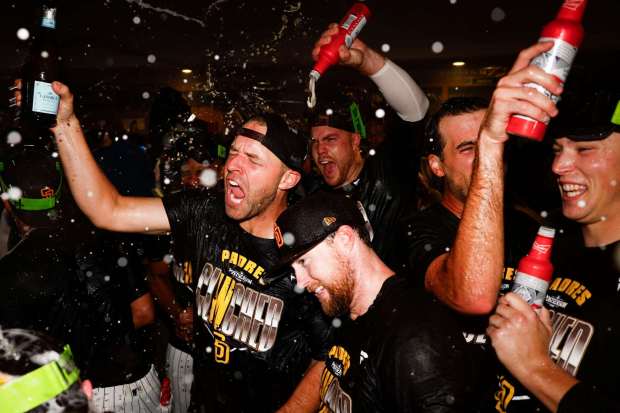 Michael King of the San Diego Padres and teammates celebrate in the locker room after defeating the Chicago Cubs in Game 2 of the National League Wild Card Series at Petco Park on Wednesday, Sept. 30, 2026 in San Diego, California. (Meg McLaughlin / The San Diego Union-Tribune)
It comes at a cost
The Padres committed $137.25 million to free-agent starting pitchers over the past three offseasons, which is the eighth-most in the major leagues.
However, the Padres will not pay anywhere near that much.
The contracts awarded to Nick Pivetta and King were creatively structured with opt-outs that ended up turning $130 million into $45 million. That drops the Padres’ commitment to free agents to $52.25 million over three seasons — and $15 million of that was covered by Darvish voluntarily going on the restricted list in 2026 while working back from elbow surgery.
So that amounts to them investing less than $40 million in new money in rotation additions. Even adding the $21.75 million they took on by trading for Dylan Cease in 2024, the net new-money commitment puts them in the bottom half among the 30 MLB clubs.
That is a paltry sum for a team with virtually no starters coming up through their minor league system.
The underlying issue behind the Padres’ low-innings, high-ERA showing from starting pitchers is the sheer number of starting pitchers they have had.
The Padres have since 2024 gotten at least six starts in a season from 19 different pitchers, which is tied for third most in the major leagues during that span.
More is assuredly not better, as it means they were mixing and matching.
The teams that have ranked in the top 10 in ERA over the past three seasons have averaged 14 different pitchers making at least six starts.
In all, the Padres have guaranteed $142.1 million to the 19 pitchers who have made at least six starts for them.
The teams that rank in the top 10 in starter ERA over the past three seasons have invested an average of $190.7 million in guaranteed money in that span to the pitchers who have made at least six starts in a season.
(Those totals only include a pitcher’s salary in seasons in which he made at least six starts. For example, it does not include the $40 million paid to Musgrove over the past two seasons as he rehabilitated following Tommy John surgery.)
The average of the teams with the 10 best cumulative starter ERA over the past three seasons is skewed by the Yankees (first), Dodgers (fifth) and Phillies each spending more than $250 million. Three of the top-10 teams spent at least $65 million less than the Padres did for starters who made at least six starts in a season from 2024 to 2026.
But that is largely because those teams featured multiple homegrown, young and cheap starting pitchers.
The Pirates (10th) have gotten 313 starts from six homegrown starters over the past three seasons. The Brewers (fourth) got 90 starts from three homegrown pitchers. The Braves (ninth) got 161 starts from seven homegrown pitchers.
The total number of starts (not including openers) since 2024 by the two pitchers developed in the Padres system: 15. Adam Mazur started eight games and Ryan Bergert started seven.
They currently have no such pitcher ready to start for them, and will not until at least 2028.
So, for now, the spend is on.