
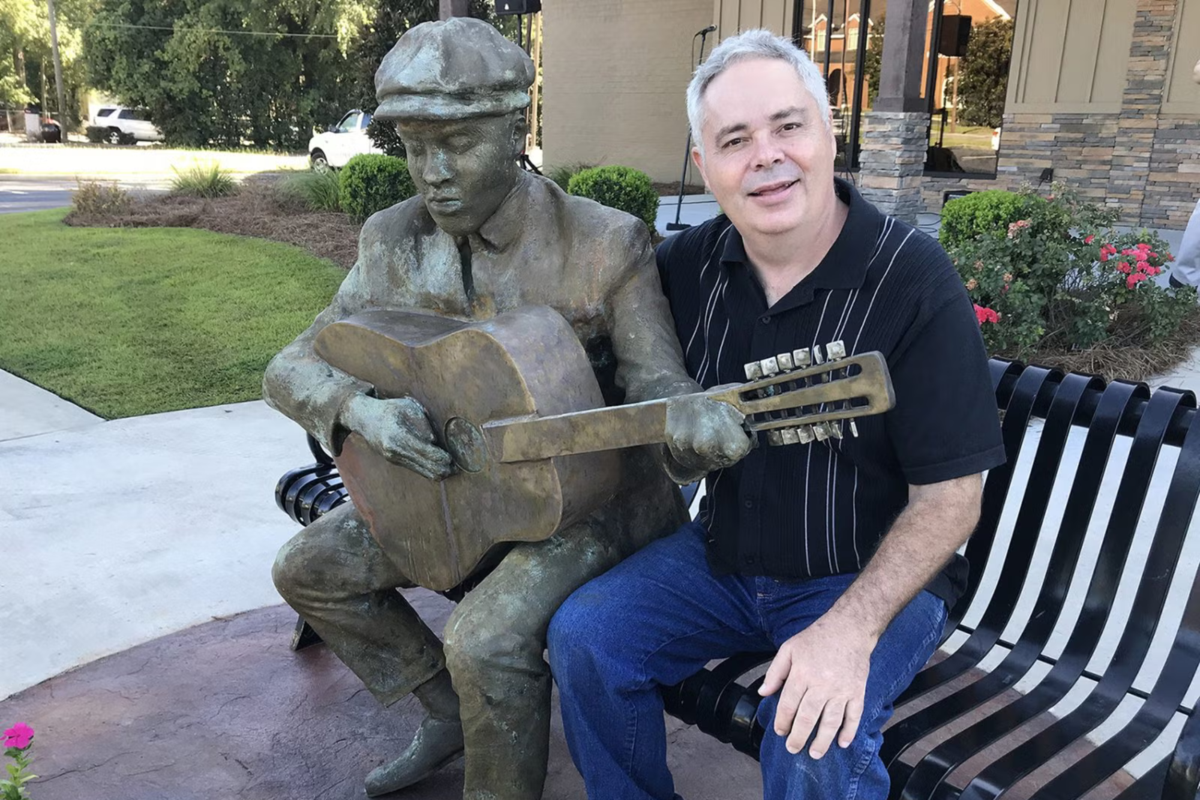
One of Statesboro’s most iconic statues comes in the form of musician Willie McTell, whose likeness was created by Georgia Southern University professor Marc Moulton. Moulton shares his process of forming the statue, step by step.
Statesboro is a town full of history, especially if you know where to look for it. One such slice of history is in the physical recreation of a man named Willie McTell, whose statue sits peacefully on a bench, playing his guitar in front of the Statesboro Convention and Visitors Bureau on S. Main St.
After learning to play the 12 string guitar in 1920s Statesboro, “Blind Willie”, as he was often referred to, went on to perform across Georgia for many years.
His song “Statesboro Blues” became his most famous song, which was later covered by other musicians like Taj Mahal and the Allman Brothers Band, further spreading its fame.
Statesboro professor Marc Moulton used his expertise in sculpting to create a cast bronze statue of the historical figure back in 2018, and now we have Moulton’s step by step process of how the statue came to be. Here was his process from beginning to end, according to Moulton himself.
Step 1: Model Willie
The very first step is to develop a digital 3D model that could be further refined to a likeness of Willie. Marc shared that he used photogrammetry, the extracting of 3D measurements and digital models from two-dimensional photographs, of a former graduate student to create his digital 3D model.

Marc’s graduate student modeling for the sculpture. Photo provided by Marc Moulton
The digital model was further refined and “sculpted” to resemble Willie. He did this using the software Zbrush, Meshmixer, and Blender.

The digital 3D model Marc created using photogrammetry. Photo provided by Marc Moulton
Next, he made an oil-based clay sculpture at a 1:1 scale. Once the clay model is completed, rubber and/or plaster copies (molds) are created off of the clay. The model was then 3D printed using a flexible fine-crystal type of wax called microcrystalline sculptors wax, which is widely favored for direct hand-modeling and carving.
This creates a wax copy of the clay sculpture. The wax is just a shell, meaning it’s hollow inside.

The 3D printed model of the face of the sculpture . Photo provided by Marc Moulton
Step 2: Investment
Investment means taking the wax positives and embedding them into a refractory material that can take the shock of high heat. The refractory material is often plaster-based but has silica sand and other ingredients to absorb thermal shock.
The full body is done in pieces and with a wall thickness of about 3/8″. At this point, there is a wax (body part) embedded into ceramic shell investments.

A few of the investments hanging to dry. Photo provided by Marc Moulton
After the investment is set, the investment/shells are heated to around 1300 degrees and the wax, filament, and other materials are melted and/or burned out, leaving a hollow shell in the shape of the original clay/digital model. At this point, you have a brick that has a hollow, negative space body part.
Step 3: Casting
This step is best done when the investment is still warm. The bronze is heated up to become liquid at around 2100 degrees and poured into the negative space within the investment.

The bronze casting of part of the sculpture. Photo provided by Marc Moulton
Step 4: Cleanup
After cooling, the investments are broken open and the bronze shape is extracted. Full figures are often made in multiple parts called castings. The castings are then welded together.
Once welded, the sculpture is sanded, cleaned up, polished, and colored with a chemical coloring called patina that seals the material underneath from exposure to the outside elements.

The bronze casting welded together, before installment in downtown Statesboro. Photo provided by Marc Moulton
Marc Moulton is currently teaching in the art department at Georgia Southern University, and his contributions to remembering Willie McTell are on display for all to see at 222 S. Main St. in downtown Statesboro.