
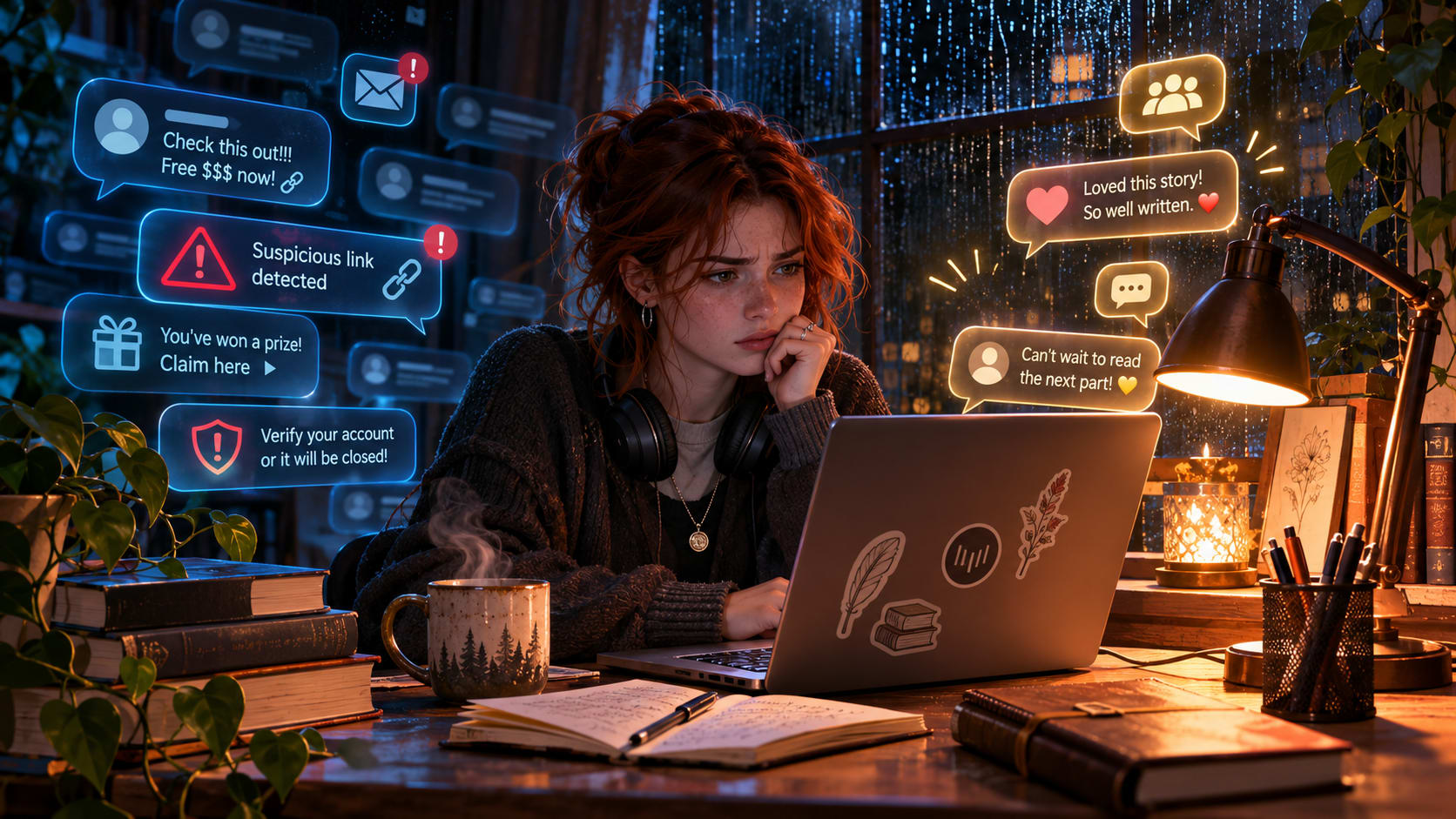
800,000 Spam Comments Overnight: When the Internet Stops Feeling Human
What happened on Vocal Media is a warning for every online community. Here’s how we can recognize scams, protect ourselves, and bring genuine conversations back.
I wrote a story about a man who paid for his coffee with a secret.
I wasn’t expecting someone to show up in the comments trying to send me to a suspicious website.
But apparently, that’s the internet now.
You spend hours writing something. You edit it, rethink the ending, wonder whether anybody will enjoy it, and finally hit publish.
Then a notification appears.
Someone commented!
You get that little moment of excitement. Maybe somebody laughed at your joke. Maybe they connected with your characters. Maybe they hated the ending and have a better idea.
You open the comment.
And instead of an actual reader, you find a warning about your account being flagged for suspicious activity, followed by a link asking you to verify your information.
Wonderful.
Apparently, even spam has started reviewing our work.
Except it hasn’t read a word.
Recently, I began seeing these suspicious comments appearing beneath my stories on Vocal Media. They weren’t thoughtful responses. They weren’t constructive criticism. They weren’t even particularly creative attempts at self-promotion.
They were interruptions.
And when similar messages kept appearing under different stories, the problem stopped feeling like a random annoyance.
It started feeling like somebody had turned our comment sections into a distribution system for scams.
Then Vocal Media published an official warning.
And the number was staggering.
800,000 Times. Seriously?
On November 15, 2026, Vocal Media published an official announcement titled Community Alert: Spam Comments.
According to the Vocal Team, a spam message was posted more than 800,000 times across the platform between the night of November 14 and the morning of November 15.
Eight hundred thousand.
Not eight.
Not eight hundred.
More than eight hundred thousand repetitions of a message claiming that users’ accounts had been flagged for suspicious activity.
The messages directed creators toward a link to supposedly verify their accounts.
Vocal made three things clear:
The messages were not from Vocal.
Creators should not click the links or provide personal information.
Receiving the comments did not mean their accounts were actually flagged or restricted.
The company also confirmed it was aware of the issue and working to address it.
That clarification matters.
Because imagine being a new writer.
You finally publish your first story, you’re still learning how the platform works, and suddenly an apparently official account tells you that something is wrong.
Would you know immediately that it was fake?
Would you panic?
Would you click?
That’s what makes these messages more troubling than ordinary spam.
They’re designed to make people react before they think.
The Problem Isn’t Just Spam. It’s Trust.
We’ve all seen annoying comments online.
The mysterious person promising to make you rich by Friday.
The account advertising a miracle product underneath a video about rescued kittens.
The stranger who thinks your thoughtful essay on grief is the perfect place to promote cryptocurrency.
And, of course, the timeless classic:
“Congratulations! You’ve won something!”
I once wondered whether anybody actually believed these messages.
Now I think that’s the wrong question.
The better question is how many people need to believe one message for the person sending it to consider the effort worthwhile.
When a message can be repeated at enormous scale, even a small number of people responding may be enough to motivate whoever is behind it.
And the damage isn’t limited to someone losing money or revealing a password.
Spam also changes the way we interact.
A genuine compliment becomes something we inspect suspiciously.
A new follower makes us wonder whether the account is real.
A message from someone who wants to talk about our writing suddenly feels less innocent than it once did.
That’s a terrible direction for the internet to take.
We should be able to enjoy a conversation without conducting a miniature security investigation every time someone says hello.
Why Fake Security Warnings Work
One particularly effective technique is pretending to be the people responsible for protecting you.
It’s an unpleasant little trick.
A message arrives telling you something is wrong with your account.
Perhaps it says you’ve violated a rule.
Perhaps your profile is about to be suspended.
Perhaps you must verify your information immediately.
The message looks official enough to create uncertainty.
And uncertainty is useful to scammers.
They want you thinking about how to fix the imaginary problem rather than asking whether the problem exists.
This technique is commonly called phishing.
The US Federal Trade Commission warns that scammers impersonate familiar organizations to persuade people to click links, disclose personal information, or download harmful files.
The safest response to an unexpected account warning is to visit the platform independently using its official website or app, not the link supplied in the suspicious message.
That principle applies whether you’re on Vocal, Instagram, Facebook, YouTube, or somewhere else.
A recognizable logo isn’t proof of identity.
An impressive username isn’t proof of authority.
And a message written in professional language isn’t necessarily trustworthy.
Frankly, if a stranger walks into a coffee shop wearing a homemade police badge and announces that everyone must hand over their wallets for security reasons, we’d have questions.
We should ask the same questions online.
What Should We Actually Do?
I don’t think we need to become cybersecurity experts just to publish stories.
But a few habits can make a genuine difference.
First, don’t interact with suspicious links.
If an unexpected comment claims your account is in danger, don’t use its link to investigate. Open the service directly and look for legitimate account notices.
Second, report suspicious comments.
Vocal’s Community Guidelines explicitly prohibit spam, impersonation, and unsolicited promotional links in comments.
Use the platform’s reporting feature when you encounter this behavior.
Third, keep evidence when the problem repeats.
Screenshots of the comment, account name, and date can help explain a recurring problem to a moderation team.
You don’t need to publicly share dangerous links or give suspicious accounts additional publicity.
Fourth, protect your account.
Use a unique password, and enable two-factor authentication wherever it’s available.
If you’ve already entered your password on a suspicious website, change it through the legitimate service, secure any other accounts using that password, and contact official support.
If you’ve downloaded a suspicious file, run an up-to-date security scan.
Finally, warn people without spreading panic.
A calm message explaining what happened and pointing readers toward an official announcement is more useful than an angry post making accusations nobody can verify.
The goal isn’t to frighten everybody.
It’s to make the trick less effective.
For practical guidance, the Federal Trade Commission’s phishing advice is a good place to start.
What Platforms Need to Do Better
Users have responsibilities, but they shouldn’t be expected to solve the entire problem themselves.
If a platform wants people to publish original work, build communities, and spend time interacting with others, it also has a responsibility to protect those interactions.
Vocal has previously outlined measures against spam, including account reviews before publishing, moderation improvements, and penalties for abusive behavior.
It has also acknowledged that automated moderation can make mistakes and sometimes flag genuine comments.
That last point is important.
We don’t want a system where every enthusiastic reader gets treated like a bot.
Someone writing “I loved this!” isn’t automatically suspicious.
Someone making a joke, sharing an opinion, or recommending a genuinely relevant story isn’t necessarily doing anything wrong.
The problem is repeated, deceptive, unwanted behavior.
So what would better protection look like?
I’d love to see platforms invest more heavily in detecting large numbers of identical comments, restricting suspicious mass-posting activity, making reporting easier, and providing clearer information when a widespread incident occurs.
Creators should also have practical tools to manage recurring abuse without having to close their comment sections entirely.
And when moderation gets something wrong, genuine users should have a fair way to challenge that decision.
These aren’t magic solutions.
Bad actors adapt.
Technology changes.
No system will catch everything.
But the burden shouldn’t fall entirely on the person who just wanted to publish a poem.
Please Don’t Let the Bots Win
Here’s the part I care about most.
I’ve had some genuinely lovely conversations on Vocal.
People have read my fictional stories and shared what they thought about the characters.
Some have asked whether I’ll write sequels.
Others have noticed little details in the dialogue or told me that a story made them smile.
Those conversations matter to me.
Not because they increase a number on a dashboard.
Because somebody, somewhere, spent a little of their day reading something I created.
And then they took another moment to respond.
There’s something wonderful about that.
A good comment can encourage a writer who was considering giving up.
A thoughtful disagreement can lead to an interesting discussion.
A little joke can turn a stranger into someone whose name you’re happy to see again.
That’s the sort of internet I want.
Not one where we’re counting suspicious accounts and wondering whether every notification is another scam.
And honestly, I’d rather receive one real comment from someone who actually read my story than fifty meaningless messages telling me how amazing I am.
Although if fifty real people want to tell me I’m amazing, I’m certainly not going to complain.
I do have some self-esteem to maintain.
A Message to Vocal Media
I’m glad Vocal publicly acknowledged the situation.
The official warning helps creators understand what’s happening and avoid potentially harmful links.
That’s important, and it deserves recognition.
But I hope the response doesn’t end with removing the latest wave of spam.
I hope this becomes an opportunity to improve how repeated abuse is detected, how quickly suspicious comments can be addressed, and how creators are kept informed.
Writers shouldn’t feel that publishing a new story means signing up for another round of cleaning suspicious messages out of their comments.
We’ve already got enough to worry about.
Finding a decent title.
Fixing the paragraph that sounded brilliant at midnight and ridiculous the next morning.
Discovering that we’ve used the word “suddenly” fourteen times.
And trying to remember whether our character had blue eyes in chapter one or brown eyes in chapter five.
Surely that should be enough drama for one day.
One Question for Everyone Reading This
I don’t want to end this by simply telling people to be careful.
I’d genuinely like to hear from other writers and readers.
Have you received suspicious comments or fake account warnings on Vocal or another platform?
And more importantly:
What is one thing you think platforms should do to make their communities safer without making genuine conversations harder?
Maybe you’ve experienced something similar.
Maybe you’ve seen a clever solution elsewhere.
Maybe you just want to tell me how tired you are of the same messages appearing beneath your work.
I’d love to hear it.
Because if spam is going to flood our comment sections, perhaps the best response is to fill them with something it can never genuinely offer.
Real people.
Real experiences.
Real conversations.
And, occasionally, a terrible joke.
I’ll bring the terrible jokes.
You bring the conversation.
Sources and further reading
Vocal Team — Community Alert: Spam Comments (November 15, 2026)
Vocal — Community Guidelines
Vocal — Taking a Stand Against Spam on Vocal
U.S. Federal Trade Commission — Protect Yourself from Phishing Scams