
The Athletic has live coverage of NFL Week 10 news and reactions.
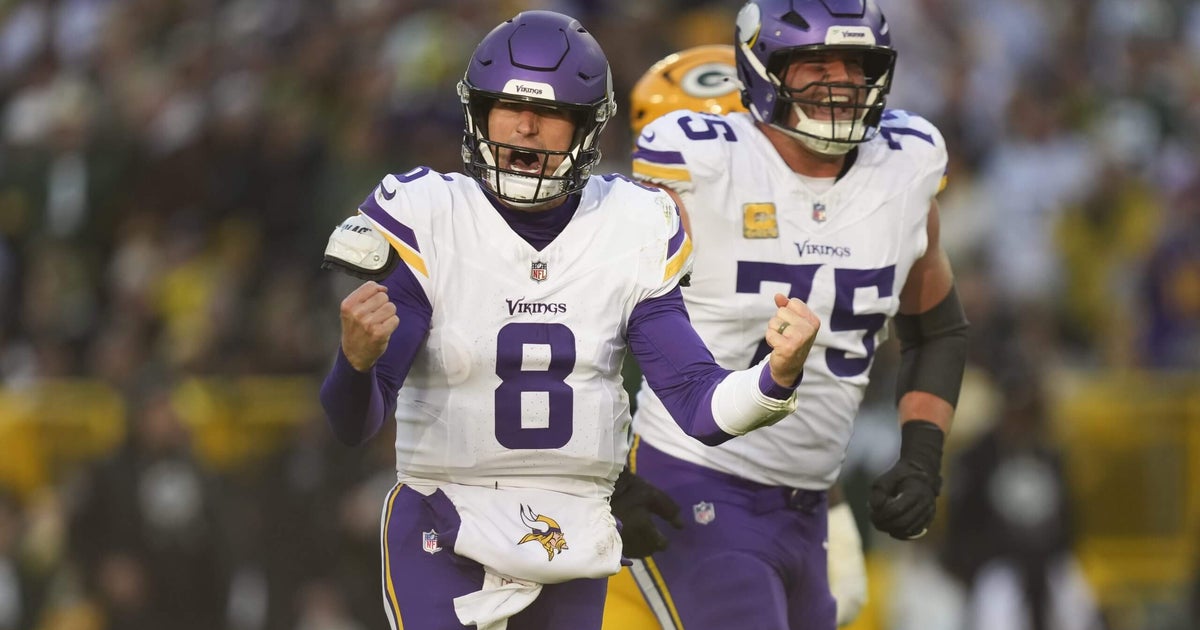
If the first three quarters of the Minnesota Vikings’ 30-10 victory at Green Bay didn’t convince the purple masses that acquiring Kirk Cousins was the answer to their trade-deadline prayers, consider what happened early in the fourth.
Cousins completed passes to star receiver Justin Jefferson on five consecutive plays. Then, after a handoff, Cousins targeted Jefferson for yet another completion.
“I mean, that is just quality ball right there,” a coach from another team said. “Cousins wears the guy out. Jefferson is huffing and puffing. The kid takes himself out of the game. It’s like he had fallen out of shape because for two months, he’s been watching (Kyler) Murray scramble and (Carson Wentz) bounce it off the ground 5 yards in front of him. It’s funny, but it’s true.”
The Pick Six column for Week 10 ranks the NFL’s in-season trades by the immediate returns and the ripple effects, starting with the Vikings’ move to reunite Cousins with a team and fanbase that appreciates him like never before, even though Minnesota won Sunday the way it has won all season: by dominating on defense and special teams.
The full menu:
• Cousins and the top trade impacts
• Tomlin Paradox remains for Steelers?
• Mendoza, Beck thrown to the wolves?
• Justin Herbert, meet Boomer Esiason
• The Rams’ looming dilemma at WR
• Two-minute drill: Browns beat Texans (and Vegas)
1. Three days of practice with the Vikings was enough for Cousins to upgrade the position.
The Packers faced a choice after Cousins threw incomplete to Jefferson on third-and-8 from the Green Bay 23-yard line on Minnesota’s third drive. They could accept a 15-yard face mask penalty, betting their defense could force a longer field goal attempt by stopping Cousins on third-and-23. Or they could decline the penalty, conceding a 41-yard attempt.
Packers head coach Matt LaFleur had a rough day on offense, letting the play clock run while sticking with a deep passing game. That gave Vikings defensive coordinator Brian Flores time to configure his personnel before the snap, and time to disrupt the deep passing game. Jordan Love took eight sacks, giving him 12 in two games against the Vikings and 13 in eight against everyone else.
Despite all that, LaFleur had reason for accepting the face mask penalty on the Vikings’ third drive. His defense had ranked among the NFL’s best in recent weeks. Cousins had already taken a 9-yard sack.
Who could have known Cousins would find receiver Myles Price up the seam for a 38-yard touchdown? It was the first time in 50 career attempts that Cousins threw a scoring pass on third-and-20 or longer. It was exactly what the Vikings needed after suffering through one of the worst offensive performances in franchise history just six days prior.
Vikings blow out Packers in Cousins’ return
“That ball he threw on that third-and-23, that’s as good of a Tier 1 throw as you will see in the NFL all year,” the coach said. “There is only one place he can put the ball, but he actually does one better. He back-shoulders it, twisting the receiver to keep him away from the corner.
“You have to be not afraid to make that throw — and remember, he spent two days game-planning for Seattle (while with the Raiders), flew in Tuesday night and had to switch gears.”
Cousins’ other touchdown was a work of art: a fake screen to his left, a spinning fake screen to his right and a very real timing strike over the middle to tight end Gavin Bartholomew.
“That is just pure veteran quarterback with a veteran play caller (head coach Kevin O’Connell) saying, ‘I see the game like you do,’” another coach said. “Now, Kirk tries throwing the thing when he gets sacked, and he gets saved from an interception by replay because his knee was barely down. And he hesitates against the rush, and can’t get the ball up and down when there is a half safety there (resulting in an interception).”
The Vikings’ offense wasn’t great Sunday (-1.5 EPA), but it was good enough to win big on the road with a dominating day from the defense (+13.7 EPA) and special teams (+7.9). Minnesota got even bigger contributions from those two phases against Tampa Bay in Week 3 but won that game by only a touchdown, 23-16.
Functional quarterback play gives the Vikings an opportunity to more accurately evaluate their roster and coaching staff, including O’Connell, whose reputation for maximizing quarterbacks has taken a hit through recent failures.
“He’s a quarterback whisperer, so why can’t he get Wentz to play better?” the coach asked rhetorically. “Because the guy is never playing good. Never.”
Functional quarterback play also makes the idea of this defense — clearly the best of Flores’ already impressive tenure — carrying the Vikings on a deep playoff run just a little bit more plausible.
“I’ve been watching the game for 25 years, and I get a headache watching those guys line up,” another coach said of the Vikings. “I get nervous watching on TV. My God, who’s coming? What are they doing? They are up in the A-gaps, then they are out, then they are back in the A-gaps, then the linebackers and DBs change positions, then (Andrew) Van Ginkel changes what foot is up in his stance multiple times. It’s ridiculous.”
The ripple effects of the Cousins trade are also being felt in Las Vegas, where Fernando Mendoza made his first start Sunday, struggling against Seattle’s defense in a 21-13 defeat (more on that in a bit).
There’s no break for Cousins and the Vikings, who travel to Mexico City to face the 49ers and their top-ranked offense in Week 11 as the race for the NFC’s top seed heats up. In the meantime, Minnesota fans can enjoy what is, so far, the most impactful trade of the season.
Seven other trades moving the needle:
• DT Jeffery Simmons from the Titans to the Bears: Simmons had 10 tackles, including two sacks and an additional tackle for loss, while playing 121 snaps in his first two games with the Bears. His downfield tackle in a 27-24 victory over Tampa Bay showcased an all-out playing style few men his size can match. It’s the type of move that elevates contenders.
• QB J.J. McCarthy from the Vikings to the Giants: No one should suggest the Giants have found their long-term starter, but after losing Jaxson Dart to a season-ending injury in Week 2, their chances of winning the NFC East appear higher with McCarthy than they were with Jameis Winston.
As of Nov. 16, 4:27 a.m. UTC
 Giants 5-3-156%56%<1%<1%
 Cowboys 4-629%28%<1%<1%
 Commanders 3-5-116%16%<1%<1%
 Eagles 2-7<1%<1%<1%<1%
The Giants are 2-1 in McCarthy’s three starts and have a higher rate of explosive plays with him (15.1 percent) than with Dart (10.7) or Winston (8.5). That’s good value for a fifth-round pick, and great value if McCarthy revives his career over the season’s second half.
• S Amani Hooker from the Titans to the Bills: Hooker played all 73 defensive snaps in his Bills debut, a 31-12 victory over the Jets. He made seven tackles, including five short of the first-down marker, and broke up a pass while filling an obvious need in Buffalo.
• S Jessie Bates III from the Falcons to the Jaguars: Bates hasn’t even played for the Jaguars yet, but Atlanta seemed to miss him Sunday. The Chiefs’ Patrick Mahomes, who had completed zero passes on throws traveling at least 20 yards downfield over the previous four games, connected on four of them for 150 yards and three touchdowns Sunday.
“Sometimes those new guys that get in charge of teams can’t wait to collect draft picks and can’t wait to get their own people,” an exec said of the Falcons’ decision to move on from Bates. “It sounds like a great idea, but good luck finding Jessie Bates in the second or third round next year. If you do find him, it’s gonna take him a couple years, so you take a big step back.”
• WR Keenan Allen from the Colts to the 49ers: Allen made two third-down conversions against Dallas in his 49ers debut, catching five passes for 61 yards overall, both most among Niners wide receivers, on only 31 snaps (21 routes).
“Keenan is very well-rounded,” another exec said. “He can work the middle of the field. (Brock) Purdy will find him a lot.”
• WR Josh Downs from the Colts to the Chiefs: Downs caught four passes for 53 yards and a touchdown while running just eight routes in his Kansas City debut. Mahomes badly needs reliable targets, so the early returns are encouraging. Sunday marked Mahomes’ first game with five passing touchdowns since the 2022 season opener.
• DL DeForest Buckner from the Colts to the 49ers: It’s tough to say any 49ers defender made a huge difference Sunday during a 46-40 victory featuring San Francisco’s worst defensive performance (-22.2 EPA) in 65 total games over the past three-plus seasons. But with 93 snaps in his first two games, Buckner is logging considerable snaps at a position of need.
Two others that probably will:
• LG Quenton Nelson from the Colts to the Seahawks: Nelson needed work on his knee after one game with Seattle. He could return against San Francisco after a Week 11 bye and will be a big part of a late-season push to get the ground game rolling.
• DT Jordan Davis from the Eagles to the Jaguars: This one better pay off for Jacksonville, which sent first- and second-round picks to Philly, despite Davis lacking the pass-rush ability Simmons brings to the Bears.
Two that probably will not:
• CB Joey Porter Jr. from the Steelers to the Cowboys: Adding prime Joey Porter Sr. might not be enough to help Dallas’ defense at this stage. The Cowboys allowed 584 yards to the 49ers, most at home in franchise history, with the younger Porter playing 59 of 67 snaps. It’s looking like Dallas will need another coordinator to get value from this investment, and Porter’s contract situation still needs addressing.
• QB Jacoby Brissett from the Cardinals to the Ravens: The Ravens feed off Lamar Jackson’s energy and ability. Brissett isn’t good enough to pick up enough of the slack for an extended period. It’s not a given that the Ravens will beat the 0-8 Chargers on Monday night.
One that definitely will not:
• WR Marvin Harrison Jr. from the Cardinals to the Texans: Six catches for 60 yards and a touchdown in three games with Houston looks a lot like the five catches for 85 yards and a score Harrison had in four games with Arizona.
2. With Mike Tomlin in the building, are the Steelers still in the Tomlin Paradox?
The Tomlin Paradox suggested that the Steelers’ coach from 2007 to ’25 raised the team’s floor while lowering its ceiling, leaving the franchise stuck in a state of not quite contending.
The Steelers did not instantly collapse following Tomlin’s transition from their sideline to NBC’s Sunday night broadcasts. Pittsburgh won six of its first eight under Mike McCarthy while checking some long-empty boxes:
• More zone defense (notably quarters coverages) with man responsibilities built in
• More ways to deploy pass rushers
• Newfound identity in the run game behind an optimized offensive line
In getting blown out by Joe Burrow and the Bengals on Sunday night, the Steelers provided evidence that their ceiling might not be much higher.
The floor might have dropped a couple inches as well after the Bengals’ Jonathan Allen bull-rushed Steelers left guard Mason McCormick into quarterback Aaron Rodgers for a sack, with McCormick suffering an apparently serious right ankle injury in the process.
McCormick and an offensive line reconfigured in Week 3 were the leading reason this team was different.
From Weeks 3 to 8, the Steelers averaged 5.6 yards and 0.17 EPA per designed rush. Those figures ranked third and first, respectively, for any six-start stretch of Rodgers’ career in which his teams had at least 130 designed rushes.
The problem Sunday night was not simply that falling behind took away Pittsburgh’s running game. The offense enabled the deficit. Rodgers failed to complete his first eight passes, while Steelers running backs managed six carries for 15 yards before McCormick exited on a cart, an air cast bracing his lower leg.
Burrow and his wide receivers were brilliant in this game, same as in the Week 3 meeting, which Pittsburgh won 30-27 after taking an early 17-10 lead. Burrow has now passed for 983 yards and 11 touchdowns and no interceptions with a 135.8 passer rating in three games against the AFC North, splitting with Pittsburgh and winning at Baltimore. That’s a good indication why, as of Sunday night, a bettor would have to risk $600 for a shot to win $100 on the Bengals winning the division (the Steelers are a 7-1 longshot to win it).
Pittsburgh’s changes on defense under coordinator Patrick Graham could not stop Burrow from passing for 302 yards and three touchdowns in the first half.
Burrow tosses 4 TDs as Bengals win fifth straight
The biggest difference from the teams’ first meeting was in how easily the Bengals solved the Steelers’ offense.
Rodgers at age 42 and DK Metcalf at any age simply cannot keep pace with the better pass offenses, let alone the one Cincinnati has put on the field this season with Burrow, Ja’Marr Chase and Tee Higgins.
The Steelers’ search for a quarterback of the future remains as murky as it was in Tomlin’s final years. Once again, Pittsburgh will likely win too many games to have a chance to draft a top quarterback. Its last swing in the back half of Round 1 was a miss on Kenny Pickett.
During Sunday night’s broadcast, Cris Collinsworth said Steelers coach Mike McCarthy suggested in his production meeting with NBC that he might prefer to go with Drew Allar (2026 third-round pick) or Will Howard (2025 sixth-round pick) rather than draft another QB.
The Bengals would presumably be fine with that.
3. Thrown to the wolves? Fernando Mendoza and Carson Beck survived, at least.
No NFL team plans for a rookie quarterback’s first career start to fall against a powerhouse defense. It just works out that way sometimes.
In one of the all-time mismatches, the 2002 Panthers turned to fifth-round rookie Randy Fasani for a Week 8 debut start against a Buccaneers defense featuring future Hall of Famers Warren Sapp, John Lynch, Ronde Barber and Derrick Brooks.
Fasani completed nearly as many passes to the Bucs (three) as to his own team (five) during a 12-9 defeat, in what would be the only start of his NFL career.
Sapp called Fasani “either real bright or real brave” for the poise he showed during his welcome-to-the-NFL experience.
The Raiders’ Fernando Mendoza and the Cardinals’ Carson Beck did not face the legendary 2002 Bucs in their starting debuts Sunday, but they did struggle against two of the strongest defenses this season, combining for as many sacks (11) as passing first downs.
Mendoza completed 17 of 29 passes for 143 yards and no touchdowns or turnovers with six sacks in a 21-13 defeat to Seattle. The Raiders set season lows for yards (163), points (13) and first downs (12). Mendoza took 12 hits, six of them for sacks.
Beck completed 11 of 18 passes for 108 yards and two interceptions in a 34-6 defeat to the Rams. His Cardinals set season lows for plays (34, the team’s fewest in a game since at least 1940, per Pro Football Reference), yards (123) and first downs (six, the Cardinals’ fewest since they had five in a 34-0 defeat to the Rams in 2018). Beck took five sacks and an additional hit.
Seattle entered Week 10 ranked fourth in defensive EPA per play, including third against the pass. The Rams were sixth and fifth, respectively.
Those high rankings in EPA per play against the pass made Mendoza’s debut the 12th-toughest and Beck’s the 15th-toughest out of 81 qualifying rookie first starts since 2000.
I excluded debut starts made in the first four games of a season or in the last game (when teams often rest their starters), to provide a truer statistical baseline for opposing defenses while heightening the sense of being “thrown to the wolves” in the middle of a season.
Fasani’s start against the 2002 Bucs was the toughest, followed by Dillon Gabriel’s debut start for Cleveland against Minnesota last season.
We can also measure how much each QB outperformed or underperformed the standard set by the opposing defense to that point in the season. Mendoza ranks 25th out of 81 by that measure, with Beck lagging at 72nd.
The top three: Charlie Frye for Cleveland against Jacksonville in 2005; Matt Moore for Carolina against Seattle in 2007; and Brock Purdy for San Francisco against Tampa Bay in 2022.
Mendoza started promisingly against the Seahawks, showing resourcefulness with his legs to buy time, throw on the run and scramble. But Seattle’s pressure packages overwhelmed him and Las Vegas’ offense in the second half, including two sacks by defensive back Devon Witherspoon.
Next up is a trip to Denver, which ranks 10th in EPA per pass play allowed and first in QB hits.
4. Chargers coach Jim Harbaugh predicted Justin Herbert would be remembered as the greatest quarterback in NFL history. How about the next Boomer Esiason?
From 1985 to ’89, Boomer Esiason ranked second in passer rating among 19 quarterbacks with at least 40 starts over that span.
Joe Montana was first. Dan Marino was third.
This was elite company for Esiason, who won MVP honors in 1988, when he helped the Bengals reach Super Bowl XXIII, where they lost to the 49ers on Montana’s touchdown pass in the final minute.
Esiason’s career fell apart beginning in 1990, when he led the NFL in interceptions (22). From 1990 to ’96, Esiason ranked last in passer rating among 16 quarterbacks with at least 60 starts over that seven-season run. He was a mess.
What happened to Esiason can help inform our analysis of the best modern-day comp.
Herbert ranked seventh in EPA per pass play out of 21 quarterbacks with at least 50 starts over his first five seasons (2020-24) with the Chargers.
Aaron Rodgers was sixth. Tom Brady was eighth.
This was elite company for Herbert, whose lack of postseason success was the only strike against him.
But with Herbert’s career falling off a cliff since then — he is 19th in EPA per pass play out of 21 quarterbacks with at least 20 starts over the past two seasons, including 29th out of 31 qualifying passers this season — the Esiason experience is instructive.
The path to career oblivion for Esiason featured:
• Bruce Coslet, the Bengals’ offensive coordinator beginning in 1986, leaving to become the Jets’ head coach in 1990
• Pro Bowl guard Max Montoya leaving in 1990 as a Plan B free agent
• Future Hall of Fame tackle Anthony Muñoz suffering a shoulder injury, which led to his retirement after the 1992 season
• Receiver Eddie Brown, who scored 24 touchdowns over the 1988-90 seasons, suffering a neck injury and retiring after the 1991 season
Herbert’s career has tanked after the Chargers hired Mike McDaniel as offensive coordinator. McDaniel imposed a specific system tailored to quick-processing and quick-delivering QBs, whereas his predecessor, Greg Roman, was best known for molding offenses to fit personnel at the position (Alex Smith and Colin Kaepernick in San Francisco, Lamar Jackson in Baltimore, etc.).
“Herbert can make throws all over the field,” an exec from another team said. “He can stretch the field in every way, but those quicker, get-the-ball-out, more intricate passing philosophies — like the 49ers, like some of those other guys, like McDaniel — I just don’t see the fit.”
The Chargers’ offensive line crumbled, with Pro Bowl tackles Rashawn Slater and Joe Alt suffering injuries (center Tyler Biadasz was lost to injury before the season).
At receiver, Herbert entered the season without much and has been missing his favorite target, Ladd McConkey, for stretches due to various injuries.
Esiason never bounced back fully, but there’s a fascinating footnote to his career. He overlapped with Coslet on the Jets in 1993, starting fast enough that season to earn Pro Bowl honors as a replacement before fading. After three seasons with the Jets and one with the Cardinals, Esiason re-signed with the Bengals as a backup in 1997, his final season.
Coslet was back as the Bengals’ head coach. He made Esiason his starter beginning in Week 13. The results were spectacular. Esiason posted five consecutive triple-digit passer ratings to end the season, the 12th time since 1933 a starting QB had put together a streak that long, and the only time Esiason did it.
But when team owner Mike Brown failed to step up with a contract to Esiason’s liking, the QB took a job in the “Monday Night Football” booth. He never played again.
Herbert is 28 years old, as Esiason was in 1989. He has lots of time left. But as his 0-8 Chargers take center stage in primetime Monday night against the Lamar Jackson-less Ravens, it’s remarkable the team has not made a change at offensive coordinator.
“He’s really smart, but he’s not an instinctive football player,” the exec said of Herbert. “That’s what the disconnect is right now. They’re asking him to process when that’s not his deal. Just give me a play to run, which is what he did in college, which is what he did a little bit when he got to the NFL.”
5. For the first time in memory, re-signing a historically productive 25-year-old wide receiver isn’t a no-brainer.
Los Angeles is riding a four-game winning streak into its bye after beating Arizona 34-6 to earn a season split with the Cardinals.
What better time to zoom out for some big-picture Rams talk?
The case of star fourth-year receiver Puka Nacua comes to mind first.
Julio Jones, Ja’Marr Chase and Justin Jefferson all commanded contract extensions following their fourth NFL seasons. These were no-brainer decisions for their teams, as all three ranked among the all-time top 10 in yards through their first 51 games.
The 51-game cutoff matters because that’s how many games Nacua has played. He ranks second to Jefferson in receiving yards through the first 51 games of a career. The production says Nacua should be a slam dunk for a top-of-market extension.
But as the Rams keep proving in this most complicated of Rams seasons, there are no slam dunks. The situation with Nacua has been percolating. His placement on injured reserve last week and recent insights from Steve Smith, who ranks eighth on the NFL’s all-time receiving yardage list, invite a closer look heading into the bye.
“Puka is a No. 1 wide receiver,” Smith said on Domonique Foxworth’s podcast. “The problem that we have is, we get locked in and think Puka is the guy. … Sean McVay’s offense always (invents) one wide receiver. The first wide receiver it invented is my guy, Cooper Kupp. … Then who stepped in? Puka Nacua. Now, I think they are going to be looking for the next guy.”
Keeping a highly productive young receiver such as Nacua, 25, would normally be a high priority for a franchise under any circumstances, as Kupp was for the Rams, who signed him to two contract extensions.
But the NFL continues to investigate civil-suit allegations that Nacua bit two women and shouted an antisemitic remark on New Year’s Eve in 2025. Nacua’s attorney used the term “horseplay” to characterize those interactions. Nacua subsequently entered a holistic treatment/recovery center in Malibu to address issues including alcohol use.
On the field, Nacua has suffered injuries to his shoulder, chest/ribs (twice), right knee (multiple times, including a current MCL/PCL sprain), toe and ankle (multiple times dating to college).
Has there ever been a higher-production, lower-odds bet at wide receiver than the one the Rams will be considering with Nacua?
“I think they are going to be looking for the next guy because Puka, he plays so physical and the type of way he plays is wear and tear on him,” Smith said. “It’s going to be tough to pay him when you already know that he’s going to be out — and it’s not Mike Evans, where he gets a hamstring and then he misses 2-3 games and still gets 1,000 yards for 10 straight years. (Nacua’s) injuries are (more significant).”
Did we mention Los Angeles is riding a four-game winning streak into its bye?
The Rams’ defense ranks third in EPA per play and could improve with Myles Garrett and Trent McDuffie playing together for the first time since Week 1 (Garrett missed Weeks 2-8, while McDuffie played Sunday for only the second time since Week 5).
The question marks are on offense, where injuries to Nacua and Davante Adams have made it tougher for quarterback Matthew Stafford, who turns 39 a week before the Super Bowl and could be in his final season, to build on his 2025 MVP production.
Adams, who turns 34 on Christmas Eve, and Nacua are both free agents after the season, among many key Rams in contract years. If Stafford retires, Adams could decide to play elsewhere. Would McVay consider stepping away if Stafford left and the Rams entered into a rebuilding season? Would the team consider tagging and trading Nacua? Not your typical bye-week musings.
6. Two-minute drill: The Browns surpassed their preseason Vegas win total by defying the odds (again!) against Houston
Monday is Day 51 of a 70-day guaranteed stretch of the Browns being above .500.
Enjoy it, Cleveland.
The Browns have managed only two streaks longer since the franchise returned to the NFL in 1999. A 99-day streak in 2020 and an 85-day streak in 2023 top the list.
Overcoming a 17-0 deficit to beat Houston on Sunday upped Cleveland to 6-4 heading into its bye. The Browns, above .500 since beating Carolina in Week 3, will remain on the winning side of the ledger through at least Dec. 5, one day before facing Cincinnati.
Seventy days has felt like so much longer in Dawg Pound time over the past quarter century, but Todd Monken’s first season as coach is flying by.
Vegas set the Browns’ preseason win total at 5.5. Monken didn’t blink.
“Winning’s hard, but the reward is unbelievable,” he said upon taking what has been a hopeless job. “If you like a challenge, let’s go. … Not everybody wants to run in that smoke. Not everybody wants to look at it like it’s fourth-and-1 every day. And it is.”
The Browns have outscored their opponents by 19 points over their six wins, while getting outscored by 51 in their four defeats.
With another 300-yard passing day against Houston, Deshaun Watson became the first player in NFL history with three consecutive 300-yard games while throwing zero touchdown passes in any of them, per Pro Football Reference.
Top Plays from Texans @ Browns
The Cleveland defense held Houston’s previously hot offense to six three-and-outs and a turnover on downs on eight second-half possessions. That’s how the Browns collected their fourth fourth-quarter comeback victory of the season.
The Browns are the only team with zero points on their opening drives this season.
None of it feels plausible.
• Football smarts: Seahawks receiver Tory Horton executed a play so uncommon that CBS officiating analyst Gene Steratore, a veteran of 235 games on the field and nine seasons with the network, admitted he wasn’t certain of the rules governing the play.
Seattle led by 8 after a Las Vegas field goal with 2:04 remaining. The Raiders tried to kick off through the end zone, to force the Seahawks to run a play before the two-minute warning, saving the Raiders time. But as the ball reached the back of the end zone — near the 10-foot crossbar of the goal posts — Horton leapt to bat it back in the end zone. Teammate Rashid Shaheed returned the kickoff 22 yards, taking the clock to 1:59.
It’s not the sort of play a team could necessarily practice. Horton also knew that, after landing out of bounds, he could not be next to touch the ball, so he signaled for Shaheed to gather the loose ball and return it. It seemed brilliant, and it was, but not necessarily repeatable.
• Houston’s late problem: The Texans are the only team in the past 50 seasons to lose five times in their first nine games when tied or leading in the final two minutes, per CBSSports.com researcher Doug Clawson. At 3-6, the Texans need to win seven of their final eight games to beat their 9.5 preseason Vegas win total.
• New Orleans’ early problem: Offensive play callers take pride in crafting their game plans in the tradition of Bill Walsh, who popularized scripting the first 15 plays.
Teams will not be copying whatever script the Saints are using early in games.
New Orleans’ first-quarter offense ranks 32nd in EPA per play for the second season in a row under coach Kellen Moore. That was again a problem during a 20-17 home defeat to Carolina, as the Saints failed to score until the third quarter.
Of 862 offenses since 2000, the Saints rank 812th (2026) and 831st (2025) in first-quarter EPA per play, per TruMedia (the 2026 Browns rank last).
Moore, 9-17 as a head coach heading into road games against Chicago and Cincinnati, is one of 104 coaches to last at least 26 games with a team since 2000. His first-quarter offensive EPA per play ranks 102nd on that list. Only the Bears’ first 26 games with Lovie Smith and the Raiders’ first 26 with Tom Cable rank lower.
The Saints have scored on one opening drive this season. The Browns are the only team with no points on an opening drive. Something needs to change in New Orleans.
• A first for Jaguars: Parker Washington, who torched the Titans for 152 yards on seven receptions in Jacksonville’s 40-23 victory, is the first player in team history to have at least 600 yards receiving and a 17.9-yard average through nine games, per Pro Football Reference.
• Timing is everything: CBS’s Adam Archuleta had barely finished complimenting Kyle McCord for protecting the football when the Dolphins’ backup quarterback took a sack and lost a fumble, which the Colts recovered in the end zone for a touchdown. The camera crew appeared less surprised, immediately cutting to a shot of McCord’s parents in the stands.
At 1-8, the Dolphins are in prime position to secure a top-three pick in the 2027 draft while remaining competitive in nearly all their games. That seems ideal for a franchise that slashed salary as part of a reset. Since losing their first three by a combined 50 points, the Dolphins have not lost any game by more than 10.
The current top five teams in the order: Chargers (0-8), Titans (1-8), Dolphins (1-8), Jets (2-8) and Eagles (2-7). Those teams have lost a combined 26 games in a row. The Jets would also pick sixth and 13th in the first round at present, thanks to trades with Indy and Dallas.
• About the officiating: The FAA’s shutdown of airports Friday disrupted travel enough for the NFL to cancel its usual assignments, with officials driving to the games nearest their homes.
Don Willard, a field judge and side judge since 2001, worked two games as a referee on Sunday, first in Indianapolis and later in Cincinnati. Three other crew members worked both those games. Meanwhile, umpires Duane Heydt and Barry Anderson also worked as referees. Regular refs Alex Kemp, Carl Cheffers and Shawn Hochuli worked other positions.
In all, 18 officials worked at positions they had never worked previously this season.
There were 7.1 flags thrown per game, a season low with the Monday night game still to play. That included 20 flags for offensive holding, an average of 0.7 per team, down from 1.8 over the previous nine weeks.
Anyone complaining?
“Don Willard and his crew of four who took the van 110 miles from Indy to Cincy looked smoother in their operation than the Steelers’ offense,” one team exec cracked.