
In May, Roseller Rodriguez, a mayor in the Philippines, was startled to learn from news reports that American officials had arrived in his district to start an artificial intelligence hub.
He saw a video of senior American and Filipino officials standing on a makeshift stage, unveiling a new initiative called Pax Silica.
Mr. Rodriguez had not been invited. Nor had he ever heard about the hub. Was it a data center? Where would the water and electricity come from? What would happen to the farmers living there?
Months later, he says he has few answers.
“I’m not concerned with the geopolitics of Pax Silica,” Mr. Rodriguez said in his office in the municipality of Capas. “My problem is Pax Silica will be built in our community.”
Last December, the United States started Pax Silica to unite partners around A.I. supply chains independent of China. The initiative is part of President Trump’s effort to counter Beijing’s economic and technological influence.
Trump administration officials have cast it as a 21st-century successor to “Pax Americana,” the era of relative peace among major powers after World War II.
The significance of Pax Silica, which 26 signatories have joined, has become heightened after revelations that Nvidia’s former chief executive, Jensen Huang, was targeted by Chinese intelligence, exposing the growing geopolitical stakes of the global A.I. race.
In the Philippines, America’s oldest ally in Asia, the backlash has been fierce.
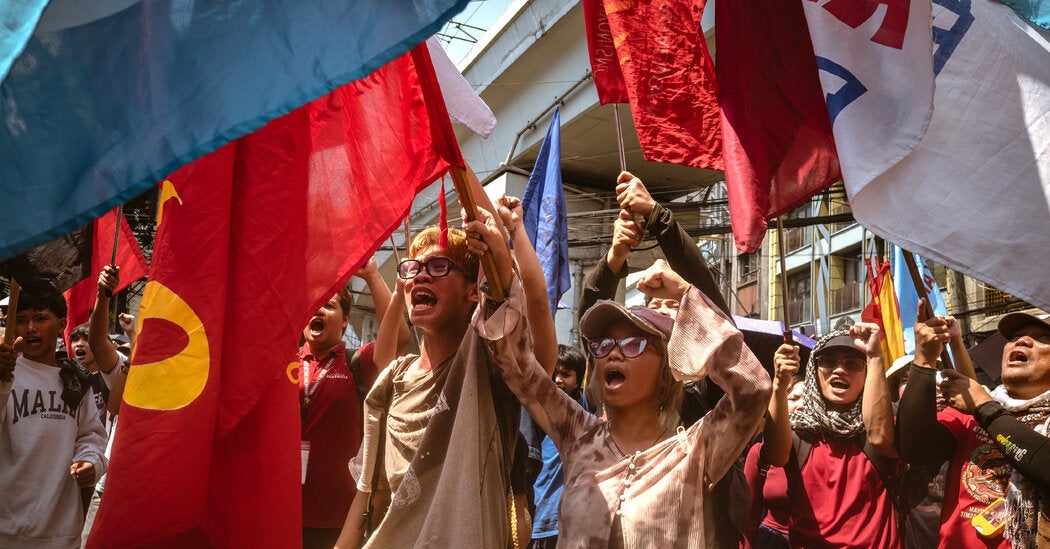
More than 70 organizations formed the Network Opposed to Pax Silica. Farmers, students and activists warn it could drain scarce water and electricity supplies and displace hundreds of Indigenous Ayta people. They plan a demonstration when Mr. Trump is expected to arrive in Manila this week for the Association of Southeast Asian Nations summit.
Beyond fears about A.I., the opposition reflects the Philippines’ complicated relationship with its former colonial ruler. Many Filipinos feel a strong cultural affinity for America. But resentment over exploitation runs deep, as does unease over their government’s increasingly close embrace of Washington.
In February, the Philippines signed a memorandum of understanding giving the United States a “first look” at its critical minerals.
“That is unheard-of in the history of our country,” said Renato Reyes Jr., president of Bayan, a political group opposing foreign intervention.
Two months later, the Philippines announced that it had joined Pax Silica and would build a hub about the size of 3,000 football fields. In July, President Ferdinand R. Marcos Jr. pledged that the project would “bring quality jobs to our people, accelerate our industrial competitiveness, and revitalize our economy.”
Local officials wanted to know at what cost.
In August, Roberto Mallari, the Catholic bishop of Tarlac Province, where the hub is planned, met with Joshua Bingcang, head of the government agency overseeing the project. Mr. Rodriguez and other officials were also there.
They pressed Mr. Bingcang on where its power would come from and how many people would be affected.
Mr. Bingcang said the government was considering rainwater harvesting, a desalination plant and a solar farm. More than 100 farmers could be displaced “in the first phase,” he said. Activists estimate the number could be higher.
Bishop Mallari left unconvinced.
“I started to talk about it in my homilies,” he said. “I was telling the parishioners we should get involved in this because we would be the first to be affected.”
Sovereignty Fears
Critics question the hub’s resource demands, who would control it and even what it will be.
Government estimates suggest that the project would require up to 90 million liters of water a day and 3 gigawatts of power. Its water needs would require amounts triple the area’s available supply during the dry season, while its projected power demand would be the equivalent of roughly a fifth of Philippine electricity consumption in 2024.
The estimates have fueled suspicions that a sprawling data center is planned. Philippine officials deny this, calling it a semiconductor manufacturing hub.
The State Department was less definite. A spokesman said whether the project would include data centers “will depend on a number of factors, including environmental and infrastructure studies still to come.”
Mr. Bingcang said the project could generate around $3 billion in annual revenue and create up to 190,000 jobs. More than 50 companies, including the world’s tech titans, had expressed interest, he added.
Senator Erwin Tulfo, a politician from a prominent political family, has demanded more clarity on how the hub would operate and whom it would affect, though he remains enthusiastic about the potential jobs.
“It’s money for the country,” he said.
For Senator Imee Marcos, the president’s sister, the issue is sovereignty.
She provided a draft framework that she said was proposed by the Americans. Under its terms, a private “master tenant” would receive a 99-year lease, while a so-called Pax Silica Court in New York would settle disputes.
Ms. Marcos, a critic of her brother’s closer ties to Washington, said she had no objection to an American-led hub.
“You know that the Filipinos love Americans,” she said. “It’s unrequited love, but yeah, it’s unconditional.”
But she warned that the proposed framework could violate Philippine law and the nation’s Constitution, concerns she raised in the Senate.
The State Department denied this, noting that “the Philippines is not transferring land, territory, or sovereign authority to the United States.”
Giovanni Tapang, a former dean of the College of Science at the University of the Philippines Diliman, said supplying the hub’s water needs could require building dams or diverting rivers, depriving farmers of irrigation.
“If we are going to subordinate the development of the country for the U.S.’s needs, then we’re just replicating all the decades of subservience and neocolonial development,” he said.
A Fight to Stay
The proposed Pax Silica site is about a two-hour drive from Manila, in the New Clark City economic zone.
Near a vast stretch of farmland, a sign announcing the project had been taken down. Water buffaloes roam the area. Just 12 miles away stands the former Clark Air Base, once one of America’s largest overseas military bases.
For the Indigenous Ayta people who live nearby, the threat of displacement is painfully familiar.
About 200 Ayta families live in Manabayucan, a remote village on the edge of the planned hub. The Aytas, among the Philippines’ earliest inhabitants, are also among its poorest.
Many were displaced during the Philippine-American War at the turn of the 20th century as the United States established a fort that became the precursor to Clark Air Base.
After Mount Pinatubo, a nearby volcano, erupted in 1991, many people spent years in government camps, unable to resume farming. That same year, the Philippines forced the Americans out of their military bases. But the land was never returned to the Aytas. It passed to the Philippine government.
Reaching Manabayucan requires a drive along an unpaved road, a river crossing and a hike up a steep hill. The village has no electricity, running water or mobile phone coverage.
The outside world feels far away, but now it is closing in.
Nearby, a bulldozer had dug up an Ayta cemetery in what residents said was the beginning of the Pax Silica project.
Many villagers have never heard of artificial intelligence. They know nothing of the fierce opposition to data centers in the United States.
But they understand what losing their land would mean.
Roby Dalis, an Ayta farmer who cannot read or write, earns $4.70 a day selling banana leaves. He recently joined his first protest, traveling to Manila to march alongside other farmers.
“If they take the land where we live, we will have nowhere to go,” Mr. Dalis said.
The Aytas’ plight has become a rallying cause for the movement against Pax Silica. On a recent Thursday, villagers gathered outside their bamboo huts to hear from Kim Falyao, a youth Indigenous activist.
“We should not be dictated upon by anyone saying, ‘We want to build Pax Silica here, so move out,’” she said, as villagers nodded. “No. We have the right to decide for ourselves and our community.”