
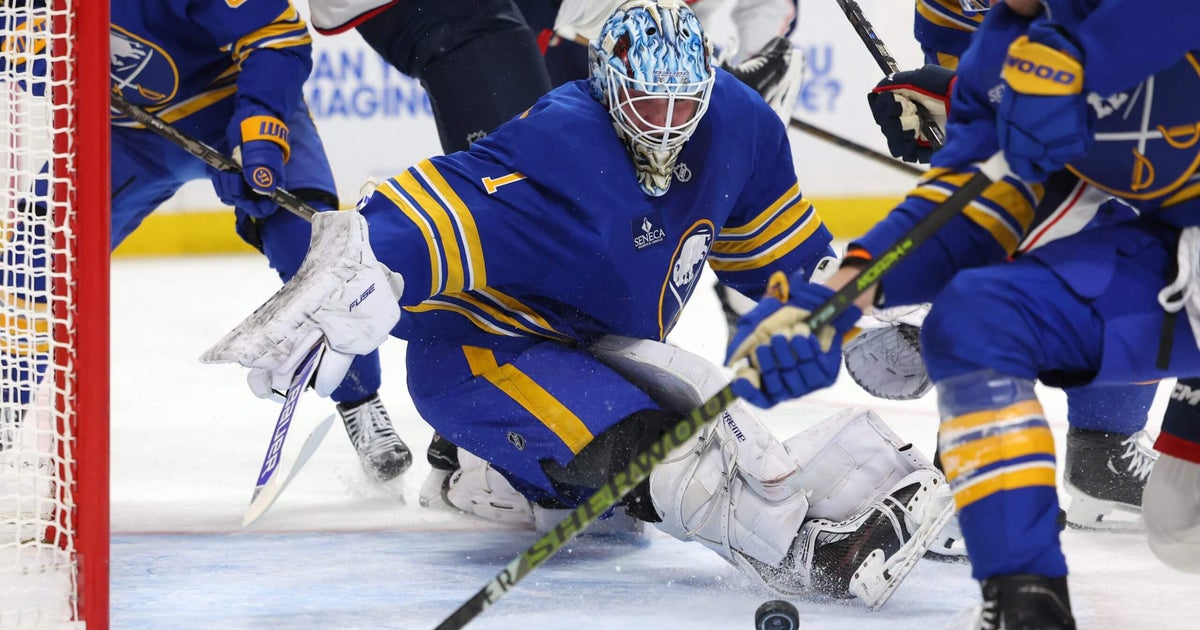
The clichés about goaltending are true: It’s the last line of defense and the great equalizer.
That’s why when a goalie allows a lot of goals against, they tend to shoulder the blame. Sometimes, it’s completely justified. But goalies aren’t always the driving force behind a leaky team. In some cases, a defense is so porous that even the best goalies can’t stop the bleeding night after night. Just look at the Chicago Blackhawks, who have been a disaster in their own zone despite Spencer Knight’s efforts.
Other times, a bad defense exposes shaky goaltending. Take the rebuilding Vancouver Canucks, who came into the season with a bottom-five goaltending duo that has been strained by abysmal defensive-zone play.
If a team is going to tighten up, it has to get to the root of the problem. Let’s take a closer look at some of this season’s leakiest teams and identify the real areas of weakness.
Anaheim Ducks
The Ducks’ 3.64 goals against per 60 in all situations is third-worst in the league, behind only Chicago and Vancouver. It’s easy to point the finger at goaltending — specifically, at Lukáš Dostál. He has an .856 save percentage and has allowed 7.97 goals above expected, which is fourth-worst in the league.
Dostál has already been pulled twice in 11 starts, and has had his starting workload reduced this month to reset his game. But that hasn’t done the trick either; in two starts in November, he has allowed nine goals on 36 shots.
The context of Dostál’s workload matters here because he has been under an enormous amount of pressure behind some really chaotic defending. The Ducks’ puck management at five-on-five is a glaring weakness. This young team is guilty of far too many turnovers in the neutral and defensive zones. And when opponents gain the blue line, they absolutely cook off the cycle and keep Anaheim hemmed in its own zone.
What makes the goaltenders’ workloads all the more difficult is that the Ducks let opponents whip the puck around the offensive zone. It adds up to a rate of 16.5 passes to the slot per 60 minutes. That isn’t just the third-highest rate this season; it’s the third-worst in Sportlogiq’s entire dataset dating back to 2017-18.
Take this play against the Nashville Predators. Jayden Struble is able to slip the puck between two Ducks defenders to Nils Höglander. That puts him ahead of all five Anaheim skaters, giving him the space to make it 2-1.
Höglander goal versus Anaheim
Or this goal from New York Islanders forward Simon Holmström that ended up being the game-winner on Saturday night. Matthew Schaefer has three Ducks defenders zoning in on him, and he still finds Holmström right in the middle for a quick strike that is impossible for Dostál to stop.
Holmstrom game-winner versus the Ducks
This isn’t a new problem. Anaheim has consistently allowed one of the highest rates of slot passes against in each of the last five seasons. That daunting of a workload could just be weighing on Dostál at this point.

While there is no question the Ducks have to improve in front of the blue paint so their goalies aren’t as vulnerable to dangerous chances, Dostál has to find his form as well. The team has been able to lean on Ville Husso and Laurent Brossoit lately, but Dostál has the highest ceiling of the three. He has to find a way to deliver more timely saves despite some of that shot quality.
Washington Capitals
Washington is a pretty surprising entry here after Logan Thompson finished second in the league with 32.8 goals saved above expected last season. But through the first quarter of the season, the Capitals have allowed the fifth-highest rate of goals against with 3.59 per 60. The Capitals have yet to earn a shutout this season, and have only limited an opponent to one goal against once in 18 games.
November has been especially tricky. The team has allowed five or more goals in four of six games so far this month, which shakes out to 4.65 goals against per 60; only the Blackhawks have allowed more in November.
Defending the rush has become a developing problem over this stretch at five-on-five. It’s concerning because the Capitals didn’t allow opponents to drive to the slot much in transition at all in the early goings of the season, and weren’t allowing many goals against, either. Another problem, for Thompson in particular, is that he has had to face a lot of shots through traffic and is struggling against those screened shots.
Robertson scores through traffic
Washington’s penalty kill has been a part of the problem, too. Across the first quarter of the season, the Caps’ defense in short-handed situations hasn’t been great, but the goalies have kept pace with their workload. But as the season has rolled on, both the defense and goaltenders have been feeling the pressure.
The good news for the Capitals is that reinforcements are on the way. Rasmus Sandin and Vincent Desharnais are still in non-contact jerseys, but are getting closer to returning. That should help the team tighten up a few areas defensively, which could help the goaltenders find their form after some recent slips.
Utah Mammoth
The problems in Utah are easier to pinpoint: It primarily falls on the goaltenders.
The Mammoth play a possession-heavy game that relies on speed, skill and puck-moving ability. And while some rush-based teams subject their goalies to some really dangerous looks against, the Mammoth have been really stingy so far this season. They deny entries well and limit scoring chances off the rush. The Mammoth don’t allow opponents to get set off the cycle or move the puck laterally to the slot, either. It adds up to a sparkling 2.13 expected goals against per 60 entering Monday’s games, which trails only the Carolina Hurricanes and Florida Panthers.
But when chances do trickle through Utah’s defense, the goalies have not come up with timely saves often enough. Karel Vejmelka and Sebastian Cossa have allowed a collective 8.07 goals above expected.
Goaltending is what ultimately cost the Mammoth the game on Saturday night against the Sharks. Utah’s shot quality added up to 4.2 xG, compared to the Sharks’ 2.7. Vejmelka allowed five goals against what should have been a pretty routine workload.
Orlov scores against Vejmelka
Vejmelka’s volatility has been the biggest issue in Utah this season. While he was never thought of as an ace No. 1, his availability has always been a strength; this franchise has counted on him for at least average goaltending in a workhorse role. He always had the potential to be this team’s weak link because 1) he isn’t the kind of goalie to steal games, and 2) Utah generally hasn’t had a reliable backup behind him. The former is why Utah kept coming up as a potential landing spot for Connor Hellebuyck, and the latter explains the Cossa addition this summer.
The Mammoth are such a dynamic threat on both ends of the ice this season, but their ceiling may be limited by goaltending.
Buffalo Sabres
Speaking of teams that were in the mix for Hellebuyck, the Sabres need to upgrade their goaltending situation.
Unlike the Mammoth, Buffalo doesn’t have a true No. 1 to lean on. The team rotated Ukko-Pekka Luukkonen and Alex Lyon down the stretch. With Lyon back from injury, the Sabres now have three goalies to rotate, with Colten Ellis also in the mix.
That by-committee approach may have worked at times last year, but it’s been a disaster so far this season. Luukkonen and Ellis haven’t been strong enough to push for more playing time so far. When either one has a solid game, they struggle to string together a strong run of play. Take Luukkonen earlier this month. After two straight solid outings against the Kings and Blue Jackets, he was lit up by the Lightning, allowing five goals on 14 shots.
Kucherov rush goal versus Luukkonen
One area that has challenged the goalies in particular has been the penalty kill, where the Sabres are near the bottom of the league at 70.4 percent. And it’s primarily due to the goalies allowing almost six goals above expected while short-handed.
As troubling as the Sabres’ goaltending has been through the first quarter of the season, it’s not all that is ailing the Sabres. A lack of goal support has been an obvious storyline through much of the season. But the defense hasn’t done the goaltenders any favors, either.
One thing that sticks out is what happens when opponents gain the blue line with control at five-on-five. Compared to last season, the team is doing a better job protecting the slot off the cycle. But off those initial entries, the Sabres have conceded a higher rate of slot shots: 7.11 attempts per 60, which is the fourth-highest rate in the league.
With Lyon back in the fold, the Sabres have another option to lean on, and maybe that helps settle a clear weakness for the team. Lyon isn’t a game-breaker in net, but he has been a short-term fixer in the past. A three-goalie system does complicate things because it means fewer reps for each netminder, but this team could use whatever help it can get.
Data via Sportlogiq, Evolving-Hockey, HockeyViz, HockeyStatCards, All Three Zones and HockeyStats. This story relies on shot-based metrics; here is a primer on these numbers.