

Tuesday night, Nov. 24, the Beaver Moon rises in the northeastern sky shortly before sunset and shines all night from Taurus the Bull. The following night it will be nearly as full and pop up at 5:01 p.m. (for Duluth), 35 minutes after sunset in a darkening sky.
The name recognizes beavers, which are busy winterizing their lodges before freeze-up, and also the start of the trapping season. The Native American Anishinaabe people gave November’s full moon an equally fitting name, the Freezing Over Moon (Gashkadino-giizis), which refers to the skim of ice that forms on puddles and lakes as temperatures dip.
One of the many joys of living near the shore of Lake Superior (or any large body of water) is seeing the moon just as it’s rising, when it’s reddest, “flattest” and most distorted. At the horizon, we view it through the bottommost layer of the atmosphere where the air is densest. Gaze higher and the air quickly thins out along your line of sight. Dense air acts as both a filter and a prism. It scatters the cooler, shorter wavelength colors away, removing purple, blue and green, the reason a low moon glows the color of cheddar cheese.
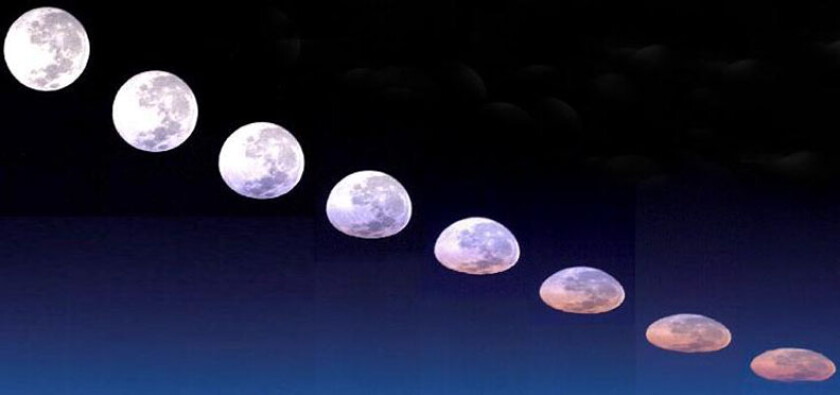
NASA astronaut Don Pettit took this sequence of the setting full Moon from the International Space Station back in 2003. The closer it gets to the horizon (and the thicker, denser air there) the more flattened it becomes. Stronger refraction at the horizon bends the light from the bottom of the moon into the top, flattening it.
Contributed / NASA
Thick, dense air at the horizon also causes the moon to look squashed like a sat-on exercise ball. Denser air refracts the light from the bottom half of the moon upward into the top half, flattening the moon from a circle into an oval. The top half doesn’t experience the same degree of refraction because it’s a little higher above the horizon where the air isn’t as thick.
By far the most talked about lunar oddity is how enormous the moon looks at the horizon compared to when it’s overhead. While a complete explanation for the Moon illusion remains elusive, scientists agree on one thing — it’s an optical illusion. In fact, when we gaze at a rising or setting moon it’s actually about 4,000 miles farther away compared to seeing it overhead. Why? At the horizon we look across the radius of the Earth and then out to the moon. When it’s overhead, there’s no Earth between us and the rocky orb, so it’s 4,000 miles closer. So when we see the moon low in the sky, it’s actually a hair smaller in apparent size.
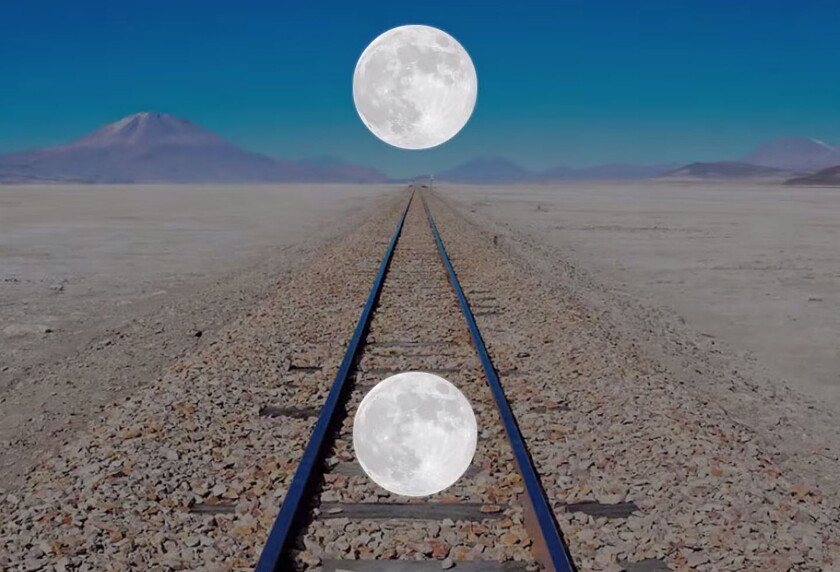
In the Ponzo illusion the upper moon looks larger than the lower because the parallel, converging railroad tracks trick our brains into thinking it’s farther away. For the best effect, glance briefly instead of staring.
Contributed / NASA
The Ponzo illusion, Ebbinghaus effect and our perception of the sky’s shape offer insights into why a rising full moon looks so huge. The first is named for the 20th-century Italian psychologist Mario Ponzo. Take a look at the illustration. The two converging lines appear to be receding in the distance like parallel railroad tracks. They trick our brains into thinking that the top moon is farther away than the bottom (nearby) moon. If it’s farther away, then our brains compel us to see it as larger than the nearby moon. Yet the two are identical in size! In the real world, we use the apparent size of trees, buildings and land forms as cues to distance.
The large moon effect is also enhanced by how we perceive the shape of the sky. Think of a planetarium sky. It’s a hemispherical dome with the horizon as far away as the overhead point, the zenith. This isn’t how most of us perceive the sky in real life. We imagine it as a flattened, inverted bowl. This perception is reinforced by watching clouds and airplanes. Clouds directly above our heads are much closer than clouds at the horizon, so the zenith seems close and the horizon distant. When the moon is at the horizon, our brains think it’s farther away than when overhead, and we mentally inflate its size to compensate.

The orange circles represent the moon. Large, gray circles mimic expanses of open sky (left), while the smaller gray circles represent objects in the landscape that appear near the moon when it’s close to the horizon. Although both circles are identical in size the one at right looks larger.
Contributed / Wikipedia, public domain
In the Ebbinghaus illusion, the apparent size of the moon is affected by how open or crowded the space is around it. A disk, representing the moon, looks larger when surrounded closely by small disks and smaller when surrounded by large disks. The small disks represent things that frame the moon when it rises, like trees, homes, beaches and power lines. When the moon has risen high in the sky, it’s surrounded by large amounts of “empty” space. Without nearby landscape cues it looks smaller.
Again, these are just partial explanations. My takeaway is how weirdly malleable our perception of the world can be. While it’s good to trust our senses, it’s important to remember there’s often more there than meets the eye.

“Astro” Bob King is a freelance writer and retired photographer for the Duluth News Tribune. You can reach him at nightsky55@gmail.com.