
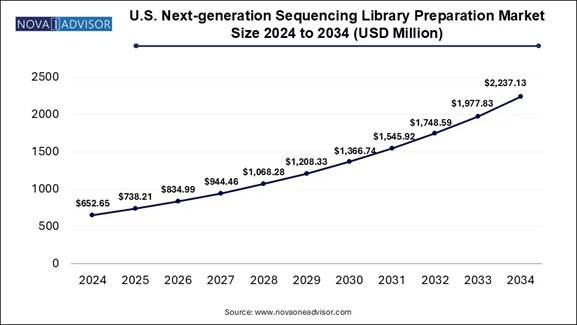
The U.S.
next-generation sequencing library preparation market size is
calculated at USD 652.65 million in 2024, grows to USD 738.21 million in 2025,
and is projected to reach around USD 2,237.13 million by 2034, growing at a
CAGR of 13.11% from 2025 to 2034.
The U.S. next-generation sequencing library
preparation market is growing due to its many benefits, as these solutions save
time and money, and they are improved specifically for instruments and
secondary analysis platforms. Even those consumers who are new to NGS find that
the workflows and applications are simple to adopt.
The Complete Study is Now Available for
Immediate Access | Download the Sample Pages of this Report@ https://www.novaoneadvisor.com/report/sample/9174
U.S. Next-generation Sequencing Library
Preparation Market Highlights:
• By sequencing type, the targeted genome
sequencing segment dominated the market with the largest share in 2024.
• By sequencing type, the whole genome
sequencing segment is expected to show the fastest growth over the forecast
period.
• By product, the reagents and consumables
segment held the largest market share in 2024.
• By product, the instruments segment is
expected to register the fastest growth during the forecast period.
• By application, the drug & biomarker
discovery segment captured the largest market share in 2024.
• By application, the disease diagnostics
segment is expected to show the fastest growth during the forecast period.
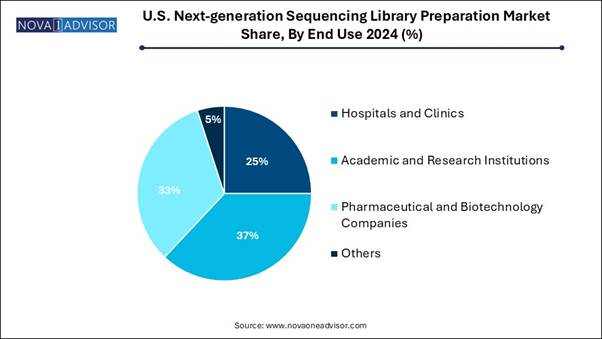
• By end use, the academic & research
institutions segment generated the highest market revenue in 2024.
• By end use, the pharmaceutical and biotechnology
companies’ segment is expected to register the fastest CAGR during the
predicted timeframe.
Market Overview and Industry Potential
The U.S. next-generation sequencing library
preparation market is expanding rapidly due to the library preparation techniques
involve converting a genomic
DNA sample into a library of fragments. It is an affordable and
time-saving procedure. Continue advancement in NGS library preparation with
advanced technology a resulting a bit becoming easier to use, scalable for any
size lab, requiring a small number of steps, and having a rapid workflow time.
It provides many benefits, such as proper
library preparation, reducing biases, ensuring even coverage, and lowering
errors, leading to high-quality sequencing data. Libraries applied for
particular applications, like whole-genome sequencing, transcriptome analysis,
exome sequencing, metagenomics,
or epigenomics. Augmented protocols save time and resources, allowing
high-throughput sequencing projects. Specific protocols enable the use of
restricted or degraded samples, like formalin-fixed paraffin-embedded (FFPE)
tissues.
• For Instance, In June 2025, DPX
Technologies, a biotechnology company providing solutions for automated sample
preparation, announces its latest products and fully automated workflows
utilizing functionalized pipette tips. The products, MicroPorous Xtraction
(MPX) Tips and NiXTips, are designed for DNA extraction and nucleic acid
cleanup.
What are Major Steps of NGS Library
Preparation?
NGS library preparation has four usual
steps, such as DNA
fragmentation or selection of target, adapter sequences addition, size
selection, and lastly, library quantification and QC. It involves converting
nucleic acid samples (gDNA or cDNA) into a library of homogeneously sized,
adapter-ligated DNA fragments, which are then sequenced using an NGS
instrument.
Immediate Delivery Available | Buy This
Premium Research https://www.novaoneadvisor.com/report/checkout/9174
Advantages of Next-generation Sequencing
Library Preparation Market
Application
Advantages
DNA/RNA Requirement
Low DNA/RNA input
Single investment for screening multiple samples
Multiple Marker & Variant Types
Screening of multiple genes
Multiple variant types
Detection of heterogeneity
High throughput
Screening of multiple samples
High Sensitivity
High sensitivity Sanger/PYRO sequencing
Reporting
Single clinical report with mutation states of multiple markers
What are Latest Trends in
Nest-generation Sequencing Library Preparation Market?
• In October 2024, Illumina, Inc., a global
leader in DNA
sequencing and array-based technologies, unveiled its MiSeq i100 Series
of sequencing systems, delivering unparalleled benchtop speed and simplicity to
advance next-generation sequencing (NGS) for labs.
• In January 2024, QIAGEN Digital Insights
(QDI), the bioinformatics business of QIAGEN, announced its enhanced QIAGEN CLC
Genomics Workbench Premium with LightSpeed technology now supports
next-generation sequencing (NGS) for somatic cancer secondary analysis.
• In August 2024, Illumina, Inc. announced
Food and Drug Administration (FDA) approval of its in vitro diagnostic (IVD)
Tru Sight Oncology (TSO) Comprehensive test and its first two companion
diagnostic (CDx) indications. This single test interrogates over 500 genes to
profile a patient’s solid tumor, helping to increase the likelihood of
identifying an immuno-oncology biomarker or clinically actionable biomarkers
that enable targeted therapy options or clinical trial enrollment.
Increasing Digitalization in CDMO:
Market’s Largest Potential
Next-generation
sequencing (NGS) library preparation is a significant tool used in
genomics research. NGS sequences millions of DNA fragments at the same time,
offering detailed information related to the structure of genomes, gene
activity, genetic variations, and fluctuations in gene behaviour. Modern
developments focused on rapid and more precise sequencing, lower expenses, and
better data analysis. These advancements hold great promise for unlocking novel
opportunities in genomics and enhancing the understanding of diseases and
personalized healthcare. This revolutionary technology has driven genomics advancements
in the various domains of healthcare.
• For Instance, In June 2025, Illumina,
Inc. announced it has entered into a definitive agreement with Standard
BioTools under which Illumina will acquire SomaLogic, a leader in data-driven
proteomics technology, and other specified assets for $350 million in cash
payable at closing, subject to customary adjustments, plus up to $75 million in
near-term performance-based milestones and performance-based royalties.
U.S. Next-generation Sequencing Library
Preparation Market: What to Expect in the Country in Upcoming Period?
In the U.S. increasing application of
next-generation sequencing is due to its ability to transform all fields of
biological science. Increasing application of precision medicines has allowed
clinicians to gain a better understanding of novel rare genetic diseases
because of the use of next-generation
sequencing (NGS) technologies.
Also in this region, advancements in
genetic testing, growing prevalence of chronic diseases, and an increasing
importance of patient-centered care increase the demand for next-generation
sequencing library preparation.
• For Instance, In April 2025, Watchmaker
Genomics announced an important milestone in providing comprehensive and robust
automated solutions for next-generation sequencing (NGS) workflows. Its
collaboration with Revvity has resulted in fully automated and verified methods
for all of its DNA and RNA library preparation kits on the Sciclone G3 NGSx
liquid handling workstation, making Revvity the first provider to automate
Watchmaker’s entire library preparation portfolio.
Report Scope of U.S. Next-generation
Sequencing Library Preparation Market
Report Coverage
Details
Market Size in 2025
USD 738.21 Million
Market Size by 2034
USD 2,237.13 Million
Growth Rate From 2025
to 2034
CAGR of 13.11%
Base Year
2024
Forecast Period
2025-2034
Segments Covered
Product, Sequencing
Type, Application, and End use
Market Analysis
(Terms Used)
Value (US$
Million/Billion) or (Volume/Units)
Key Companies
Profiled
Agilent Technologies,
Inc., BD, F. Hoffmann-La Roche AG, Inc., Illumina, Inc., New England Biolabs
Inc., Oxford Nanopore Technologies, Pacific Biosciences of California, Inc.,
QIAGEN N.V., Revvity, Inc., Thermo Fisher Scientific Inc.
U.S. Next-generation Sequencing Library
Preparation Market Segmentation Analysis:
By Sequencing Type Analysis:
The targeted genome sequencing segment
dominates in the U.S. next-generation sequencing library preparation market, as
it focuses on a particular genomic region of interest. This technology is best
for investigating genes in precise pathways or for follow-up experiments as
compared to whole-genome sequencing (WGS). It is fast and more affordable than
WGS, and it allows for deeper sequencing. Targeted sequencing is an extremely
sensitive and significant technique for recognizing variants and mutations,
including rare variants.
On the other hand, the whole genome
sequencing segment is expected to grow significantly during the forecast period
as it is the most inclusive genomic test available. It is used to test a broad
range of genes simultaneously, identifying a range of variant types. WGS has
huge potential to identify variants in both protein-coding regions and
non-coding, possibly intended regions.
By Product Analysis:
The reagents and consumables segment
dominates the U.S. Next-generation sequencing library preparation market, as
NGS Reagents are complete sets of optimized reagents that are perfect to
convert a small quantity of DNA / RNA input into indexed libraries. NGS allows
the best throughput per run, and studies are performed rapidly and affordable
cost. NGS needs lower sample input, it provides higher accuracy, and the
ability to identify variants at lower allele frequencies as compared to Sanger
sequencing
The instruments segment is expected to grow
significantly during the forecast period, as the instruments provide the main
advantages over traditional sequencing approaches, primarily because of their
high throughput, speed, and scalability. NGS instrument allows for the same
time sequencing of millions of DNA fragments, offering comprehensive genomic
insights, rapid turnaround times, and lower costs compared to traditional
technologies.
By Drug & Biomarker Discovery
Analysis:
The drug & biomarker discovery segment
captured the largest market share in 2024, as NGS supports investigators to
discover novel therapeutics, combat drug resistance, and prevent disease
evolution. NGS enables the identification of gene mutations and the determination
of disease progression via biomarker prediction and genetically stratified
clinical trials. It brings numerous advantages to biomarker discovery,
including the ability to perform deep sequencing, which allows the detection of
low-frequency genetic variants, and enormously parallel sequencing.
The disease diagnostics segment is expected
to show the fastest growth during the forecast period, as NGS is used in the
diagnosis of various diseases. As microbes grown from patient samples offer
microbial DNA for WGS, in which millions of fragments are read in parallel and
assembled to rebuild the microbial genome. NGS has the potential to speed up
the detection of disorders and create personalised pharmacogenomics profiles
for different types of diseases.
By End Use Analysis:
The academic & research institutions
segment generated the highest market revenue in 2024, as next-generation
sequencing (NGS) is a novel technology used for DNA and RNA sequencing and
variant/mutation detection in healthcare research. NGS sequences hundreds or
thousands of genes or a whole genome in a limited period. Next-generation
sequencing (NGS) is a significant tool used in genomics research.
The pharmaceutical and biotechnology
companies’ segment is expected to register the fastest CAGR during the
predicted timeframe as NGS technologies are used to appearance for microbial
contaminants to offer precise surveillance of the drug manufacturing solution.
In the pharmaceutical and biotechnology industry, it drives large knowledge-gaining
experiments that could not be financially defensible or were not even possible
in the past, including metagenomics to compare various disease states or
patient inconsistency, genome sequencing of model organisms, or ELT compound
library screening procedures.
Some of the Prominent Players in the
U.S. Next-generation Sequencing Library Preparation Market
• BD
• F. Hoffmann-La Roche AG, Inc.
• New England Biolabs Inc.
• Oxford Nanopore Technologies
• Pacific Biosciences of California, Inc.
• QIAGEN N.V.
• Thermo Fisher Scientific Inc.
What is Going Around the Globe?
• In February 2025, Roche unveiled its
proprietary, breakthrough sequencing by expansion (SBX) technology,
establishing a new category of next-generation sequencing. SBX chemistry,
combined with an innovative sensor module, offers ultra-rapid, high-throughput
sequencing that is both flexible and scalable for a broad range of
applications.
• In May 2025, Illumina, Inc., and
Ovation.io, Inc., an organization dedicated to building best-in-class
multiomics datasets, announced the development of the largest commercially
available clinical multiomic dataset from 25,000 patients treated with
glucagon-like peptide-1 (GLP-1) receptor agonist therapies. The dataset will be
made available to the pharma community to advance drug discovery and
development.
• In June 2024, the Life Science division
of Meridian Bioscience, Inc., a leading global provider of diagnostic testing
solutions and life science raw materials, proudly introduces the market’s first
innovative lyophilized Next-Generation Sequencing (NGS) library preparation
kit. This pioneering kit underscores Meridian’s commitment to sustainable and
cost-effective solutions within the life sciences industry.
• In April 2025, Zymo Research Corp
announced the launch of its revolutionary new technology: The Green DNA/RNA Dry
Transport System. This new tool sets the standard for eco-conscious,
cost-effective, and room temperature transportation of DNA and RNA samples and
is ideal for prepared libraries for any commercial sequencing platform.
You can place an order or ask any
questions, please feel free to contact at sales@novaoneadvisor.com |
+1 804 441 9344
Segments Covered in the Report
This report forecasts revenue growth at
country levels and provides an analysis of the latest industry trends in each
of the sub-segments from 2021 to 2034. For this study, Nova one advisor, Inc.
has segmented the U.S. Next-generation Sequencing Library Preparation Market.
By Sequencing Type
• Targeted Genome Sequencing
• Whole Genome Sequencing
• Whole Exome Sequencing
• Other Sequencing Types
By Product
• Reagents & Consumables
ᵒ DNA Library Preparation Kits
ᵒ RNA Library Preparation Kits
ᵒ Other Reagents & Consumables
• Instruments
By Application
• Drug & Biomarker Discovery
• Disease Diagnostics
ᵒ Cancer Diagnostics
ᵒ Reproductive Health Diagnostics
ᵒ Infectious Disease Diagnostics
ᵒ Other Disease Diagnostic
Applications
ᵒ Others
By End Use
• Hospitals and Clinics
• Academic and Research Institutions
• Pharmaceutical and Biotechnology
Companies
• Others
Immediate Delivery Available | Buy This
Premium Research https://www.novaoneadvisor.com/report/checkout/9174
About-Us
Nova One Advisor is a global leader
in market intelligence and strategic consulting, committed to delivering deep,
data-driven insights that power innovation and transformation across
industries. With a sharp focus on the evolving landscape of life sciences, we
specialize in navigating the complexities of cell and gene therapy, drug
development, and the oncology market, enabling our clients to lead in some of
the most revolutionary and high-impact areas of healthcare.
Our expertise spans the entire
biotech and pharmaceutical value chain, empowering startups, global
enterprises, investors, and research institutions that are pioneering the next
generation of therapies in regenerative medicine, oncology, and precision
medicine.
Web: https://www.novaoneadvisor.com/
Contact Us
USA: +1 804 420 9370
Email: sales@novaoneadvisor.com
For Latest Update
Follow Us: LinkedIn