
Zambia’s National Health Policy enshrines the principle of “equity of access to cost effective quality health services, as close to the family as possible” (Republic of Zambia, 2012). A mosaic of health-care providers managed by the government, faith-based organisations, other nongovernmental organisations, and the private sector strive to make this vision a reality.
But despite progress on life expectancy, maternal mortality, and other health indicators (World Health Organization, 2024), Zambia’s health-care system continues to struggle with a broad range of challenges, including a high burden of infectious diseases, inadequate infrastructure, a lack of essential drugs and medical supplies, and a shortage of health-care workers (Simangolwa et al., 2023). The COVID-19 pandemic highlighted these weaknesses, though they are long-standing problems (Health Action International, 2020).
The government increased its health budget by 6% in 2024, raising health as a share of the total budget from 10.4% in 2023 to 11.8%, still short of the Abuja Declaration’s 15% target (UNICEF, 2024). With the support of partners such as the World Bank (2025), the Zambian government has launched initiatives to strengthen health systems, enhance service delivery, and expand access to essential medicines and medical supplies in order to improve health outcomes. Focal areas include supporting maternal and child health, combating both
communicable and noncommunicable diseases, and improving health financing to ensure sustainability and equity in health-care access (Ministry of Health, 2024; Simangolwa et al., 2023; World Health Organisation, 2025).
This dispatch reports on a special Afrobarometer Round 10 survey module focusing on health care. In Zambia, findings show that only a small share of citizens have medical aid coverage. Among those who lack medical aid, a majority cite lack of awareness of any health insurance schemes and unaffordability as the main reasons.
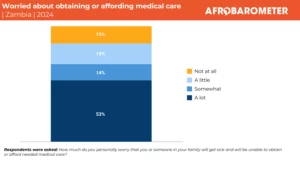
Most Zambians worry about being unable to obtain or afford medical care when needed, and they think the government should ensure universal access to health care, even at the cost of higher taxes.
Exploring citizens’ experiences with the health care system, we find that more than two-thirds of Zambians say someone in their family went without needed care during the past year. Among those who sought care at a public clinic or hospital, most say it was easy to get the services they needed, but many encountered problems such as a lack of medicine or supplies, long wait times, high cost of medicines or care, facilities in poor condition, and absent medical personnel.
Even so, trust in the Ministry of Health is high, and more than half of citizens approve of the government’s performance on improving basic health care.