
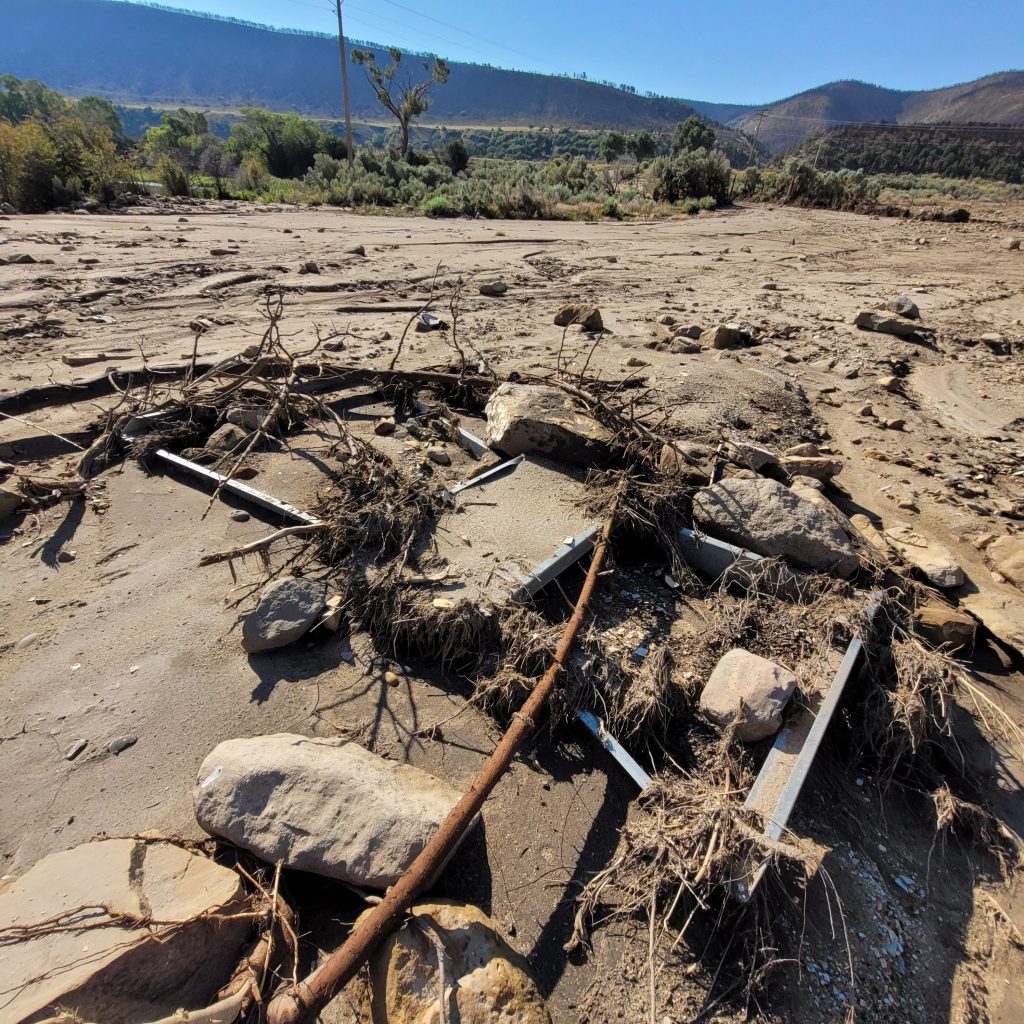
Irrigation ditch structures can be seen buried under mud in rural Rio Blanco County. Some livestock ponds are contaminated with ash and are unusable for animals.
Residents posted post-rain videos last week of black, mucky water crossing roads, surging through culverts, rushing down bar ditches and running onto fields.
Colorado Parks and Wildlife reports some fish have died in the White River on the northwest edge of the Lee Fire burn scar after heavy rains that pushed silt and ash into the river.
Those are just some of the water resources issues facing Rio Blanco County land owners, water users and agricultural producers.
Although county leaders stressed this week that the town of Meeker is open, ready and in need of tourist business — including for the Meeker Classic Sheepdog Championship Trials this weekend and the Meeker Mustang Makeover rescheduled for Sept. 26-27 — impacts from erosion and run-off remain a significant concern in rural Rio Blanco County.
With every rainstorm, there is another chance for flash flooding and debris flows, said Rio Blanco County Commissioner Callie Scritchfield.
“Lack of water is a challenge, and too much water is another challenge,” Scritchfield said during a phone interview Thursday. “We are all just taking it day by day and watching the weather and waiting to see what we will learn from the BAER team.”
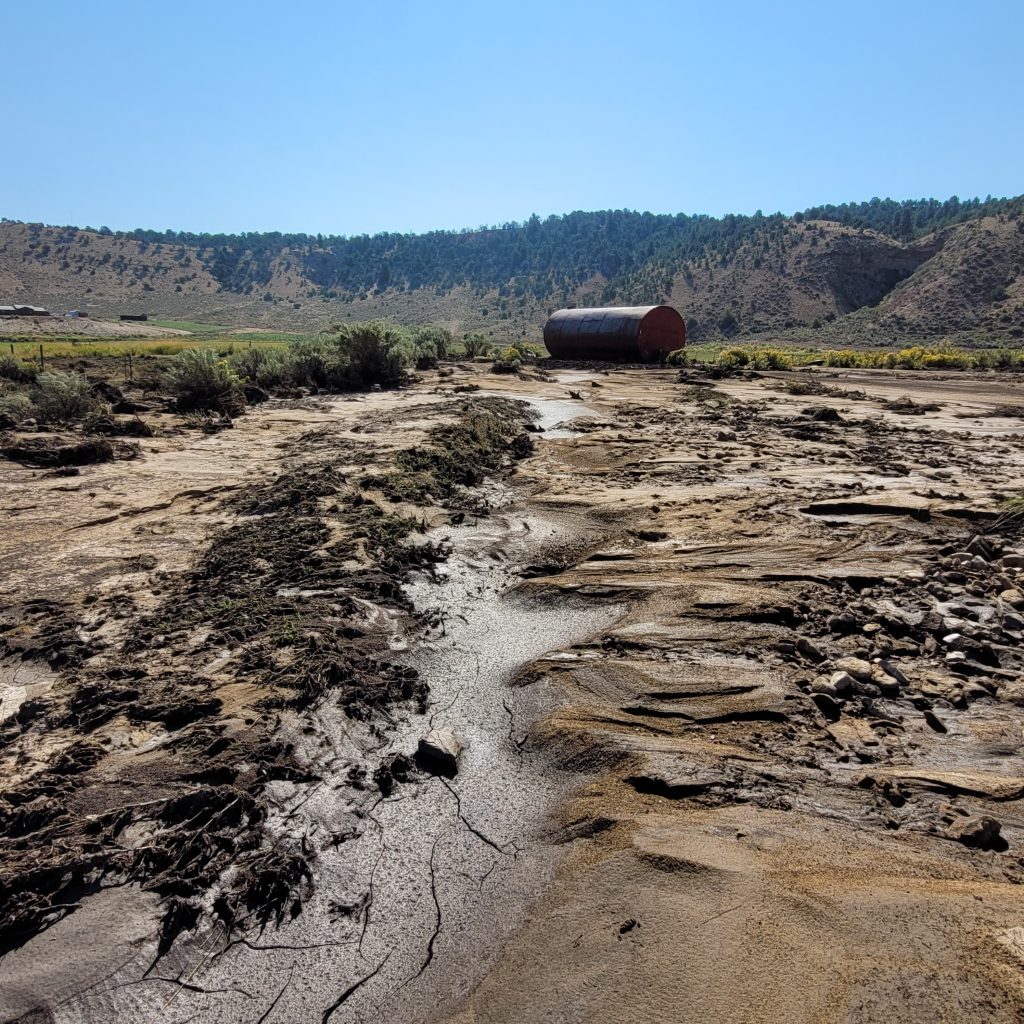 An irrigation ditch is filled in with sediment and debris on Piceance Creek in Rio Blanco County due to run-off damage after the Lee Fire.Colorado Division of Water Resources/Courtesy photo
The BAER team, or the federal Burned Area Emergency Response team, is expected to issue a report later this month to provide more direction for recovery efforts. BAER teams are staffed by specially trained professionals such as hydrologists, soil scientists, engineers, biologists, vegetation specialists and archeologists.
“The objective of the BAER program is to determine the need for and to prescribe and implement emergency treatments on federal lands to minimize threats to life or property resulting from the effects of a fire or to stabilize and prevent unacceptable degradation to natural and cultural resources,” according to the U.S. Forest Service.
Regional organizations, state and federal agencies and Rio Blanco County departments are doing what they can and helping to educate landowners impacted in the wildfire burn scar about recovery resources.
However, staff members at multiple agencies and Meeker residents interviewed say grant funding is only available for the long term. So, immediate financial assistance for landowners to purchase materials and supplies for run-off and erosion prevention appears limited.
“Everything is extremely delayed,” said lifelong Rio Blanco County resident Suzan Pelloni.
“The immediate need for our ranchers, I don’t know if those needs are really being met. I think everyone is doing what they can. Grants are not fast and not 100% guaranteed. It just keeps everyone on edge. Everyone is trying to seek out their own path, and they are just met with a lot of challenges right now.”
“Nobody has fast funding; it’s going to take a while,” Scritchfield said. “Rio Blanco County and partners continue to gather data to understand the impacts of fires and rains that follow.”
Pelloni, a Realtor in Meeker, said ranchers and landowners are helping each other as best they can right now, such as sharing heavy equipment.
“They are pooling resources. They are working together to try and help the immediate needs of the neighbor,” Pelloni said.
Pelloni highlighted some example immediate concerns for the rural landowners ranging from water tanks where electricity service repair is delayed to a ranch where both summer and winter grazing lands were burned. Looking at the big picture, Pelloni said ranchers may have to sell cattle early or sell more cattle than anticipated, and ranchers who supplement their income with guided hunting likely will lose income this fall too.
“The amount of unforeseen expenses just keep coming in different directions,” Pelloni said. “The fire was one project, and the silt is another chapter in this catastrophe. You are worried about the next flood.”
In the meantime, the White River & Douglas Creek Conservation Districts soil conservation agency, along with the Bureau of Land Management and Rio Blanco County, are hosting weekly question-and-answer sessions on Thursday afternoons continuing on Sept. 11 and 18. The meetings provide resources to assist with questions for residents in need of recovery recommendations and financial and technical recovery resources.
“We know this is a challenging time for many landowners, and we want you to know that local land management, conservation and government partners will be coming together to coordinate watershed protection and recovery efforts in response to these fires,” according to a notice on the conservation districts’ website.
The soil conservation district website includes a Wildfire Recovery Resources section that includes multiple post-fire guidebooks. The website includes specific links to “Recovery Structure” suggestions for landowners to implement to fight run-off damage, such as log and rock structures, concrete barrier walls, contour wattles, erosion control mats, flood and log erosion barriers, mechanical scarification, rock and strawbale check dams, sandbag barriers and seeding guidelines.
The Rio Blanco County Road and Bridge Department is giving out pallets of sandbags for people living in U.S. Geological Survey Post-Fire Debris Flow Hazard Zones. Residents are advised to use the sandbags in front of exterior doors, garage doors, important electrical boxes or air conditioners.
Photos taken by Colorado Division of Water Resources personnel show some examples of significant damage from the Lee Fire burn scar ranging from a ditch filled in with sediment and debris on Piceance Creek to a flume and ditch covered in mud, rocks and debris along the White River.
An earlier call by senior water right holders placed on Piceance Creek had to be removed because water infrastructure is now damaged.
“The call placed on Piceance Creek by the Colorado Division of Water Resources initiated on May 14 had to be removed as a result of the diversion dam at the calling location getting washed out and the ditch for the calling structure getting silted in by mud and debris,” said Erin Light, Colorado Water Division 6 division engineer.
Downstream in Rangely, the town water plant pulls water from the White River as a primary water source, and wildfire ash and silt coming from upstream could impact those water treatment operations, the county commissioner.
The U.S. Geological Survey’s Colorado Water Science Center office in Grand Junction reported the installation of a new real-time camera on the White River below Boise Creek near Rangely.
“We hope that the imagery is also useful for those managing water resources on the White River, especially as post-wildfire conditions play out in the near future,” Henneberg said.
Multiple agencies and task force groups in the Meeker area are continuing to collect data and ramp up recovery operations, in what the county commissioner called a “hurry up and wait” scenario.
The county’s Rio Blanco Recovery team is assisting with a damage and loss questionnaire related to agricultural and natural resources for agricultural producers, outfitters and rural landowners. The goal is to connect those in need with essential resources to address both immediate needs and long-term recovery and mitigation efforts.
Next week, a State Recovery Task Force with representatives from each of the 26 Colorado state agencies, led by the Colorado Division of Homeland Security and Emergency Management, will be Meeker for a day of onsite damage assessments, said division spokesperson Micki Trost.
“The team conducts on site assessments of impacts caused by the recent fires to the public infrastructure, economic impacts to local businesses and impacts of flooding following the fires,” Trost said.
“The team takes all of the data that is gathered to develop a plan and make recommendations for recovery efforts that may include local, state and federal funding systems, assistance from private or nonprofit partners or other forms of support with the goal of putting together all of the different programs that would are best for the Rio Blanco County community,” added Micki.
Along with wildfire damages to water resources that impact everything from livestock ponds to wildlife, fish kill also is a concern, said Meeker Area Aquatic Biologist Gage Dean with Colorado Parks and Wildlife.
“More commonly, the impacts to fisheries occur following a fire when rain falls on fire scars and carries ash, sediment and debris into a creek,” Dean noted. “These ash flow and debris flow events can cause water quality issues that result in fish mortality, and impacts can also be seen in aquatic habitat loss or degradation when these events result in habitat being smothered by sediment or debris.”