
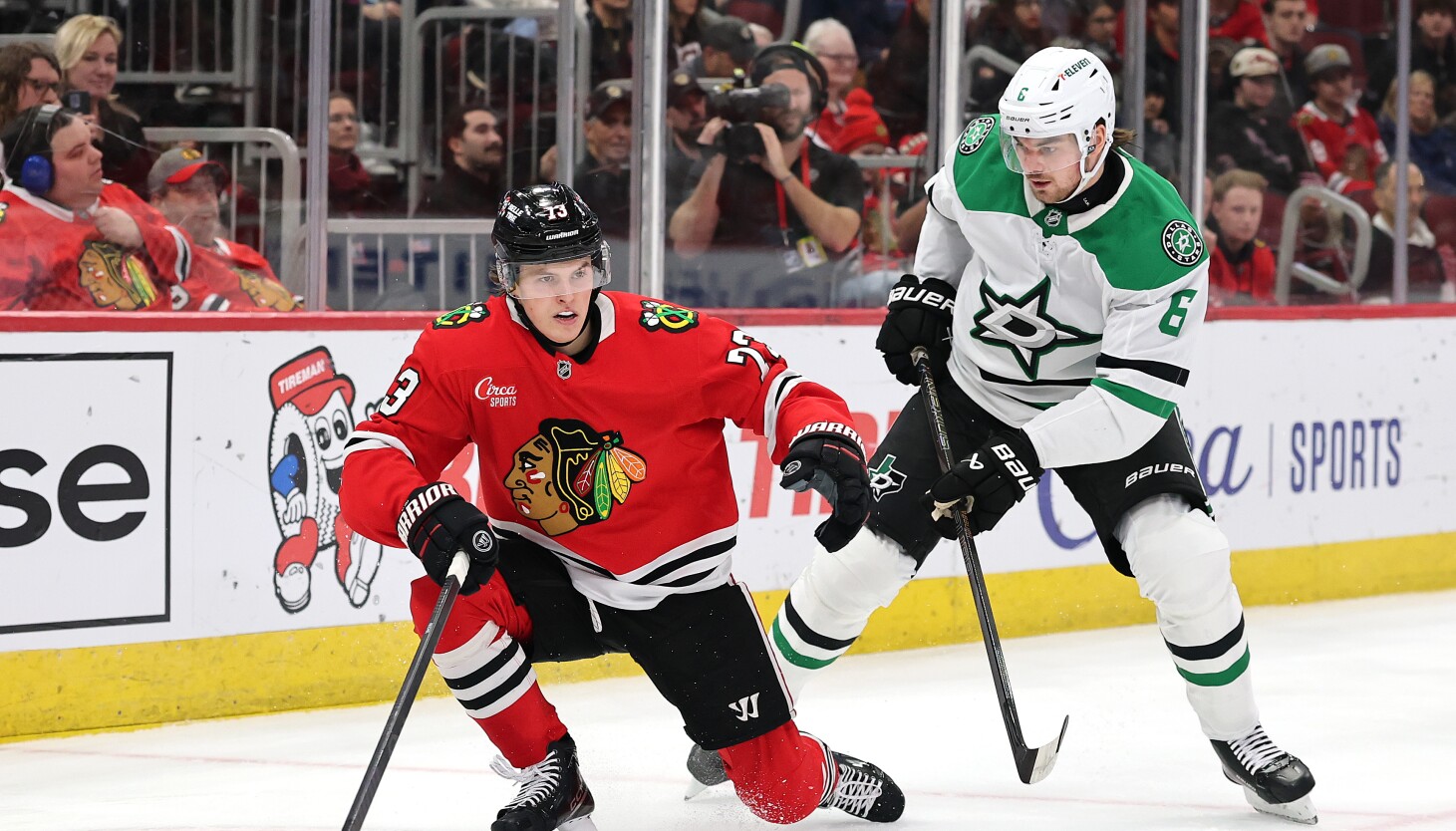
When Blackhawks forward Lukas Reichel returned home to Europe in April, there was no guarantee his return flight to North America this month would bring him back to Chicago.
Trade rumors were bubbling then, and they continued to do so throughout the summer. Despite staying off social media, Reichel found them impossible to avoid.
‘‘I heard from guys in Germany that I didn’t know knew hockey,’’ Reichel said recently. ‘‘They come up to me and say, ‘You’re going to go to Edmonton.’ I can’t do anything about it.’’
But now it is September, with training camp set to open next week, and Reichel remains with the Hawks. Plus, another change in coaching staffs — with Jeff Blashill now in charge — has given the 23-year-old former first-round pick another clean slate and opportunity to earn more playing time.
This is a back-against-the-wall season for Reichel in Chicago, especially with his contract set to expire next summer. He knows that. But at least he’s still in Chicago, and he thinks he’s prepared — at last — to take a big step forward.
‘‘Now I’m like, ‘Oh, my God, I just want to get started,’ ’’ he said. ‘‘It makes it even more motivating for me because you have one year and you just put everything into it. That’s why you try stuff with the training.’’
Three trainers
Trying stuff training-wise has been the theme of Reichel’s offseason.
In the past, he spent most of his summers at his familiar home rink with his familiar skating partners while training remotely with Hawks skills coach Brian Keane. It wasn’t the most innovative approach. This summer, he decided to push himself outside his comfort zone.
The highlights of his summer were a pair of two-week camps — one in Switzerland and one in Czechia — with skills coach Yanick Dube. He trained alongside new Mammoth forward JJ Peterka, whose trade rumors did come to fruition this summer, and Peterka’s former Sabres teammate Jack Quinn.
In between the camps, Reichel drove to Munich most days to continue skating with Peterka, Wild forward Marco Rossi, Red Wings forward Marco Kasper and other likely fixtures of Germany’s 2026 Winter Olympics team. (Reichel already has been named to the preliminary roster.)
Reichel also continued his usual remote offseason work with Keane and began remote work with Massachusetts-based skills coach Jon Lounsbury, Pat Maroon’s former trainer, who sent him more workouts.
‘‘If you practice with one [coach], he says, ‘You’ve got to do this, this and this,’ ’’ Reichel said. ‘‘But maybe the next coach says, ‘Try this,’ and that helps me more. Practicing with different coaches and against different players helps a lot.’’
Reichel loves to talk about trying to replicate certain things Lightning star Nikita Kucherov does, and he has talked similarly about Oilers star Leon Draisaitl in the past.
But replicating Peterka, who racked up 68 points for the Sabres last season, would benefit Reichel tremendously — and might represent a slightly more achievable goal. They’ve known each other since they were 8.
‘‘He was always a goal-scorer, and I see it every day in practice,’’ Reichel said. ‘‘With his release, he just knows how to score. We do lots of challenges. Like today, we played a three-on-two game [to see] who has more goals. It’s always competitive, and it makes it more fun for us.’’
Peterka’s output last season was 46 points more than Reichel had while stuck on the Hawks’ fourth line, averaging less than 12 minutes per game. His analytics improved marginally from his rough 2023-24 season, but they still weren’t great.
‘‘[Last season] was up-and-down,’’ Reichel said. ‘‘If you have a down game, you’ve got to learn from it. Then you feel better if it happens again. You know what to do. … Knowing you’ve been through it all…and how to handle it or how to try to stay positive, it definitely helps a lot.’’
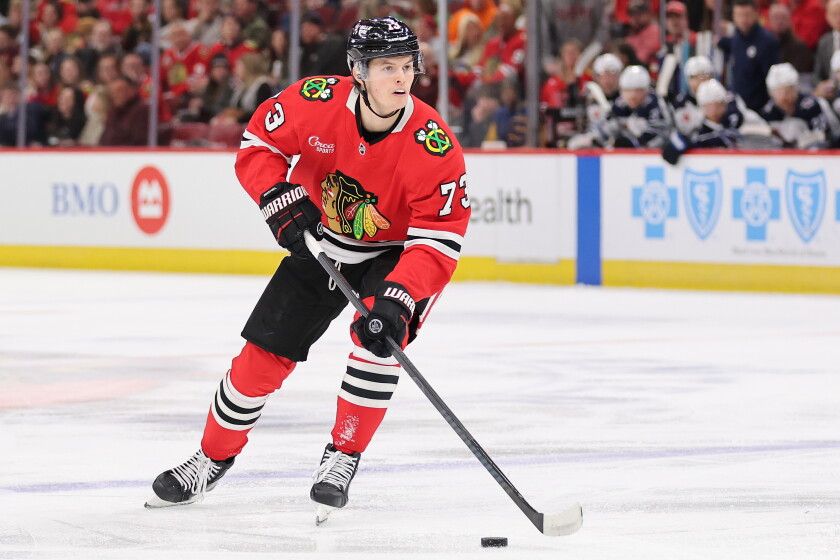
Skills coach Yanick Dube worked with Lukas Reichel on scanning the play earlier.
Michael Reaves/Getty Images file photo
Two focus areas
Reichel and Dube primarily focused on two things: Reichel’s vision when carrying the puck and his ability to win board battles.
Dube reviewed video of Reichel on the Hawks and noticed he often struggled to translate his elite skating and speed into tangible offense. That’s because opposing defenses usually funneled him toward the perimeter, and he lacked the skills to penetrate their structure.
‘‘Through watching his shifts, you can see if a guy had an idea of the play before he got the puck or if the guy was [only then] trying to read the situation,’’ Dube said. ‘‘At the NHL level, that’s often too late. He was missing plays or having problems beating guys.
‘‘We discussed that, and afterward we did some drills [about] where to look when a guy is on you — when his stick is on you, when you have less space to work with.’’
Dube talked with Reichel about the value of varying his speed, something the Hawks also have discussed with speedy prospects such as Oliver Moore. Sometimes it’s useful to slow down, either to give yourself more time to make a play or to make yourself less predictable to defenders.
Dube also taught Reichel how to be more deceptive in his skating, so defenses can’t easily anticipate where he wants to go.
‘‘It’s [about] trying to avoid the crossover or, if you do cross over, try not to point the toe in the direction you want to go,’’ Dube said. ‘‘Try to get [rid] of all the reads the ‘D’ could have on you. It’s [also about] weight-shifting, loading all your weight on one side to push to the other side.’’
Meanwhile, when the Hawks dumped (rather than carried) the puck into the offensive zone, Reichel — by far the fastest player on his line — was often the target last season, but he struggled to gather pucks cleanly off the wall.
Physical strength is important in those board battles, but body positioning is, too. Opening his hips wider, allowing him to twist within the defender’s pin and pivot out of it more easily, was one big emphasis.
‘‘Maybe the rim [around the boards] comes and the ‘D’ arrives at the same time, so there’s no chance you could do any deception skating,’’ Dube said. ‘‘You have to get the puck first, so you absorb that check or the ‘D’ pins you into the wall. We worked on different techniques to use your hands or your hips to get out of the pin.’’
Reichel and Dube hope these adjustments will enable him to better use his natural talent, which always has been there but hasn’t yielded much fruit.
‘‘If you look at the practice, it looks easy, but it’s more about reps,’’ Reichel said. ‘‘In a game, it’s different. But then you have the confidence in the game because you did it, like, 1,000 times in the summer.’’