
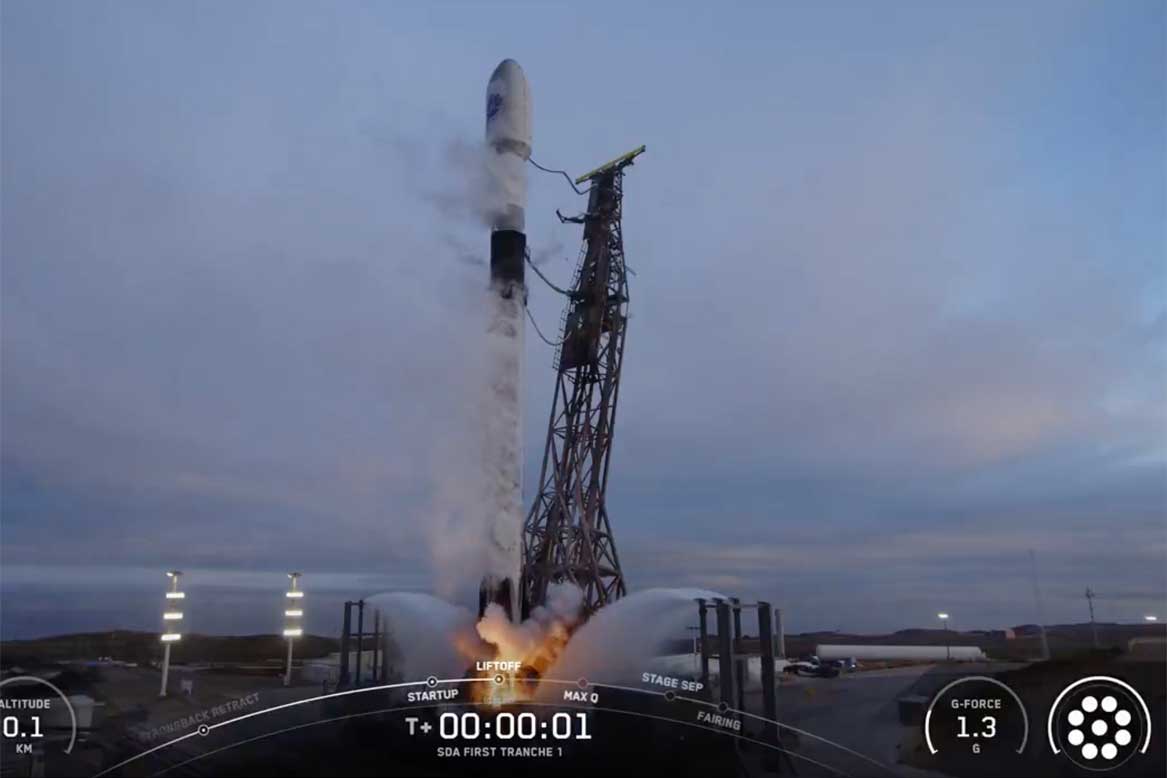
Ushering in a new era, a Falcon 9 rocket delivered the first batch for the military’s new generation of missile warning and communication satellites on Wednesday with nine similar missions planned in the next year from Vandenberg Space Force Base to complete the first phase.
The SpaceX rocket blasted off at 7:12 a.m. from Space Launch Complex-4. The rocket’s first-stage booster returned about eight minutes later to land on the droneship in the Pacific Ocean.
On board were the Space Development Agency’s first 21 operational satellites for the Tranche 1, designed to be a constellation of 154 satellites. Wednesday’s spacecraft will deliver data transport or improved communications in support of warfighters.
“We had a great launch today for the Space Development Agency, putting this array of space vehicles into orbit in support of their revolutionary new architecture,” said U.S. Space Force Col. Ryan Hiserote, senior materiel leader for Assured Access to Space’s (AATS) Launch Execution Delta.
The rocket deployed the satellites, built by York Space Systems, into an insertion orbit where SDA will begin test and checkout procedures, eventually raising the craft to the operational orbit approximately 621 miles high.
The Tranche 1 phase will require 10 missions including six launches for the transport craft and another four carrying satellites for the tracking layer as the military deploys the new network for improved data transport and tracking of advanced missile threats.
“Our planned cadence is about a launch a month going forward, approximately once a month,” SDA’s Acting Director Gurpartap “GP” Sandhoo said during pre-launch meeting with media.
Each satellite has a $14-million average price tag, according to SDA.
The second load of Tranche 1 satellites, a group built by Lockheed Martin Corp., could launch as soon as mid-October, he added.
The system is designed with a layered approach to provide additional capability and coverage with each new batch of satellites.
Of the 154 satellites making up Tranche 1, 126 are data transport craft with the remainder being tracking spacecraft. Tranche 1 also includes four other satellites to demonstrate missile-defense capabilities.
SDA was created in 2019 to develop spaced-based systems with an eye on speed while using existing technology as much as possible.
The system makes up what the military has dubbed the Proliferated Warfighter Space Architecture, or employing multiple small satellites instead of one large and complex craft that often took years to development.
“The start of Tranche 1 delivery, just over six years since SDA stood up as an agency, is a remarkable accomplishment highlighting the speed at which the agency moves,” Sandhoo said.
Along with developing the system’s satellites, other work involved creating ground control centers and other needs to support the constellation.
“There is a ton of effort that goes into building the satellites, developing the software and standing up all the ops facilities that are required to be ready for Wednesday,” said SDA’s Acting Deputy Director Mike Eppolito, also chief program officer. “(I am) incredibly thankful for the dedicated team we have that pulled this off.”
Two state-of-the-art SDA Space Operations Centers will operate the T1 constellation from Grand Forks Air Force Base, North Dakota and Redstone Arsenal, Alabama while a global network of ground entry points provide support
SDA’s Tranche 0 satellites previously launched from Vandenberg to demonstrate the new approach would work and provide lessons ahead of the operational satellites traveling to space.
That includes improving the time to test each satellites bus, or frame, plus the instruments once they arrive in orbit and dealing with supply chain issues.
“We’ve learned a ton from Tranche 0 so you’re going to see our bus checkouts go from months down to days on Tranche 1 so we’re excited to see that performance once we get on orbit,” Eppolito said.
Sandhoo said SDA has seen fewer problems as the program moved toward the Tranche 2 phase.
“I think we’ve always talked about having to build out the supply chain to do what SDA wants to do,” Eppolito said. “We always understood we would have some growing pains here as we got the supply chain up and operating.”
Following Wednesday’s launch, SpaceX plans another Falcon 9 rocket launch this weekend from Vandenberg to deliver Starlink satellites into orbit. That launch opportunity will take place between 8:41 a.m. and 12:41 p.m. as soon as Saturday.