
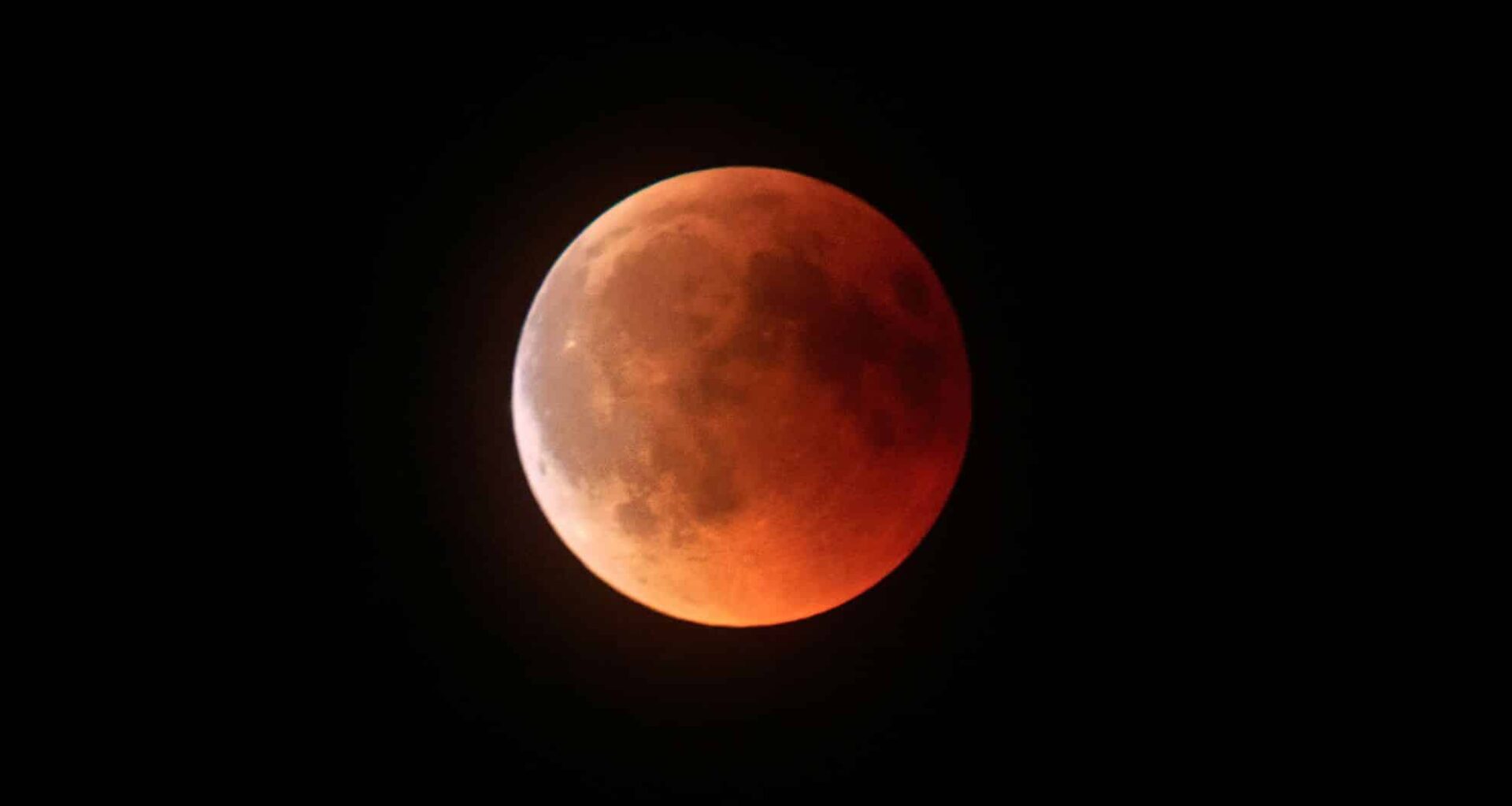
As 2025 approaches, skywatchers worldwide are preparing for a celestial event of breathtaking beauty: a total lunar eclipse set to occur on the nights of September 7 and 8. This event, which follows an earlier eclipse earlier in the year, is expected to last a remarkable 5 hours and 27 minutes, with the moon taking on an eerie reddish-orange hue, commonly known as a “Blood Moon.” According to Time and Date, the eclipse will be visible across several regions, including much of Asia, parts of East Africa, and Western Australia, offering a spectacle that will be enjoyed by over 60% of the global population. The specific details of this event have been documented by Time and Date, which has provided valuable information about the event’s timing and visibility in various regions around the world.
The Total Lunar Eclipse Explained: Why the “Blood Moon” Phenomenon Happens
A total lunar eclipse occurs when the Earth perfectly aligns between the Sun and the Moon, casting the moon completely into Earth’s shadow. Unlike a solar eclipse, where the moon blocks sunlight from reaching the Earth, a lunar eclipse causes the moon to darken and take on a striking reddish-orange glow. This color effect, often referred to as the “Blood Moon,” occurs because of the Earth’s atmosphere filtering sunlight, scattering shorter wavelengths (such as blue and green) and allowing longer wavelengths (such as red) to pass through and illuminate the moon.
In 2025, the total lunar eclipse promises to be the longest since 2022, with totality lasting 1 hour and 22 minutes. This extended duration allows skywatchers to fully appreciate the dramatic change in the moon’s appearance as it transitions from bright and white to an eerie, dark red. The phenomenon of the Blood Moon has fascinated astronomers and casual skywatchers alike for centuries, providing a rare but awe-inspiring opportunity to witness an event where the heavens seem to take on a darker, more mysterious hue.
Best Viewing Locations for the 2025 Total Lunar Eclipse
According to Time and Date, nearly 60% of the world’s population will have a prime opportunity to observe this total lunar eclipse from beginning to end. Regions such as Asia, East Africa, and Western Australia will enjoy full visibility of the eclipse, while other regions, including parts of Europe, Africa, and Australia, will witness at least some phases of the event, depending on cloud cover and local weather conditions. If you’re located in these regions, make sure to find a clear spot with minimal light pollution for the best possible experience.
For those in the United Kingdom, the eclipse will peak at 19:11 BST, although the moon will still be below the horizon at that time. The best visible phase will occur slightly later, at 7:33 p.m., when the moon will begin to emerge from Earth’s shadow. As the moon rises slowly from the Earth’s umbra and penumbra, the display will continue until 9:55 p.m., providing a prolonged period for observation. It’s important for viewers in the UK and similar locations to seek high vantage points with an unobstructed view to the east for the clearest and most immersive experience.
Limited Visibility for North America
Unfortunately, for most North Americans, this lunar eclipse will largely be out of view. The event occurs during daylight hours on the opposite side of the planet, meaning that the moon will be positioned too far below the horizon for most observers to see. The timing of the eclipse, combined with Earth’s rotation, makes it impossible for much of the United States, Canada, and Mexico to witness this lunar phenomenon.
That said, there is a silver lining for a small group of observers in Alaska. Due to its geographic location, Alaska will be able to catch the very beginning of the penumbral phase of the eclipse, when the moon first begins to enter the outer part of Earth’s shadow. This means that, while the full display will be missed, some Alaskans will still get to enjoy a portion of the celestial show. For most of the United States and Canada, however, it may be time to turn the focus to other celestial events, such as the solar eclipse scheduled for April 8, 2024, which promises a spectacular display for North American observers.
The Science Behind Lunar Eclipses: A Rare Celestial Alignment
Lunar eclipses are much rarer and less dangerous than solar eclipses, which require viewers to take special precautions to protect their eyes. A total lunar eclipse occurs when the Sun, Earth, and Moon align in such a way that the Earth completely blocks sunlight from reaching the moon. This creates a darkening effect on the moon’s surface, but unlike solar eclipses, lunar eclipses are safe to view with the naked eye.
During the 2025 total lunar eclipse, the Earth’s shadow will gradually move across the moon’s surface, creating a gradual shift in its color from bright white to a deep red. The time it takes for the moon to travel through the Earth’s shadow, and the degree of red coloration, can vary based on atmospheric conditions and the moon’s distance from Earth. The phenomenon has sparked centuries of awe and fascination, with ancient cultures interpreting these eclipses in various ways, often attributing them to supernatural events or omens.
How to Prepare for the 2025 Lunar Eclipse: Tips for Viewing
To fully enjoy the upcoming lunar eclipse, viewers should prepare in advance to make the most of this rare celestial event. First, it’s essential to check the exact timing of the eclipse in your location, as the event’s visibility can vary greatly depending on the time zone and geographical region. For those in the UK and other affected areas, planning to watch the eclipse from an elevated location with a clear eastern view will ensure a better experience. Similarly, those in areas with higher levels of light pollution should aim to find locations away from city lights for the most immersive view.
Additionally, while no special equipment is needed to watch a lunar eclipse, binoculars or a small telescope can enhance the view, especially when observing the finer details of the moon’s surface during the eclipse’s various phases. As with any celestial event, patience is key, as the eclipse will unfold gradually, offering a slow but mesmerizing transformation of the moon.