
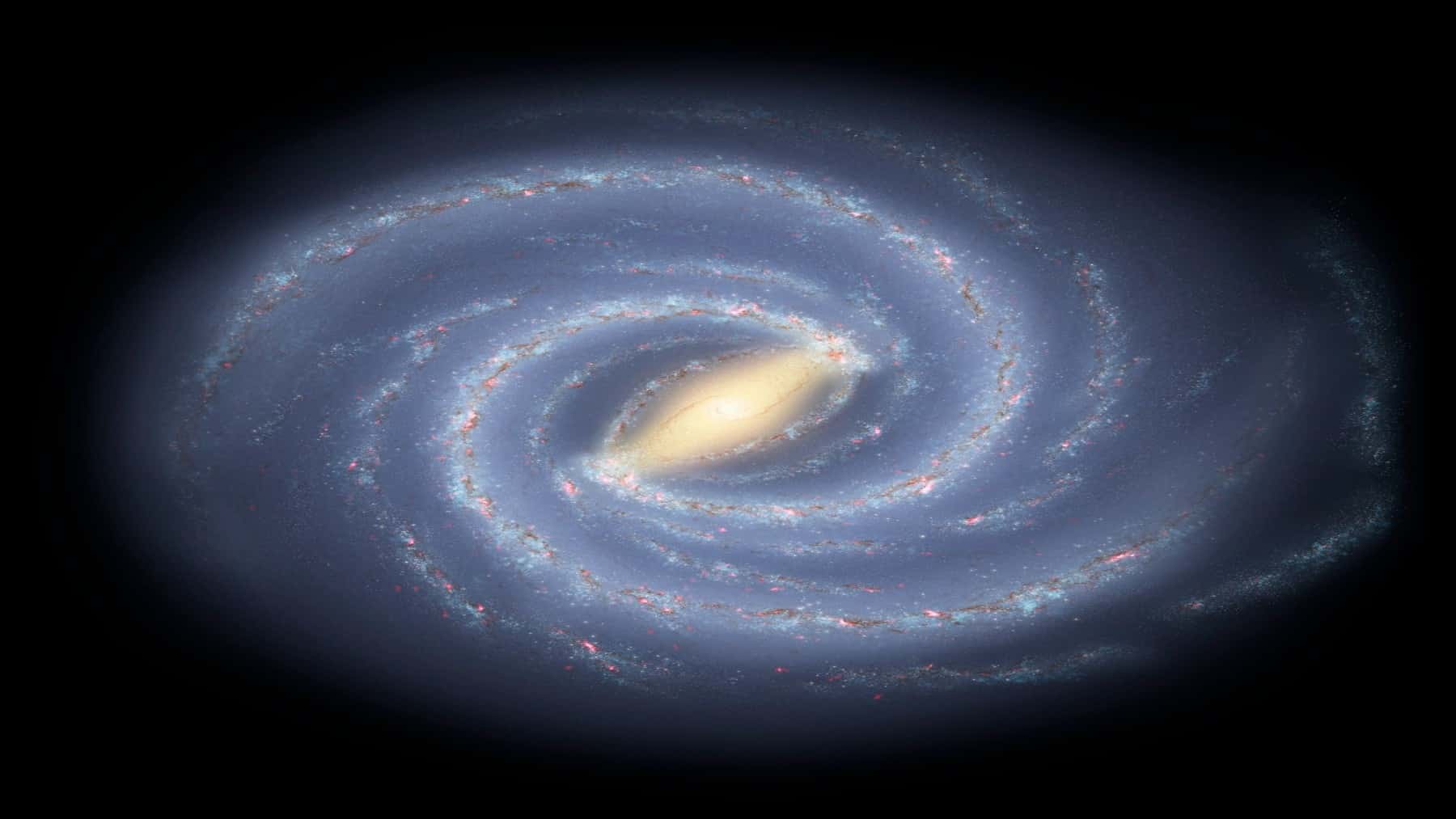
To a lot of people, 500 billion years seems almost impossible to conceptualize, let alone the actual reality where this might be happening. Specifics like the Hubble concept happening to the universe might also be extremely vague. Scientists have been able to substantiate claims about ‘universe rotation,’ that the universe might be spinning slowly and silently. But is this the reality? Let’s go!
History regarding universe rotation
As the universe is not as we thought, the topic of a rotating universe cannot hold water without tracing it back to the roots. One of the major roots is none other than Albert Einstein, the progenitor of the famous field equations of general relativity that expressly defined a rotating universe. This equation was later solved by the popular mathematician Kurt Gödel. His approach to the problem stemmed from the deduction that the universe is in a constant state of motion and the matter present in it was subject to a constant state of rotation, thereby causing a frame-drag effect.
Implications of Gödel’s solution and the effect on how we perceive the universe
Disrupting the foundation of time as we know it
According to Gödel, there is the existence of the phenomenon CTCs (closed timelike curves). The introduction of this concept completely disrupts the knowledge of time as we know it because the main idea of CTCs rests on the existence of time travel. And while time travel itself has been disproved several times, challenging the very fabric of what we consider normal is quite interesting!
Challenging the rule of general relativity
Before Godel put forward his solution to Einstein’s conundrum, the whole world was unanimously following his relativity theory. The examination of Godel’s equation allowed for Einstein’s equation on relativity to be thoroughly challenged.
Hubble tension and the new model
The Hubble tension refers to the discrepancy, specifically 10%, between two measurements of cosmic expansion, namely the supernova observation (late-time universe) and the cosmic microwave background (early universe). It is a persistent issue that cosmologists face.
We would not talk about the new model to solve the Hubble Tension crisis without talking about the University of Hawaiʻi (2025) proposal. A team of inspired and well-trained astronomers at this prestigious university, led by István Szapudi, published a study in MNRAS (March 2025) titled “Can rotation solve the Hubble Puzzle?”
They built and expanded the standard model by adding a very small rotational component to depict a very slow rotation of the universe.
Furthermore, Newtonian physics allows astronomers to accurately predict the trajectories and interactions of the motion of the planets, stars, and other celestial bodies. The new model for the Hubble Tension crisis is built primarily using Newtonian physics with a drizzle of excerpts from general relativity. Although a fully relativistic approach is still pending for it to become absolute.
It is important to note that the proposed universe rotation under the new model does not conflict with the current data we have pertaining to cosmological studies. In fact, it has been tweaked to align with pre-existing models for other rotating-universe models. The key features astronomers and observers are looking for include observational signatures, such as polarization patterns. To set the record straight, the universe is not rotating around some object in space, nor is it orbiting an external structure. A better way to put it would be “a global spin of space.”
The concept of universe rotation is a fascinating hypothesis, and much like this mysterious cosmic phenomenon that challenges our current understanding of cosmology, its potential implications are transformative. The next phase of substantiating the rotating-universe model is leveraging the power of technology and advanced computer superchips to simulate a more accurate version of the rotating-universe model.