
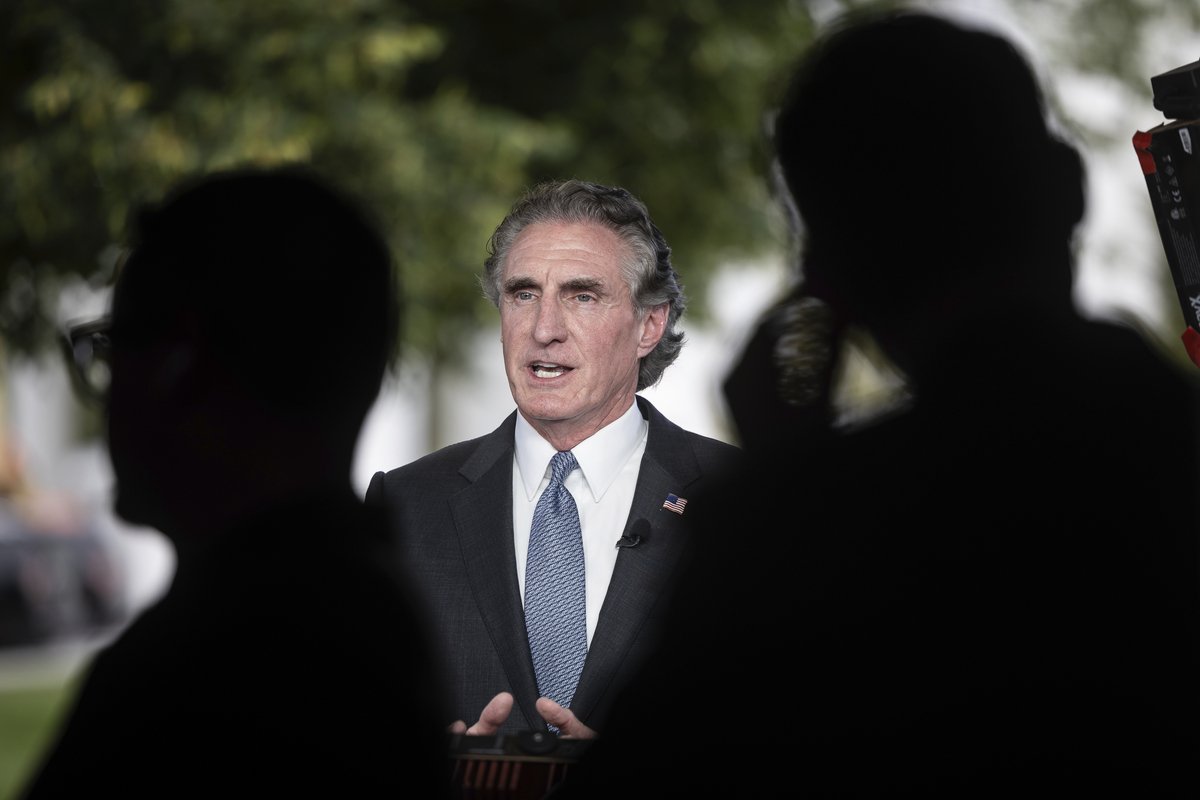
Interior Secretary Doug Burgum said Wednesday that the risk of losing the global race to develop artificial intelligence is a bigger “existential threat” than climate change.
Burgum’s comments came as he promoted a sweeping expansion of fossil fuels to power the wave of data centers that are needed to run AI technology. He also crystallized the political favoritism that President Donald Trump exerts toward coal and natural gas at a time when his administration has halted construction on offshore wind projects, a large source of electricity that has been thrown into disarray even as the nation’s thirst for energy surges.
“What’s going to save the planet is winning the AI arms race. We need power to do that, and we need it right now,” Burgum told reporters on the sidelines of Gastech, a major natural gas industry conference held this year in Italy.
Burgum echoed other administration officials, and the president himself, in dismissing the risks posed by rising temperatures, including intensifying heat waves that contribute to the death of hundreds people annually in the U.S. Burning fossil fuels has increased global temperatures by at least 1.2 degrees Celsius over the past 150 years, according to the scientific community.
“The real existential threat right now is not a degree of climate change,” Burgum said. “It’s the fact that we could lose the AI arms race if we don’t have enough power.”
“I’m worried about the next generation, but that’s all solvable,” he added, referring to rising temperatures.
Energy Secretary Chris Wright, who spoke alongside Burgum, has also downplayed the dangers of global warming and described efforts to address it as “silly.” He and Burgum were at Gastech to promote U.S. natural gas, which he said is “the fastest growing source of energy on the planet.”
AI technologies use vast quantities of electricity and data to generate original texts, music, images and video. Trump — whose reelection campaign was largely bankrolled by Silicon Valley billionaires — has issued a series of executive orders to remove regulatory hurdles for the technology, which he claims has “the potential to reshape the global balance of power, spark entirely new industries, and revolutionize the way we live and work.”
At the same time, the Trump administration has halted construction of nearly completed offshore wind farms, canceled a $4.9 billion loan guarantee for a grid upgrade, and clawed back a $20 billion fund meant to bring renewable energy to low-income communities. Those projects could have added new sources of energy to the grid or made it easier to move electricity across state lines.
The attacks on climate science and clean energy have infuriated advocates who say if the administration wanted to prioritize winning the AI race, it should be adding all new sources of affordable electricity.
“It’s one thing to argue that American energy dominance supersedes climate concerns, or that we need an all-of-the-above energy strategy that doesn’t pick clean energy sources as favorites,” said Jesse Jenkins, a Princeton University professor and climate modeler, in an email. “But the Trump Administration and Secretary Burgum are going far beyond that. They are actively blocking cost-competitive, ready-to-deploy American energy resources to suit their own political or ideological predilections.”
He called the moves by the administration to throttle clean energy “the single biggest threat” to America’s ability to shape the future of AI.
“It is truly hard to fathom how we win the AI race if the Trump administration continues to block the fastest-growing and most cost-effective sources of new American electricity,” Jenkins said.
Eric Gimon, a policy adviser with the climate policy think tank Energy Innovation, echoed those comments.
“Even if you weren’t thinking about climate change, the clean resources are the fastest, cheapest, easiest resources to deploy right now. So if your priority right now is speed to power, that’s where you should be focused,” he said.
A spokesperson for the Interior Department, Aubrie Spady, did not respond to questions about how the technology race presents existential threats to people, or why the administration is canceling clean energy projects if new sources of power are key to winning.
“Clearly you have not been paying attention to the energy and or AI conversation that is happening in this country with your sensational and ill-informed questions,” Spady said in an email. “Winning the AI race against China is critical to America now, and for generations to come. Secretary Burgum has and will continue to underscore the importance of reliable, affordable power and America’s leadership in innovation and national security. If you can’t understand the importance of America winning the AI arms race you probably shouldn’t be reporting on this issue.”
Orders for natural gas turbines currently face a yearslong backlog, meaning the kind of new power plants that Burgum said are critical to the AI race could take years or even decades to build and bring online.
Some industry executives and associations have also expressed concern about the Trump administration’s restrictions on certain forms of energy.
The chief executive of NextEra Energy, John Ketchum, said at a POLITICO Energy Summit in June that the anticipated surge in power demand over the next 20 years could make the country vulnerable to energy shortages and reliability problems if “we take renewables off the table.”
Aaron Bartnick, who worked on technology policy in the Biden White House, argued that the Trump administration’s energy actions don’t match its AI rhetoric.
“If you believe that the AI competition is existential and winning it requires producing an unprecedented amount of energy, then you should be pursuing an all-of-the-above energy policy, which includes yes more oil and gas, but also more of everything else,” said Bartnick, a who is now an energy policy fellow at Columbia University.
The nation would be better served in the AI race if the Trump administration followed the policies Burgum pursued as governor of North Dakota, Bartnick argued. While it’s the third-largest oil-producing state, North Dakota also generates 40 percent of its electricity from wind and other renewable energy sources, according to state data.
The race for power
The U.S. Energy Information Administration has reported that wind, solar and batteries accounted for more than 80 percent of new generation in 2024 and forecast that renewables would be 81 percent of new capacity in 2025.
Trump’s attacks on clean energy have already led to project cancellations. An August report by Climate Power, an environmental advocacy group, found that nearly 14,000 megawatts of planned energy generation have been lost this year due to project cancellations or delays.
“The Trump administration has done everything in [its] power to forfeit the energy arms race to China,” said Jesse Lee, senior adviser at Climate Power. “And if you forfeit the energy race, you’re forfeiting the AI race.”
Growing the country’s AI capabilities is one way of competing with China, Trump said earlier this year during a speech to the World Economic Forum in Davos, Switzerland, where he called for a doubling of energy to make AI “as big as we want to have it.”
He said his plans to unleash fossil fuels and scrap environmental regulations would make the U.S. “the world capital of artificial intelligence and crypto.”
China has been pouring massive amounts of money into manufacturing clean technologies such as solar, wind and nuclear power. It’s hoping to harness that energy to power its own AI ambitions.
The country will require, under new renewable energy targets for industry, that new data centers in national hubs use clean power to meet 80 percent of their electricity needs, according to a note from the National Development and Reform Commission in July.
That’s leading to a split in how the world’s two largest economies are using energy to support AI, noted a brief from Energy Intelligence, a consulting firm that said the U.S. under Trump “is prioritizing speed of adoption by fully embracing fossil fuels and low regulation,” while China “is aligning the pursuit of AI with its quest for dominance of the low-carbon economy.”