
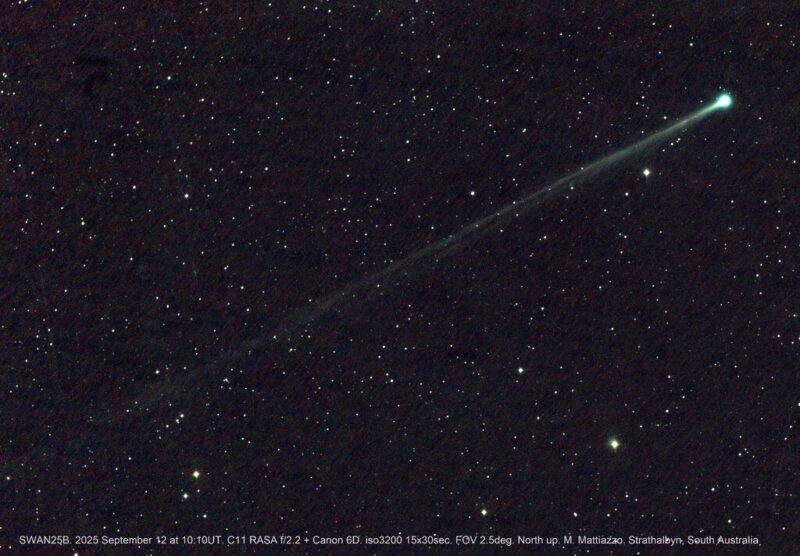
 View larger. | Australian comet expert Michael Mattiazzo captured this image of the new comet SWAN25B on September 12, 2025. Used with permission.
New Comet SWAN25B soars into the sky
There’s a new, fairly bright comet in the sky, and it was just discovered on Friday, September 12, 2025. The Solar Wind Anisotropies (SWAN) instrument on the SOHO spacecraft detected it. And it’s relatively bright (as comets go), shining at around magnitude 7.4. That’s not bright enough to see with the eye. But it’s bright enough to detect using binoculars, or a camera with a 200-mm lens.
Right now the comet appears among the background stars of the constellation Virgo. Its trajectory is currently under analysis. So it’s too early to determine if the comet will get brighter or fade, but good news is observers in the Northern Hemisphere might be able to get a glimpse of the comet, as it will gradually move away from the area where we see the sun. At the moment, it’s best positioned for observers in the Southern Hemisphere. Because it’s so close to the sun, it will be tricky to spot. Check out the finder map below.
The reported exact location in the sky at discovery was right ascension (RA) 13 08.5 and declination (DEC) -09 10.
SWAN25B is the comet’s temporary name until an official name is designated by the International Astronomical Union.
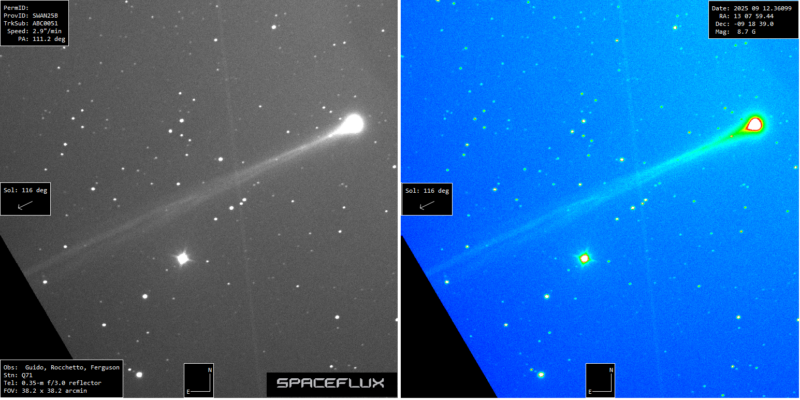 Comet SWAN25B is already shining (relatively) brightly, though it’s close to the sun. Image via E. Guido/ M. Rocchetto/ J. Ferguson/ Spaceflux/ X. Used with permission.
A finder map for comet SWAN25B
Want to see comet SWAN25B for yourself? You’ll need a clear view to the western horizon after sunset. Look west after sunset in the direction where the sun has just disappeared. If you can find Mars, the comet is currently just below Mars. The comet will be passing below Mars and above Spica in Virgo. You’ll want to use optical aid.
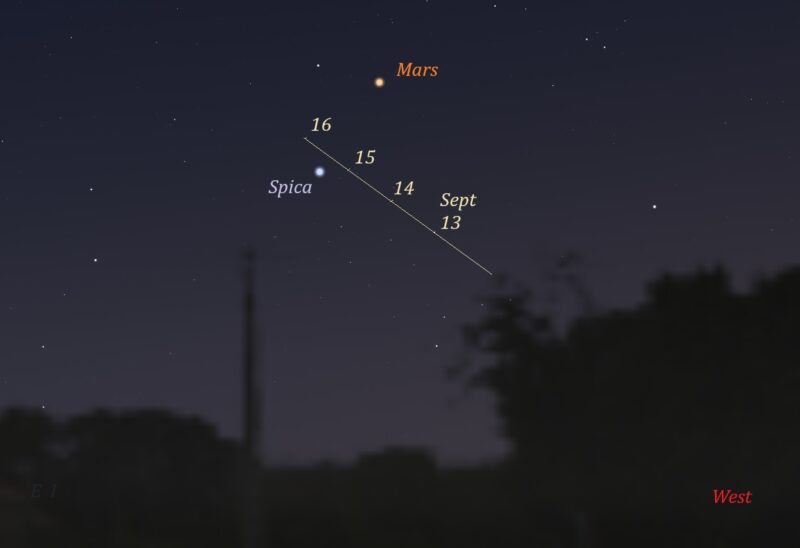 Here’s a finder chart for comet SWAN25B. Look west after sunset. The comet will be passing between Mars and the star Spica in Virgo in mid-September. You’ll need to use binoculars. Image via Eddie Irizarry/ Stellarium.
Observations of the new comet
Comet hunter Vladimir Bezugly detected the new comet in recent SWAN images. Meanwhile, comet astrophotographers are capturing nice images of the new celestial visitor. Comet expert Michael Mattiazzo said:
I was able to visually see it this morning (September 12) using 15 x 70 binoculars from Australia.
Martin Mašek of the Institute of Physics of the Czech Academy of Sciences, at the Cherenkov Telescope Array site near Cerro Paranal, also confirmed the new comet on the ICQ Comet Observations Facebook page. Mašek said:
I was very pleasantly surprised by such a bright comet with a long tail. I originally expected to be searching for a small, faint patch.
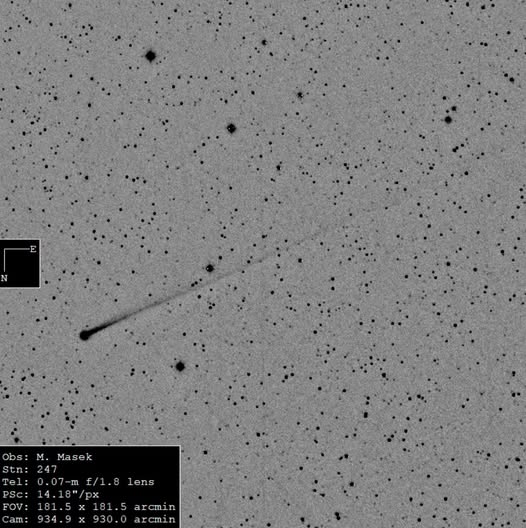 Martin Mašek of the Institute of Physics of the Czech Academy of Sciences at the Cherenkov Telescope Array in Chile captured this image of comet SWAN25B. Image via ICQ Comet Observations.
So why haven’t we seen this bright comet before now? The new comet was apparently behind, or too close to the area where we see the sun, and perhaps has appeared just after its perihelion. However, scientists are still comparing observations of the comet to determine its exact trajectory.
This is a developing story, so stay tuned for updates!
Bottom line: A new comet is now visible not far from the setting sun. Comet SWAN25B is already bright, though its location will make it a challenge to observe.
Eddie Irizarry
View Articles
About the Author:
Eddie Irizarry of the Sociedad de Astronomía del Caribe (Astronomical Society of the Caribbean) has been a NASA Solar System Ambassador since 2004. He loves public outreach and has published multiple astronomy articles for EarthSky, as well as for newspapers in Puerto Rico. He has also offered dozens of conferences related to asteroids and comets at the Arecibo Observatory.
Asteroid 33012EddieIrizarry, a 7.8 km space rock, has been named in his honor.