
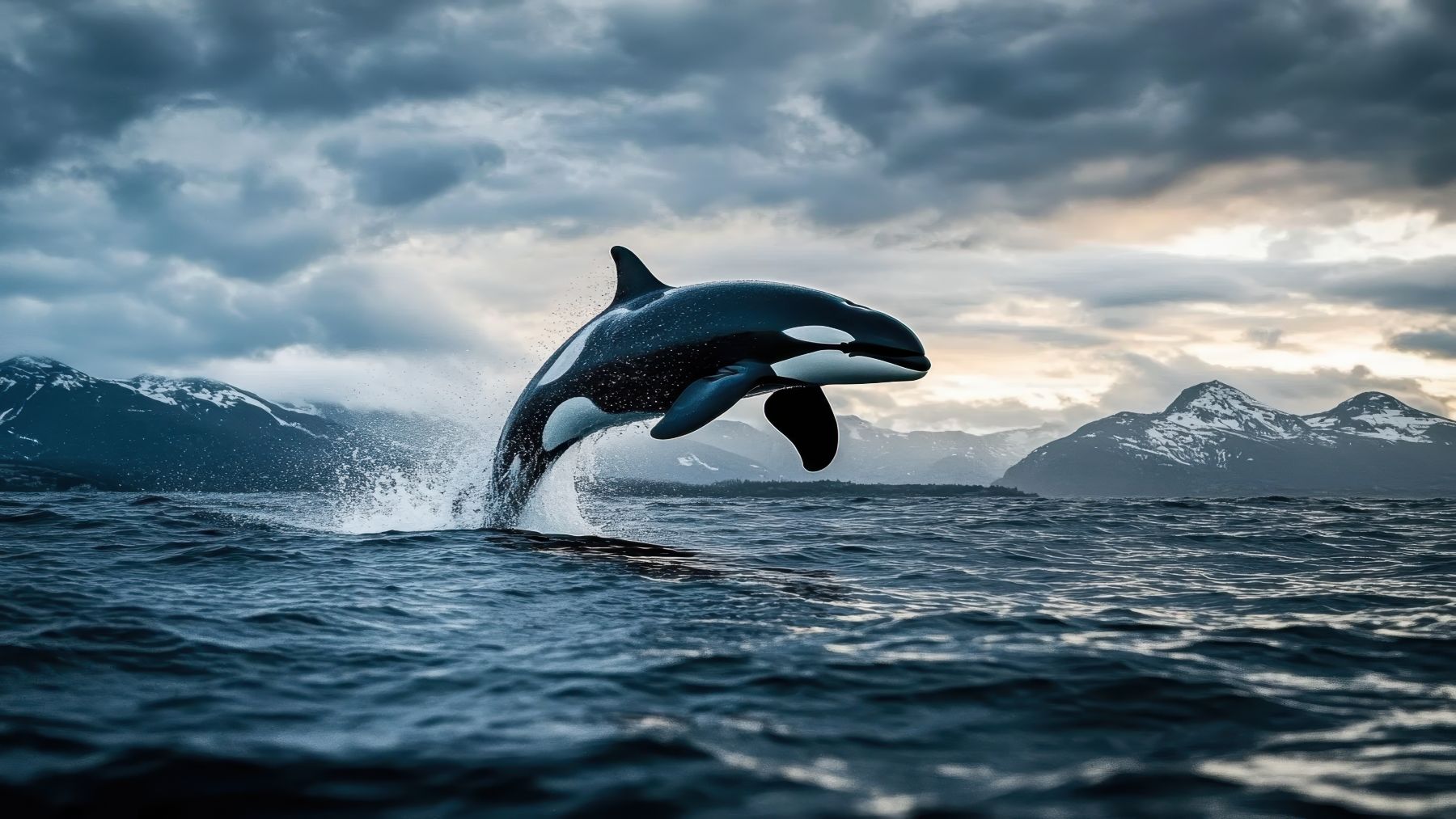
The evolution of species is a subject that continues to be studied because every so often, new data is discovered that sheds a little more light on the life of certain species on Earth. Dolphins and whales are mammals that formerly lived on land and evolved to become aquatic animals. A study has settled the question of whether these animals could evolve in reverse. It all stems from Dollo’s law, which states that an organism or being cannot undergo “reverse evolution.” That is, once it has undergone such a significant change through evolutionary processes, it cannot revert to its original form.
Study clarifies that whales and sirenians never leave the water
Evolutionary processes dictate that, in this case, the limbs that enable walking do not simply revert after years as an evolutionary process. A study, published in Proceedings of the Royal Society B (12 July 2023), clarifies that whales and sirenians never leave the water, while lineages e.g., pinnipeds and sea otters still move around and maintain limited terrestrial locomotion.
“We interpret these patterns as a result of thermoregulatory constraints associated with the high thermal conductivity of water”
“In lineages transitioning to aquatic realms, including semiaquatic ones, we observed a consistent trend toward increased relative body mass and a significant association with a more carnivorous diet,” the researchers say of their findings, adding, “We interpret these patterns as a result of thermoregulatory constraints associated with the high thermal conductivity of water, leading to increased body mass consistent with Bergmann’s rule and a prevalence of more nutritious diets.”
Once lineages cross into the fully aquatic state, changes are functionally incompatible with walking
This is important because once lineages cross into the fully aquatic state, their forelimbs transform into flippers, spines and tails become propulsion systems, and body plans strengthen for thermoregulation—changes that are functionally incompatible with walking, if they become terrestrial again.
“The reduced legs in some marine tetrapods and their inability to walk is thought to follow Dollo’s Law”
“Technically, these transitions are either irreversible or just extremely unlikely to be reversed, but for simplicity,” say the researchers, explaining that they will call this a simply ‘irreversible’ transformation. “We will refer to them hereafter as irreversible. For instance, the reduced legs in some marine tetrapods—and, consequently, their inability to walk—is thought to follow Dollo’s Law.”
Bergmann’s rule describes a consistent pattern of increased body size in homeotherms associated with high latitudes
Another question that may arise is the size of the animals. Dolphins, and especially whales, are gigantic animals. Bergmann’s rule describes a consistent pattern of increased body size in homeotherms associated with high latitudes or cold regions, a process that is likely related to lower relative heat loss in larger animals, the study explains. Experts suggest a similar pattern can be expected in aquatic lineages, since the high heat capacity of water increases relative heat loss in aquatic animals compared to terrestrial ones.
The authors analyzed a global dataset of 5,635 extant and recently extinct mammals
In fact, relative to size, what makes dolphins and orcas such effective hunters is precisely their streamlined bodies, teamwork, and diets adapted to marine prey. For this study, the authors analyzed a global dataset of 5,635 extant and recently extinct mammals and found that fully marine lineages haven’t transitioned back to land-capable forms.
The experts explain that among the 5,635 species collected, 96.7% (5,449 species) are fully terrestrial, while semi-aquatic and fully aquatic species represent only 3.3% (186 species) and are distributed across eight different orders. With this data, the conclusions are clear: “Our analyses using phylogenetic comparative methods found strong statistical support for a scenario in which aquatic adaptations become irreversible after a threshold.”