
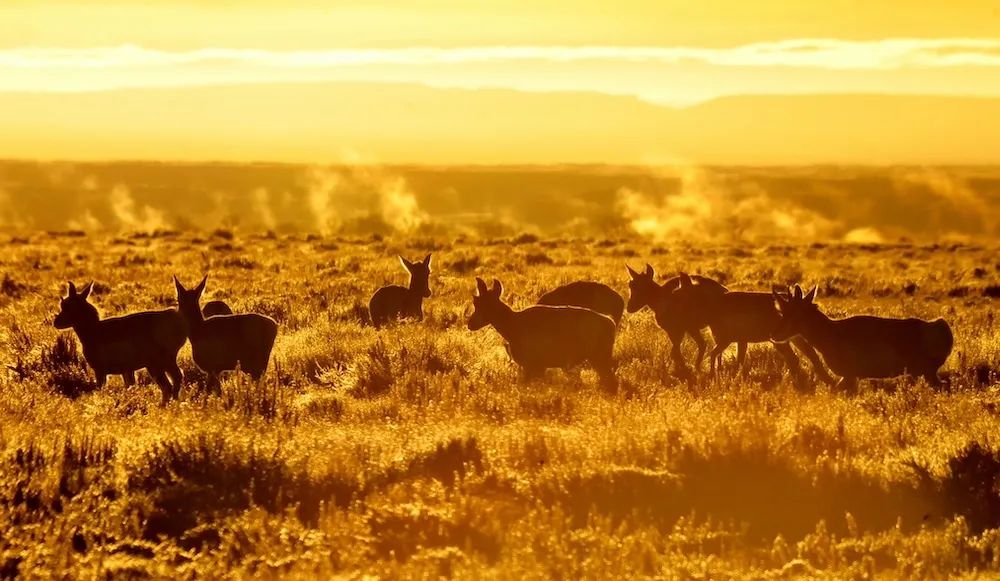
by Mike Koshmrl, WyoFile
After a four-hour discussion about nixing protections for two portions of a famous pronghorn migration that weaves across the Green River Basin, the Wyoming Game and Fish Commission reversed course to formally designate the route in its entirety.
“With 20 years of science, data and the vast support of the public, I believe this should move forward to the next stage,” Commissioner Ken Roberts, who made the motion, said at Wednesday’s meeting in Lander.
In the moment, the court clerk from Kemmerer didn’t say much about why he wasn’t going with Game and Fish’s recommendation to not designate two of the 10 segments of the Sublette Pronghorn Herd’s migration. That had come much earlier. Roberts jumped in to share his doubts shortly after the Wyoming Game and Fish Department’s Jill Randall and Martin Hicks presented their agency’s proposal.
“I can’t see where it hurts anybody,” Roberts said of leaving the migration intact. “I’m just kind of mystified.”
 Game and Fish Commissioner Ken Roberts discusses pronghorn during a September 2025 meeting in Lander. (Mike Koshmrl/WyoFile)
Hicks, the state’s deputy chief of wildlife, reasoned the threats to pronghorn moving through the Red Desert and “East of Farson” segments didn’t rise to a level that warranted protection under Wyoming’s policy, which is being taken for its first spin nearly six years after it was revamped in response to industry concerns.
“There’s no bottlenecks, and the threat levels were limited — that, to us, precluded designation,” Hicks said.
He also explained there was a lack of “high-use” habitat in the two segments. That’s the designation for areas used by greater than 20% of collared pronghorn.
But there was another unspoken factor at play that partly explained why Roberts was skeptical and why most seats were filled for hours at the Lander Community and Convention Center.
The Wyoming Stock Growers Association’s lobbyist, Jim Magagna, renowned for his influence in Wyoming politics, has a ranch in the vicinity, and he’d asked that the two segments be removed, while also noting that his land and grazing lease locations had nothing to do with the request.
 Jim Magagna, executive vice president of the Wyoming Stock Growers Association, explains his position about pronghorn migration corridors at a September 2025 Wyoming Game and Fish Commission meeting in Lander. (Mike Koshmrl/WyoFile)
On Wednesday, Maganga told commissioners his concern with including the two segments had to do with the sheer size of the migration corridor — at 2.6 million acres, it’s larger than Yellowstone National Park.
“That’s going to build opposition to the whole concept of the executive order,” Magagna said. “It’s the lumping of everything together, that is our major concern.”
There were other concerns aired as well. Oil and gas industry representatives shared doubts about the need to advance a new layer of habitat protection for a migration path that cuts across the Pinedale Anticline, Jonah and Normally Pressured Lance gas fields. Steve Degenfelder, a Casper-based landman for Kirkwood Oil and Gas, told the governor-appointed commission that the Anticline alone had generated $2.75 billion in education funding.
 Landman Steve Degenfelder, of Kirkwood Oil and Gas, details his opposition to designating a pronghorn migration corridor in the energy-rich Green River Basin at a September 2025 meeting in Lander. (Mike Koshmrl)
“Twelve-thousand, eight hundred and sixty-five Wyoming students had their entire K-12 education made by one project,” he said.
Repeatedly through the morning, commissioner John Masterson asked commenters for input on how the Game and Fish Commission should balance its mission — “conserving wildlife and serving people” — with “perfectly legitimate” social and political considerations. The question was posed to Degenfelder, too.
“Your initiative should be towards wildlife,” Degenfelder said.
The sentiment was a theme of almost all the other public comments. Retired biologists, recreational hunters and bunches of professional conservationists had a unified message in urging the seven-person commission to designate all 10 segments of the Sublette Pronghorn Migration. It’s among the largest and the best studied pronghorn populations in the world, and Brock Wahl of the North American Pronghorn Foundation worried about the repercussions of inaction or getting the designation wrong.
“If we can’t get it right in this particular instance,” he told commissioners, “I feel as if it sets a very bad precedent for anything going forward.”
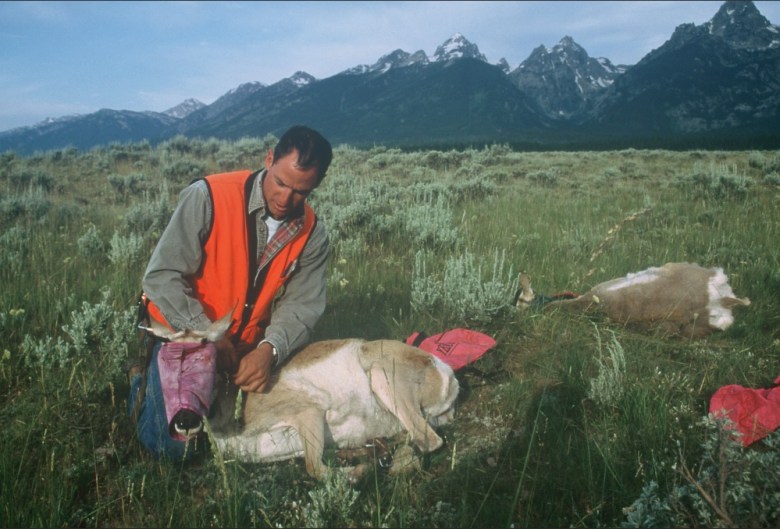 Wyoming ecologist Hall Sawyer fits a tracking collar onto a migratory pronghorn near the Tetons in 1998. Twenty-seven years later, state wildlife managers are pressing to designate the pronghorn herd’s migration path. (Mark Gocke/Wyoming Game and Fish Department)
Meghan Riley of the Wyoming Outdoor Council emphasized the sheer number of pronghorn migrating through the segments at risk of being axed. There are about 5,000, she said, far more than traverse the famous Path of the Pronghorn and punch through all the way to Jackson Hole.
“It would be a mistake to discount the significance of this segment to the population as a whole,” Riley said. “Accessing summer range matters to animals’ survival just the same, whether that animal travels 165 miles or 30 miles.”
Todd Guenther, a Lander archaeologist, joined the chorus in calling for the commission to designate the entire migration. Pronghorn are “fragile,” he said, and in need of “proactive” care.
“Too many times over my life, since I was a kid, wildlife [has] become a sacrificial lamb for different types of development projects,” Guenther said. “We’re running out of opportunities to preserve these different forms of wildlife.”
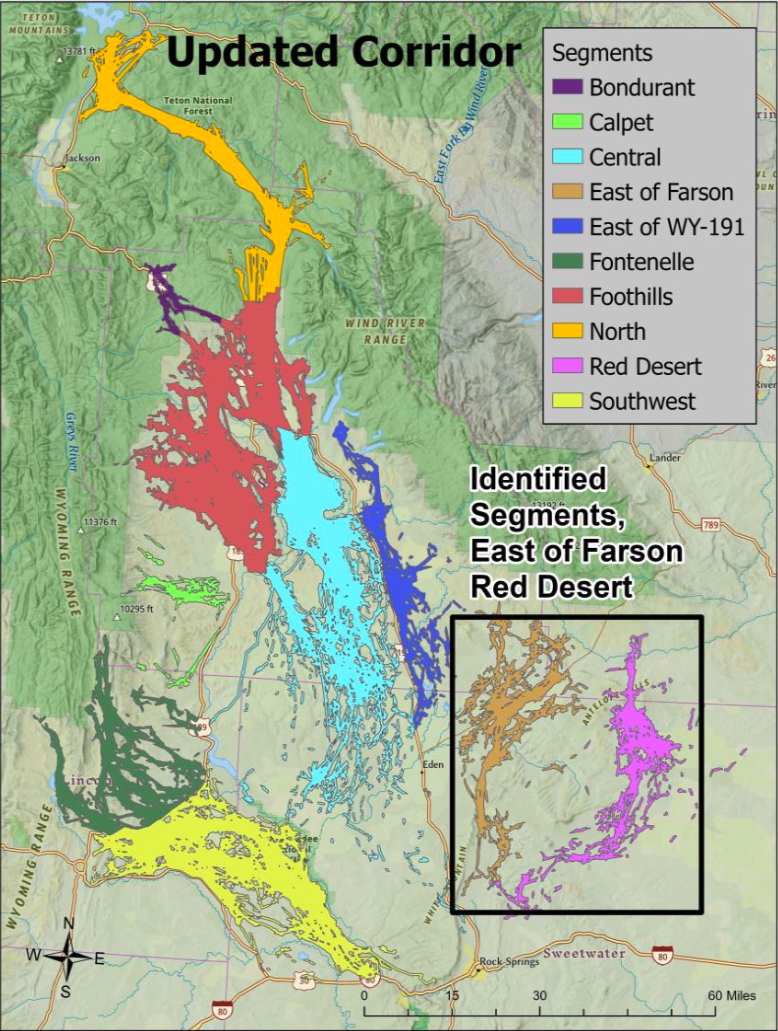 The Wyoming Game and Fish Department’s plan to not designate two southeast segments of the Sublette Pronghorn Herd’s migration corridor, illustrated in this map, was denied by its commission at a September 2025 meeting in Lander. (WGFD)
Because of housing sprawl and industrial development, Sublette Pronghorn Herd’s migrations are at “high risk” of being lost, according to an earlier Game and Fish analysis. In a later phase of the years-long process, the public came out in strong support of taking action and deploying Wyoming’s migration policy for the first time. Nearly 99% of the 530 comments the state agency received asked for designation, according to data Randall, with Game and Fish, presented in the meeting.
Game and Fish Commissioner Rusty Bell, of Gillette, cited the volume of public support as he explained why he was supporting Roberts’ motion to designate all 10 migratory segments used by the Sublette Pronghorn Herd.
“I think people want to see designation,” Bell said. “I’m going to go along with what the people have said.”
Unanimously, the other six commissioners made the same call. The Game and Fish Commission’s decision to buck its department’s proposal was “not unexpected,” Magagna told WyoFile after the vote.
“I respect their decision,” he said. “We’ll go along to the next step and be engaged there.”
Next up in Wyoming’s labyrinthine designation process, Game and Fish’s migration proposal will go to Gov. Mark Gordon. If the governor finds it favorable, he’ll then appoint an “area working group” to review the migration. That will include representatives for each county that the corridor cuts through and a number of stakeholders — at least two will represent agriculture.
This article was originally published by WyoFile and is republished here with permission. WyoFile is an independent nonprofit news organization focused on Wyoming people, places and policy.
Related