
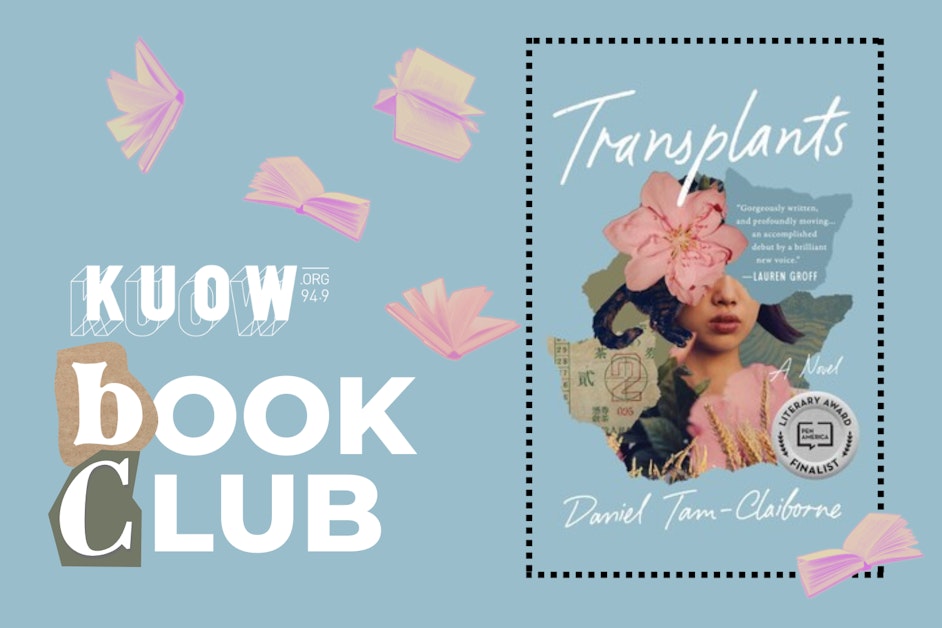
The KUOW Book Club is reading Danial Tam-Claiborne’s “Transplants” this month. I’m your reading guide Katie Campbell. Let’s get into the first half of the book.
T
he same word comes up as we are introduced to the two main characters in “Transplants”: biantai. “Off,” Tam-Claiborne clarifies as our Chinese American friend Liz tries to make excuses for her white male colleagues at the college in China where they’re teaching English.
Even though she spoke Mandarin with her mom growing up, her vocabulary was limited, and it took considerable effort to read characters. She looked at the guards, whose faces contorted as she spoke, the familiar shame rising in her chest. It was bad enough she couldn’t be taken seriously as a native English speaker. But she didn’t expect that people would sooner choose to believe she was born biantai — off — than entertain the possibility that someone with her face could have learned Mandarin as a second language.
TRANSPLANTS, PAGE 29
Such is the nature of both Liz’s and her counterpart Lin’s struggle in the book. Neither seems to fit in wherever they go, whoever they try to be.
Liz grew up in the States after her parents left China, and Lin grew up in China with more of an affinity for English and animals than her own native tongue or peers. They’re alike in the ways they’re different, highlighting the core theme of “Transplants” with crystal clarity. Identity, Tam-Claiborne makes clear, is not only in our own concept of ourselves but also in how others see us — whether they’re right or wrong.
RELATED: Subscribe to the KUOW Book Club newsletter here
That would be enough to deal with for these young women. Liz is a recent graduate teaching English in China, and Lin is a college freshman at the school where Liz and several other Americans teach. Both are farther from home than they’ve ever been, and both feel a deep loneliness that’s exacerbated by others around them.
And they meet under less than ideal circumstances.
In her desperation to be understood and valued, Lin falls for her English teacher, Travis. They begin a sexual relationship that, from Lin’s view, seems genuinely lovely. Then, the reader is thrust into reality when we see the relationship from the perspective of Liz:
Travis never described his relationship with Lin as anything remotely romantic. He preferred the term language partner, invoking the words anytime he knew Lin would be coming over. Liz marveled at the lengths he went to avoid being seen with her in public. Whenever Jim or Collin [the other American English teachers] brought Lin up, he would change the subject. At group hot pot dinners, when they bragged about the girls they’d fucked at Florida State, Travis would laugh, and Liz quietly drowned her vegetables in a bowl of sesame sauce.
TRANSPLANTS, PAGE 31
(Side note: As a University of Florida alum, I must say it just makes sense to me that the jerks Jim and Collin are FSU grads. But I digress.)
Talk about biantai. The vibes were already off early on.
But, of course, things get worse. I want to try to avoid spoilers, but it’s hard not to mention the arrival of the third major character of sorts in “Transplants” — Covid-19.
The pandemic arrives suddenly in the novel, much like it seemed to do in real life. The tension that seemed to lurk in the background from the start of the book hurtles into full view, taking the predicaments in which both Liz and Lin find themselves out of their hands.
The lockdowns and strict precautions that follow the swift spread of the virus thrust Liz into a relationship of her own, with a man she met on vacation, Stephen. He’s a good sport about the whole thing, welcoming Liz into his home even though they hardly know each other. But as many of us know, having lived through the pandemic, even the most committed relationships were put to the test. Liz and Stephen’s is no different.
This ominous line hit me especially hard:
She couldn’t leave him now even if she wanted.
TRANSPLANTS, PAGE 138
And here is where I’ll mention my one complaint about “Transplants,” now that we’re halfway through the book: The thing that is most off to me is how much the lives of these two independent young women ends up revolving around men.
Their love interests, absent fathers, and one very annoying brother hold so much sway over Liz and Lin, and it doesn’t feel quite right, doesn’t feel quite in line with them. They’re not exactly comfortable with their outsider status, but they’re aware of it and seem perfectly willing to forge their own path. Yet they lose agency somewhere along the way.
RELATED: How to get out of a reading rut, according to one of Seattle’s most decorated readers
The strength of “Transplants” is in how Tam-Claiborne makes the reader hope the women get that agency back. But with the world facing Covid, how much control can they regain? How much did any of us regain in the wake of a pandemic that changed the world?
Maybe that’s cynical — I admit to feeling a bit cynical as I write this — but I think these are questions the author is inviting us to ask ourselves.
“Was it worth it?” [Lin’s roommate Mei-ying] asked.
“Was what worth it?” Lin replied, feeling her head spin. Mei-ying stretched both arms across the table and took Lin’s hands in hers.
“Some of us still got everything we wanted,” she said, so smug she was almost beaming. “And look how far that got you.”
TRANSPLANTS, PAGE 49
—————————————————————————————-
Spoiler alert: For those of you who like to plan ahead, I’ve got October’s book lined up for us. We’ll be reading “Elita” by Kirsten Sundberg Lunstrum.
I think this will be just the thing to set a vibe for spooky season, with a healthy dose of moody Pacific Northwest atmosphere. Maybe more than a health dose, actually.
RELATED: The five spice levels of horror, according to KUOW’s Katie Campbell
The novel takes places at a penitentiary on a remote island in Puget Sound. In the 1950s. In the middle of winter. I have goosebumps already. And there are more to come as Bernadette Baston goes to the penitentiary to meet the feral girl discovered living alone in the nearby woods. Why won’t she speak? Could she protecting someone? You’ll have to read along with us to find out.