
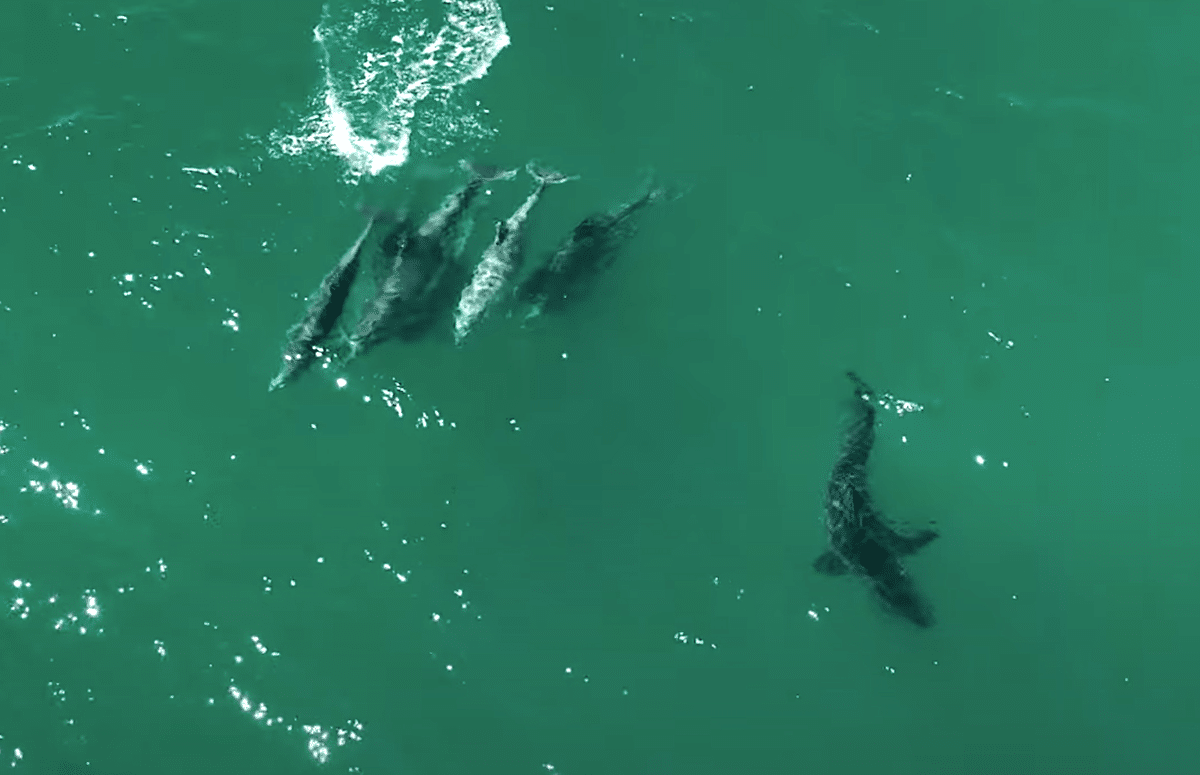
“Dolphins, unlike most species, they don’t shy away from sharks. In fact, they’ll often approach them directly.”
A little over one week ago, the well-known and widely adored Sydney surfer Mercury Psillakis was killed by a Great White shark while surfing a few hundred metres up the beach from famous Dee Why point.
The fatal mauling whipped up the usual responses, along the lines of, well, it’s the ocean, what do you expect? You’re more likely to get hit by a bolt from the gods than die in the mouth of a clearly abundant fish despite it still being listed, officially, as “vulnerable.”
Police described the attack as “rare” but it was only rare through the prism of someone who didn’t realise that prior to the Great White becoming a protected species in NSW in 1996 and federally in 1999, the notion of being killed by a Great White was as abstract as the fabled lighting bolt.
Now?
Since protection, RIP Zac, Paul Tadashi, Rob, Mani, Mark, Tim, Simon, Nick, Cameron, Jevon, Paul, Nick, Jarrod, Peter, Sam, Simon, Tod, Khai, Lance, Ken, Bradley, Geoffrey, Brian, Nicholas, Kyle, Bryn, George, Peter, Ben, Chris, Jay, Ben, Doreen, Laeticia, Gary, Andrew, Paul, Steven and, now, Mercury.
What’s the solution?
No one has the stomach for culls or nets or cowboy fishermen with lassos (read: How to kill a Great White), which does lessen effective measures.
Drones and tagging are little more than window dressing and plastic bracelets with a small magnet inside insult any surfer of clear mind.
But a recent video from Carlos Guana, which shows dolphins attacking a Great White shark, might offer some way to ease back the Great White crisis in Australia.
“Dolphins, unlike most species, they don’t shy away from sharks. In fact, they’ll often approach them directly,” Carlos says.
“Here, a pod of seven dolphins closes in on a shark from behind. At first, the shark startles, and veers away. Notice how the dolphins bunch tightly together as they pass – a strategy to appear larger and more intimidating. Strength in numbers on full display. As the dolphins press forward, the shark circles behind them – a classic shark behavior.
“But suddenly, a second shark appears. Once again, the dolphins startle it. Just like before, this shark veers off, and tries to fall in behind. The dolphins keep moving, until they meet a third shark. Once again, they bunch tightly, and the shark circles back.”
The takeaway, as they say, is pretty simple: trained dolphins, and don’t say it can’t be done ’cause they can minesweep harbours, patrol the beaches and give some of that hell to any Great White that shows its damn head.