
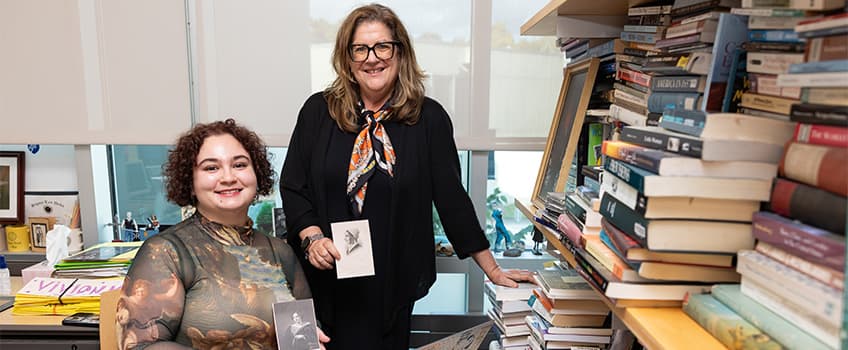
Galloway, N.J. — Catharine Maria Sedgwick may be “the most famous and innovative American writer
you’ve never heard of.”
That’s what Stockton University Professor of Literature Deborah Gussman calls the prolific writer who was considered a celebrity in the early
19th century. She published 20 books and more than 150 shorter works in multiple genres,
including novels, short stories, sketches, biographies and travel.
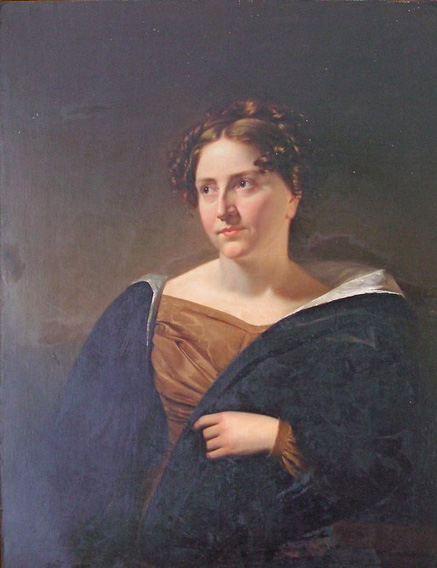
Catharine Maria Sedgwick published 20 books and more than 150 shorter works. She was
a very popular author in the United States in the early 19th century.
Now, thanks to a nearly $300,000 grant from the National Endowment for the Humanities,
Gussman, her co-editors and a group of Stockton graduate and undergraduate students
will continue to add to an online archive of Sedgwick’s letters.
“Her letters provide a window, from the perspective of a cultivated, well-connected
single woman, into a wide range of important 19th-century issues, including authorship,
gender roles, education, national and local politics, religious diversity, marriage,
social reform and work,” Gussman said. “The letters are also a look into her fascinating
and deeply reflective private life.”
The NEH grant is part of $34.79 million awarded to 97 humanities projects across the
country to support various humanities projects that celebrate the 250th anniversary
of the United States.
“The National Endowment for the Humanities is proud to support research, exhibitions,
teacher training and preservation projects that examine and illuminate our history,
literature and culture,” said NEH Acting Chairman Michael McDonald. “These NEH grants
will produce new resources and media that will help Americans meaningfully engage
with the nation’s founding principles as we approach the U.S. Semiquicentennial and
ensure that educators, students and the public have access to accurate, informative
materials that deepen our understanding of the American story.”
Sedgwick’s works became a passion for Gussman when she included a chapter in her dissertation
about her rivalry with American author James Fenimore Cooper, who’s probably best
known as the author of “Last of the Mohicans.” Gussman joined with other Sedgwick
scholars to found the Catharine Maria Sedgwick Society.
The online letters project began around 2015 when Gussman brought her expertise on
Sedgwick and digital humanities together with work on the letters begun by Sedgwick
scholars Patricia Kalayjian of California State University-Dominguez Hills and Lucinda
Damon Bach of Salem State University.
“We came to realize that further in-depth study of Sedgwick’s writings required a
more thorough scholarly infrastructure,” Gussman said. “We decided to combine our
energies in an effort to make her letters widely available.”
The three assembled an advisory board with expertise in studying Sedgwick, 19th-century
American literature, archival research and digital humanities and began creating the
database. In 2017, the project joined with the Massachusetts Historical Society and
was awarded a National Historical Publications and Records Commission Mellon grant
to create a hub for the digital presentation of the primary source documents and the
website was born.
“The goal of the Catharine Maria Sedgwick Online letters project is to provide an
open-access, online edition of Sedgwick’s complete, unexpurgated outgoing letters
as accurate, annotated transcriptions that adhere to the Association of Documentary
Editing’s best practices,” said Gussman, who took a year’s sabbatical from Stockton
in 2024 to work on the project.
The project has 1,095 letters in its inventory — the first from the 1790s when Sedgwick
was about 9 and the last from the year she died in 1867 when she was 78. Most of the
letters are currently only available through microfilm or as holographs in archives
around the United States and abroad. Of that inventory, 432 letters are posted online
with another 300 ready to be digitized and uploaded sometime this fall.
It really gives you a different aspect because a lot of times when you look at historical
figures, you just see their legacy. You don’t get to know what happened with them
and their relationships. So, it’s a really neat aspect to consider for someone who
loves history like I do.”
Junior Mary DeRose from Hammonton
Students have been a big part of the project, helping to transcribe and edit the letters
before being posted. Eryn Genova, who graduated from Stockton in 2020 with a Literature
degree and is currently pursuing a master’s degree in American Studies at Stockton,
worked on the project with Gussman as a graduate assistant last year.
“It’s nice to be able to see this going out in the world,” said the Glassboro High
School teacher. “I think that in this day and age, access and accessibility are really
important. There are so many paywalls that are limiting people from seeing these really
valuable resources or learning about people who have been marginalized.”
Genova, of Pitman, said she was surprised how political many of Sedgwick’s letters
were, and they repeatedly made her laugh because of the gossip contained in them.
“I love that this project is taking all of this information and very selflessly making
it public,” she said.
Junior Mary DeRose, who just began working on the project this fall, also said it
was fascinating to read someone else’s gossip, especially from a woman who was a popular
writer during that time in American history.
“It really gives you a different aspect because a lot of times when you look at historical
figures, you just see their legacy,” said the Hammonton native who’s in Stockton’s
dual degree in Literature and American Studies program. “You don’t get to know what happened with them and their relationships.
So, it’s a really neat aspect to consider for someone who loves history like I do.”
Gussman said the current grant should provide the funding necessary to get all of
Sedgwick’s letters from 1837 to 1846 published.
“We will continue to publish the letters and seek funding to help us do it faster,
until we have published all of Sedgwick’s known correspondence,” she said.
— Story by Mark Melhorn, photo by Susan Allen