
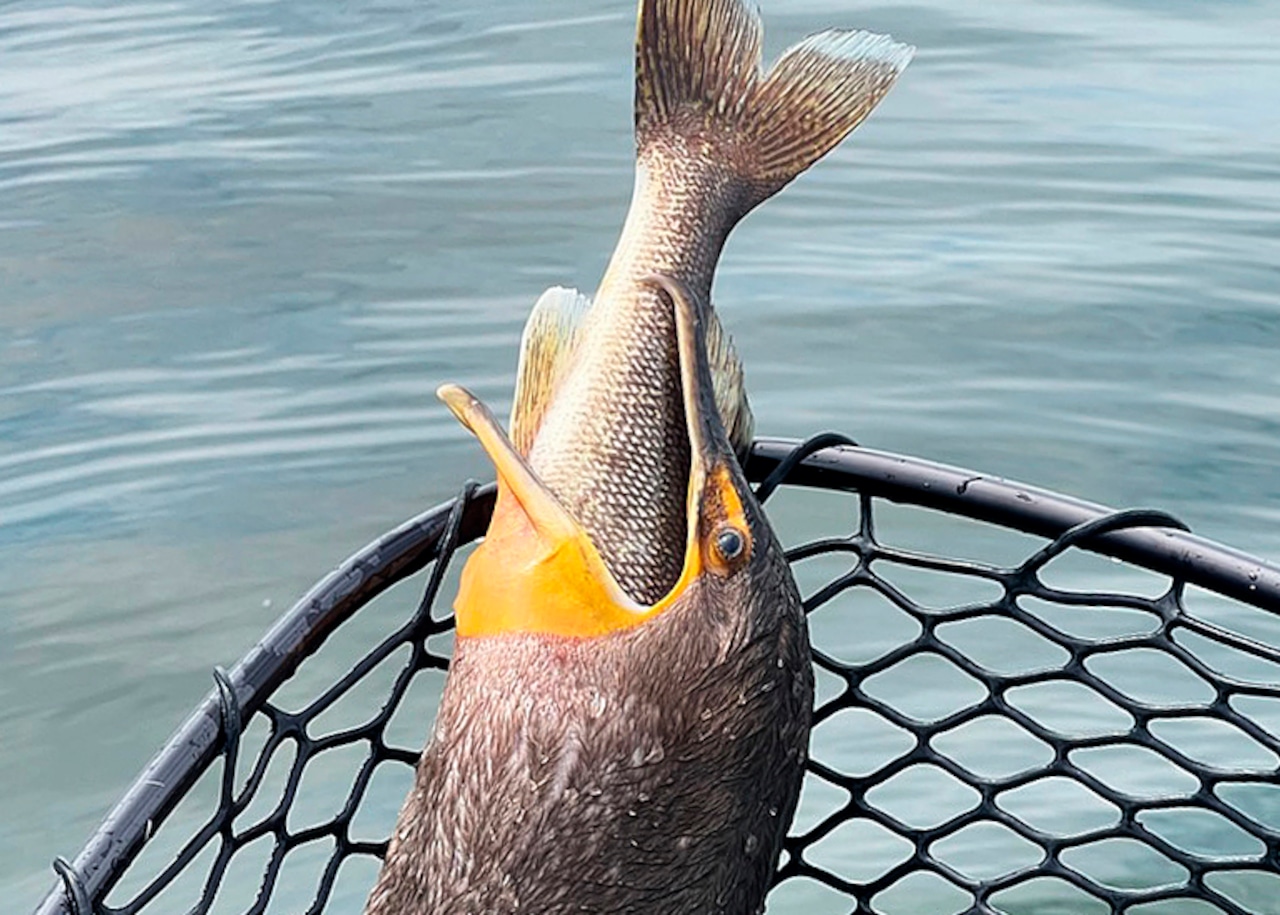
Joe Pudney was out fishing last week when he came across the aftermath of a battle between two of Oneida Lake’s most voracious predators.
Bobbing on the surface was a double-crested cormorant with the tail end of a large walleye sticking half way out its mouth.
Both bird and fish were dead.
We’ll never know which critter died first, but clearly the cormorant bit off more than it could chew—or in this case, gulp.
And cormorants, with their long necks and hooked beaks, are great gulpers of fish, consuming up to 1.5 pounds per day, including the occasional adult walleye.
“We do find legal-size or larger walleyes in their stomachs sometimes,” said Thomas Brooking, research specialist at Cornell University’s Biological Field Station at Shackelton Point.
“It’s not common,” he added. “But we have found 15- or 16-inch walleye that they have swallowed successfully.”
The cormorant’s prodigious appetite was responsible for serious declines in Oneida Lake’s walleye population during the late 1990s, a little more than a decade after the migratory seabird first began nesting on the lake.
According to Cornell’s data, 1997 marked the peak of cormorants’ damage to Oneida Lake’s fishery. That year they devoured an estimated 89.4 tons of fish, about twice the amount of fish cormorants scooped from the lake in 2024.
“They’re coming down from Lake Ontario and the St. Lawrence river and they stop over on Oneida Lake to feed,” Brooking said. “And that’s when you sometimes get flocks of a thousand or two thousand.”
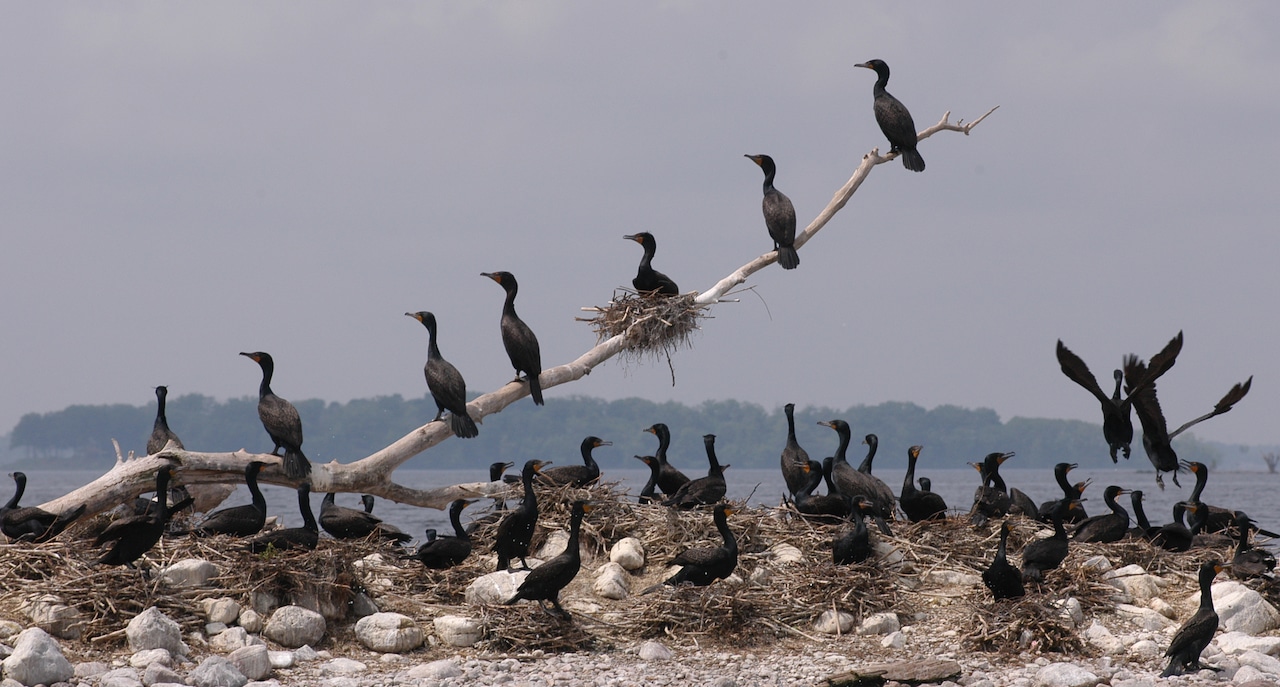 In this 2008 photo, cormorants occupy Long Island on Oneida Lake. Cormorants nest in colonies that can devastate habitat for other nesting birds such as terns.
The New York State Department of Environmental Conservation runs a non-lethal cormorant hazing program on Oneida Lake with the goal of keeping the spring and summer resident population at around 100 birds.
Each year, from April to October, DEC and U.S. Fish and Wildlife personnel scare off cormorants with pyrotechnics and boats.
Hazing occurs three times per week beginning in late August, when the birds start making pitstops on Oneida Lake during their fall migration south. DEC also oils cormorant eggs to prevent them from hatching.
You won’t find many Oneida Lake anglers shedding a tear for a cormorant killed in the act of choking down a keeper walleye, much less concerned about DEC shooting off fireworks around cormorant roosting sites.
Many anglers believe in a more lethal approach to managing the cormorant population. Stick around a bait shop or boat launch long enough and you’ll hear some colorful language about blasting the species into oblivion.
DEC’s current management plan is restricted by the federal Migratory Bird Treaty Act. It cannot kill cormorants merely to protect fisheries important to anglers.
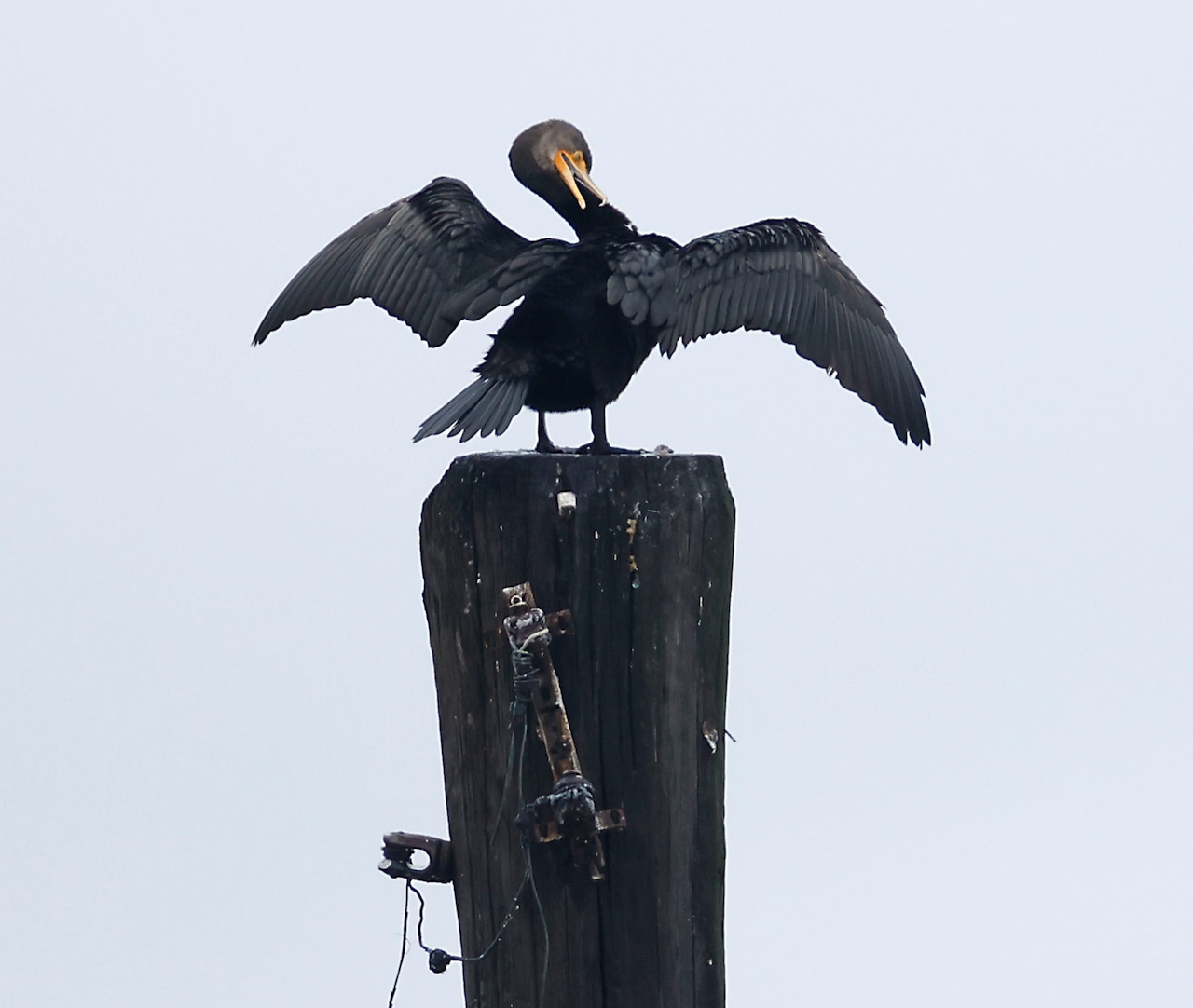 A cormorant dries its wings during a morning visit to the end of the Creek Walk at Onondaga Lake, January 25, 2024
(Scott Schild | sschild@syracuse.com)
Scott Schild | sschild@syracuse.com
So what are cormorants eating from Oneida Lake’s buffet?
DEC is permitted to kill around 220 cormorants annually on Oneida Lake for diet studies. Brooking says they find just about every species in cormorant stomachs, but the birds prefer gizzard shad the most.
Since 2019, however, Oneida Lake’s gizzard shad population has been trending lower than normal in the fall, so cormorants are eating a lot more walleye and yellow perch than they ordinarily would to make up for it.
“They eat a lot of perch and walleye early in the season,” Brookings said. “And then when gizzard shads start to become abundant, if there’s a lot of gizzard shad, they’ll switch over. And they also eat a lot of round gobies.”
In 2019, the first year of DEC’s cormorant hazing program, the birds consumed 48 tons of fish from Oneida Lake. Diet composition by weight consisted of yellow perch (34%), walleye (30%), gizzard shad (13%), and round goby (10%).
Last year, cormorants again consumed almost 48 tons of fish. Their diet by weight consisted of yellow perch (59%), walleye (18%), gizzard shad (8%), and round goby (7%), with no other species accounting for more than 4%.
While Joe Pudney’s photo gives proof to the hostility that some anglers feel toward cormorants, there’s no reason to believe the birds, under DEC’s current management program, are harming Oneida Lake’s fishery.
Brooking said he liked that Pudney’s photo captured the clash of two Oneida Lake titans, but cautioned that it depicted a rare occurence.
“I don’t want anglers to think that they eat like that all the time,” Brooking said, though this unfortunate bird died trying.
If you purchase a product or register for an account through a link on our site, we may receive compensation. By using this site, you consent to our User Agreement and agree that your clicks, interactions, and personal information may be collected, recorded, and/or stored by us and social media and other third-party partners in accordance with our Privacy Policy.