
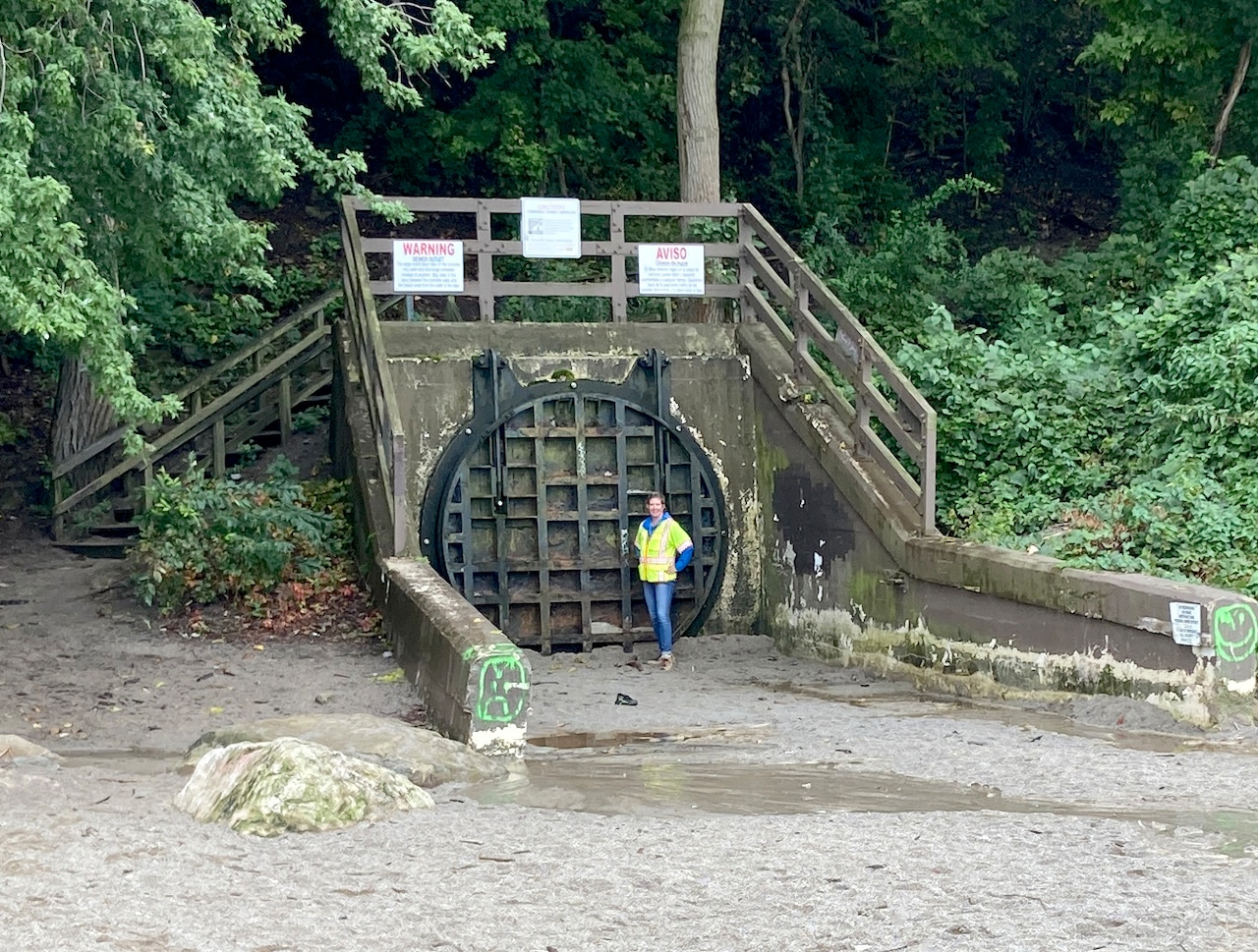
The Northeast Ohio Regional Sewer District recently announced seemingly complex plans to stop raw sewage from flowing onto Edgewater Beach, but as the Today in Ohio podcast crew points out, that sewage will still be dumped into Lake Erie.
The sewer district’s original announcement gave the impression that new technology would solve the problem Edgewater Beach, where swimming is prohibited following big rain storms because raw sewage rolls down the beach and into the water. What’s happening is not that complicated, podcast hosts noted.
“Yeah, everything they’ve said about this is pretty much nonsense,” said Chris Quinn. They’re capping it and they’re pushing that sewage somewhere else. And they have to do a little bit of work to absorb the extra until it can flow out. This has got nothing to do with new technology.”
So what’s actually happening? Laura Johnston explained the mechanics: “It’s redirecting the overflow to the Westerly treatment plant. It’s adding this 1,400-foot long tunnel, and that should be able to send it further down the pipe that connects to that treatment plant. It’s about a half mile east of the beach.”
This isn’t part of the original “Project Clean Lake” consent decree with the EPA, which has greatly reduced the number of days when sewage gets spewed into the lake. It’s an additional measure driven by a specific concern about Cleveland’s most popular swimming site.
Quinn got straight to the point about the real motivation: “They’re just embarrassed because every time it happens, we have a story about it. There is raw sewage — crap — on our most important swimming beach. And they finally got so embarrassed. They figured, okay, let’s spend some money and cap that outfall.”
The hosts made clear that the sewage coming from Northeast Ohio toilets and showers isn’t being eliminated from Lake Erie—it’s simply being redirected to a less visible location.
Johnston described the project as providing “more time for the gates at the Westerly plan to open to relieve the pressure to the overall system,” comparing it to “unclogging a bathroom tub drain.”
While the hosts were glad to see action being taken to protect Edgewater Beach, they were clear-eyed about the limitations of this approach. Johnston provided an important public health reminder that goes beyond the sewage overflow issue:
“Just to be clear, anytime it rains a heavy rain like that, even if we’re not talking about stormwater overflows, there’s pesticides on lawns, there’s stuff in creeks,” Johnston saidm All of that washes into the lake. “It is not a great idea to swim in Lake Erie after a giant rainfall.”
The podcast highlights how public pressure and media attention can drive infrastructure improvements, even when they’re not required by regulatory agreements. The embarrassment of having raw sewage on a popular beach ultimately proved more powerful than environmental regulations alone.
Listen to the discussion here.
Listen to full “Today in Ohio” episodes where Chris Quinn hosts our daily half-hour news podcast, with Editorial Board member Lisa Garvin, Impact Editor Leila Atassi and Content Director Laura Johnston.
If you purchase a product or register for an account through a link on our site, we may receive compensation. By using this site, you consent to our User Agreement and agree that your clicks, interactions, and personal information may be collected, recorded, and/or stored by us and social media and other third-party partners in accordance with our Privacy Policy.