
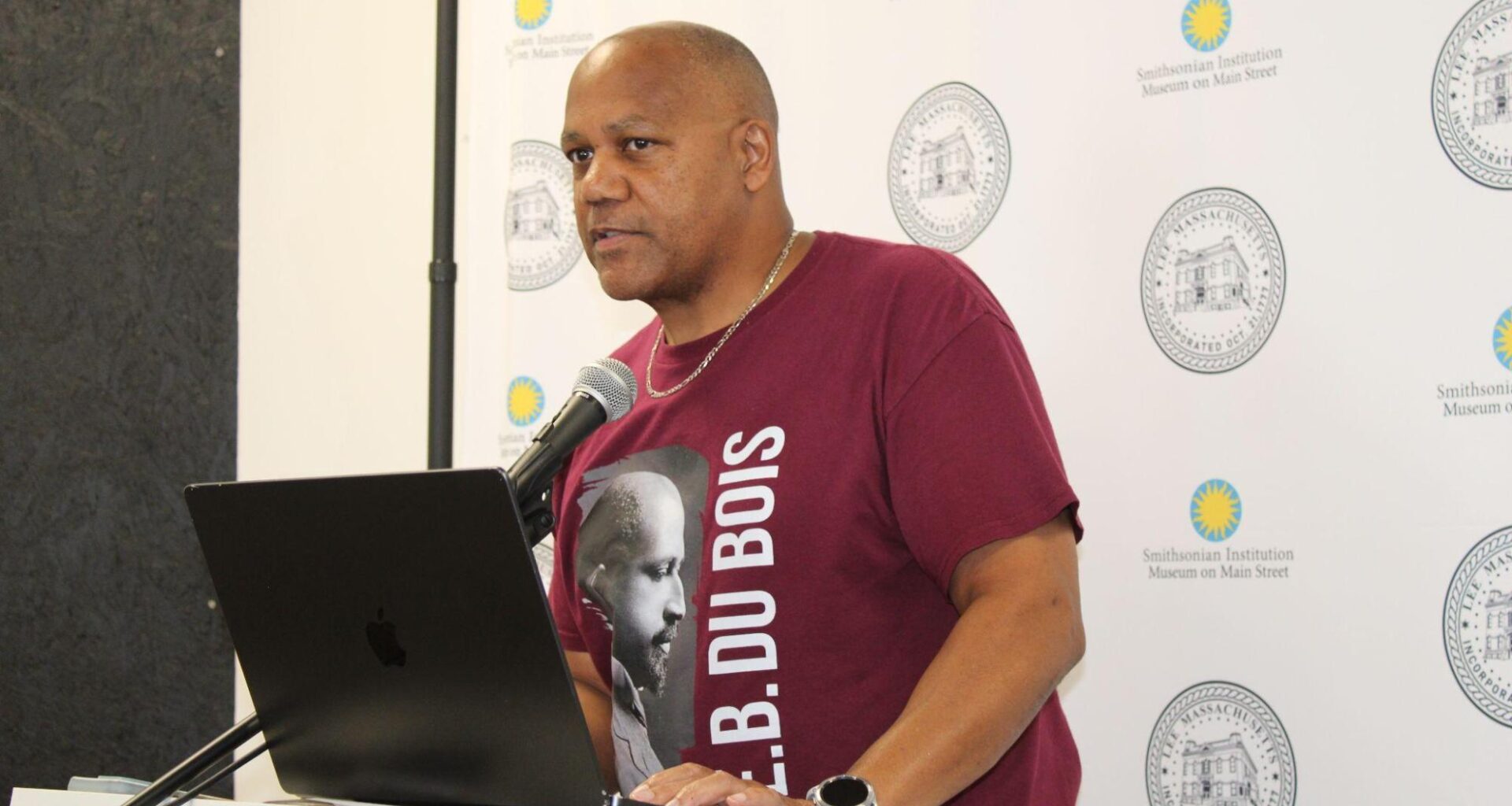
Lee — W.E.B. Du Bois’ great-grandson Jeff Peck was one of many speakers at an event celebrating the unveiling of the Du Bois sculpture in front of Great Barrington’s Mason Public Library.
The event was held on Wednesday, July 16, at the Smithsonian’s “Voices & Votes: Democracy in America” exhibit on display at the Lee Premium Outlets. The event included multiple speakers from local organizations and several scholars reflecting on the legacy of Du Bois.
The Du Bois sculpture will be unveiled at the Mason Public Library at 2 p.m. on Saturday, July 19.
Du Bois, a historian, sociologist, and civil rights activist, was born in Great Barrington on February 23, 1868. Among his many accomplishments, Du Bois was a co-founder of the National Association for the Advancement of Colored People (NAACP) in 1909 and was also the editor of the NAACP’s journal, The Crisis.
The July 16 event was hosted by Multicultural BRIDGE founder and CEO Gwendolyn VanSant.
“Many people have asked me, ‘What do you think Dr. Du Bois would say if he was here today, and what would he ask of you?’” Peck said in his speech. “I’m still scratching my head about that question. I wake up [in the morning] thinking about it all the time. As a group, collectively, so many people across the world are doing things in his memory. I’m just overwhelmed with what I’ve seen, especially in the climate that we have in the United States right now with all the things that are going on.”
“But one thing that I must say is that I’m just one person,” Peck added. “[There are people] who have made Du Bois’ name into a household name and [who] have worked to honor his legacy and carry it on.”
Having spent the last years of his life in Ghana, Du Bois died in Accra, Ghana, in 1963. Peck said that he has traveled to Ghana for the past four years to participate in Du Bois; birthday celebrations. “When I’m there, I talk a lot about Great Barrington and how kind everyone has been here,” he said. “To me, Great Barrington is just a big happy family when I come here. I claim you all in this home, and I hope you all claim me as being family as well. Every time I come here, I feel like I’m at home because of all the things that I see, the fact that Du Bois was born here, and what this place meant to him. The fact that [the town] poured into him and helped him with his education to get started, and this means so much to me.”
Peck emphasized importance of history to Du Bois and stressed the need to remember and learn about history. “People are going out of their way to hide history from us,” he said. “I’ve been to Niagara Falls, and I’ve seen a Harriet Tubman statue that most people haven’t had the opportunity to see, but it’s amazing.” The Niagara Falls Underground Railroad Heritage Center opened in May 2018 to honor Tubman, an abolitionist and activist.
Tubman was born into slavery in 1822 but escaped in 1849. She eventually went on 13 missions to rescue 70 people out of slavery. The network of antislavery activists and safe houses became known as “The Underground Railroad.”
“At the museum they talk about slaves crossing into Canada to be free,” Peck said. “One of the gentlemen giving me a tour of the museum told me that some people who come to the museum look for a train in an underground cave. That’s how bad it is when it comes to our history, because people don’t really know it. I pinch myself as I go across the country and I get a chance to see our history that some people still have no clue about.”
Peck said he encourages others to learn history through travel. “Get out and travel, not just in the United States, but travel the world because there’s so much history out there,” he said. “There’s so much that we don’t know about. When we find out how things are in other places, it sheds light on other people’s outlook of their history. Everybody’s history is important, but it just seems like Black History has taken a back seat to everyone else’s history.”
 Williams College Vice President for Institutional Diversity, Equity, and Inclusion Leticia Smith-Evans Haynes speaks at the July 16 event as historian Alexandria Russell looks on. Photo by Shaw Israel Izikson.
Williams College Vice President for Institutional Diversity, Equity, and Inclusion Leticia Smith-Evans Haynes reflected on Black history during her speech. “What strikes me about when [Du Bois] was born [in 1868], it was just a few years after the Civil War ended in 1865,” Haynes said. “It was still in the thick of things. We had, quote, unquote, ‘vigilante justice.’ We had the Ku Klux Klan rampant. It had always been active, but even more so [in that era]. We had laws against Blacks all throughout the country. You name it, we had it. As you all know, [during the] Civil War, there were matters of race, freedom, money, money, money, money, and money. That’s always at the forefront of everything here in this country.”
Haynes highlighted Congress abolished slavery through the 13th Amendment to the U.S. Constitution in 1865. “But that wasn’t too long ago,” she said. “My parents grew up during the era of Brown v. Board of Education, and they were alive when that decision was handed down. They grew up in the segregated South, and in other parts of the country, there were ‘Black Codes’ and the Klan. There was a significant erasure of the significance of Black people and their bodies, and the fact that people thought that they could determine the worth of Black bodies was hugely significant. In doing that, we are consistently violating Black bodies, Black people, and women, utilizing them for all sorts of things. [Using them as] free labor is at the top of the list, just because they do whatever they could do with them as though they were not human. This is important to remember, because it’s something that has happened throughout history. It continues today with the violation of Black bodies, including mass incarceration, how people engage with Black people ordinarily walking on the street, and police overpolicing in communities that are Black. If you are in a community that is not Black, you are definitely being policed.”
Haynes said that Du Bois instilled in her a sense of advocacy. “It’s not doing what we want to do for communities, it’s going into communities and understanding and appreciating what they need,” she said. “You go into Black communities and ask people, ‘What are your needs?’ You help to enable those communities to advocate for themselves and be there as a voice when they cannot do that. That is what it means to advocate.”
 Multicultural BRIDGE founder and CEO Gwendolyn VanSant with Housatonic Postmaster Keytoria Jenkins. At the event, Jenkins unveiled a plaque featuring a stamp of Du Bois that was issued in 1998 by the United States Postal Service. Photo by Shaw Israel Izikson.