
The Bounce Newsletter  | This is The Athletic’s daily NBA newsletter. Sign up here to receive The Bounce directly in your inbox.
On this date, in 2018, the Raptors traded DeMar DeRozan, Jakob Poeltl and a first-round pick (eventually Keldon Johnson) to the Spurs for Kawhi Leonard and Danny Green. In 2001, the Suns traded Jason Kidd and Chris Dudley to the Nets for Stephon Marbury, Johnny Newman and Soumaila Samake. In 1996, Shaquille O’Neal signed with the Lakers. If your team makes a deal today, there’s a good chance you’re either giving up a Hall of Famer or acquiring one.
The Last 24
LeBron-Lakers situation appears to be resolved
🏀 LeStaying? There has been a lot of conjecture about LeBron James possibly leaving the Lakers. He’s likely staying.
🌞 How bad? The Bradley Beal trade didn’t work out for the Suns. Is it their worst ever?
🦌 In the moment. Eric Nehm spoke to Bucks general manager Jon Horst about this summer. “The now matters more than anything.”
👣 Is he next? Andrew Nembhard was a no-name who became a big deal for Indiana. Can his brother do the same for Dallas?
🎥 Summer League film festival. Kevin Garnett has dished out yet another big assist. This time, it’s bringing films to Vegas.
🚚 Time to expand? The NBA might be headed toward adding some new cities. The league has started researching.
🎧 Tuning in. Today’s “NBA Daily” dishes out its offseason awards.

The story of the greatest players in NBA history. In 100 riveting profiles, top basketball writers justify their selections and uncover the history of the NBA in the process.
The story of the greatest players in NBA history.
Buy All-Star Weekend
Three WNBA questions at the break
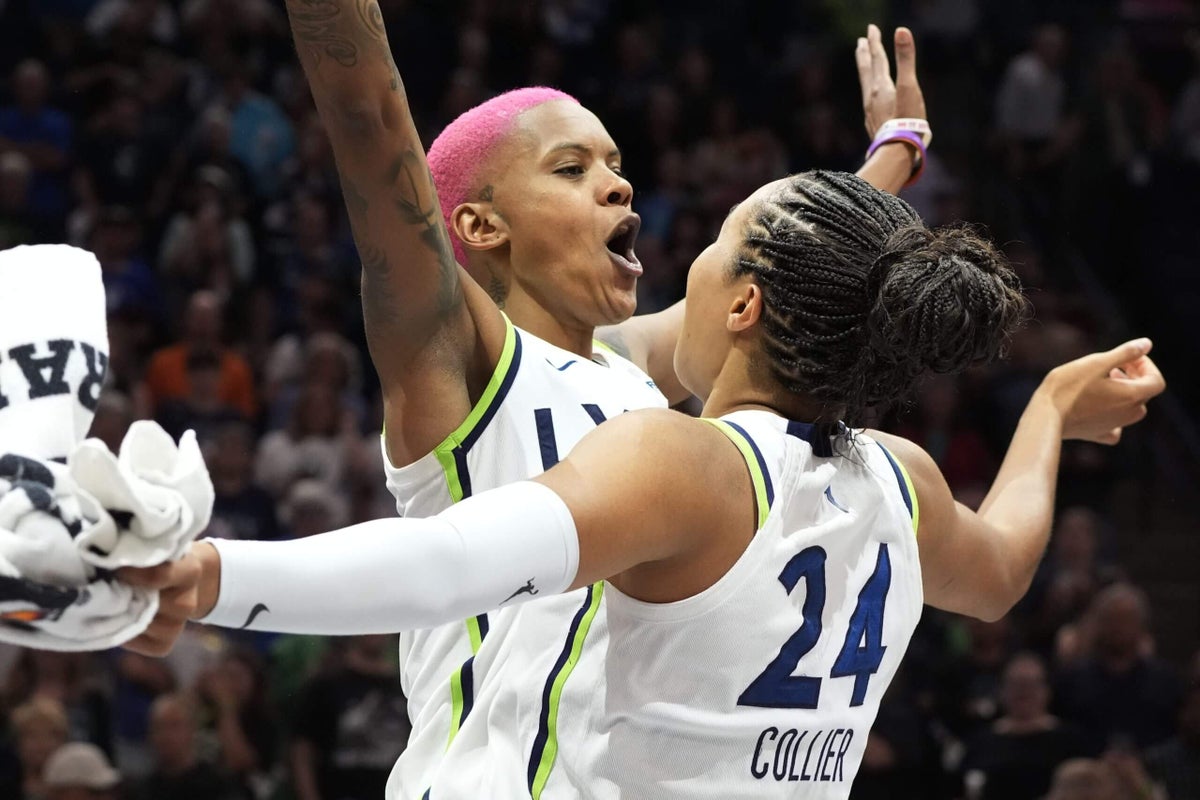
The WNBA All-Star Game is tomorrow night in Indianapolis, and we continue to see fantastic growth and momentum for the league. The talent pool has never been deeper. The WNBA is expanding and seeing early success with the Valkyries. And the league continues to boast Caitlin Clark, Napheesa Collier, A’ja Wilson, Breanna Stewart, Kelsey Plum, rookie Paige Bueckers and so many more stars to grab the attention of the basketball world.
With the All-Star weekend here, it felt like a great time to tap in with Sabreena Merchant and ask her three questions to get us ready for the stretch run of the W’s season.
We’re at the All-Star break and dealing with another Caitlin Clark injury. How much has this impacted the entire league this season?
Sabreena: Clark’s injury and other personnel challenges in Indiana (like multi-time All-Star DeWanna Bonner asking out within 10 games) have the Fever teetering around .500 instead of making the jump to championship contenders. She has still been a needle mover for the league; nationally televised games with Clark used to break 1 million viewers in 2024 and are now regularly crossing the 2 million threshold in 2025. However, Clark’s injury threatens to impact the W’s marquee events like the All-Star Game and the postseason, if Indiana is no longer set up for a deep playoff run. It’ll be interesting if Paige Bueckers steps into the new kid on the block role if Clark’s absence lingers, much like Clark filled the void created by Bueckers’ injury during their college careers.
Who has been the best player in the league this season, and does that mean they’ll get MVP?
Sabreena: Napheesa Collier has been itching for revenge since the 2024 WNBA Finals ended in a controversial loss for her Lynx. She successfully launched a new league, Unrivaled, and was its MVP as well as 1-on-1 champion. Collier has continued that heater into the W season, leading the league in scoring (23.2 points per game) and placing top five in steals and blocks. With the Lynx topping the standings (20-4), the reigning Defensive Player of the Year has the statistical and narrative case to win her first MVP.
What’s your bold prediction for after the All-Star break?
Sabreena: The WNBA will have an active trade deadline. The league has historically had minimal midseason movement, but with the uncertainty 2026 brings — essentially every veteran is a free agent, a new CBA will upend the cap/team-building process and there will be a double expansion draft — it makes sense for teams to try to go all in now. All of the top contenders created an extra roster spot before the league-wide cutdown date, and none of them should feel comfortable enough with their current rosters. With teams like Washington and Golden State sitting on boatloads of cap space to help facilitate deals, the Aug. 7 deadline will bring significant action.
The All-Star Game is at 8:30 p.m. ET tomorrow on ABC (or stream on Fubo — try for free).
Line ‘Em Up!
What if NBA teams chose 3-point distance?
During the previous weekend, I spent time in Las Vegas talking to a lot of people about the state of the NBA, potential places the league might be going and ideas on how to improve the product we love. One of those conversations involved Jay King, as we discussed a bit of a ridiculous idea while drinking at a casino bar at 3 a.m. perusing our notes during normal work hours.
Here are three questions with Jay about a radical change that would mimic how baseball stadiums are built.
You have an idea to revolutionize 3-pointers in basketball. What should the NBA adopt?
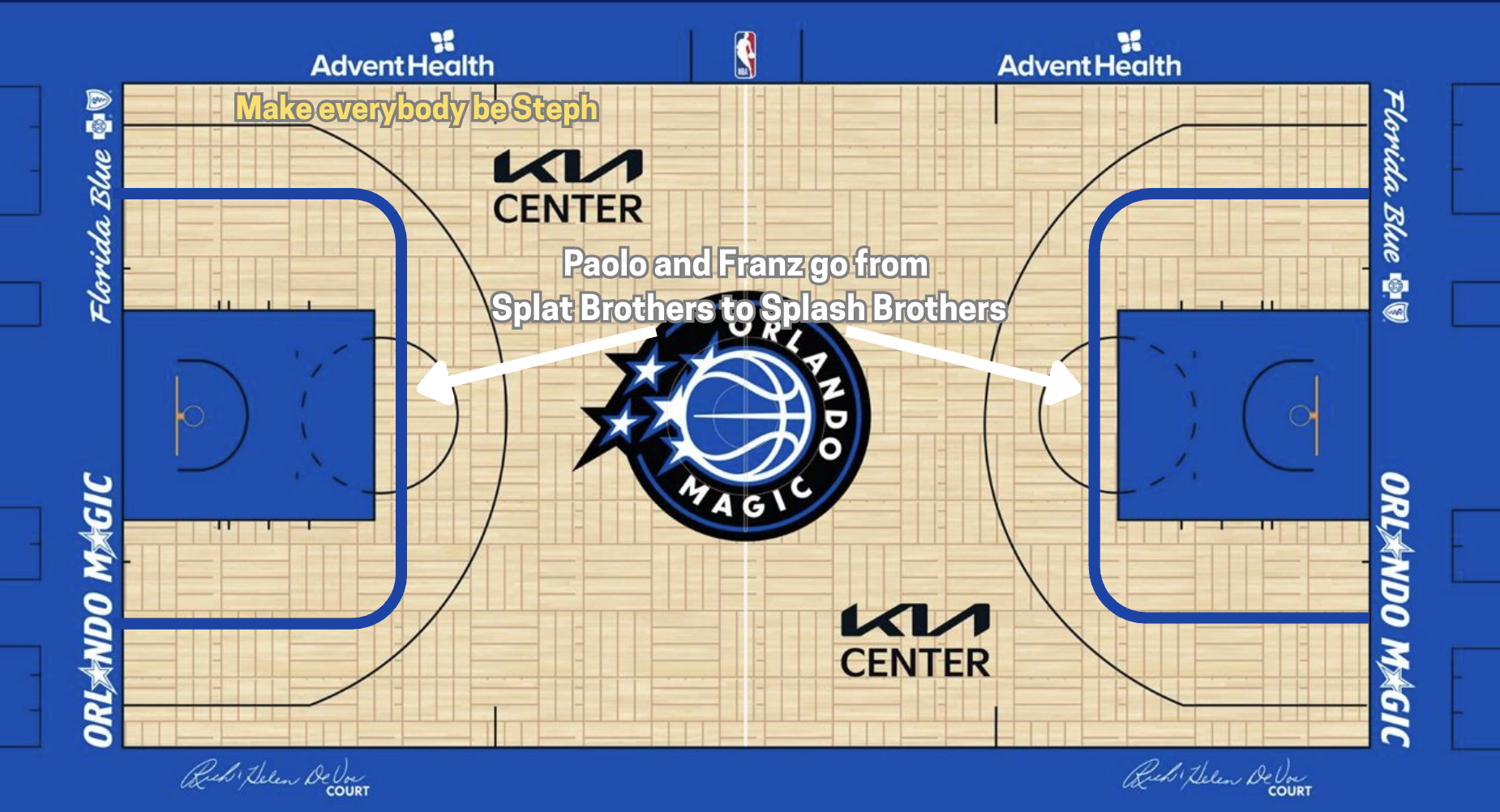
Jay: Let me first emphasize that it’s not my idea. I heard it somewhere else first (I wish I could remember where). But each NBA team should be able to choose its own court dimensions. It would be a little bit like baseball, where each field is different. But instead of building weird fences and short porches, teams would change the 3-point arc. The Warriors would have the ability to extend their arc to 30 feet, where only Stephen Curry would be able to make shots consistently. The Magic could put their arc inside of 15 feet, so that even Paolo Banchero and Franz Wagner would be able to cash in. Each team would have a decision to make, and it would dramatically alter the style of play in that building.
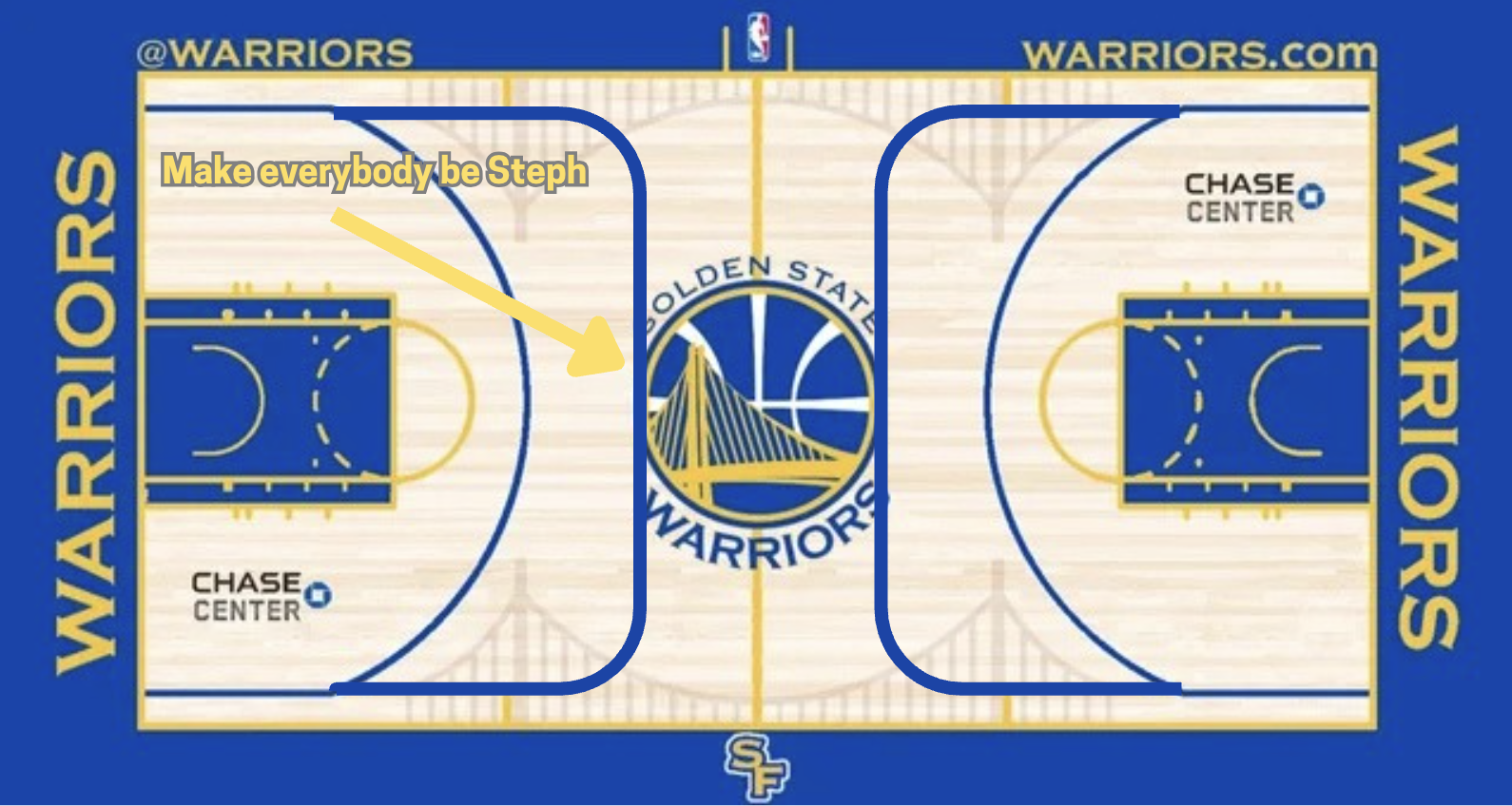
My twist, which I haven’t heard elsewhere: Each team would have to stick with the same court dimensions for at least a predetermined period of time (let’s say 15 years). That means teams would need to make long-term roster decisions based on their own court dimensions; as the Rockies need to adapt because they play in Coors Field, basketball teams would need to adapt to maximize home-court advantage in their unique gyms. It would all seem weird at first, but it would end some of the uniformity that has crept into the game.
But wouldn’t this make the “3-point problem” everybody whines about even worse? Why wouldn’t everybody just move the line in? How many teams do you think would employ something different than the rest of the league?
Jay: Not necessarily. I suggested the Magic would pull in their arc, but what if they went the other way and pushed it back so far that nobody would be able to make 3-pointers either for or against them? That way, they would eliminate Banchero and Wagner’s biggest weakness (it’s no longer a weakness if nobody can shoot) and turn their driving strengths into an even bigger must. While at home, Orlando could effectively throw the game back to the 1990s. And the Magic could do it in their throwback jerseys, which are just perfect.
I miss the Zach Randolphs of the world. I need more bruising post-ups. I want slow, ground-bound big men to have a chance again. I don’t dream of every team playing just like the Grit ‘N Grind Grizzlies or 1990s Knicks, but some more variety in the game would be nice. I think this would provide some. Shooting as many 3s as possible right now makes sense, but I miss the other, weirder parts of the game. Let’s bring some of it back.
With the way teams change coaches and the way the second apron could slash rosters every few years, how often do you think these teams would regret being married to a line distance for 15 years?
Jay: All the time! But that would be part of the fun. Teams would need to make every decision with their unique home court in mind. If the Magic tried to be like the 1990s Knicks now, they would be stuck targeting brolic non-shooters for the next decade and a half. Everything from the players on their roster to the offense they run to their defensive strategies would be dictated by their one decision on where to put the 3-point arc. Most teams probably wouldn’t be too dramatic with their changes, but even a subtle tweak would have a significant impact. Let’s be honest — it won’t happen, but the league would be more fun if it did.
Streaming links in this article are provided by partners of The Athletic. Restrictions may apply. The Athletic maintains full editorial independence. Partners have no control over or input into the reporting or editing process and do not review stories before publication.
(Photo: Bruce Kluckhohn / USA Today Network via Imagn Images)