
Key Points
As authoritarian regimes such as China increasingly turn to overseas information campaigns as a tool of geopolitical competition, this report investigates how autocratic propaganda highlighting regime performance affects broader attitudes toward democracy globally.
This report examines two messaging strategies: “autocratic advantage,” which highlights positive benefits of authoritarian governance, and “democratic disarray,” which includes more traditional attacks on the flaws of democracies. Through machine learning–assisted text analysis of a large dataset of social media posts and a survey experiment fielded in three major developing countries, I find that autocratic advantage messaging is both more prominent in Chinese government propaganda and more effective at undermining public support for democracy.
These findings have worrying implications for understanding how authoritarian countries could accelerate global democratic backsliding as well as China’s ability to gain ground in strategic competition with the United States.
Executive Summary
Authoritarian regimes like China increasingly wield overseas propaganda as a tool of geopolitical competition. I introduce the concept of “political demonstration effects”: when information about a foreign country’s regime performance influences public attitudes toward democracy. I examine two messaging strategies—“autocratic advantage” messaging, which emphasizes the performance and procedural benefits of authoritarian governance, and “democratic disarray” messaging, which highlights the corresponding shortcomings of democratic systems. I evaluate the real-world prevalence of these strategies in China’s overseas propaganda, using an unsupervised machine learning approach to analyze 8.7 million tweets.1 I then test whether such propaganda shifts attitudes toward democracy through a multicountry survey experiment. I find that autocratic advantage messaging is both more prevalent and more effective at undermining public support for democracy. Despite a focus in academic and policy analysis on negative attacks, pro-regime propaganda matters, as it affects broader political attitudes, with implications for democratic backsliding and the playing field of US-China strategic competition.
Introduction
Does information about another country’s regime type and governance performance affect individual-level attitudes toward democracy? The answer is directly relevant for understanding the consequences of authoritarian overseas propaganda, China’s ability to gain global influence, and the trajectory of geopolitical competition in the information domain. Information and foreign influence operations have become a prominent tool for shaping global narratives, deepening democratic systems’ internal divisions, and strengthening authoritarian states’ standing.2 Russian disinformation and electoral interference efforts in the United States and elsewhere have worsened political polarization and undermined trust in democratic institutions, and China has implemented increasingly active and aggressive overseas propaganda campaigns to promote the effectiveness of its political model at the expense of democracies.
As authoritarian states increasingly turn to informational tools to expand their political influence and weaken the legitimacy of democratic governments, the information sphere has become an arena of geopolitical competition. The widespread transnational use of social media and digital platforms has enabled the easy penetration and dissemination of ideas from multiple sources within and outside of a country. Online misinformation is linked to lower trust in mainstream media and widened political polarization.3 While declining authoritarian powers have attempted to sow chaos and confusion in democratic systems, rising authoritarian powers have an even greater incentive to tout their political system’s legitimacy against internal and foreign criticisms. Even if rising powers may not be actively seeking to export autocracy, their defensive ideological actions often threaten healthy democratic functions and enable authoritarianism.4
The heightened use of authoritarian information campaigns is set against a global backdrop of spreading authoritarianism and faltering democratization.5 In recent years, political strongmen with autocratic and populist tendencies have been elected in countries such as Brazil, Hungary, the Philippines, and the United States. Brexit and Donald Trump’s election in 2016 sparked renewed academic and popular discussions over the limitations of democratic political systems. While baseline support for democratic ideals and values remains high globally, studies have also found increasing support for strongman rule, particularly in traditional Western liberal democracies.6 Competing narratives from autocratic information campaigns—especially about regime types and governance performance—have the potential to substantially shape public attitudes toward democracy, with consequences for the health of democratic norms. Changes in the international information environment and intensifying competition over political systems could easily accelerate a global “democratic recession.”7 As former US President Joe Biden declared at a press conference in March 2021, “This is a battle between the utility of democracies in the 21st century and autocracies. We’ve got to prove democracy works.”
The combination of growing democratic backsliding and expanding authoritarian informational statecraft underscores the importance of understanding how external information can influence domestic political attitudes. Bridging the literature on autocratic propaganda and public diplomacy with scholarship on the role of public attitudes in democracy consolidation, I develop and test a theory of “political demonstration effects”: that information about another country’s regime performance can influence attitudes toward democracy in general and support for democratic norms in one’s own country—especially in political contexts where democratic consolidation is incomplete. I then examine the relative success, prevalence, and characteristics of two different messaging strategies—“autocratic advantage” versus “democratic disarray.”
I first investigate these authoritarian propaganda strategies in the real world, analyzing a dataset of 8.7 million tweets to examine patterns in Chinese propaganda messaging strategies. This dataset includes 1.3 million tweets by prominent Chinese state media accounts and a set of control accounts consisting of leading English-language news outlets globally. I identify key trends in how Chinese government propaganda discusses the characteristics and outcomes of US-style democracy versus China’s own political system, and I find autocratic advantage framing—which highlights the performance and procedural benefits of China’s system, though without using the terms “authoritarian” or “autocratic”—to be more prevalent.
I then test whether and when these messaging strategies influence individuals’ attitudes and preferences regarding their own country’s political system and democracy in general. In a multicountry survey fielded in three populous but flawed democracies—Brazil, India, and South Africa—I find evidence of political demonstration effects. Moreover, positive messaging highlighting the performance and procedural advantages of authoritarian political systems more effectively shifts public attitudes toward democracy than messaging focusing on the dysfunctional features of democracies.
This report makes three major contributions. First, it introduces and tests the concept of political demonstration effects, underscoring the insidiously powerful impacts of authoritarian propaganda about governance models used to alter domestic political attitudes. Second, it finds that positive messaging may be more persuasive than negative messaging, contrary to conventional expectations that negative information is more effective. Third, it examines propaganda outcomes in the context of foreign public support for democracy or autocracy (including the components of democracy, such as free elections and civil liberties) in their own country, beyond the conventional focus of public diplomacy and propaganda on shifting views of either the propagandist or target countries.
My text analysis and experimental results suggest that pro-regime propaganda providing information about the advantages of autocratic systems can have adverse implications on global public support for democracy as a political system. Authoritarian informational statecraft is concerning because it could not just change views of specific governments or countries but also fundamentally shift broader political attitudes. The effect of authoritarian overseas propaganda on public attitudes toward democracy is a crucial and relatively under-studied issue with serious implications for the global balance of power and the nature of the international order: If more citizens are persuaded to support autocratic governments, this will further catalyze democratic backsliding and likely make the world safer for autocracy.8
Authoritarian Overseas Information Campaigns: Regime Type and Geopolitical Competition
Authoritarian information campaigns have assumed increased salience in recent years among scholars and policymakers. While Russia famously delights in amplifying chaos and disruption in democracies such as the United States, China has expanded its global media footprint and become a more prominent propagator of its own messaging and ideas to, as President Xi Jinping puts it, “tell China’s story well.”9 Great-power competition and US-China relations have become more overtly framed in ideological terms. In his first news conference as US president, Joe Biden described geopolitical competition with China as “a battle between the utility of democracies in the 21st century and autocracies. I’ve got to prove democracy works.”10
Authoritarian information campaigns have also increasingly focused on regime type and relative performance. Chinese state-affiliated actors have not hesitated to laud China’s model of governance and criticize democracy. As an outgrowth of China’s efforts to improve its global public image, narratives of autocratic efficiency and democratic chaos have become more weaponized. Such propaganda simultaneously promotes positive stories about the Chinese government, engages in revisionist narratives, and exploits paid ad campaigns to push its messaging.11
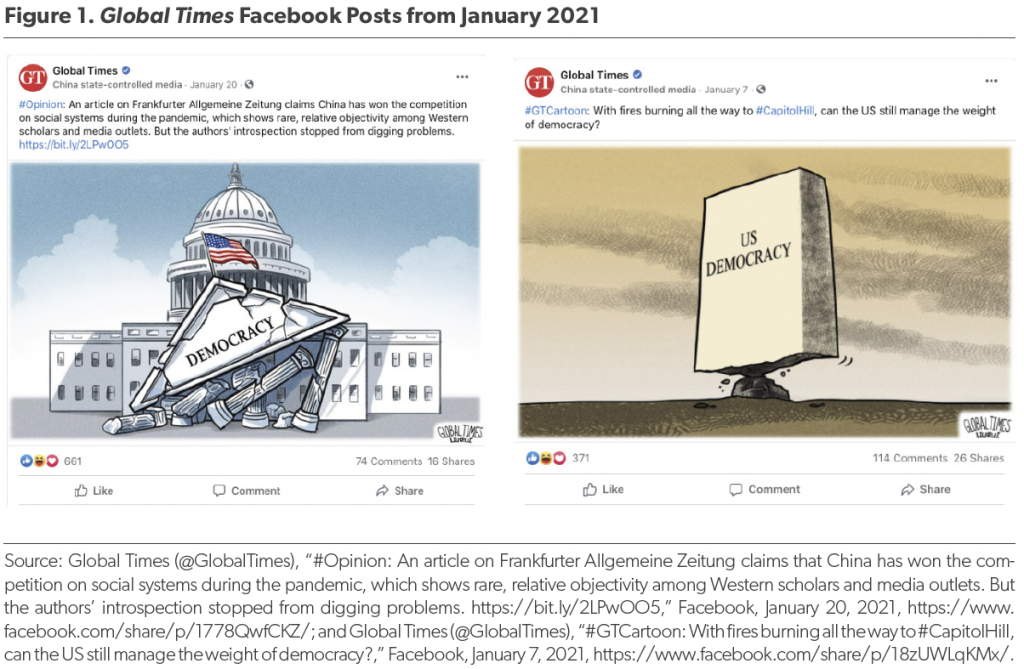
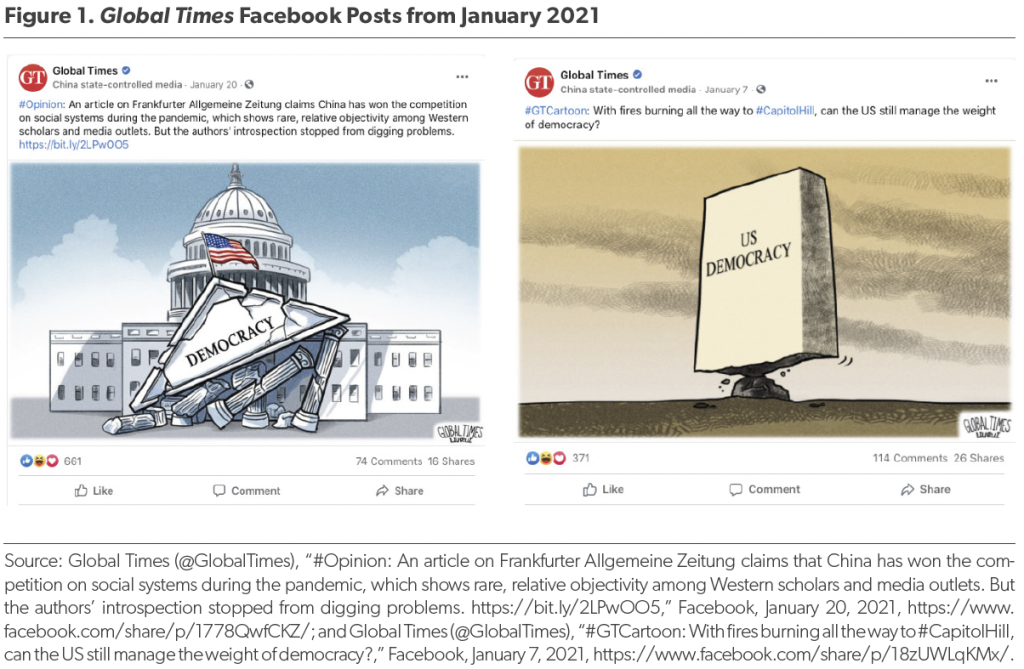
These tactics became prominent during the COVID-19 pandemic, when the Chinese government mobilized its diplomats and took to social media platforms to promote narratives of effective Chinese governance in controlling the outbreak. Beijing actively publicized “mask diplomacy” and “vaccine diplomacy,” constructing narratives of its outward-facing benevolence and competence in donating masks and other personal protective equipment to countries facing shortages.12 Moreover, China aggressively slammed critics and defended China’s side of the story, an approach that came to be known as “wolf warrior diplomacy.”13 Part of this included renewing its criticisms of democracy. A Global Times Facebook post from January 2021 cited a German article claiming China had “won the competition on social systems during the pandemic,” accompanied by a cartoon depicting the facade of the Capitol as crumbling pillars of democracy. Crises in US democratic politics have also provided fodder for Chinese propagandists. Chinese media portrayed the January 6 insurrection as another indicator of democratic turmoil and imminent collapse (Figure 1).
Authoritarian regimes have also prized the co-optation of Western voices (genuine or fabricated) to back up their information campaigns, positive or negative. Chinese media has picked up on writings by scholars, such as Francis Fukuyama, criticizing the rigidity and divisions inherent in American democracy, or quoted political scientists Steven Levitsky and Daniel Ziblatt’s book How Democracies Die. In promoting China’s governance model, social media posts by Chinese diplomats showed clips of World Health Organization officials praising the Chinese government’s coordinated and effective management of the pandemic and selectively touted an article by Peter Hessler, an established New Yorker writer based in China, as unvarnished praise of the regime. In another instance, Chinese television network CGTN received flak for inventing a French journalist based in Xinjiang who decried Western “fake news” on human rights abuses and detention camps in the region.
How much traction has China gained with its information campaigns? Research suggests that members of the public form their opinions more from social and informational cues around them than from elites.14 This raises the importance of understanding how effective such authoritarian information operations are in shifting foreign audiences’ attitudes toward their own political system. Despite limitations, the Chinese Communist Party’s (CCP’s) propaganda operations have also demonstrated agility and an ability to co-opt public opinion.15 Informational tools are playing an increasingly significant role in Beijing’s attempts to gain global influence. To the extent that these information operations seek to tout the benefits of an authoritarian model such as China’s and undermine the legitimacy of democratic systems, including that of the US, they are likely to play an important role in shaping public attitudes at the national and global levels on regime type and governance outcomes.
There has been an important discussion on whether overseas propaganda can change perceptions of China, but the effects on foreign public support for democracy in target countries are a distinct outcome—and less explored. These effects could be corrosive over time. Moreover, analyses of authoritarian foreign influence operations need to take into account the efficacy of such efforts in targeted countries, which remains unclear.
Political Demonstration Effects, Messaging Strategies, and Theoretical Contributions
I conceptualize political demonstration effects as the impacts of information about a foreign country’s governance performance on individual attitudes regarding political systems and regime types. Political demonstration effects of China’s propaganda messaging can be examined at three levels: views of democracy as a concept and general mode of governance; attitudes regarding democratic norms and institutions or, conversely, strongman rule; and attitudes toward democracy in the context of one’s own country.
I suggest that political demonstration effects are most salient in countries where the role of democratic political processes is most contested and democratic norms and values are less consolidated. In countries where democratic processes and institutions are relatively new or fragile or where governance is poor, there is likely more leeway for debate over the right model of governance and openness to antiestablishment or authoritarian populist political leaders. Furthermore, as Russian election interference has shown, even in purported bastions of liberal democracy such as the United States, competing sources of information can deepen political polarization and undermine democratic institutions.
As a theoretical contribution, this project connects scholarship on authoritarian propaganda and great-power competition with work on the sources of public attitudes toward democracy. On the latter, I join two disparate strands of literature (on political attitudes and democracy) to answer questions of when and how information about different regime types’ performance affects individual-level attitudes toward democracy. Existing research has focused on how domestic economic governance and performance affect a citizen’s perceptions of democracy, leaving open the question of how external information regarding a foreign country’s performance affects political attitudes. These arguments contribute to a nascent body of scholarship on democratic backsliding, helping to explain the drivers and mechanisms of such a phenomenon, in particular the potential spillover effects of global events.
Additionally, this project contributes to understanding broader international security questions on new forms of outward-facing authoritarian information campaigns and their role in great-power competition. In contrast to existing work on public diplomacy and domestic autocratic propaganda, I examine the use of overseas propaganda to influence foreign audiences’ attitudes toward their own country’s domestic political system, rather than the sender state per se. This, in turn, bears important implications for the trajectory of the “liberal international order” as an authoritarian state such as China accumulates power and potentially sparks future waves of “autocratization.”
Benchmarking and the Determinants of Public Attitudes Toward Democracy
The concept of political demonstration effects builds on arguments of benchmarking, or how individuals judge their own government’s performance compared with the performance of foreign countries, largely in the context of economic governance.16 Thus, it remains an open question if similar benchmarking occurs for individuals’ attitudes toward political systems. Recent research suggests that information exposure to the social and political challenges faced by liberal democracies has led to popular reevaluation of politics in China and increased support for the governing regime.17
A related pillar of research examines the role of mass attitudes and civic culture as key to the growth and consolidation of democracy.18 This underlies the importance of understanding the drivers of public opinion change at a time when democratic norms and institutions are under increased duress. The cross-border drivers of such change in a globalized, international information environment should be of particular interest but have been largely under-studied. Because democratic institutions can be weaponized by autocrats to undermine the system from within, the widespread acceptance of democratic norms—such as mutual toleration of dissent and forbearance from manipulating institutions for partisan purposes—is crucial in ensuring the resilience of democracies.19 In turn, declining support for democracy has also been a driver of democratic backsliding.20
There are often close linkages between public satisfaction with their democratic government and support for democracy.21 Unsurprisingly, poor government performance in democracies—including the failure to meet citizens’ demands for recognition and equality—has decreased public support for democracy and increased preferences for a strong executive.22 Recent research has highlighted how individuals’ conceptions of democracy ultimately affect support for it. Those who see democracy as centered on electoral and liberal norms are more supportive, while individuals who focus on redistributive outcomes display weaker and more inconsistent support.23 The emergence in democratic countries of authoritarian populist leaders who capitalize on such dissatisfaction to promote exclusionary and antiestablishment narratives has exacerbated an illiberal turn in governance.
However, there has been little research on how information about other countries’ governance performance can influence public attitudes on regime type and ideas about what political system is appropriate for one’s own country. Does external information matter? And if so, what kinds of information about regime type and governance effectiveness can shift public support for democracy?
Authoritarian Information Strategies and Great-Power Competition
In studying the strategies and outcomes of propaganda focused on regime type, this report also extends scholarship on autocratic propaganda strategies and complements literature on the efficacy of public diplomacy.24 While public diplomacy centers on altering foreign public attitudes toward the state conducting the diplomatic effort or its policies, I examine how information campaigns can be used to change individuals’ views regarding their own government and political system.
Scholarship on autocratic propaganda has traditionally examined the domestic impacts on regime legitimacy and survival.25 Some work has studied the effects of Russia’s outward-facing propaganda in the United States, suggesting that foreign policy views are easier to manipulate than opinions about domestic politics.26 Others have shown that Russian propaganda has had limited effects on respondents’ beliefs in conspiracy theories.27 In a similar vein, my findings draw attention to the effects of authoritarian information campaigns on overseas audiences as opposed to domestic ones. Linking to a growing body of work on authoritarian foreign influence operations attempting to interfere with electoral outcomes and undermine democratic legitimacy, I examine the effects on public attitudes toward nondemocratic political systems and, in particular, the use of alternative informational strategies focused on touting the benefits of autocratic governance rather than attacking democracy.28
Finally, this research has crucial implications for understanding new dimensions of geopolitical competition between the United States and China. Scholars have examined how the rise of a democratic hegemon such as the United States can lead to waves of democratization.29 The actions of a rising autocratic power could also facilitate parallel autocratization. Even though authoritarian regimes traditionally face challenges in appealing to the global public, a seeming autocratic advantage in contrast with democratic fumbling—accompanied by propaganda campaigns that promote such narratives—might acquire broader public appeal and empower more authoritarian leaders.30
Disaggregating Propaganda Messaging Strategies
How might different messaging strategies affect the propagandist’s ability to shift public attitudes? Is public support for democracy more likely to shift in response to information about democracy’s failings or autocracy’s advantages?
Research in political communication has pointed to the relative efficacy of negative over positive messaging in changing attitudes and voting behavior.31 Studies suggest that humans regularly pay more attention to—and have stronger physiological reactions to—negative information.32 Others, however, have found mixed or inconclusive results, including that negative political ads can produce a backlash effect.33
In the context of international diplomacy, negative information campaigns appear to successfully worsen public opinion regarding the target country and increase foreign public support for the sender country without the backlash effect sometimes seen in domestic electoral campaigns, because governments usually possess a significant informational advantage in the foreign policy domain.34 In contrast, positive messaging seems to be easily overshadowed by negative attacks and tends to work only when public opinion is relatively favorable to begin with.35
At the same time, recent research has found that positive messaging works if attitudes regarding a certain issue (such as immigration) are based on multiple dimensions (such as economic, cultural, or national security considerations) and messaging focuses on providing information on those dimensions.36 Applied to the context of autocratic propaganda, framing messages around the economic, social, or political benefits of a nondemocratic system may change attitudes toward authoritarian models of governance. Additionally, because informational asymmetry lends credibility,37 pro-autocracy messaging could provide new information to foreign public audiences that know relatively little about politics and governance in the sender country.
Given this, I examine the prevalence and effectiveness of two possible messaging strategies underlying political demonstration effects. The first approach is what I call “democratic disarray,” which centers on how institutional inefficiencies and failings in a democracy may lead to poor governance. For example, during the COVID pandemic, Beijing’s propaganda emphasized how uncoordinated policies (e.g., due to democratic federalism), constrained executives, divided societies, and how unprepared leaders hamstrung democratic governments’ efforts to fight the virus, coordinate supply procurement, and compel compliance with government mandates. This strategy is in line with common understandings of autocratic propaganda and influence activities as seeking to undermine democratic legitimacy, and it also aligns with China’s record of wolf warrior diplomacy.
The second strategy is what I call autocratic advantage—a narrative that the concentrated power of authoritarian regimes and the relative lack of de jure institutional constraints enable such states to efficiently direct resources toward implementing required policies and managing governance issues. In the context of COVID, such propaganda portrayed China as a strong, centralized state able to implement extensive lockdown measures, build new hospitals in days, and contain the virus from spreading nationwide. This strategy is in line with the Chinese government’s sustained efforts to tout its political model’s legitimacy and achievements to a global audience. An autocratic advantage strategy does not necessarily mean that propaganda praises authoritarianism per se—in fact, this is not usually the case—but that it highlights how constituent elements of this governance model may be beneficial.
What constituent regime characteristics are salient in these messaging strategies? One dimension on which political systems can be compared is performance—whether the government delivers governance outcomes, such as economic growth, development, social services, and improved standards of living for its people. A second dimension is procedural—how the political system ensures that leaders are accountable and responsive to the public, and how political institutions are designed to operate efficiently and effectively. Autocratic propaganda often highlights one or both dimensions.
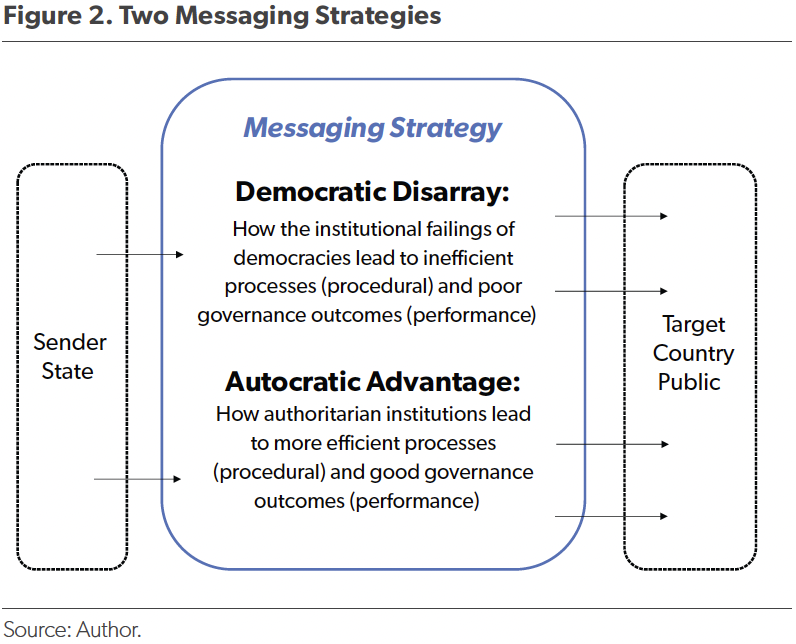
Figure 2 summarizes the two possible messaging strategies leading to political demonstration effects. In my empirical analysis, I first analyze an original Twitter dataset to examine the relative prevalence of democratic disarray versus autocratic advantage strategies in China’s overseas propaganda. I then test the two strategies’ relative effectiveness in shifting public attitudes toward democracy using a multicountry survey experiment.
China’s Propaganda Strategies on Twitter
In this section, I analyze the real-world usage of different messaging strategies in China’s propaganda campaigns on social media.
Data
To assess how state media sources implement democratic disarray and autocratic advantage framings, I collected a dataset of 8.7 million tweets, including a control population of media sources and 1.3 million posts by Chinese state media accounts, individuals affiliated with state media, and prominent government officials between 2009 and January 2023. Twitter provides an ideal environment to examine overseas propaganda produced by autocratic state media, which can reach widespread audiences globally via the platform. Previous research has demonstrated how autocratic governments use Twitter to manipulate public opinion and political outcomes in democracies.38
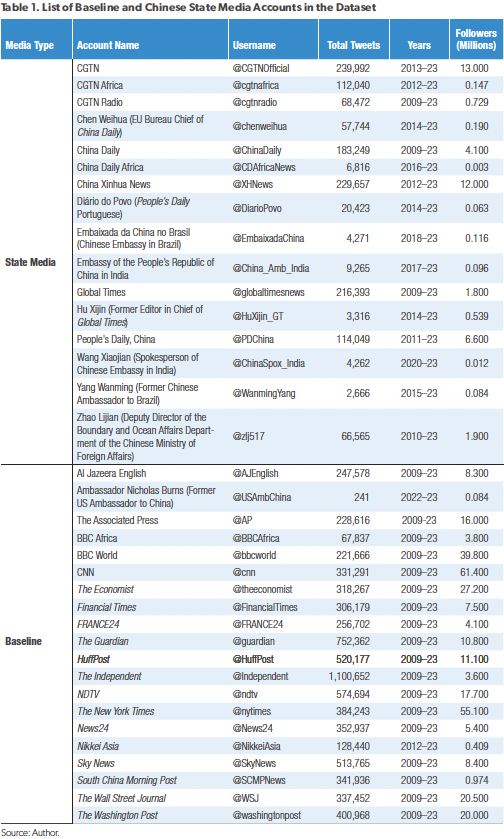
I selected accounts based on their prominence on Twitter, determined by their follower count in 2023 and the relevance of their news coverage to Brazil, India, and South Africa. My state media sample includes 16 accounts in total (Table 1), including those from leading state media organizations such as People’s Daily, CGTN, and Global Times, along with more regionally specific accounts such as those for China Daily’s Africa news section and the Chinese ambassador to Brazil. For accounts that post non-English content (the largest non-English language in my sample is Portuguese), I translated tweets into English using Google Translate before tokenization.
To evaluate the relative presence of messaging strategies and propaganda frames in Chinese state media accounts, I constructed a dataset of posts to use as a baseline. I identified the most followed English-language news accounts on Twitter in 2023 and collected their posts—over 7.3 million of them—from 2009 to 2023. My dataset draws from 20 accounts, including those of BBC World, The New York Times, and The Wall Street Journal. I also collected posts from news sources based outside the United States and United Kingdom, such as Al Jazeera, NDTV, News24, and Nikkei Asia.
Methods
I analyze this dataset using a family of unsupervised machine learning algorithms called word embeddings.39 This approach estimates words as numeric vectors and examines the relationships among these vectors in a corpus. The distribution of words immediately around a specific term (within a specified window size) is seen as a way of quantitatively capturing the meaning of that term and how it is used. In contrast to structural topic models, another popular text analysis approach that generates groupings of words at the document level, word embeddings are particularly helpful for examining the contextual use of a specific word.40 In recent work, word embeddings have also been used to measure media and propaganda framings across different corpora.41
I apply the à la carte embeddings regression method.42 This method, known as ConText, provides two main analytical advantages. First, it performs well when analyzing rare words or small corpora, whereas traditional word embedding techniques are highly data intensive. Second, it also allows researchers to draw inferences about observed covariate effects. Terms were tokenized, and English stop words, punctuation, URLs, and symbols were removed. I locally train embeddings over 10 iterations, using a window of six features.43
To analyze how Chinese state media and baseline accounts discuss political systems and governance, I identify key terms of interest across two conceptual categories in parallel with those in the survey experiment: performance outcomes and procedural characteristics. I then estimate cosine similarities between these terms of interest and other word vectors. Cosine similarity scores, which fall in the range from −1 to 1, reflect the degree to which two word vectors co-occur in similar contexts. A score of 1 would indicate that the words always co-occur, while a score of −1 indicates that they are orthogonal to one another.
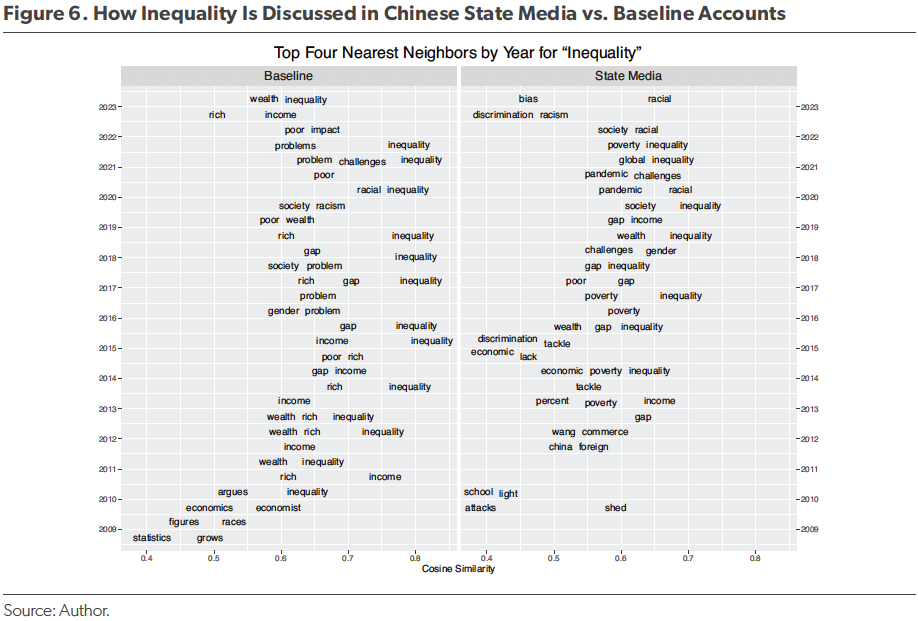
I conduct two main analyses. First, I generate the top 10 “nearest neighbors” for my terms of interest for every year of my dataset—that is, the 10 words with the highest cosine similarity scores in association with the focal term. This provides a rich contextual picture of how Chinese state media covers performance and procedural issues relative to baseline accounts, including the specific vocabulary used and how these trends may evolve over time.
Second, I compare the use of autocratic advantage and democratic disarray messaging strategies in Chinese state media and baseline accounts by estimating cosine similarity scores for specific pairs of word vectors. The animating idea is that higher cosine similarity scores indicate that these concepts are more likely to co-occur and be used together—in other words, that concepts are being framed in certain ways. For example, democracy could be discussed in association with polarization, or China’s political system could be discussed in tandem with economic development.
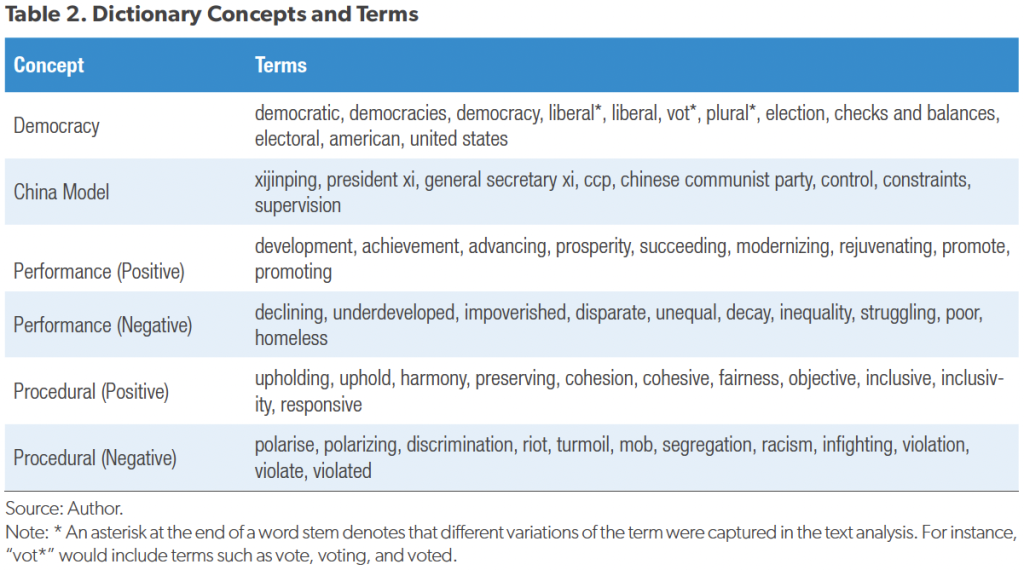
I created dictionaries for the concepts of “democracy,” “China model,” “performance,” and “procedural” (Table 2). I then estimated cosine similarities for “China model” with positive performance and procedural terms—as a reflection of the autocratic advantage framing—and similarly for “democracy” with negative performance and procedural terms, which reflects the democratic disarray framing. To compare the Chinese government’s use of these messaging strategies with baseline usage, I look at the first differences in cosine similarity scores.
In selecting dictionary terms for the concepts of democracy and the China model, I included words that capture key elements of these political systems, such as “elections” and “vote” for democracy. I also manually read random samples of tweets containing these chosen terms to verify that my interpretations of their usage contexts are accurate.44 I include words for the United States and Chinese governments, respectively.45 This is because both public audiences and media outlets (in China and globally) largely view the United States as the reference point for liberal democracy.46 Additionally, Beijing is less likely to refer to its political system as an authoritarian regime. In fact, empirical evidence suggests that the Chinese government is often eager to co-opt and reinterpret the language of democracy and civil liberties to describe its own governance system. For this reason, I refer to this dictionary as the “China model” rather than “autocracy” per se.
Results: Nearest Neighbors
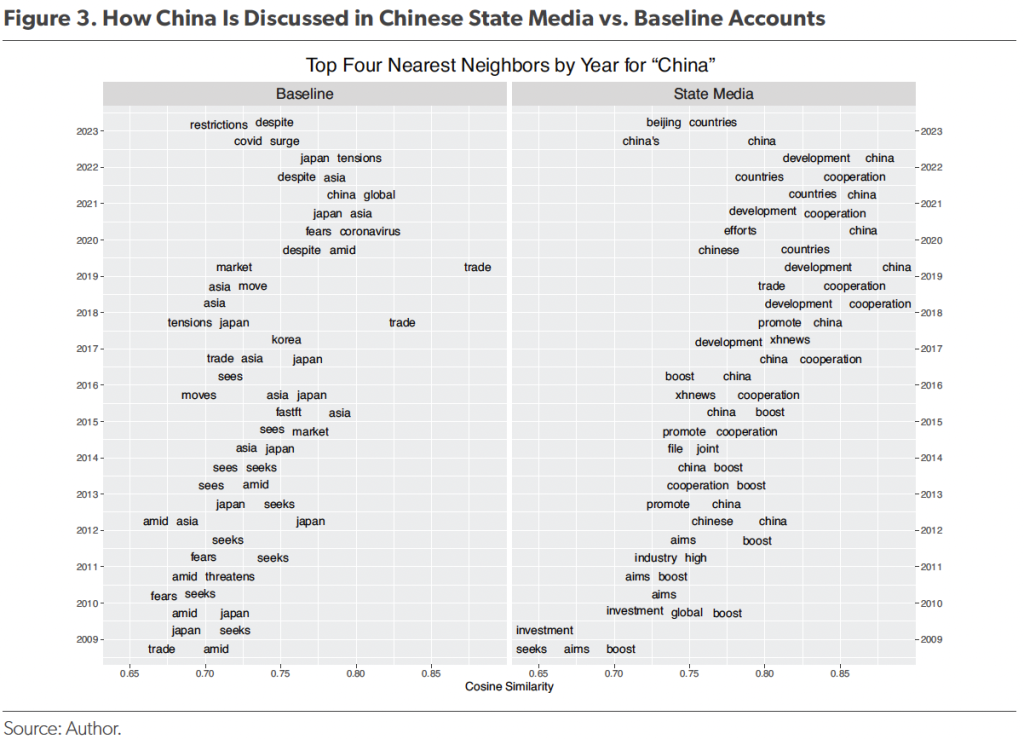
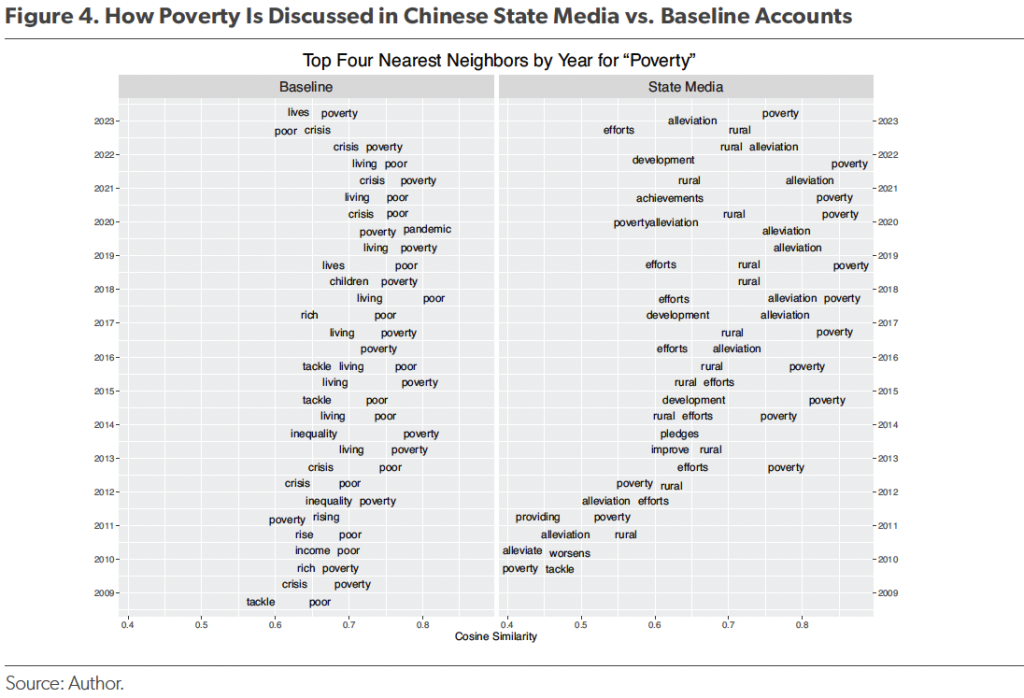
The nearest-neighbors analysis of key performance and procedural terms sheds interesting light on the tactics and language adopted in China’s overseas propaganda. Chinese state media actively frames China as a positive-sum global player, using words such as “cooperation,” “promote,” and “boost” (Figure 3). In line with an autocratic advantage messaging strategy, China is also frequently associated with positive governance outcomes and performance-related terms such as “development” and “promote,” particularly in the realm of economics and trade. When discussing poverty, Chinese state media focuses on the government’s achievements in poverty alleviation and rural development, while baseline media highlights themes of inequality and crisis (Figure 4).
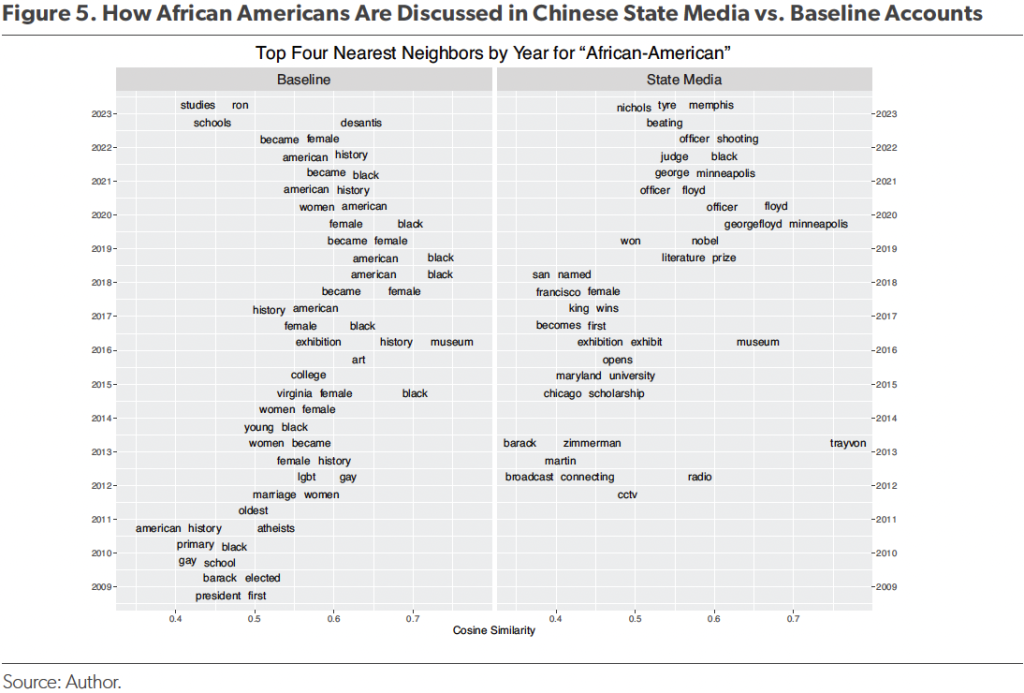
Additionally, Chinese state media actively highlights themes of polarization, dysfunction, and racial divisions in the United States—reflective of a democratic disarray strategy. For example, as seen in the plot for “African American” (Figure 5), Chinese propaganda actively uses the term alongside words such as “shooting” and “officer” and mentions of specific incidents in US politics to amplify social fissures in a manner consistent with Beijing’s use of wedge narratives targeting diaspora populations.47 Similarly, inequality is frequently linked by Chinese state media to themes of racism and discrimination, whereas the baseline news accounts discuss the concept mostly in the context of economic inequality (Figure 6).
Results: Messaging Strategies
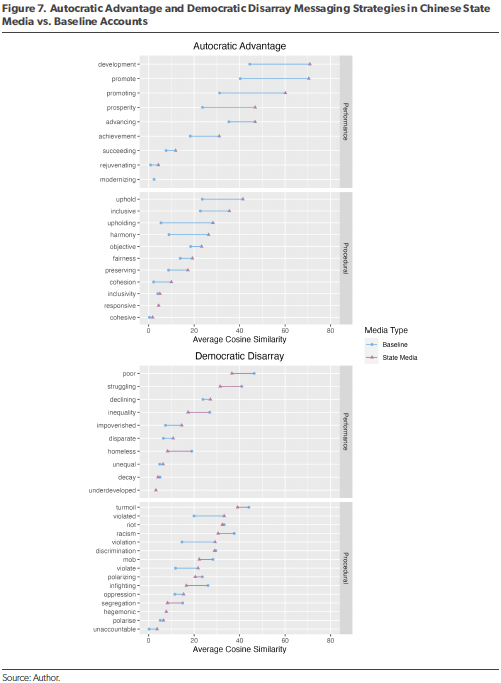
Figure 7 shows the differences in cosine similarity scores between baseline and Chinese state media accounts for the autocratic advantage (top panel) and democratic disarray (bottom panel) messaging strategies. Chinese state media is far more likely than baseline accounts are to frame China’s political system as having positive performance outcomes and procedural characteristics. For example, the average cosine similarity of the term “development” in Chinese state media was 72.5 percent—almost 58 percent higher than for baseline accounts—with similar trends in other performance-related terms such as “promote,” “prosperity,” and “advancing.” Nearest-neighbor analyses for these terms also suggest that these terms co-occur to a large degree. This points to a prominent emphasis in Beijing’s outward-facing propaganda on linking China’s political governance to delivering economic growth and social welfare. Similarly, positive procedural terms such as “uphold,” “inclusive,” and “harmony” are often used in association with China and its governance system.
The findings for democratic disarray messaging strategies are less consistent. Some words such as “impoverished” and “violated” co-occur with discussions of democracy to a greater extent in Chinese state media, but several terms that reflect negative performance and procedural outcomes—such as “poor,” “inequality,” “turmoil,” “racism,” and “infighting”—have higher cosine similarities in baseline media accounts compared with Chinese state media. This could indicate that global mainstream English-language media outlets also extensively report on many of these challenges faced by democracies (particularly the United States).
Overall, the word embeddings analysis suggests that the positive autocratic advantage messaging strategy is much more pronounced in Beijing’s outward-facing propaganda. The Chinese government pays particular attention to touting the material benefits of its political system, highlighting a narrative that the CCP effectively provides public goods and delivers on its promises to the people. This narrative also accords with Beijing’s long-standing domestic focus on performance legitimacy to maintain regime support.
The relative prevalence of autocratic advantage is further corroborated by my qualitative readings of random samples of Chinese state media posts on Twitter and Facebook in which the dominant coverage is positive news about Chinese politics, society, and culture rather than posts specifically attacking the United States or Western countries. While democratic disarray framings certainly exist, particularly in a subset of particularly nationalistic and hawkish outlets, by and large, most posts are geared toward praise of China and the CCP’s achievements. This is even more so in Chinese state media targeting developing countries, such as CGTN Africa.
Behavioral Foundations: The Effects of Authoritarian Messaging Strategies
Next, to test the behavioral foundations of political demonstration effects and compare the relative effects of autocratic advantage versus democratic disarray messaging on support for democracy, I fielded a survey experiment in three countries—Brazil, India, and South Africa. A survey experiment is particularly appropriate for providing evidence for effects at the individual level. An experimental setting allows me to randomly assign different kinds of information linking regime type with procedural and performance outcomes to assess the effects of this information on attitudes toward democracy.
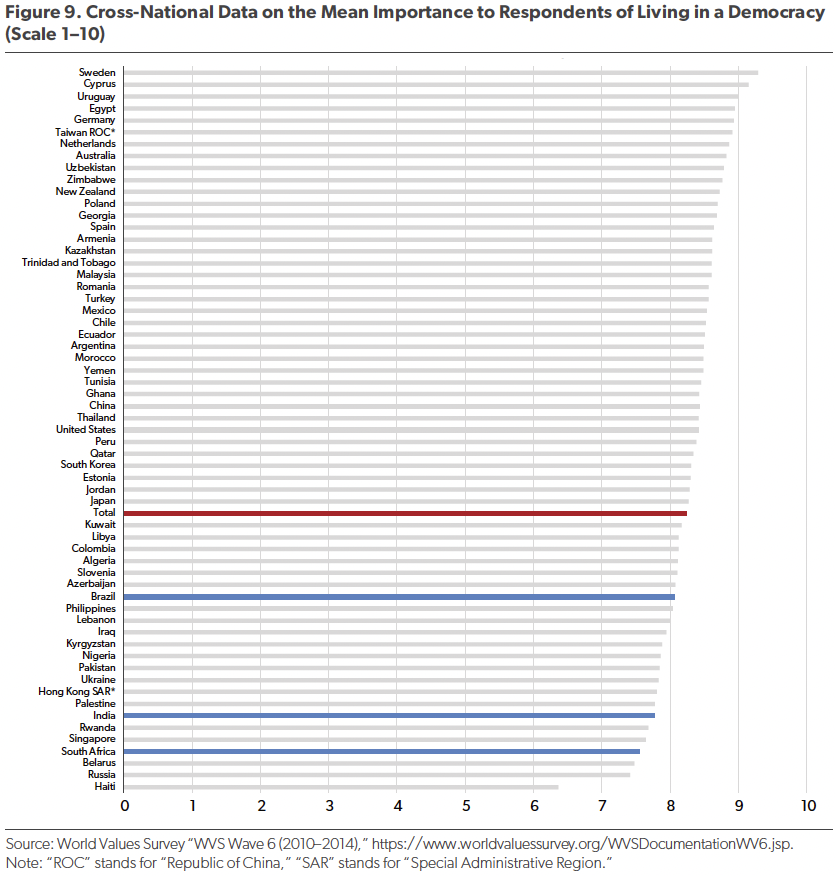
To inform case and sample selection, I draw on cross-national data from Wave 6 of the World Values Survey (WVS) for the question, “How important is it for you to live in a country that is governed democratically?” Participants were asked to respond on a scale of 1–10, where 1 is “not at all important” and 10 is “absolutely important.” Figure 8 shows the percentage of respondents by country who chose “absolutely important,” and Figure 9 shows the mean value of importance. The global average is shaded red.
I select putatively democratic countries that survey data show have unconsolidated public support for democratic norms and institutions. Brazil, India, and South Africa (shaded in blue) each fall into this category. To increase the experiment’s external validity, I select countries from different regions of the world (Africa, Asia, and South America). At the same time, these three countries share important fundamental attributes: They are large emerging economies with democratic political systems that are also characterized by cronyism or have strongman leaders who are arguably attempting to centralize power and weaken accountability mechanisms.
All three are also populous nations seen to carry considerable economic and political weight in at least their respective neighborhoods. Together with their authoritarian counterparts Russia and China, they make up the loose grouping known as BRICS. India is conventionally referred to as the world’s largest democracy, but the survey data suggest that public support for democracy there is considerably lower than the global average. Less than 30 percent of respondents in India and South Africa and under 50 percent in Brazil say it is “absolutely important” to live in a democracy. National mean values for all three countries are also considerably lower than the global average, suggesting a large spread of public attitudes toward democracy and overall unconsolidated support.
Data Collection
Respondents were recruited online through Qualtrics panel providers in March and April 2021. All aspects of the design were preregistered before the experiment was fielded. Participation was restricted to those who gave consent to participate, passed a reading comprehension check, were based in the targeted countries (based on the geolocation of IP addresses), and were over 18 years old. Aside from a gender quota to ensure even balance, no other eligibility based on demographic factors was considered. I dropped respondents who failed an attention check (a question asking them to select the month in which they were taking the survey) and those who excessively sped (defined as taking half the median time to complete the survey based on an initial “soft launch”) or delayed (those who took 2.5 times or more than the median time to complete the survey during the “soft launch”). The final N per country was roughly 600 respondents, and the total N was 1,840.

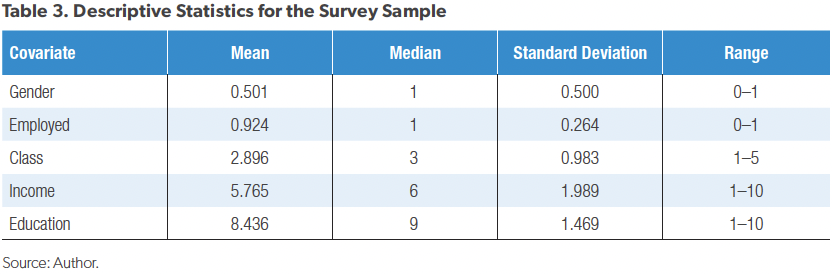
The main demographic covariates of the survey sample are presented in Table 3. Similar to other online Qualtrics samples, this sample was not nationally representative. Respondents tend to be more educated, middle-class, and employed than the average citizen in those countries. But this population represents an important, growing constituency that is more likely to have access to the internet, be engaged with political debates, and be exposed to authoritarian information campaigns in the form of social media posts. Additionally, a highly educated population, which is more likely to have liberal ideological beliefs, presents a harder test for observing any changes in political attitudes toward authoritarianism. This survey population, therefore, approximates both the politically salient and theoretically relevant groups for evaluating authoritarian messaging strategies and political demonstration effects.
Experimental Design
Figure 10 summarizes the experimental design. Respondents were randomly assigned to one of three treatment populations. The first group (T0) served as a control that did not receive any information, the second group (TD) received the democratic disarray treatment, and the third group (TA) received the autocratic advantage treatment. For TD and TA, the survey also included a manipulation check at the end to verify that respondents had successfully taken up the given treatment. This comprised four factual true-or-false questions based on information provided in the treatment vignettes.
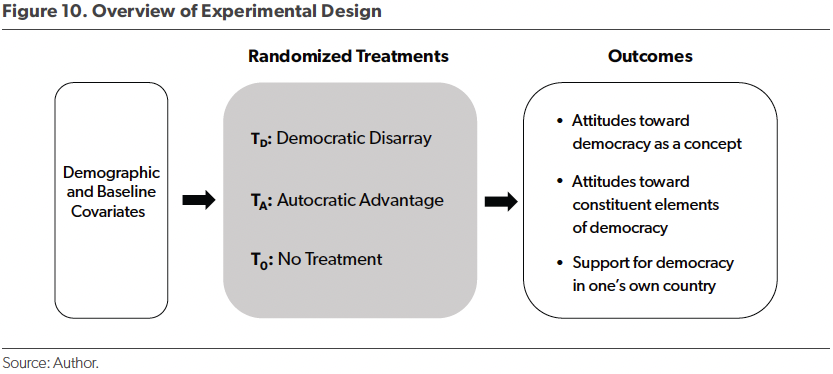
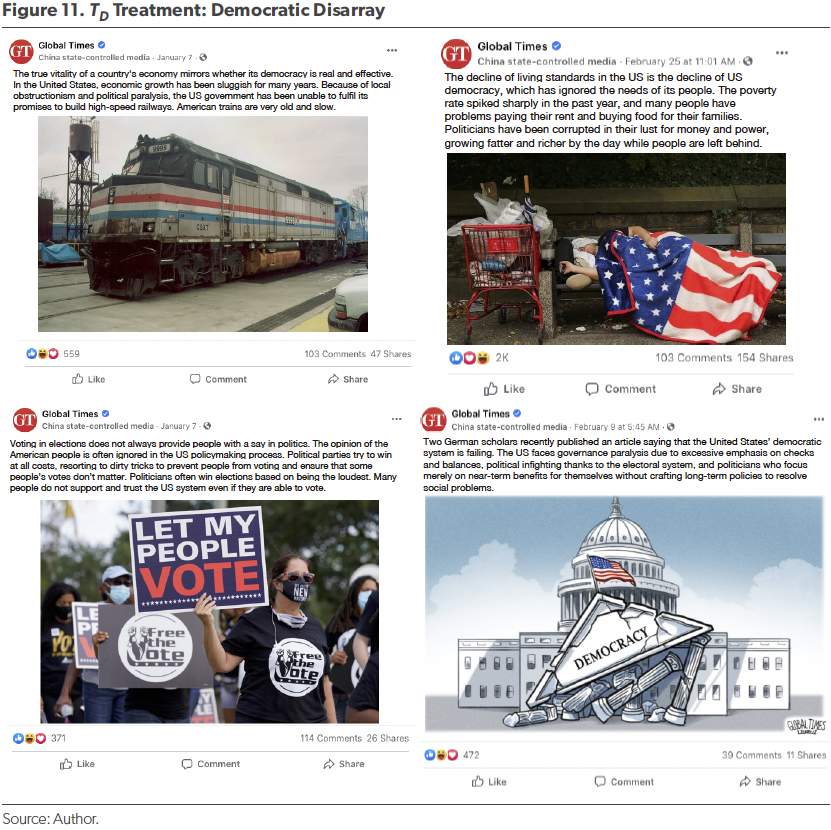
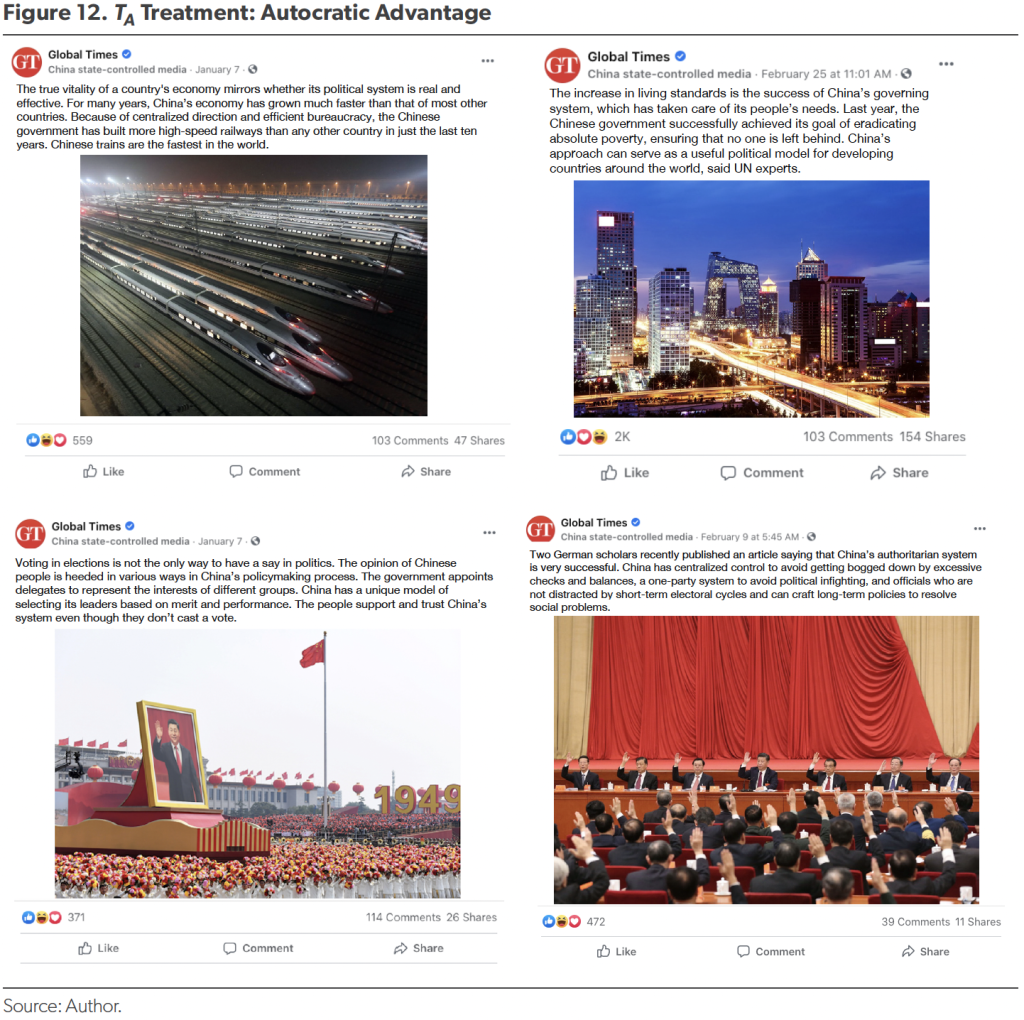
To maximize conceptual comparability and applicability across different political contexts, the content of the treatment vignettes was adapted from actual Facebook posts and media articles by a prominent nationalistic Chinese newspaper, the Global Times. Each treatment contained four Facebook posts shown in succession, discussing two performance outcomes (economic growth and social welfare) and two procedural attributes (institutional design and accountability).
Each post contained a short paragraph that explicitly linked the topic being discussed to the nature of the political system, along with a relevant image, simulating what an actual Facebook post would look like. For tangibility, the democracy disarray treatment discussed these issues in the context of the United States—a globally prominent democratic nation and frequent target of Beijing’s propaganda—while the autocratic advantage treatment discussed these issues in the context of China—again, a frequent feature of China’s information campaigns. These design choices increased external validity by simulating a high information environment while ensuring that the vignettes reflected China’s information campaigns across a range of topics. Figure 11 shows the full treatment for democratic disarray, while Figure 12 shows the parallel treatment for autocratic advantage.
I modeled these treatments’ effects on respondents’ support for democracy as a function of messaging strategy, controlling for covariates that have been shown in cross-national research to predict support for democracy. These include standard demographic covariates (age, gender, education, and income) and other factors, such as news consumption via social media and baseline political satisfaction in their country.
Outcomes of Interest
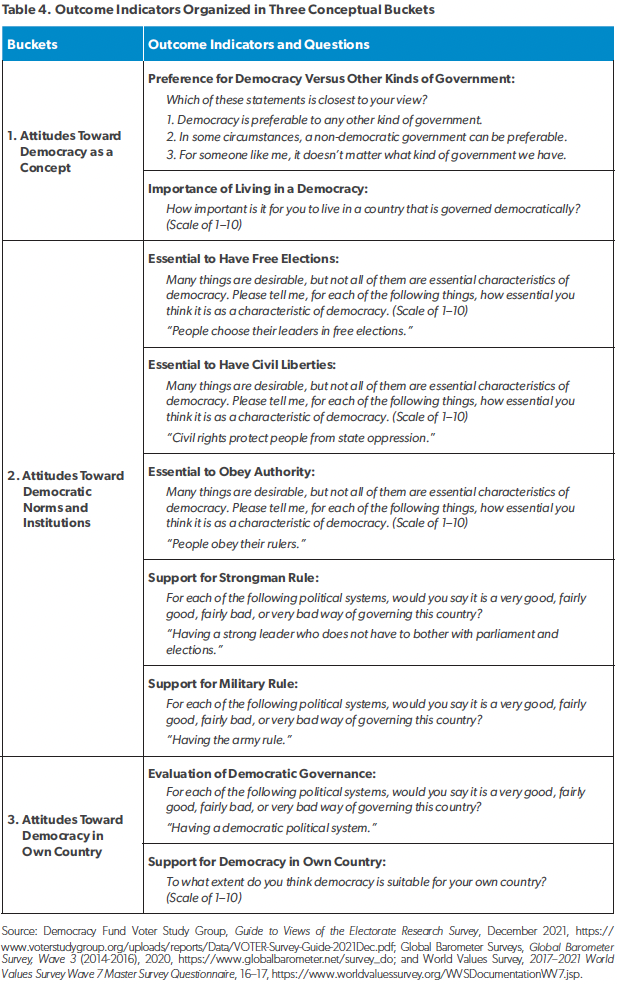
Because support for democracy is a complex concept, I measure public attitudes toward democracy using several complementary indicators. Table 4 summarizes the outcome variables of interest divided into three categories. The wording chosen for my outcome questions is identical to language used in established cross-national and US-based surveys, including the WVS, the Global Barometer Surveys (GBS), and the Democracy Fund Voter Study Group (VSG). This allows me to compare my survey’s baseline attitudes with existing data, increasing the external validity of my survey experiment.
First, I asked respondents about their attitudes toward democracy as a general concept, including whether democracy is preferable to any other kind of government and how important it is to live in a democratically governed country. Second, I asked respondents about their attitudes toward democratic norms and institutions as constituent elements of democracy. This included questions about how essential it is for people to choose their leaders in free elections, have civil liberties, and obey authority and to what extent respondents support strongman rule and army rule. Third, I asked respondents specifically about their support for democracy as a mode of governance in their own country—how good democracy is as a way of governing and how suitable democracy is for their country.
Findings and Discussion
In general, I find that autocratic advantage messaging had more significant negative effects on public attitudes toward democracy than democratic disarray messaging (Figure 13). This applied across the three categories of indicators: support for democracy as a concept, support for authoritarian versus democratic practices, and evaluations of democracy as appropriate for respondents’ own countries. Respondents who received the autocratic advantage treatment were more likely to say that a nondemocratic government could be preferable—preference for democracy over any other kind of government decreased by 0.22 points on a scale of 3, a decrease of 9 percent from the mean sample value. Views of free elections as essential decreased by 3.1 percent, while support for strongman rule increased by 7 percent. Finally, autocratic advantage messaging decreased respondents’ support for democracy as a good way of governing their country and their evaluations of democracy as suitable for their own country by 2.14 and 5.31 percent, respectively. Respondents also thought it was less important to live in a democracy generally and had greater support for military rule, although there was more uncertainty around these estimates.
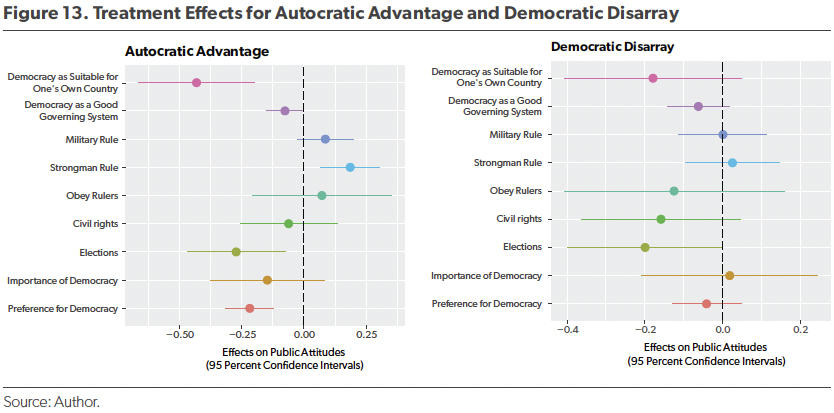
The democratic disarray treatment was much less successful at altering respondents’ support for democracy or their preference for authoritarian rule, although the point estimates mostly followed the expected patterns (and preference for free elections decreased rather substantially and significantly). Roughly two-thirds of each of the treatment populations took up the given treatment (defined as correctly answering at least three of four information checks), and the effects in this uptake population are similar to those for the full treatment populations, with a slightly more substantive effect for autocratic advantage.
Autocratic advantage could operate by revealing more new information to foreign public audiences about how nondemocratic forms of governance could lead to improved performance and procedural outcomes, whereas—for the modal respondent—themes of democratic disarray are already relatively prevalent or evident in national and global media coverage. This suggests that in countries where there is relatively little societal awareness or understanding of China, especially in terms of its political and economic systems, populations may be more likely to take Chinese government propaganda at face value. This may be the case in many developing countries, where the dominant source of information about China is often free or low-cost news content from Chinese state media. Future research could look at how pretreatment information exposure and issue familiarity condition individuals’ receptivity to propaganda about political systems. Other individual-level factors that could be interesting to examine include preexisting views of China, ideological orientation, and psychological traits such as social dominance orientation.
Overall, these findings suggest that positive propaganda touting the benefits of China’s governance model is more effective than negative propaganda in changing public attitudes toward democracy. In fact, Beijing’s use of an aggressive attack strategy, such as wolf warrior diplomacy, will likely be less successful than more traditional forms of pro-China propaganda. Moreover, the results point to the corrosive effects of authoritarian information campaigns in not just making people more disgruntled with democracy and less likely to support democratic governance in their own political contexts but also increasing receptivity to key elements of authoritarian governance. This may facilitate democratic backsliding if there is reduced public pressure to safeguard democratic norms and institutions.
Beijing’s propaganda emphasis on performance outcomes could have very strong effects on public support for democracy, particularly among those most concerned with the societal redistribution of wealth and resources, which is already the subset of the population with the weakest support for democracy.48 Evidence also suggests a link between protection-based attitudes—a combination of cultural conservatism and left-leaning economic attitudes—and openness to authoritarian governance in Western countries.49 To the extent that voters are dissatisfied with perceived elite capture by powerful interest groups at the expense of the middle class, they may be particularly receptive (or susceptible) to China’s autocratic advantage messaging strategies. Such propaganda is also more likely to be persuasive in developing countries, where new information about positive governance outcomes may serve as an aspirational reference point for those seeking to improve their standards of living. Although my analysis has focused on major emerging economies, it is also plausible that such pro-regime propaganda could appeal to segments of the population in developed democracies who feel marginalized and dissatisfied with their lot in the existing political system.
Conclusion
In examining the observational evidence of China’s overseas propaganda tactics in tandem with the experimental evidence of their effects, I find that autocratic advantage messaging strategies are more salient and effective. This is a potentially potent combination for the long arm of Chinese overseas propaganda. While much academic and policy analysis has centered on the emergence of China’s wolf warrior diplomacy attacking the West and Beijing’s use of disinformation and misinformation tactics, my findings highlight the less provocative, but perhaps more insidiously consequential, role of China’s pro-regime propaganda campaigns, focused on bolstering its global image and reputation. Such messaging is often based on some degree of truth, making it potentially even more persuasive and appealing.
Future work could disaggregate the components of autocratic advantage and democracy disarray messaging to compare the relative persuasiveness of propaganda focused on performance outcomes versus procedural processes. Studies could also investigate a related messaging strategy of autocratic gaslighting, in which China co-opts the language of democracy to describe its system, and its implications for public attitudes toward democracy. Collecting additional observational social media data could shed light on user engagement and amplification—which kinds of individuals and audiences are receiving these messages and potentially disseminating these ideas on or beyond social media. Parallel work could also investigate political demonstration effects in China and other authoritarian regimes—whether information about democratic dysfunction or autocratic advantages in governance influences mass public attitudes in autocracies away from liberal democratic ideals and in favor of continued one-party rule.
The concept of political demonstration effects is highly salient in the context of authoritarian information statecraft, which has actively sought to spread narratives of democratic dysfunction and autocratic advantage. Examining the impact on domestic political attitudes in targeted countries has significant bearing on not just the trajectory of internal democratic consolidation but also global trends of democratization. Just as autocratic propaganda is increasingly outward facing, public attitudes on seemingly domestic political issues can be directly or indirectly a function of—or contribute to—broader geopolitical competition. Should the legitimacy of contrasting political systems continue to be an area of contestation between China as an authoritarian rising power and the United States as an established democratic hegemon, it will be crucial to understand the prevalence and endurance of political demonstration effects and the efficacy of such authoritarian information campaigns.
About the Author
Audrye Wong is a Jeane Kirkpatrick Fellow at the American Enterprise Institute, where she focuses on China’s foreign policy, economic statecraft, propaganda and disinformation campaigns, and foreign influence operations. Concurrently, she is an assistant professor of political science and international relations at the University of Southern California.
Acknowledgments
I thank Stephen Schick for excellent research assistance and the Massachusetts Institute of Technology’s Program on Grand Strategy, Security, and Statecraft and the University of Southern California’s Center for International Studies for funding support. For helpful comments, I thank Meir Alkon, Larry Diamond, Genia Kostka, Maria Repnikova, participants at the 2023 University of Chicago “Domestic Politics in the Shadow of International Competition” workshop and audiences at the American Political Science Association, International Studies Association, Harvard Kennedy School, University of Oxford, and Fordham University.