
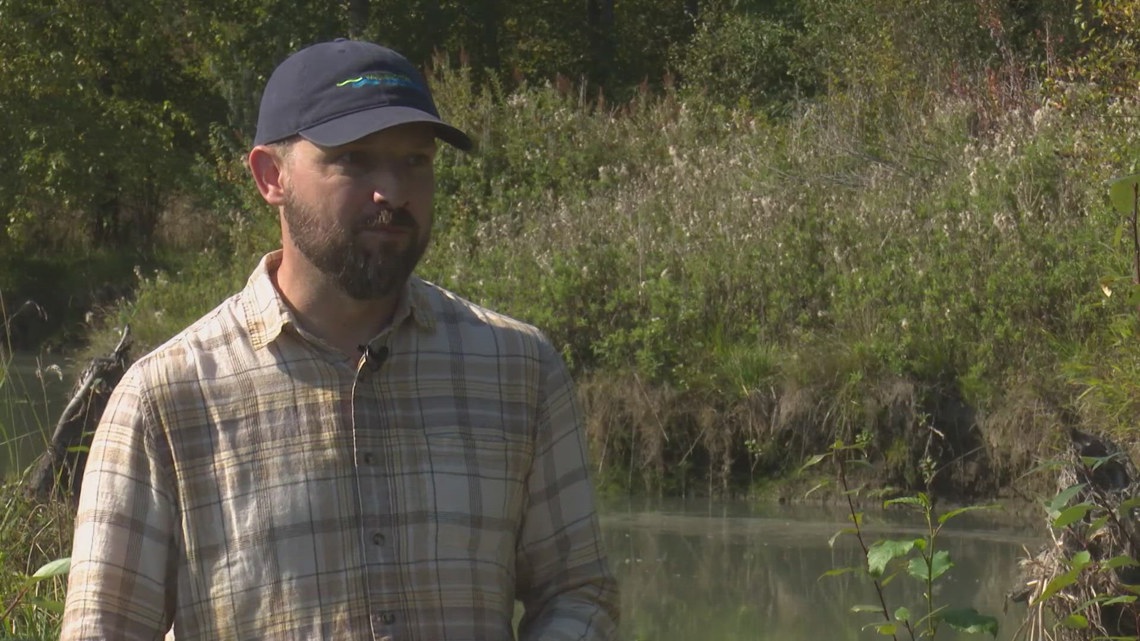
The collaborative water-sharing program pays agricultural producers to support the spawning season in the Dungeness.
SEQUIM, Wash. —
Through an innovative partnership among farmers, the Jamestown S’Klallam Tribe, and conservation groups, the stakeholders along the Olympic Peninsula’s Dungeness River are demonstrating how collaboration can address water scarcity and protect a Washington icon: salmon.
The program pays farmers to voluntarily stop irrigating from the river during the final month of growing season, leaving water in the river for spawning salmon during drought years.
For fourth-generation dairy farmer Ben Smith, who now serves as president of the local Water Users Association and whose family has farmed the land since 1933, it’s a practical solution.
“We have a limited resource in water. We have decreasing fish runs. And we have a need to produce food,” Smith said. “That’s been a great tool in our toolbox as a community.”
The lowering river levels comes from a one-two punch from mother nature: typically dry conditions combined with recent worsening drought.
The Dungeness River watershed sits in the rain shadow of the Olympic Mountains, where geography create one of the driest areas in the Pacific Northwest. While the western slopes of the mountains receive more than 100 inches of rain annually — including 101 inches on average in Quillayute, 120 inches on average in Forks and around 130 inches annually in the Hoh Rain Forest, Sequim averages just 17 inches per year.
“Just 40 or 50 miles that way, you have the Hoh Rain Forest, some of the wettest area in the whole country. But here it’s actually really dry because the moisture doesn’t make it across the mountains,” said Chris Czarnecki, development director for Washington Water Trust. “What that means is this watershed is particularly susceptible to drought.”
The normally dry conditions are exacerbated by drought.
Drought has been declared on the Dungeness in three consecutive years and in five of the last 10 years, according to Czarnecki. The declining water levels have impacted multiple salmon species, including Dungeness chinook, which dropped to such low numbers they were designated a “limiting stock” — meaning fishing for all species was restricted to avoid accidentally catching the endangered chinook.
The Jamestown S’Klallam tribe has been working for decades to rehab this river specifically because of the rich biodiversity and multiple salmon species that spawn here.
“The S’Klallam will very frequently refer to themselves as salmon people,” said Hansi Hals, the director of natural resources at the Jamestown S’Klallam tribe. “It’s very heartfelt, the efforts of salmon recovery.”
The tribe had already invested in extensive habitat restoration, including a major project that began as an idea in the early 1990s and took more than 20 years to complete. Three years ago, they relocated a dike to restore the river’s floodplain, allowing natural river function to return. They also installed engineered log jams to create deep pools that provide crucial salmon habitat.
Then, drought became more prevalent.
“Now we have habitat and fish and we’re watching, okay, well what else is going on to limit fish, and we’re seeing that in the last several seasons we’ve had declared drought,” Hals said.
The solution emerged through continued dialogue among all parties.
The current water-sharing program builds on nearly three decades of collaboration that began in the 1990s when species in the river were first listed as endangered.
Smith’s family and other farmers formed the Water Users Association, representing seven irrigation districts with water rights to the Dungeness. They chose to work together with the tribe and environmental regulators to find solutions.
“Thank goodness for my father and his fellow farmers and our tribal community at that time who had the foresight to know that we can disagree all day long but if we stay at the table, we’re not going to waste money in court,” Smith said. “We’re going to figure out a solution the best we can and be able to move the ball forward, use funds to fix the problems.”
The first formal agreement came in 1998 — a memorandum of understanding among the agricultural community, the Jamestown tribe and the state Department of Ecology. Initially, irrigators committed to leaving 50% of the water flow in the river. That standard later increased to a minimum of 60 cubic feet per second.
As droughts became more frequent, the partners recognized they needed additional tools to help salmon during late summer, when adult fish return from the ocean to spawn and water levels hit their seasonal lows.
The stakeholders have developed two similar but different programs to fix the problem of decreasing river levels.
Under the “dry year leasing” program, farmers voluntarily opt in to stop irrigating for the final month of the growing season — typically August and September — in exchange for payment. The compensation is calculated based on the production value of the crop they forgo, usually their final cutting of hay or other crops.
“We gathered our data and said, okay, if we lose our last crop, we know what that production loss is and said, okay, this is what it’s going to take to make us whole for that last cutting that we’re basically forgoing by not irrigating,” Smith explained.
That final cutting can represent 25% of a farm’s annual production. For Smith’s operation, which farms about 1,000 acres of pasture, hay, corn silage, barley and vegetable seeds, compensation ensures the farm remains economically viable.
“With the land base we have available, we can nearly double the production off of it if we have access to water,” he said.
The second initiative, called “pulse flows,” asks participating farmers to shut off irrigation for half a day to a full day once a week for several weeks. This creates an artificial surge of water in the river that mimics a rain event, triggering salmon to move upstream.
To test the pulse flow concept, technicians tagged fish and tracked their movement. The data showed salmon responded to pulse flows the same way they responded to natural rainfall, validating the approach.
The programs require funding to compensate farmers for lost production. A combination of public and private resources has made the effort possible.
Amazon has committed approximately $750,000 over three years to support the initiative. Will Hewes, Amazon’s global water stewardship lead, said the company identified the Dungeness as a priority due to its rich biodiversity and the collaborative approach already underway.
“You can’t ask them to do something for nothing, but you have corporations that have water stewardship goals with funding available,” Hewes said. “We listen to the experts. We say, what does this area need in terms of water resources, and they said this is such a high priority because of the rich biodiversity.”
The Washington State Department of Ecology has also been a key partner, providing $215,000 toward the Dungeness drought program this year alone, building on support from previous drought years.
“It’s a nice example of both private and public resources together supporting the effort to ensure streamflow for salmon during the drought emergency,” Czarnecki said. The combined funding from both sources enables a significantly more substantial drought response than either could support alone.
Amazon’s funding structure includes flexibility to carry over unused money between years, ensuring resources remain available when drought conditions are most severe.
The program has produced encouraging results in its first years. Salmon returns have improved, including a strong showing this year of pink salmon, which return in two-year cycles. Tens of thousands of pinks came back to spawn, according to Hals.
For Smith and other participating farmers, the program has worked well.
“That’s been a great tool in our toolbox as a community to help both keep ag whole during those low-flow drought years, basically go out and purchase the feed that we’re not able to use on our farm,” he said.
The collaborative approach has attracted attention from other watersheds facing similar challenges.
“You have a lot of different groups of people coming together, wanting to find the solution together,” Czarnecki said. “Water can be this contentious thing, but here everybody knows it’s important for human use but also for the environment.”
Hals emphasized the spirit of partnership: “How can we find a solution together? And the dry flow leasing and pulse flow leasing is very much in the model of doing that together — collaborative, hard for everyone and yet great for the resource.”
As climate patterns continue to evolve, stakeholders are already exploring additional solutions, including the possibility of building a reservoir to capture and store water during high-flow years. Smith acknowledged uncertainty about whether such a project would work but said the collaborative approach means all options remain on the table.
“Drought, low flow conditions are only getting more challenging, so it’s a program that’s going to be needed as we move forward,” Czarnecki said.
Salmon populations, while still recovering, have shown improvement. “The populations have been declining recently, so it’s really important that we don’t let these salmon species, this incredible symbol of the people in Washington, go away,” Czarnecki said. “We have to protect them and help them come back.”