
IN A NUTSHELL
🛰️ Satellites like CryoSat-2 have revealed hidden subglacial lakes in Antarctica.
These lakes are part of interconnected hydrological networks that affect glacier movements.
Sudden drainage of lakes acts as a lubricant, accelerating glacier flow towards the ocean.
The hidden lakes demand updated climate models to accurately predict sea level rise.
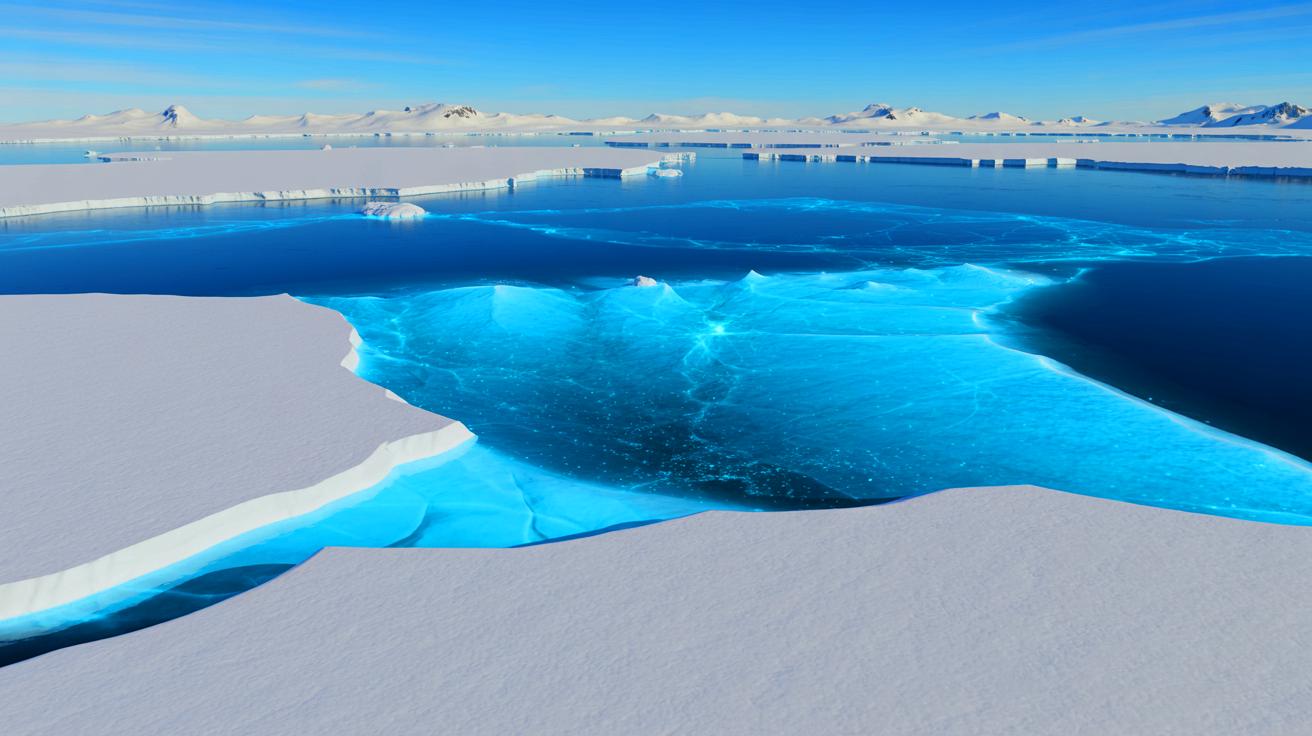
Deep beneath the icy surface of Antarctica lies a hidden world that could dictate the future of our global coastlines. Recent satellite technology has unveiled the existence of subglacial lakes, bodies of liquid water trapped under miles of ice, that play a crucial role in the melting of glaciers and the rising of sea levels. This discovery challenges the previous perception of Antarctica as a static, frozen continent. Instead, it reveals a dynamic landscape where these mysterious lakes influence both the ice above them and the oceans beyond.
How Satellites Revealed Hidden Subglacial Lakes
For many years, the concept of subglacial lakes was merely a hypothesis. The idea that liquid water might exist beneath ice sheets millions of years old seemed improbable. However, the launch of modern satellites, such as the European CryoSat-2 in 2010, has transformed this hypothesis into a reality. Equipped with radar altimeters, these satellites can detect minute surface variations, sometimes just a few centimeters, observed over extended periods.
In a decade, researchers have identified 85 new active lakes, bringing the total number of known hydrological entities beneath Antarctica to 231. These findings indicate that the continent’s surface is not as static as once thought. It experiences subtle movements, rising and falling as these subglacial reservoirs fill and empty. Some lakes take years to fill, while others drain within months, releasing volumes of water comparable to hundreds of Olympic-sized swimming pools.
Understanding the Role of Interconnected Hydrological Networks
Subglacial lakes do not exist in isolation. They are part of extensive interconnected hydrological networks. Water can travel from one lake to another, akin to a system of communicating vessels. An important study published in Nature Communications highlighted five major systems of these interconnected lakes. One notable example is located beneath the David Glacier, where the drainage of a lake supplied water to another lake over 60 miles away.
Each lake behaves uniquely. Some fill without ever draining, while others undergo complete cycles. Certain lakes progress in stages, like an invisible staircase. Even their geographical boundaries are fluid, expanding or contracting by 10 to 50 percent. This movement under the ice is a testament to the dynamic nature of these hidden systems.
Why These Lakes Accelerate Glacier Melting and Sea Level Rise
The existence of these subglacial lakes is not just a scientific curiosity; it has significant implications for global sea levels. When a lake suddenly drains, it acts as a natural lubricant, reducing the friction between the ice above and the rocky bed below. This reduction in friction allows glaciers to slide more rapidly towards the ocean. In certain regions, such accelerations have increased by 10 percent, with effects lasting more than a year.
These invisible dynamics are crucial for climate models. Without incorporating them, predictions of sea level rise will remain incomplete. A faster rise in sea levels poses a substantial threat to millions of people living in coastal areas worldwide.
“We Spent $36,000 To Prove The Earth Is Round,” Flat Earther Admits Shockingly
Towards Better Understanding to Anticipate Risks
The old image of an unchanging Antarctic landscape is rapidly being replaced by the understanding of a complex hydraulic system beneath the ice. This system is sensitive to even the slightest changes. It is a fascinating revelation of Earth’s liveliness, yet it is also a cause for concern as these processes can directly impact our future.
These subglacial lakes are akin to the backstage of a theater. Though invisible, they are the forces moving the scenery, and in this case, the scenery is the level of the oceans. As we continue to study this hidden world, the question remains: how will these revelations change our strategies for dealing with climate change and its impacts on our planet?
In light of these discoveries, it becomes imperative to deepen our understanding of the Antarctic’s hidden waterways. Their influence on global sea levels underscores the need for comprehensive climate models that incorporate these factors. As we navigate the complexities of climate change, we must ask ourselves: how can we better predict and mitigate the looming risks to our coastal communities?
This article is based on verified sources and supported by editorial technologies.
Did you like it? 4.4/5 (23)