
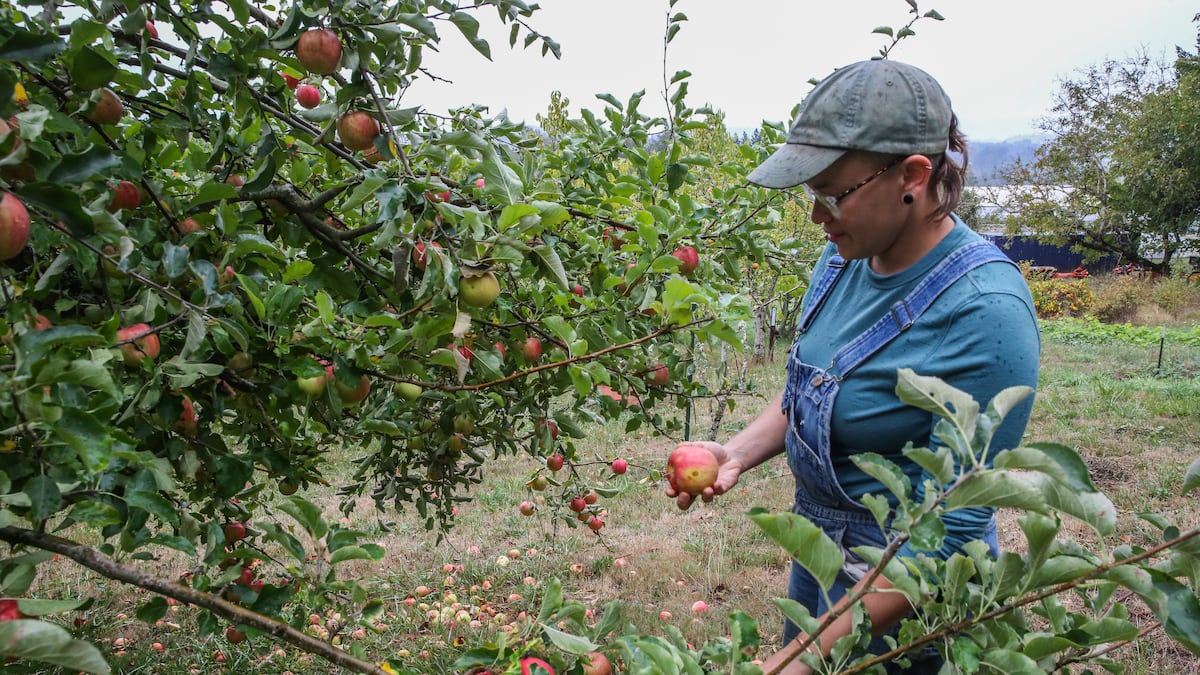
Farmer and nurse, Bear Carter, inspects apples on her farm in Troutdale, Ore. on Sept. 29, 2005.
Kristian Foden-Vencil / OPB
Most of us weren’t around to see the Dust Bowl of the 1930s. But a mixture of drought and poor farming practices saw the topsoil of a half dozen states stripped away. Picture the dusty and desolate landscape of John Steinbeck’s “The Grapes of Wrath.”
The government’s reaction was to create soil conservation districts across the country, according to Kelly Beamer, the executive director of the East Multnomah Soil and Water Conservation District.
“Our district was started in 1950 by a group of passionate landowners and farmers that wanted to come together and focus on soil erosion,” Beamer said.
Back then, three-quarters of the Portland metro area was rural, filled with hundreds of small farms. The new conservation district taught farmers and landowners the importance of things like cover crops and contour farming.
But Multnomah County is now largely urbanized and home to about 800,000 people. So the question is: Does the county still need a conservation district?
“We absolutely still need a soil and water conservation district,” said Beamer. “We’re still working with individual folks to rebuild riparian areas with clean, cool rivers for our salmon. We are looking at building community gardens and rain gardens. We’re looking at things like our tree canopy, that’s essential for keeping neighborhoods cool.”

The executive director of the East Multnomah Soil and Water Conservation District, Kelley Beamer on Sept. 26, 2025.
Kristian Foden-Vencil / OPB
One of the district’s other main aims is to preserve farming in the area. That means stepping in when farms change hands.
Last year, the owners of the 10-acre Crooked Tine Farm, outside Troutdale, wanted to sell the property and retire. The asking price was $815,000, mainly because the property could be developed or bought by a well-to-do family. At that price, farming simply wouldn’t cover the investment.
But the owners wanted it to remain a working farm. So they worked with the conservation districts’ Forever Farm program to place a conservation easement on the land, essentially blocking future building or zoning changes.
“The value of the land goes down,” Beamer explained, because there are no more mineral rights for Crooked Tine Farm, or timber rights or development rights. “It ensures that going forward, no matter who buys it, it’s going to always remain a farm and it’s going to always be available for farmers.”
The easement reduced the Crooked Tine Farms’ value by 38%. So the district bought it for $815,000 and sold it for $500,000.
The new owner, Bear Carter, said that the big reduction meant she and her partner could now afford the deal.
“Before we found this property, I didn’t know what the soil and water conservation board was,” Carter said. “They have made purchasing and conserving farmland a possibility. And it’s a partnership.
“We have some rules that we have to abide by. Most of them are things that we wouldn’t do anyway. We’re not going to turn this into a dirt bike park. We’re also not going to dump a bunch of rusty old cars down at the end of the property.”

Bear Carter feeds her goose at the Crooked Tine Farm in Troutdale, Ore. on Sept. 29, 2025.
Kristian Foden-Vencil / OPB
What they are going to do is farm. If not for the conservation district, Carter said they might have had to move back to Missouri for cheaper land or buy a much smaller property.
Carter said it’s been a tough but enjoyable first year. On one hand, they had a great carrot crop. But on the other hand, a beetle infestation ruined their cucumbers.
“The conservation district, I mean, without them, I don’t have any idea how we would have gotten such an incredible piece of land to work,” Carter said.

Onion crop, Crooked Tine Farm in Troutdale, Ore., Oct. 29, 2025.
Kristian Foden-Vencil / OPB
The East Multnomah Soil and Water Conservation District has helped 14 such new farms this way over the last 13 years via the Forever Farm program.
The agency is supported by $6.4 million in property taxes, or about $53 per year for the owner of the average Portland home.
And the district continues to change with the times. Until two years ago, all board members had to own at least 10 acres to be elected. But not anymore.
New board member Ramona DeNies lives in Portland’s Montavilla neighborhood, far away from any farmland. She said the conservation district is also crucial in her area.
“We have headwaters of salmon streams that are captured within the district that I represent,” said DeNies. “It’s very important to me that these are healthy salmon streams.”
DeNies is currently working on removing a dam along Kelly Creek at Mt. Hood Community College.

New board member of the East Multnomah Soil and Water Conservation District, Ramona DeNies, lives in the urban neighborhood of Montavilla.
Kristian Foden-Vencil / OPB
Oregonians vote on board members for their soil and water conservation districts every two years. There are 45 districts in Oregon and more than 3,000 nationwide.