
A few years ago, Rebecca Hu-Thrams and her business partner, Areeb Malik, rented an attic from an ad on Craigslist to test out their robots using artificial technology.
Fast forward and their company, California-based Glacier, which develops robotic waste recycling systems, has its technology in more than 70 facilities in major cities across the country, including Los Angeles, Chicago and Detroit.
Now Glacier has arrived in central Pennsylvania.
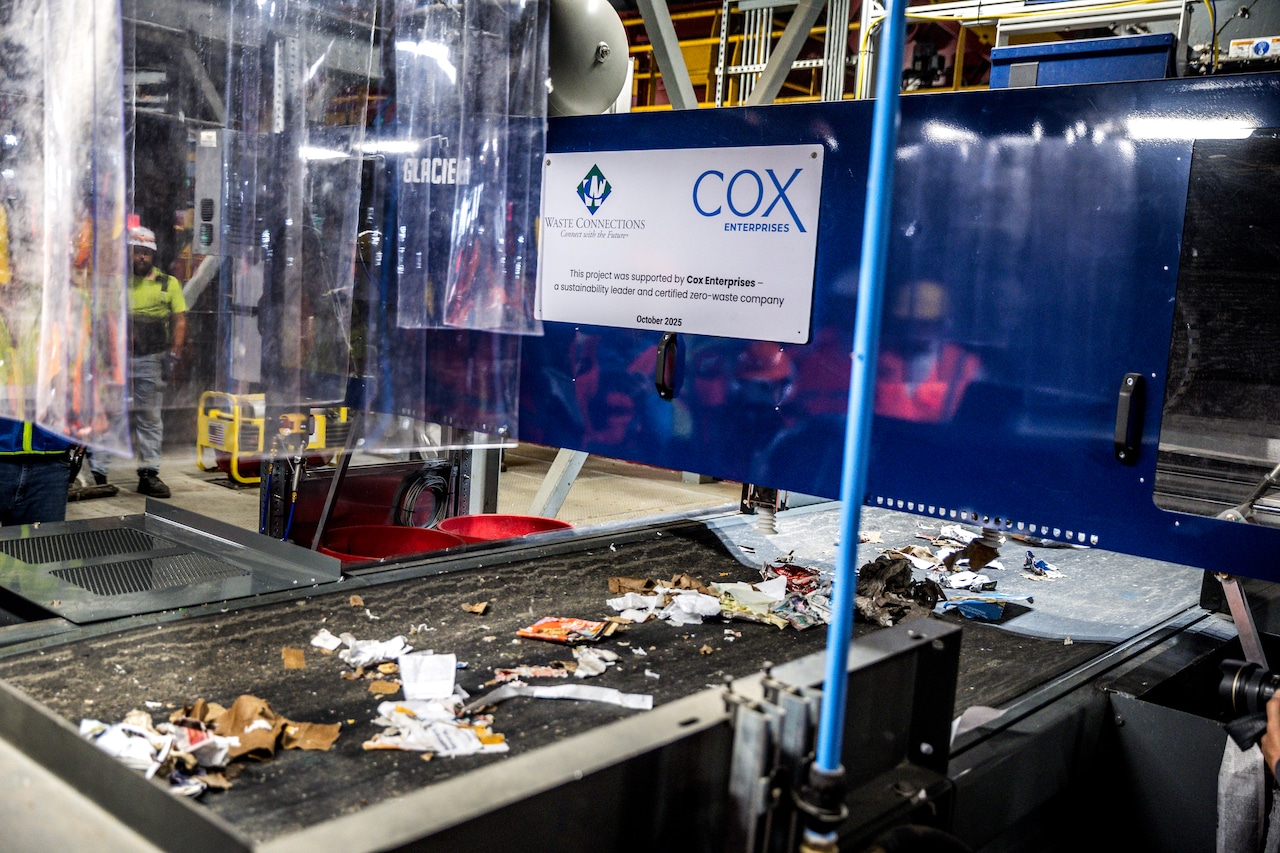
Earlier this month, Glacier installed its robotic recycling system at Penn Waste’s material recovery facility in Manchester Township, York County. The material recovery facility is where recycling bin material is sorted into categories — and where items that can’t be recycled are removed.
The robot at the Penn Waste facility is on a paper sort line picking out cardboard, plastics, and other items.
Two robotic arms with suction cups on the blue machine drop down and sort the materials.
Hu-Thrams explains that a camera in the machine is taking live footage of everything that’s coming down the belt. She said the company’s proprietary artificial intelligence model is trained on more than three million images and can detect what items are rolling through.
“It then feeds that information to the robot,” she said. “When I say feeds that information, it is in a matter of milliseconds. Because you can imagine that material is constantly coming.”
“Now the robot knows what the items are, where they are on the belt, and based on the item, whether it should pick it and where to sort it. So then the arms can move in tandem to pick up that target item and put it into the right bin or the right chute.”
Hu-Thrams said that the robot can detect up to 70 different types of materials, from aluminum cans to toothpaste tubes.
“We’re even getting to the point now where we can detect the brand of items that are coming down the belt,” she said. “Our robots — they usually pick up to about 45 picks per minute.”
Hu-Thrams said the robot at Penn Waste is recovering nearly 16,000 items per day.
In addition to sorting the materials, Glacier’s vision system provides real-time data about what’s being recovered.
“The insight helps us make better operational decisions and improves the quality of the materials leaving this building,” said Kyle Byler, a division vice president at Waste Connections, which owns Penn Waste.
Officials were quick to point out that the robot is not replacing employees. The facility employs 32 people.
“This is not replacing what we do here,” Byler said. “It’s complementing the technology we already have and helping our operation run smoother and safer. This addition helps us recover more of what matters — clear paper, more cardboard, more [plastic] while taking some of the repetitive, tougher work off our team’s plate.”
“Sorting by hand can be physically, and sometimes risky. The AI unit takes on the repetitive side so our people can focus on higher skills, safer roles. This is a great example of technology working with our people rather than replacing them.”
Officials note that safety at the facility has become a growing concern in recent years.
A fire in March 2022 destroyed nearly all the equipment and electrical controls inside the 96,000-square-foot building. Penn Waste officials said that an investigation revealed the cause of the fire was most likely a rechargeable battery.
Penn Waste officials decided not only to rebuild, but to upgrade the recycling facility. Fire detection and suppression systems were installed and the facility was back online in about a year.
Officials said other items that wrongly end up at the recycling center include needles, glass, and propane tanks — all items that people regularly place in recycling bins.
Glacier’s primary investor is Cox Enterprises, which owns major brands including Kelley Blue Book, Auto Trader, and Manheim auto auction.
Hu-Thrams said the robot is not just a shiny piece of equipment
“What you’re really looking at, in my opinion, is the possibility of what can be done to solve society’s challenges when technology is applied thoughtfully with the right partners. And what you end up with is the opportunity to improve the quality of work, the quality of materials, and ultimately the quality of life in all of the communities that we live in and serve,” she said.
Penn Waste was founded in 2000 and acquired by Waste Connections in 2019. The company provides waste management and recycling services in York, Lancaster, Cumberland and Dauphin counties, and in small parts of Adams and Perry counties.
Waste Connections serves approximately nine million residential, commercial, and industrial customers across 46 states in the U.S. and six provinces in Canada.
If you purchase a product or register for an account through a link on our site, we may receive compensation. By using this site, you consent to our User Agreement and agree that your clicks, interactions, and personal information may be collected, recorded, and/or stored by us and social media and other third-party partners in accordance with our Privacy Policy.