
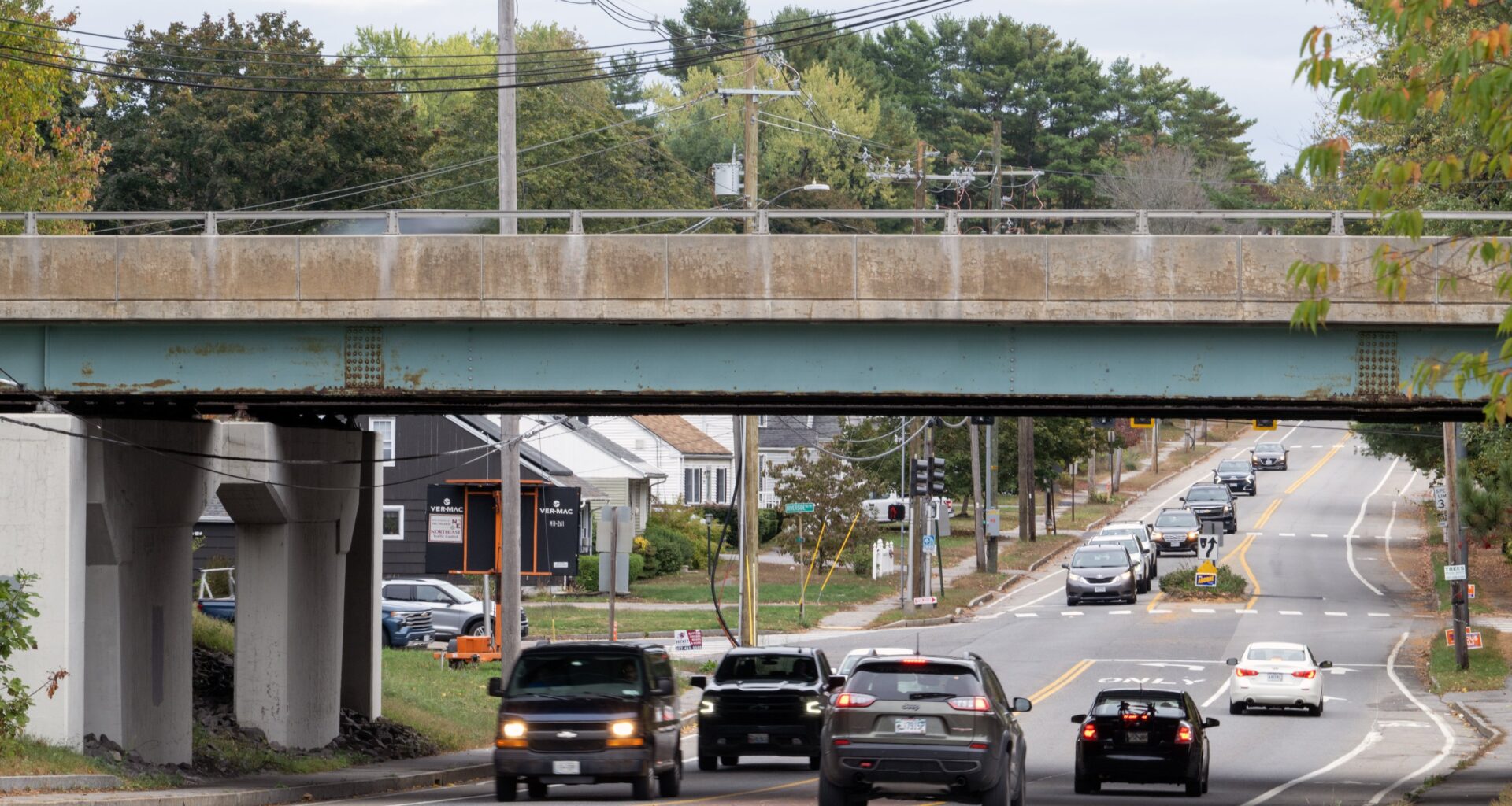
After years of promises, the Maine Turnpike Authority is finally taking steps to install noise barriers along a quarter-mile stretch of the toll highway that runs through a residential neighborhood off outer Forest Avenue in Portland.
It can’t happen soon enough for Deb Nason, who has lived beside the turnpike for nearly 40 years and had no luck prodding the state agency to address the noise problem in the past.
In that time, the roar of passing cars and trucks has only grown louder. Trees have been trimmed and removed as part of safety and construction projects, she said. At the same time, the number of passing vehicles has increased to about 50,000 each day.
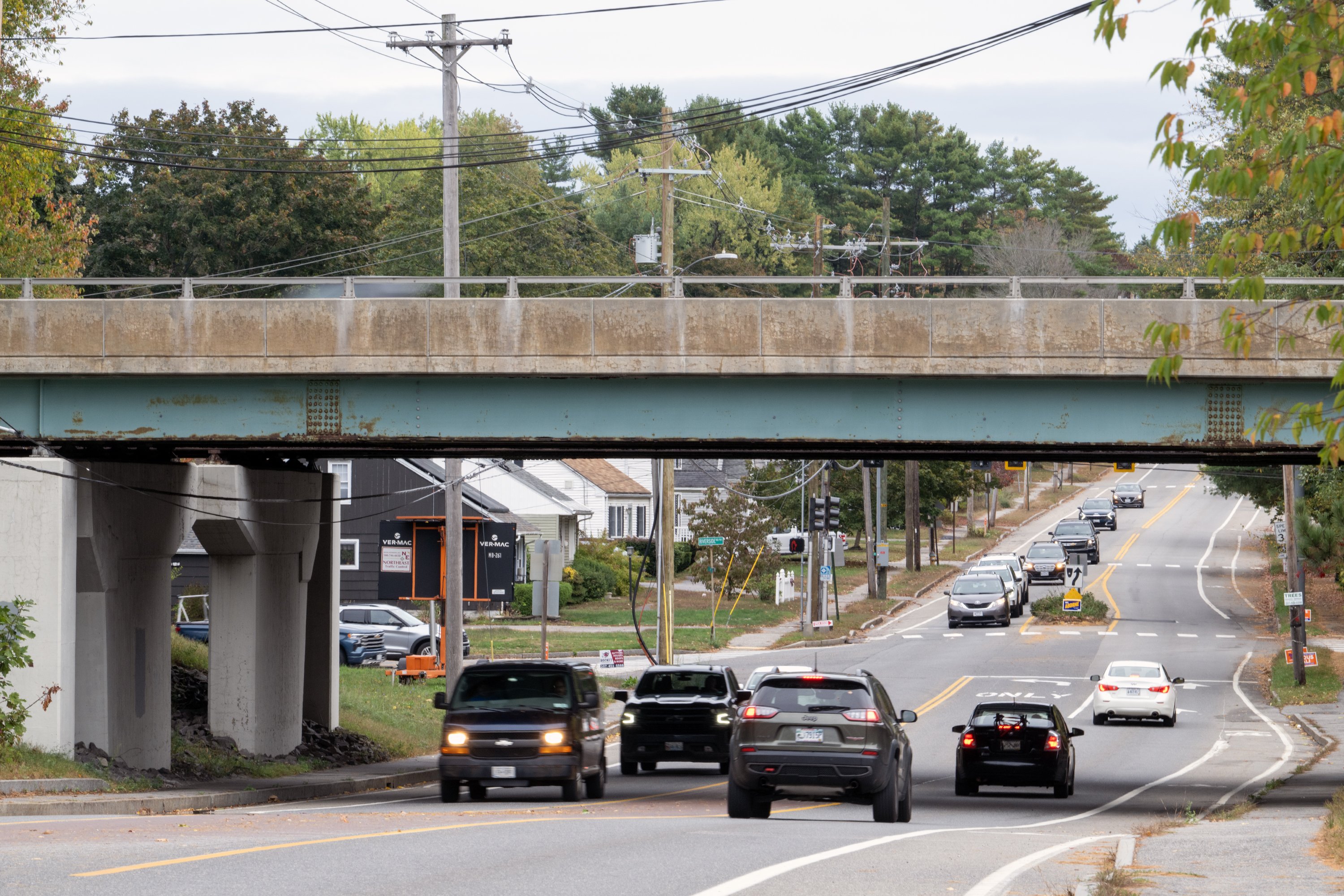 Traffic passes along Forest Avenue underneath the Maine Turnpike bridge in Portland on Wednesday. Fixing the noise problem where the turnpike crosses outer Forest Avenue is one of the first projects Andre Briere has targeted as the authority’s new executive director. (Daryn Slover/Staff Photographer)
“It’s awful,” Nason said, straining to be heard while chatting on her deck. At the edge of her property, up an embankment, vehicles fly along the highway, largely unobstructed but for the bare trunks of tall pine trees.
“I love my deck, but I don’t sit out here because it’s too noisy,” she said. “I’d love to sit out here and have a cup of coffee and listen to the birds, but I can’t because the noise is constant.”
MEETING WITH NEIGHBORS
Fixing the noise problem where the turnpike crosses outer Forest Avenue is one of the first projects Andre Briere has targeted as the authority’s new executive director. It’s part of a fresh approach to strategic planning and public engagement that Briere launched soon after he was hired in April.
The new approach, encouraged by the authority board, comes in the wake of recent public controversy over the Gorham Connector proposal, which was meant to address commuter traffic congestion west of Portland. The authority essentially scrapped the proposal and left it to the Maine Department of Transportation to solve the congestion problem.
 Traffic passes along Forest Avenue underneath the Maine Turnpike bridge in Portland. (Daryn Slover/Staff Photographer)
Briere and his staff held a community meeting in Nason’s neighborhood last month. They invited more than 400 residents and business owners near the turnpike overpass, blanketing the area with door-knob notices and social media announcements. Six people showed up.
They told the attendees that a bridge repair project would be starting soon, the work would be done at night and last through November, and it was going to be noisy — about 90 decibels or motorcycle-engine noisy.
But Briere also announced plans to replace the 70-year-old overpass in 2028 and make noise mitigation part of the more than $30 million project. Noise levels would be studied throughout the neighborhood in January and February, he said.
Turnpike officials would return to the neighborhood in early 2027 with proposals for fencing, earthen berms, tree plantings and other possible noise-mitigation measures. They would hold a public meeting and ask neighbors to help develop a mitigation plan.
“We’re not coming in with an approved selection of mitigation options,” Briere said this week. “We’re really committed to having a higher, more meaningful level of community engagement than we’ve had in the past.”
SEEKING CITIZEN INPUT
Briere also plans to appoint a citizen advisory panel in 2027 to review major capital improvement projects and other proposals. It would be a first for the authority and help avoid public relations problems like the Gorham Connector, he said.
He plans to invite a variety of community members to serve on the panel, including people who opposed the connector. It’s the best way to assess how the turnpike affects its neighbors and to minimize negative impacts, he said.
“Too often we view public engagement as a box-checking exercise,” Briere said. “You really have to make an effort to get non-traditional voices into the process.”
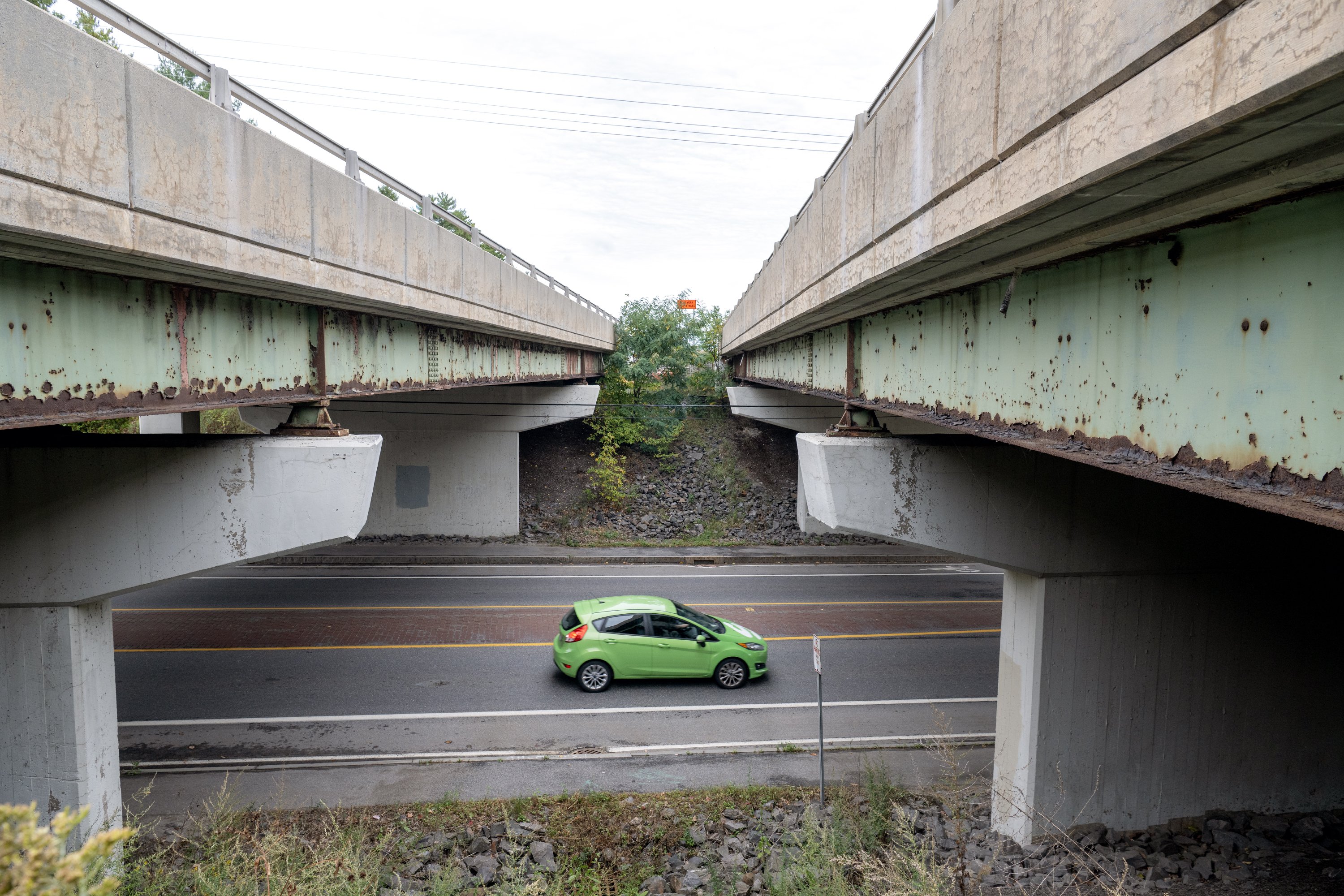 Traffic passes along Forest Avenue underneath the Maine Turnpike bridge in Portland. (Daryn Slover/Staff Photographer)
Briere acknowledged that the authority likely cannot respond to all noise complaints the way he intends to address the turnpike’s roar near Forest Avenue. He also noted that similar situations are limited along the 109-mile toll road from Kittery to Augusta.
“But if there are opportunities and we have it in our power to make life better for our neighbors, then we should do it,” he said.
Deb Nason is happy the authority finally plans to do something about the noise in her neighborhood. Turnpike officials have made promises in the past, she said, but never so publicly. This time, she figures, maybe they mean it.
“It’s about time,” she said.