
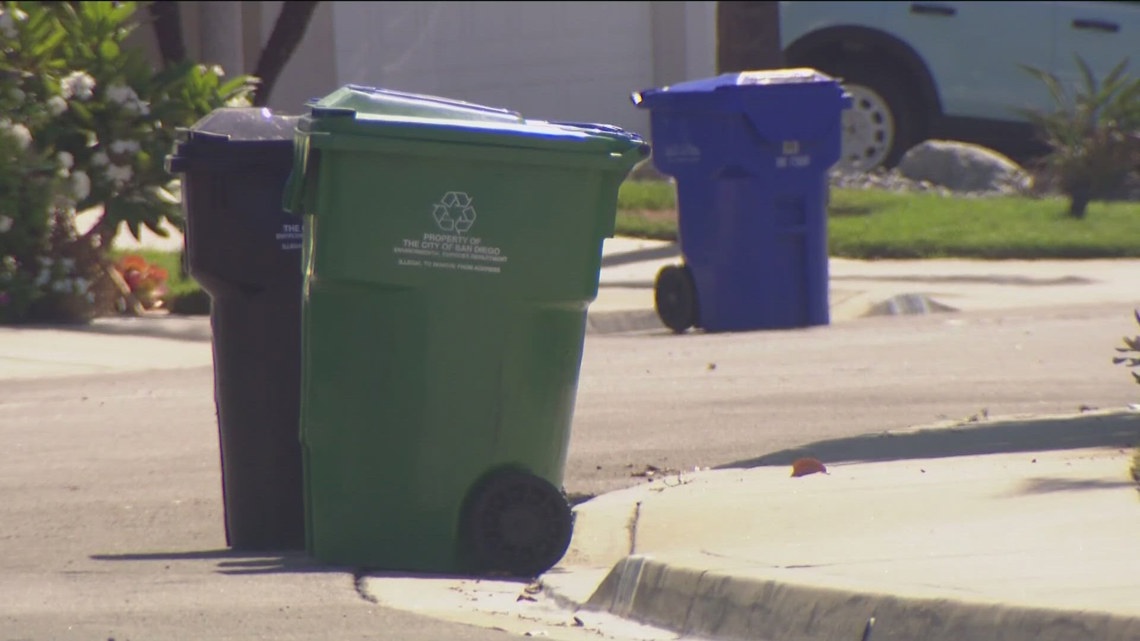
For most customers, the delivery will occur on their regular trash day schedule, and crews will remove the old black trash bins within the same day, the city said.
SAN DIEGO — San Diego city crews will begin delivering new gray trash bins to households eligible for city-provided trash service next week as the city shifts how it charges for waste pickup.
The latest development comes as the new trash bins, which were initially scheduled to roll out this week, were facing delays, according to the city’s Environmental Services Department, in a CBS 8 report.
According to the city, for most customers, the delivery will occur on their regular trash day schedule, and crews will remove the old black trash bins within the same day.
More than 225,000 households are eligible, so the delivery process is expected to continue for several months, with some properties receiving new bins in 2026.
“We’re excited for customers to experience the benefit of these new containers — newer bins will be less prone to breakage, feature helpful recycling labels to make sorting easier and come in updated colors to help drivers quickly identify which containers to service,” said Jeremy Bauer, San Diego’s assistant director for environmental services. “We want residents to rest assured that old containers will be recycled, with the material made available to create new bins. Each new container also includes a scannable tag to help the city track performance and continually improve service, a key part of our commitment to serving customers better every day.”
Gray trash bins will be delivered first, then light blue recycling bins.
The Environmental Services Department is notifying customers about their bin delivery date and other instructions through mailers, but residents can also check sandiego.gov/trash to see the scheduled date.
After customers have received their new bins, crews will collect only from the new bins, a city statement read. Until then, the city will continue servicing old containers. Old bins will be recycled into new materials.
Green organic waste bins, which were provided to more than 200,000 households in 2023, will not be provided at this time.
An initial deadline to select bin sizes and quantities has come and gone, but city leaders still encourage property owners to set up an account in the city’s Residential Waste Collection Services Portal at wasteportal.sandiego.gov.
Anyone who did not create an account will automatically receive the 95- gallon trash and the 95-gallon recycling bins. Customers may then change their service level once per year.
The change comes after voters narrowly passed Measure B in 2022, which helped repeal “The People’s Ordinance” trash collection model and allow the city to charge a monthly fee for solid trash pickup for single-family homes and multi-family complexes with up to four residences on a single lot.
The June approval of the solid waste fee broke a 106-year-old precedent of the city not charging single-family homeowners a fee for trash pickup. Starting July 1, homeowners in the city began to be charged $42.76 a month for three 95-gallon cans — one for trash, one for recycling and one for organics such as yard waste or food scraps — regardless of how much waste they produce.
Then-Council President Sean Elo-Rivera and Councilman Joe LaCava proposed Measure B in 2022 to allow the city to collect a fee for solid waste collection, transport, disposal and recycling, include the cost of bins and force short-term vacation rentals, accessory dwelling units and “mini-dorms” currently receiving city trash pickup to pay for the services.
Opponents of the waste fee were frustrated, claiming property taxes already paid for trash pickup. Even some initial supporters of Measure B felt they were hoodwinked, citing an estimated trash fee ranging from $23-$29. However, it was with the assumption that the city served 285,000 households.
The ESD, when faced with the prospect of a new fee, counted the number of households the city served following the election and came up with 226,495 — a nearly 60,000-household difference.
As a result, when a cost study came back in April 2025, the fee jumped to $36.72 per month on the low end and $47.59 on the high. That received almost universally negative feedback from the public, so a revised fee schedule then went to a range of $31.98-$42.76 in the first year by delaying certain services such as bulky item pickup and an electric vehicle pilot program.
Single-family refuse pickup is funded by the city’s general fund, which all residents pay into through property tax — whether they rent or own a single-family home, a condo or an apartment. The city takes away 300,000 tons of trash and 150,000 tons of recycling, compostables and yard waste annually.
The People’s Ordinance had been criticized for years by activists who called it inequitable because although every household pays property tax, only single-family households received trash pickup at no additional charge. In 2009, a San Diego County grand jury concluded that the ordinance had “outlived its usefulness in a 21st century society.”
According to city documents released with the ballot measure in 2022, the price of keeping the service as it existed without adding a fee was expected to cost at least $234.7 million between fiscal year 2023 and 2027.