
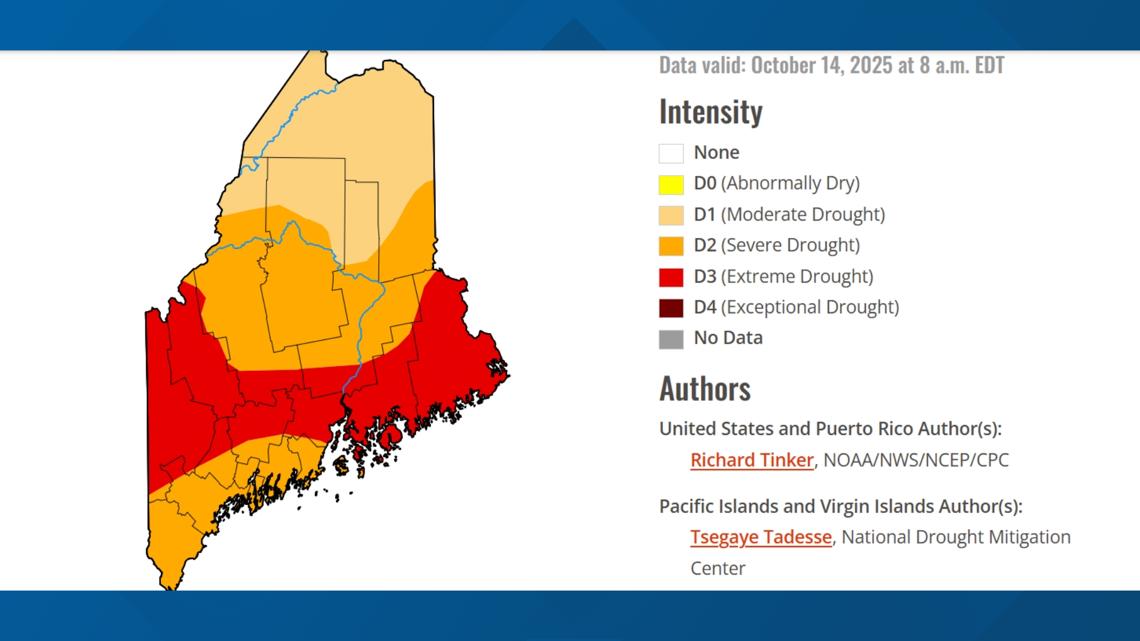
“Extreme” drought conditions have expanded since the last update, with most of Maine still in “severe” drought, impacting wells and crop yields.
MAINE, USA — More of Maine is in “extreme” drought since last week, according to a Thursday update from the U.S. Drought Monitor.
The map showed that drier conditions have spread north into Franklin and Washington counties, with the latter now almost entirely experiencing “extreme” drought. Drier conditions have also spread south into Kennebec and Waldo counties.
More than 70% of the state continues to be classified in “severe” to “extreme” drought, according to the monitor.
RELATED: U.S. Drought Monitor: Most of Maine in ‘severe’ to ‘extreme’ drought
According to the Maine Emergency Management Agency (MEMA), widespread reports show hundreds of residential wells have run dry, while stream and river levels have plunged to historic lows. Farms across Maine report sharply reduced yields in potatoes, blueberries, and other key crops.
MEMA director Pete Rogers called this past summer “one of the driest summers Maine has ever recorded,” adding, “Several streams and rivers are at record lows, farms are feeling significant impacts, and hundreds of households have reported dry wells.” The Maine Drought Task Force convened on Oct. 2 to coordinate responses.
Although some recent rainfall relieved moisture in topsoil, deeper groundwater and aquifers remain critically depleted, according to MEMA. That means communities, agriculture, and private wells remain at risk as fall and winter approach.
To fully reverse the drought before soils freeze, the National Weather Service estimates that Maine would need about 150% of normal rainfall—about six to 12 additional inches—in the coming months. Once the ground freezes, precipitation will no longer effectively recharge subsurface water stores until spring.
In response, state agencies are urging residents to:
Conserve water wherever possible
Repair leaks and avoid water waste
Heed local burn bans
Report dry wells via MEMA’s online survey to help assess statewide water supply stress
Meanwhile, the Department of Agriculture, Conservation and Forestry has allocated grants for water infrastructure projects like drilled wells, storage ponds, and water-management planning to support farmers navigating the shortages.
As fall turns to winter, Maine’s stubborn dryness leaves little room for recovery, and water supplies remain on edge.
For more local stories continue with us on our NEWS CENTER Maine+ streaming app.
Don’t miss these NEWS CENTER Maine stories