
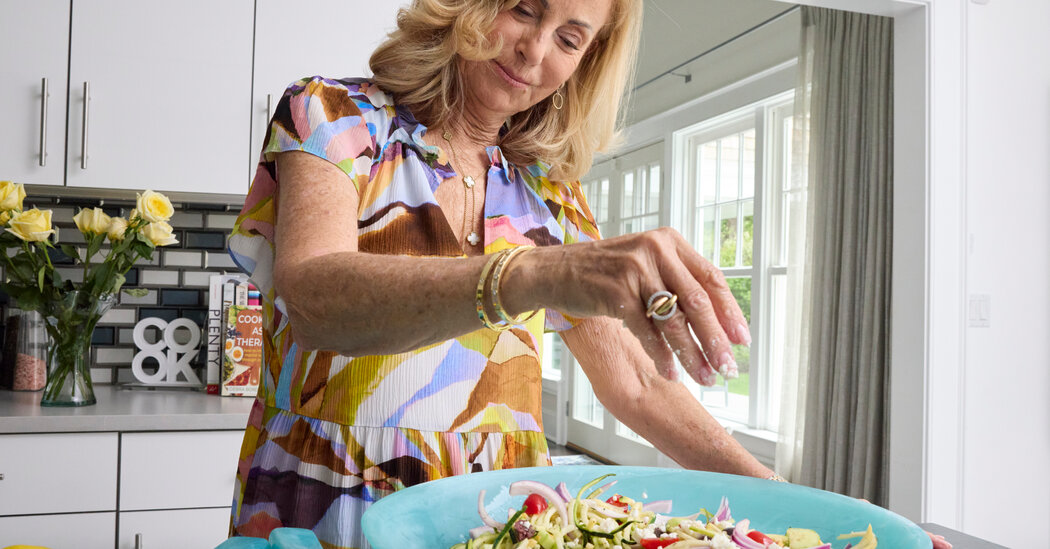
On her way to a client’s house, Debra Borden, a therapist in Water Mill, N.Y., might stop to pick up groceries. This may seem a tad unorthodox. But if her client wants to unpack their trauma, that means making a lasagna.
Ms. Borden practices cooking therapy, an experiential therapy discipline in which licensed counselors cook meals alongside their clients. Like art therapy or pet therapy, cooking therapy is designed to provide moments of self-reflection as the task at hand takes on new layers of meaning. You’re not just softening a mirepoix, you’re softening yourself.
When Ms. Borden began cooking with clients more than a decade ago, she didn’t know about Julie Ohana, a therapist in Detroit who in 2005 started a blog about cooking therapy. And neither Ms. Borden nor Ms. Ohana knew about the therapist Charlotte Hastings, who has practiced what she calls “kitchen therapy” from her home in Brighton, England, since 2011.
The three were pioneers in a small but growing network of mental health professionals focusing on the therapeutic powers of cooking.
Ms. Ohana now sees about 20 clients regularly, but she estimates she provides cooking therapy services to hundreds of people a year through demonstrations and workshops. Ms. Hastings has hosted group cooking therapy for about 70 low-income families through a food-insecurity group in her community.
Most people who reach out to Courtney Fuciarelli, a therapist in Hamilton, Ontario, are looking for a more “approachable environment for therapy,” she said. In 2021, she opened Fields and Flour Therapy, which specializes in cooking and outdoor therapy. It has grown rapidly since, which she attributes to offering cooking therapy. Her practice now includes 10 more practitioners serving more than 150 clients in kitchen settings a month.
And the therapist Stelios Kiosses incorporated lessons on the discipline in his recent culinary psychology course at Oxford University, based on his own experience of cooking with clients. (Ten years ago, Michael Kocet, a therapist in Denver, taught the first graduate-level course dedicated to culinary therapy at Bridgewater State University in Massachusetts.)
Food and cooking have clear psychological benefits. Eating tasty food stimulates the release of serotonin and dopamine, which help regulate our mood. In 2017, researchers at the National Institutes of Health reviewed a variety of studies on the use of cooking as a tool to improve mental health, suggesting that it can increase self-esteem while reducing stress and anxiety. It wasn’t a coincidence that everyone began baking bread at the height of the pandemic.
Ms. Borden’s private practice combines cooking, often conducted in a client’s home or on a video call, with elements of cognitive behavioral therapy, a form of talk therapy that helps clients recognize and disrupt negative thought patterns.
Ms. Borden begins each session by asking her patients what they’re bringing to the table, literally and figuratively. “They might say, ‘Oh, well, you told me to get salad,’” she joked. “No, ‘How are you feeling right now?’”
After getting a sense of the client’s mental mise en place, the work begins. One of Ms. Borden’s signature dishes to cook with clients is a zucchini noodle salad with feta and olives. The olives, with their soft fruit and hard pit, are particularly ripe with therapeutic metaphor, Ms. Borden said. She likes to ask clients: “What is the pit in your stomach?”
There is little research on the efficacy of cooking therapy for clients, a concern among some mental health professionals. People who use cooking as a form of wellness, even if it improves their mental health, are not necessarily engaging in a therapeutic process, according to Lynn Linde, chief of professional practice at the American Counseling Association. She compared the practice to other emerging disciplines like outdoor therapy, and considers them “more to be techniques than therapy.”
“If you’re going to use a cutting-edge technique, then you need to have evidence that it is a promising practice, and you need to have a valid reason for doing it,” she said.
Ms. Hastings, the therapist in Brighton, believes food offers a universal language for talking about our emotions.
From our earliest days cooking around a campfire, she points out, we have evolved to recognize the kitchen as an emotionally charged space that can offer security: “It might not always have been a safe place for us growing up, but it’s a place where we can return to and perhaps heal and recover.”
People are becoming increasingly accustomed to thinking of food as a product, but cooking therapy instead treats it as a process, one that connects us to our communities and personal histories.
It works for Laura Galligani, who began seeing Ms. Hastings five years ago after her mother suddenly became ill. Ms. Galligani, 55, remembers her mother as a perfectionist in the kitchen who would often scold her more free-spirited daughter for making a mess while cooking. This affected Ms. Galligani’s confidence in and out of the kitchen.
“Doing therapy with Charlotte helped me find peace within myself,” Ms. Galligani said. In one of their first sessions, the pair made a chocolate-banana cake. “She made me understand it’s OK to make a mess. It’s OK if somebody doesn’t like what you’re making, and it’s OK to be yourself.”
Hillary Krane, a parent in Scarsdale, N.Y., had long seen cooking as simply a task, and “an annoying task at that.”
But in May of 2023, Ms. Krane, 50, invited Ms. Borden, the therapist on Long Island, to host a group cooking therapy session with her book club. Ms. Krane’s club had been reading a book on narrative therapy as they navigated the stress of their children’s college admissions process.
“It was an eye opening experience, because I never thought that cutting vegetables and putting them into my salad bowl could be any sort of therapy,” she said, adding, “After that, I really thought I can start to use cooking as a peaceful time for myself, a time to reflect on my day or my children or my husband or my dog or anything.”
Cooking therapy practitioners have yet to settle on a universal term for it. Ms. Borden uses “cooking therapy.” Others, like Hector Mañón, call it “culinary art therapy.”
Mr. Mañón is a therapist in Melbourne, Fla., and the founder of the Association for Culinary Art Therapy, a small group of chefs and mental-health clinicians who aim to have cooking therapy recognized as a formal therapeutic skill.
Ms. Fuciarelli, the therapist in Ontario, recently formed the Therapeutic Kitchen Collective, a group of chefs and mental-health clinicians across the United States, Canada, the United Kingdom and Italy with similar goals.
Where practitioners of similar experiential therapies must pursue specialized licenses, cooking therapists have yet to form any such accreditation process. Mr. Mañón is an advocate for the creation of a certification course that standardizes the practice and addresses ethical and safety concerns.
Depending on the client, working with kitchen tools like knives can be dangerous, Mr. Mañón said. He also wants cooking therapists trained in basic food safety and sanitation.
Mr. Mañón, who went to culinary school and worked as a chef before becoming a mental-health counselor, is now writing his doctoral dissertation on cooking therapy.
The practice can be a powerful tool for helping clients process emotions, he said. For Thanksgiving last year, Mr. Mañón made his grandmother’s flan recipe, a dish that helped him cope with her death last April.
“I just was really feeling her guiding hand in that moment and feeling really connected to her and my Dominican culture,” he said. “Imagine what that could do for other folks who are trying to process grief.”
Follow New York Times Cooking on Instagram, Facebook, YouTube, TikTok and Pinterest. Get regular updates from New York Times Cooking, with recipe suggestions, cooking tips and shopping advice.