
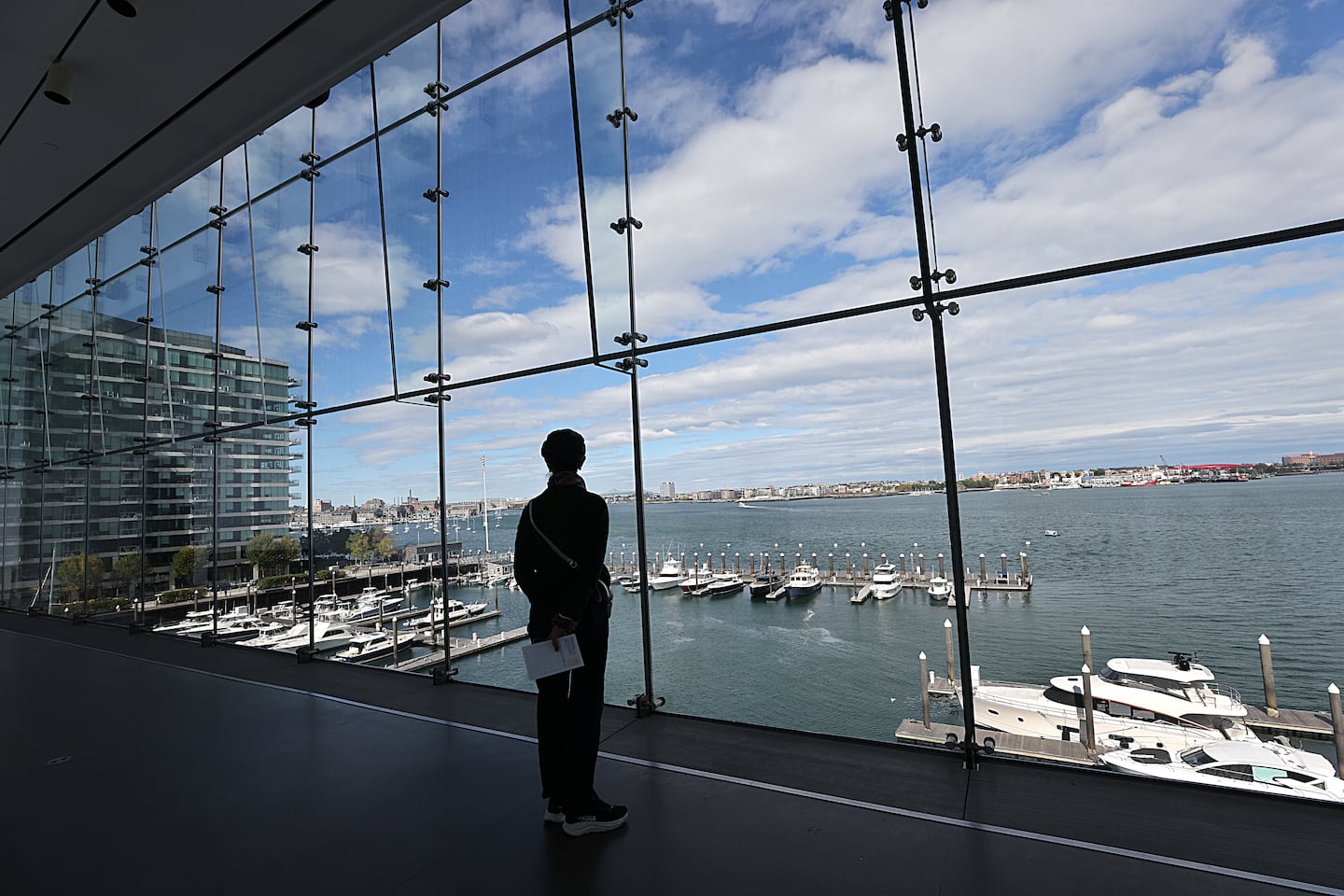
Usually, the lure of a museum has to do with the views available inside, of the works of art on display. At the Institute of Contemporary Art, the lure extends to the views available outside, too. The ICA’s John Hancock Founders Gallery, on the fourth floor, offers as spectacular a vantage on Boston Harbor as there is: the Mystic Bridge, Bunker Hill Monument, the steeple of Old North Church, Logan Airport, East Boston, the museum’s ICA Watershed satellite facility, many boats, and, of course, all that water.
“We see people all the time who take one look and have to stop and sit,” said Colette Randall, the ICA’s director of marketing and communications, earlier this month. “Two people who were here from Germany did just that a few minutes ago,” added Margaux Leonard, director of communications.
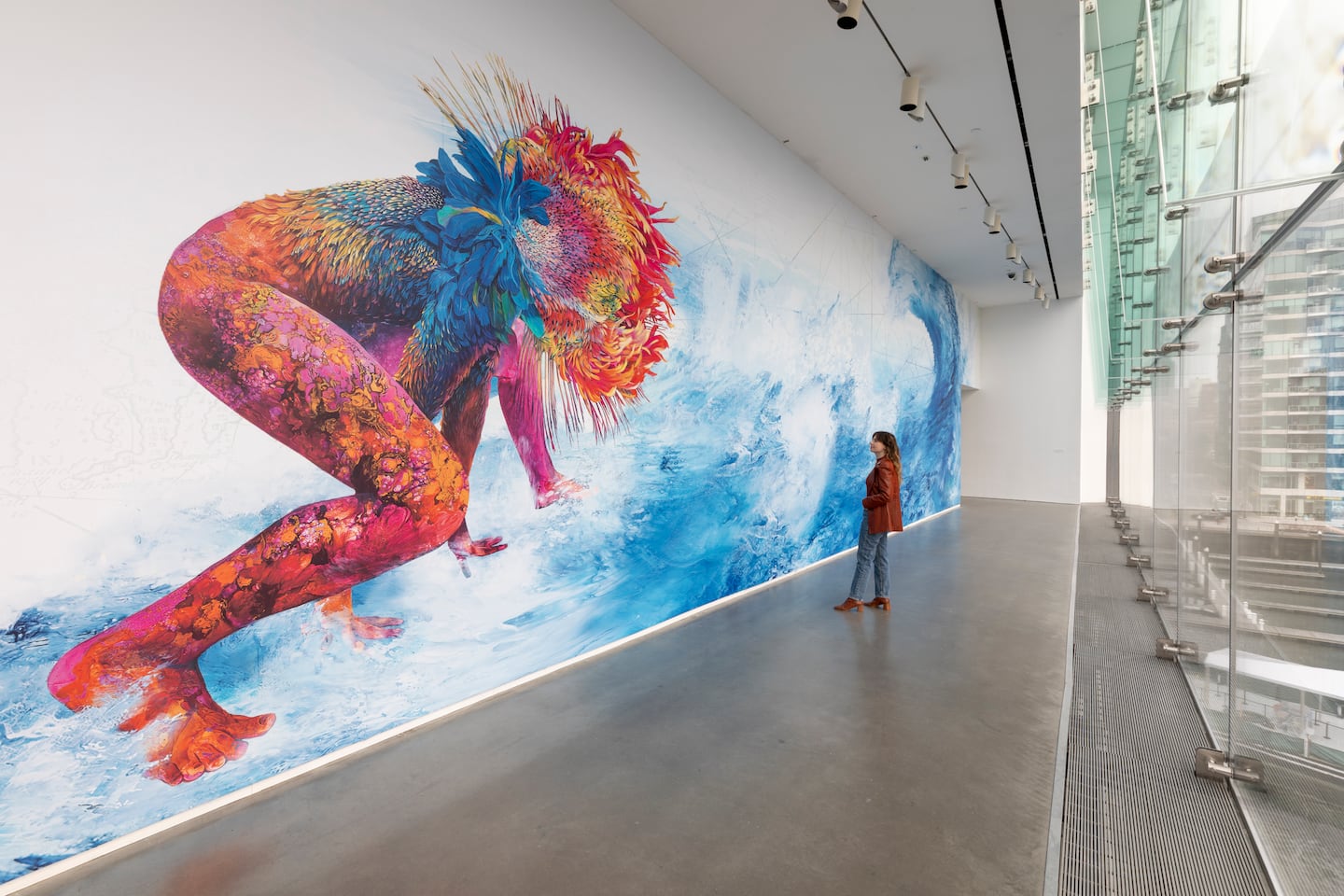 Firelei Báez, “Truth was the bridge (or an emancipatory healing),” 2024. Installation view. Firelei Báez, the Institute of Contemporary Art/Boston.Photo by Mel Taing. Courtesy the artist and Hauser & Wirth, New York/Photo by Mel Taing 2024
David Pires, the ICA’s visitor experience manager, knows what that’s like. The museum moved from Back Bay to the South Boston Waterfront in 2006. On his first visit to the new facility, Pires remembers taking in the view and “having that wow moment” himself.
The gallery extends 120 feet, with a height of 15 feet 6 inches. Some visitors know to seek it out. Others are taken by surprise. Patrons on their way to the fourth-floor restrooms pass through the gallery. It’s not unknown to see museumgoers who are clearly in a hurry to reach that destination suddenly stop in their tracks, putting their bathroom break on hold.
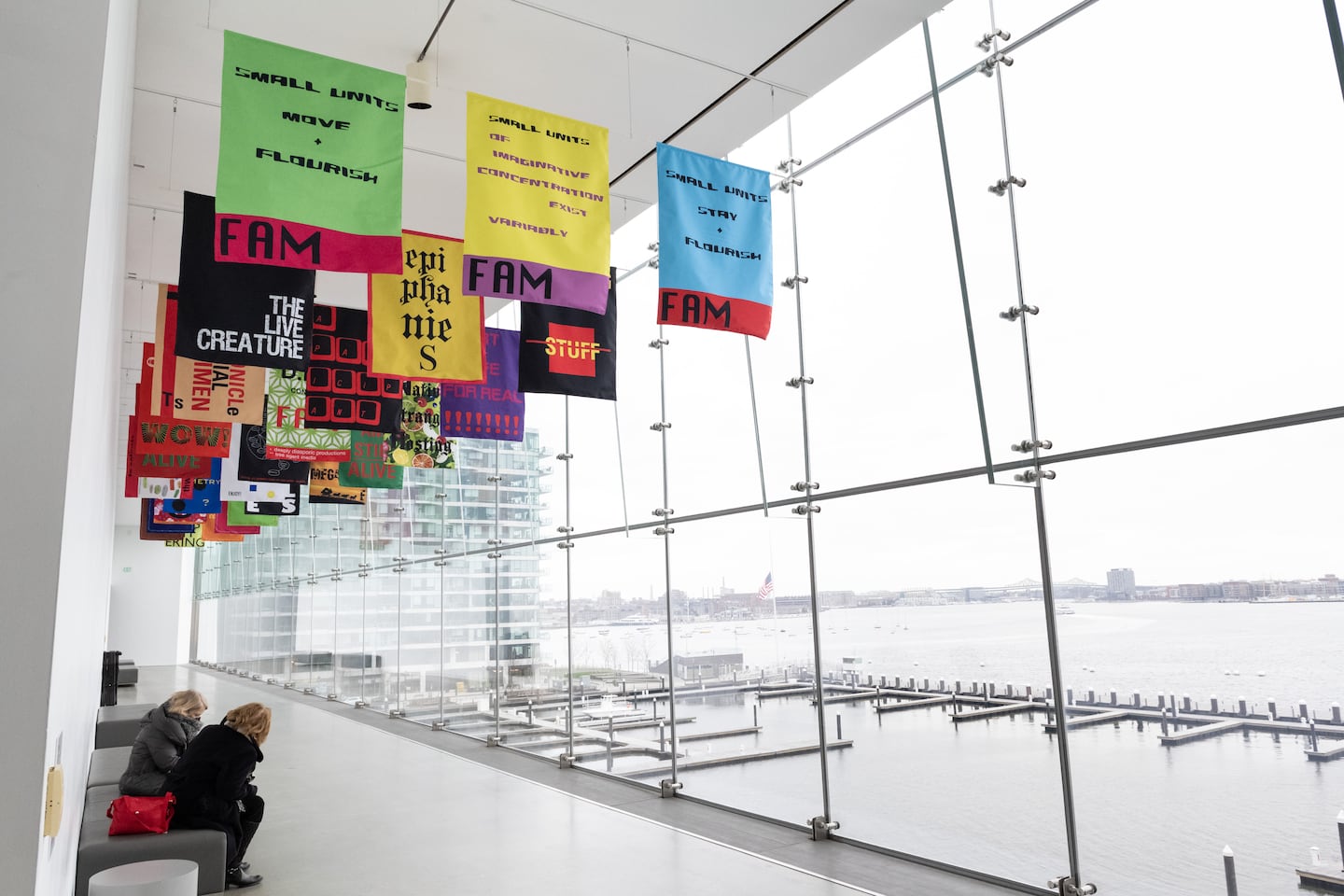 Renée Green, “Space Poem #1,” 2007. Installation view, Renée Green, the Institute of Contemporary Art 2021-22.Liza Voll
On occasion, an exhibition will incorporate the gallery. For a retrospective last year, Firelei Báez executed a mural for the space, “Truth was the bridge (or an emancipatory healing).” Renée Green’s installation “Space Poem #1” filled the gallery’s upper reaches with banners in 2021-22.
The view was incorporated into a show in 2018, “Art in the Age of the Internet,” with a virtual-reality installation by artist Jon Rafman. José Cortez, who’s visitor experience assistant manager, recalled the impact of putting on a pair of VR goggles and looking out over an altered harbor.
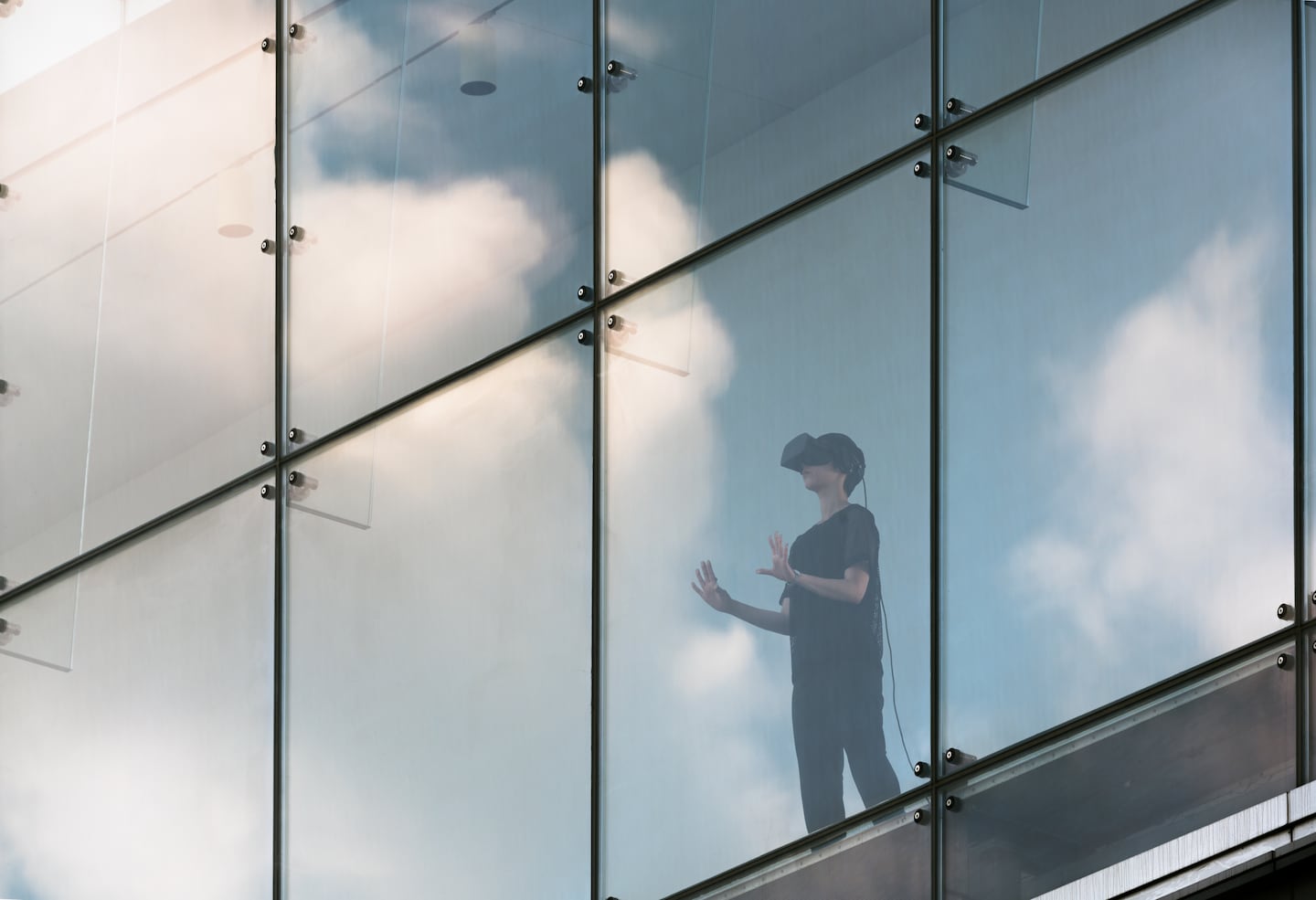 Jon Rafman, “View of Harbor,” 2017. Virtual reality headsets and 3-D simulation, from “Art in the Age of the Internet, 1989 to Today,” at the Institute of Contemporary Art.Courtesy the artist. Photo by Matthew Monteith. © Jon Rafman
The gallery is also a part of a current show, “An Indigenous Present,” though not visually. Faint sounds in the exhibition grow louder the closer one gets to the Founders Gallery, where Raven Chacon has a sound installation. Its inspiration, Cortez noted, was an American flag visible near Old North Church and the Bunker Hill Monument. The installation’s industrial-strength sounds evoke the flapping of the flag, as well as symbolic associations.
Both Cortez and Pires spoke of the boost people appear to get as they pass through the gallery. As if on cue, Joe Fanning walked by. “It’s real nice,” he said. Fanning, special events production manager at the ICA, laughed at the obvious understatement. “I come up here at least once a week to enjoy it.”
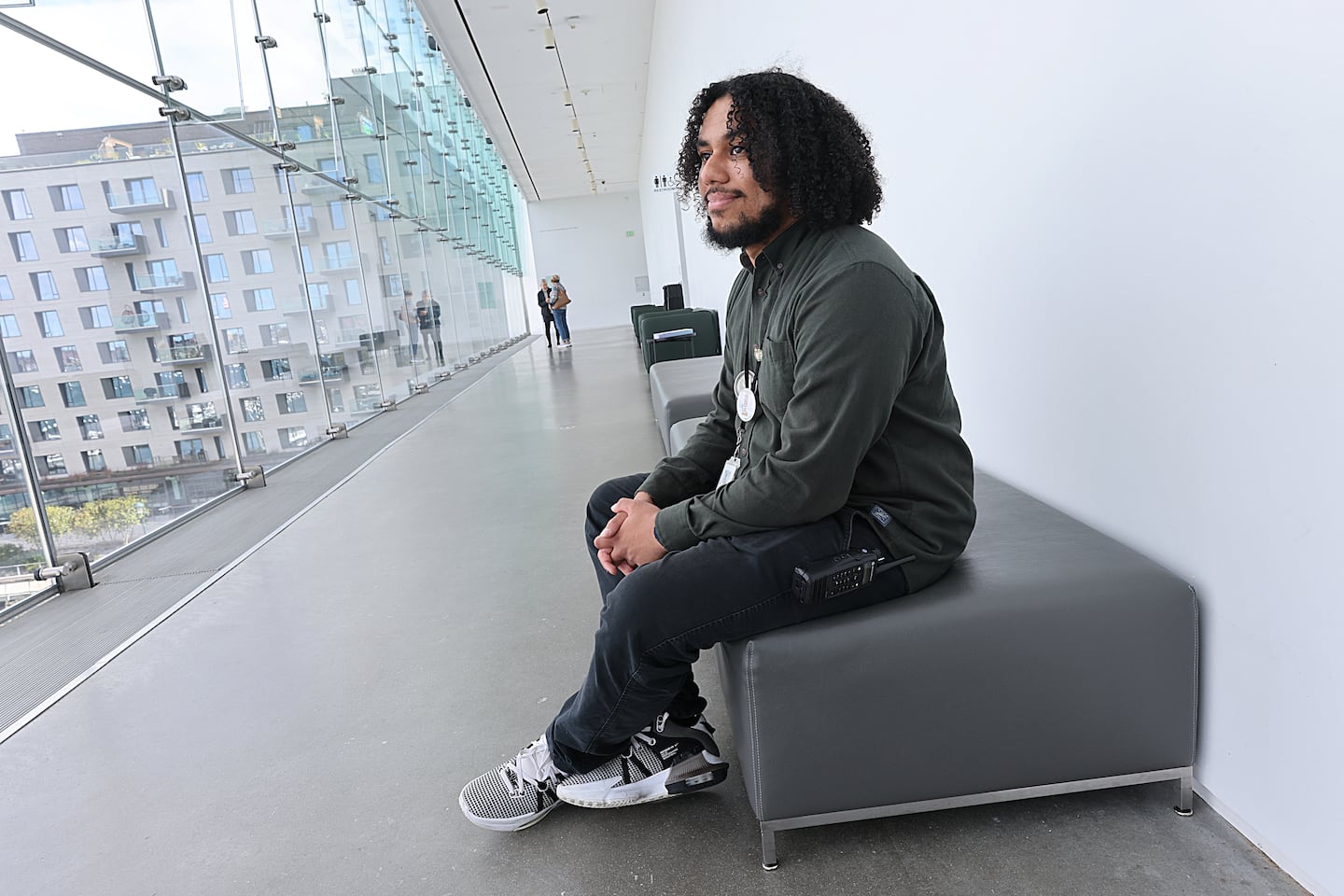 José Cortez, visitor experience assistant manager at the Institute of Contemporary Art, enjoys the view of Boston Harbor.Suzanne Kreiter/Globe Staff
With him was Amanda Gallagher, who works with the ICA’s event caterer, The Catered Affair. She nodded. “It regrounds you,” she said.
Mark Feeney can be reached at mark.feeney@globe.com.