
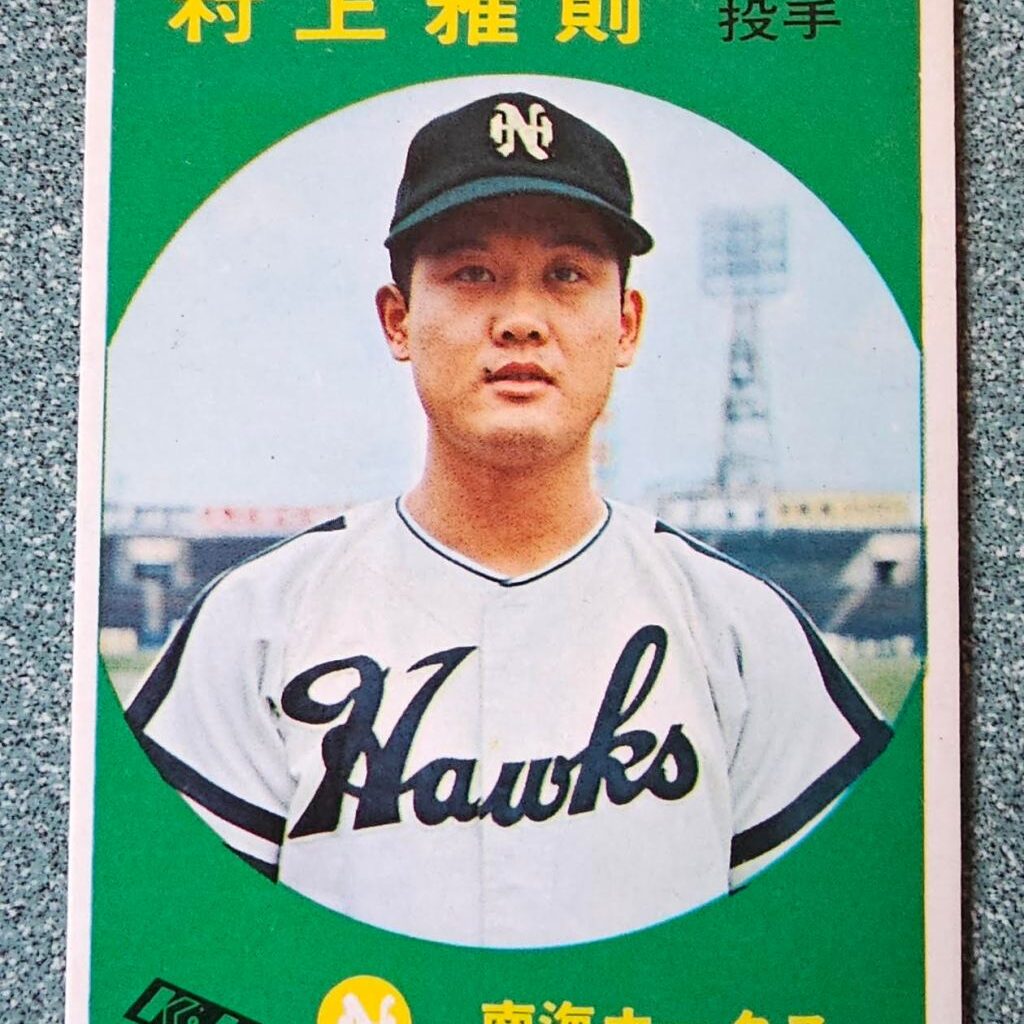
Manager Kazuto Tsuruoka of the Nankai Hawks in the Nippon Professional Baseball league initially was unsuccessful in persuading high school star Masanori Murakami to play for the team, but that changed when he promised that he would send him to America to “study baseball.”
“I changed my mind,” Murakami said during a talk at the Society of American Baseball Research convention on June 27, 2015. “I had seen ‘Rawhide’ and Hollywood movies with John Wayne and Marilyn Monroe, and I wanted to come (to America).”
On Feb. 24, 1964, Tsuruoka told Murakami and two other Hawks players—catcher Hiroshi Takahashi and infielder Tatsuhiko Tanaka—that they would be sent to the U.S. to play in the San Francisco Giants system.
Hawks executives signed an agreement written in English, apparently without noticing that a clause that stated the Giants would have an option to buy the players’ contracts for $10,000 each.
The players were assigned to the Fresno Giants, a low-level (Class A) minor league team, but Murakami did so well that he was told on Aug. 29, 1964, that he would be promoted three levels—a rare occurrence–to play for the San Franciso Giants.
He debuted on Sept. 1, 1964, against the New York Mets in Shea Stadium and went on the pitch in nine games that season, recording a stellar 1.80 earned run average in 15 innings pitched. Pleasantly surprised by his performance, the Giants exercised their option by signing him to play for them in 1965.
Masanori Murakami, who became the first native Japanese to play in the major leagues when he pitched for the San Francisco Giants in 1964 and 1965, visits the Sonoma home of Doug and Megumi Inouye on Monday, Oct. 13, 2025. (Daniel Johnson)
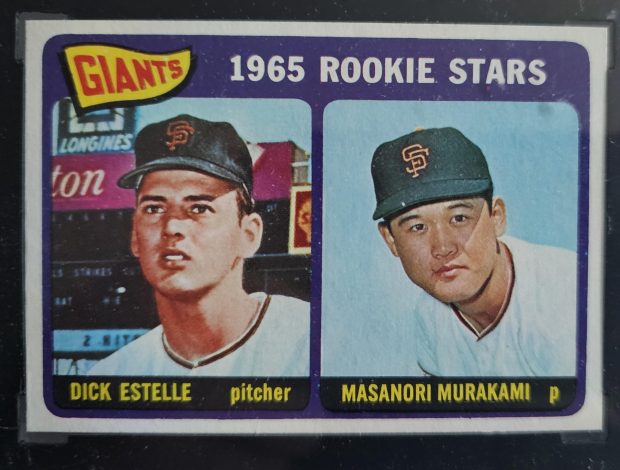
Masanori Murakami, shown in this 1965 Topps baseball card, played for the San Francisco Giants in 1964 and 1965, thereby becoming the first native Japanese to play in Major League Baseball. (Daniel Johnson)

This 1967 Kabaya-Leaf Japanese baseball card shows Masanori Murakami, who pitched for the Nankai Hawks in 1963 and then again from 1966 to 1974. He also pitched for the San Francisco Giants in 1964 and 1965, thereby becoming the first native Japanese to play in Major League Baseball. (Daniel Johnson)
Show Caption
1 of 3
Masanori Murakami, who became the first native Japanese to play in the major leagues when he pitched for the San Francisco Giants in 1964 and 1965, visits the Sonoma home of Doug and Megumi Inouye on Monday, Oct. 13, 2025. (Daniel Johnson)
But Tsuruoka indicated that he was planning to have Murakami back to bolster the Hawks’ pitching staff in 1965 and Shigeru Niiyama, the newly appointed president of the team, said he was unaware of the contract option. Feeling pressured but wanting to return to the Giants, Murakami also signed a contract to play for the Hawks in 1965.
Eventually, the two teams agreed that Murakami would play for the Giants in 1965 but would then choose whether he wanted to remain with them or return to the Hawks. He strongly desired to continue playing for the Giants, but returned to the Hawks, mainly due to “giri,” a Japanese term referring to a sense of obligation or duty to someone who has provided help. It usually pertains to a younger individual who feels a sense of obligation to a superior, and requires self-sacrifice.
“Mashi followed his conscience, but in his personal life, it was a lot for him to deal with. He wanted to continue to play for the Giants and live in the United States,” said Sonoma resident Megumi Inouye, a friend of Murakami.
Murakami had an excellent season for the Giants in 1965, compiling a 4-1 record, a 3.75 ERA and 85 strikeouts, with only 22 walks. He had only two hits in 13 at-bats, a .154 average, but his first one was unforgettable.
On June 29, in a game against the Los Angeles Dodgers at Candlestick Park, he batted against Hall of Famer Sandy Koufax. After swinging and missing badly at the first pitch, he bunted down the third base line—for a hit! It was the only time he batted against Koufax.
“I have the highest batting average of anyone against him,” Murakami joked after telling the story at the Inouye home in Sonoma this month.
On another occasion, unsure of his English vocabulary, he asked some of his Giants teammates what he should say when Herman Franks, the team’s burly, no-nonsense manager, visited him on the pitcher’s mound.
“Tell him, ‘Take a hike,’” they said, which Murakami dutifully did, followed by a stern response from Franks.
Murakami played for the Hawks from 1966 to 1974, the Hanshin Tigers in 1975 and the Nippon Ham Fighters from 1976 to 1982. He never reached his full potential due to a series of shoulder and arm injuries, but had a spectacular season in 1968, compiling an 18-4 record and a 2.38 ERA and finished his Japanese career with an impressive 103-82 record and a 3.64 ERA.
After the high-profile squabbles over Murakami’s contract with the Giants in 1964 and 1965, baseball relations between the U.S. and Japan chilled, and no other native Japanese player participated in Major League Baseball until Hideo Nomo debuted for the Dodgers on May 2, 1995. This opened the floodgates for dozens of other Japanese players to follow suit, and their successes have been celebrated in both Japan and the U.S.
Foremost among them is Shohei Ohtani, who has shocked the baseball world with his record-breaking achievements as a hitter and pitcher. His most amazing accomplishment to date—and arguably the most incredible individual performance in baseball history—occurred in the fourth and deciding game of the 2025 National League Championship series between the Los Angeles Dodgers and Milwaukee Brewers, played on Oct. 17.
Ohtani not only yielded only two hits and struck out 10 batters in six innings pitched: He also hit three home runs, earning him the series Most Valuable Player award.
Murakami has been as surprised as anyone by Ohtani’s amazing feats.
“He just showed up and is blowing everyone away,” he said.
Originally Published: October 22, 2025 at 3:49 PM PDT