
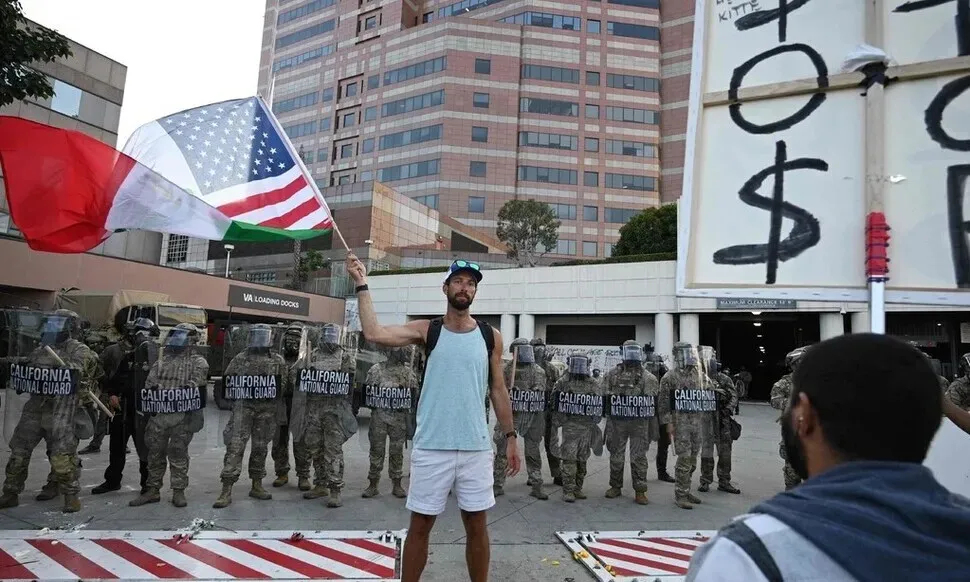
A protester waves a flag combining the flags of the US and Mexico as they stand before California National Guard members standing guard outside the Federal Building in Los Angeles during mass protests over immigration raids on June 12, 2025. (AFP/Yonhap)

By Kim Won-chul, Washington correspondent
Trump’s next target is San Francisco, which he calls “a mess.”
In a press conference at the Oval Office on Oct. 15, US President Donald Trump said San Francisco is the next city to which troops, many from the National Guard, will be deployed.
San Francisco will be the sixth city in a row, following Los Angeles, Washington, Memphis, Portland and Chicago, to be stationed with armed soldiers. The president who has championed a vision of “America first” is also giving the US first billing in troop deployments.
When Trump made the first deployment to Los Angeles, Korean correspondents rushed to the city to cover what, at the time, was a big story. But now the deployments have become a routine affair in the US. Until recently, it was common to see armed troops in downtown Washington, DC.
The ostensible reason for these troop deployments is civil disorder. Trump generally slams deep-blue cities for high crime rates and protests against ICE brutality, then he threatens to send in the troops. Trump’s narrative is that he needs to clean up after the Democratic Party’s mess.
While the US military is mostly controlled by the federal government, there are also state-controlled National Guards. The federal component is what Koreans typically think of “US soldiers,” consisting of the US Army, US Navy, US Air Force, US Marine Corps and US Space Force.
Each state’s National Guard is a reserve force under the command of the state governor. Typically, troops from the guard are charged with responding to disaster relief, supporting law and order and suppressing riots.
Trump’s chosen approach for deploying troops inside the country is federalizing the guard and ordering troops to specific areas.
Under law, federal troops are generally prohibited from maintaining law and order inside US borders.
Following constant interventions by the US military in law enforcement and political matters in Southern states following the Civil War, the US passed the Posse Comitatus Act, which prohibits the US military from acting as police or enforcing domestic law under orders from the civil authorities without the express permission of Congress.
Trump’s strategy presents two legal questions. The first is whether the National Guard can be nationalized despite the opposition of a state governor. The second is whether the statutory prohibition on the federal army being mobilized for preserving order also applies to the federalized National Guard.
While the courts’ opinion on the first question varies with the matter at hand, in regard to the second question, the courts have generally said the federalized National Guard is not allowed to maintain civil order.
The rationale is that while the federalized National Guard can perform patrol duties, it is generally unable to perform law enforcement duties such as arresting and questioning suspects. (There are witness reports of federalized guard units performing police duties in some areas, however.)
The critical variable here is the Insurrection Act, which the president can invoke in the event of “unlawful obstructions, combinations, or assemblages, or rebellion.” In such cases, the restrictions of the Posse Comitatus Act are suspended, and the prohibition on federal troops standing in for the police is waived.
A scenario in which the political and constitutional order is suspended and the military steps in to assume administrative functions is known as martial law. While the US does not have a system of martial law per se, invocation of the Insurrection Act is understood to be a rough equivalent.
For Trump, deploying troops is an essential aspect of his image as a “law and order” president. It’s a kind of “performance art” reinforcing his narrative that Democrats have made such a “mess” of their cities that there has to be a military intervention.
Trump might choose to invoke the Insurrection Act, giving the military greater scope for action, before next year’s midterm elections. If citizens try to block troops from entering cities on the president’s orders, it could lead to civil war.
So which city will be the next “mess”?
Please direct questions or comments to [english@hani.co.kr]