
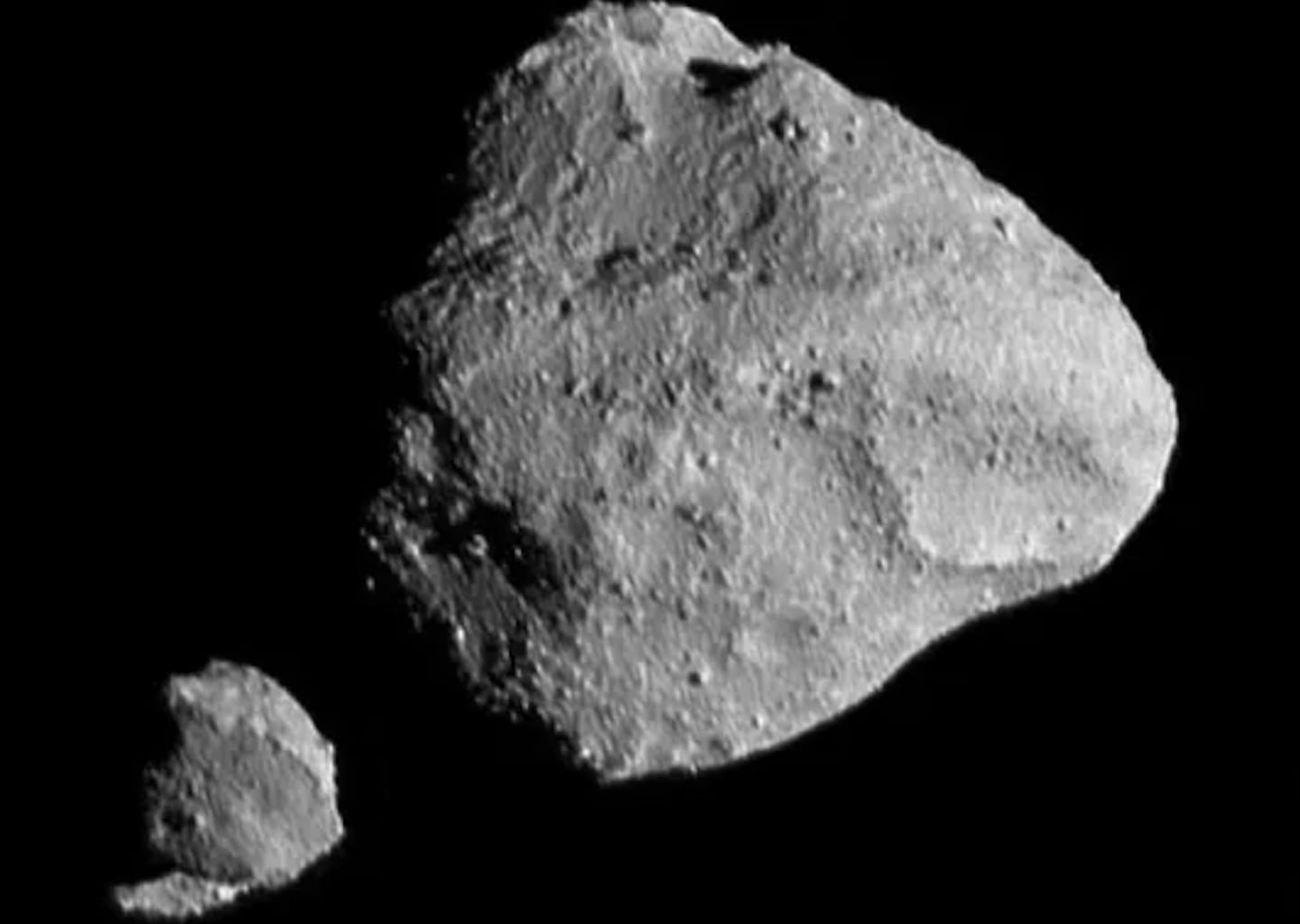
It’s been called a moonlet. Sister moon. You could even call it a moon “buddy,” a companion or quasi-satellite, if you will, to our steady lunar neighbor. Astronomers say a tiny asteroid, called 2025 PN7, has been shadowing our planet and the moon, apparently for the past several decades. But amazingly, this little space rock managed to go undetected by man’s most powerful telescopes — until now.
These so-called “quasi-moons,” of which there are now eight, are a group of celestial tag-alongs to Earth that travel closely to our planet but are too small to pose a threat to us, according to astronomers, and are not bound to Earth’s gravity, like a real moon. They simply act like a moon, keeping pace with Earth and appearing to orbit the sun in a somewhat similar path and timeframe of about a year.
“They’re actually not orbiting the Earth, but they hang relatively close to us,” said John Gianforte, director of the University of New Hampshire Observatory. “So it’s kind of drifting in and out of our orbit. It’s constantly shifting. And because of the orbit, orbital period, and the shape of the orbit of this object, there is no chance of it colliding with us or the moon.
“Then eventually, through dynamical interaction between other objects, they just drift apart and are gone. It’s still in its own orbit, but we’re far enough away, where there’s no connection.”
This visualization shows the newly discovered asteroid, 2025 PN7, orbiting the sun much like Earth.
PN7 is mostly influenced by the sun’s gravity, according to Anton Petrov, an astrobiology researcher and former teacher who operates a science YouTube channel. “As a matter of fact, it’s not truly captured by Earth’s gravity almost at all and instead appears to have this synchronized dance with planet Earth around the sun.”
At 60 feet wide, roughly the size of a tractor-trailer, 2025 PN7 is a mere speck compared to our real moon that’s been around for billions of years, said Gianforte. These types of asteroids are not to be confused with the near-Earth asteroids, which originate from the main asteroid belt between Mars and Jupiter but can be moved closer to Earth by gravitational forces from planets like Jupiter. A subset of these are known as potentially hazardous asteroids, or PHAs, which are basically space rocks larger than 100 meters or 328 feet that can come close to Earth. Currently, none of the known PHAs is on a collision course with our planet, astronomers say.
PN7 has only been around for about 60 years, but it took a team of researchers from the University of Hawaii to finally spot it. Working at the Pan-STARRS Observatory on the Haleakala volcano in Maui, the scientists captured observations of PN7 during a routine telescope survey in August. The observations were then confirmed by independent scientists in a paper published in the journal Research Notes of the American Astronomical Society.
Carlos de la Fuente Marcos, of the Complutense University of Madrid, one of the main authors of the paper, called PN7 “a challenging object.” He told CNN that the object is so faint that it can only be detected by telescopes when it passes close to Earth. It’s actually part of the Arjuna asteroid belt, those closest to Earth, according to de la Fuente Marcos.
At its farthest point, 2025 PN7 can be tens of millions of miles away from Earth, yet it can swing closer, at about 185,700 miles. For reference, the moon is about 239,000 miles from Earth. And PN7 “is about as far away from our moon as it is from us, about a quarter of a million miles away,” Gianforte noted.
Astronomers estimate that PN7 will stick around until 2083.
“It won’t have any effect on Earth. No astronomical and no astrological effect on Earth,” Gianforte said. “It’s not going to ruin anybody’s day or make you win the lottery or anything like that.”