
Key Points
Iran and its so-called Axis of Resistance are at their weakest in years. They have sustained significant defeats since the beginning of 2024, losing much of their military strength and influence across the Middle East.
Iran and its Axis of Resistance are now trying to slow and reverse their losses. They are also fundamentally rethinking their strategy, which will change the nature of the threat that Iran poses to US interests, personnel, and partners in the Middle East.
The United States cannot allow Iran to rebuild and again threaten to destabilize the Middle East. That would risk Washington again suffering a strategic surprise and jeopardizing its competition with China and Russia.
The United States should take proactive measures to solidify the losses that Iran and its Axis of Resistance have incurred and use that momentum to further contain them across the Middle East.
Executive Summary
Iran has suffered repeated defeats across the Middle East since the beginning of 2024. Israel has severely damaged the Iranian-led Axis of Resistance in its campaigns against Hamas in the Gaza Strip and Hezbollah in Lebanon. The Assad regime in Syria has fallen and severed Iranian access to its militia allies in the Levant. And Israeli operations have eliminated key Iranian and Iranian-backed figures and degraded Iranian air defenses and missile forces. Tehran has thus become more vulnerable and lost much of its regional influence and ability to project force, bringing it to its weakest in decades. These defeats have reduced the threat to US interests, personnel, and partners in the Middle East and afforded the United States the strategic bandwidth to focus its attention and resources on other parts of the globe.
There is no guarantee, however, that these victories will last. Iran and its Axis of Resistance remain hostile to the United States and its partners and expect more conflict. They will spend the coming years rebuilding their strength and collaborating with major US adversaries, such as China, North Korea, and Russia, to erode US global influence and undermine the US-led international order. Tehran and its militia allies will, of course, need years of concerted effort and investment to return to their previous levels of strength. But if left unchecked in that time, they will likely succeed, which would enable them to again plunge the Middle East into instability.
The United States cannot accept that risk, as it was under those conditions that Hamas invaded Israel and ignited a war that rapidly spread across the Middle East. Washington faced numerous crises suddenly, as Iranian and Iranian-backed forces attacked American service members, international shipping, and key US partners. Tehran meanwhile accelerated its nuclear activities, at one point having enough fissile material to produce nine nuclear weapons within weeks. These challenges yanked US attention and resources back to the region and away from other global priorities, such as competition with China and Russia. Incurring such a strategic surprise in the Middle East at some future point when the United States has already committed itself to managing crises elsewhere in the world, such as a Chinese attack on Taiwan, could be catastrophic.
The United States should therefore capitalize on the moment of relative weakness affecting Iran and its Axis of Resistance to make lasting gains and prevent them from rebuilding. That means solidifying recent progress and using the positive momentum to further constrain Iranian and Iranian-backed forces across the Middle East. Washington has an unprecedented opportunity in this regard. Pressing this advantage could reduce the medium- and long-term threats to US interests, personnel, and partners and help stabilize the region after two years of widespread conflict. It could also help ensure that the United States can safely focus on advancing its interests and defending its principles elsewhere.
This report provides recommendations that form a foundation from which the United States can develop a more coherent, long-term approach to containing the Iranian threat and promoting Middle Eastern stability.
First, the United States must collaborate with its international partners, especially the European countries, to prevent Iran from acquiring a nuclear weapon and rebuilding its offensive capabilities. Negotiations are a perfectly viable way to prevent nuclear proliferation in principle. But the United States must remain prepared to use force—as it has already to tremendous effect—to prevent Iran from becoming a nuclear power. The United States and its international partners must also enforce the UN “snapback” sanctions that the United Kingdom, France, and Germany reactivated against Iran. Those sanctions include an international arms embargo that will hinder Iran’s efforts to rebuild its offensive capabilities with foreign assistance.
Second, the United States should support an international effort to establish a new Palestinian governing authority that opposes Hamas and can rebuild the Gaza Strip. That authority could manage the distribution of aid, housing of displaced Gazans, and administration and reconstruction of the strip. It could supplant Hamas as the primary political power in the strip and gradually erode Hamas’s influence. This is the most effective way to create long-term peace in the Gaza Strip; military operations cannot achieve this effect alone, because they challenge Hamas at the military level but not the political one. The international community would, of course, need to support a new governing authority with financial and security assistance, especially as that authority works to destroy the remaining Hamas remnants. Egypt and the Gulf states are well poised to assist here.
Third, the United States should aggressively support the full implementation of the Israel-Lebanon ceasefire agreement, which requires that the Lebanese government and military remove Hezbollah forces from southern Lebanon and prevent the group from rebuilding militarily. Newly elected Lebanese leaders have voiced their desire to disarm Hezbollah promptly. Hezbollah has responded characteristically with threats to the government, highlighting the risk inherent in trying to disarm the group. But Hezbollah is weaker now than at any point in decades; Washington has a rare window of opportunity to defeat a terror group that has long antagonized the United States and killed many Americans. The United States should also explore how to collaborate with regional partners and use sanctions to prevent Hezbollah from reconstituting.
Fourth, the United States must support long-term Syrian stability and a political order that integrates all ethno-religious minorities, reconciles rival political factions, and destroys Assad-era militant and criminal networks that seek to destabilize the country. Promoting such stability requires maintaining the US force presence in Syria as part of the international coalition to defeat ISIS. The United States should also pressure the transitional government and its backer, Turkey, to build a broad-based and fully representative political system. The United States should similarly press the transitional government to pursue fair and transparent justice against former Assad regime officials who committed crimes against the Syrian people. Doing so would minimize the appeal to some Syrian elements of supporting anti-government networks tied to Bashar al Assad and potentially aligned with Iran.
Fifth, the United States should increase support for—rather than abandon—Iraqi leaders who wish to see their country independent from Iranian domination. The United States should retain its force presence in Iraq, as it empowers those Iraqi leaders, and collaborate with them to constrain and marginalize Iranian-backed militias. Washington must also be prepared to use force against those militias should they again threaten US service members. The militias stopped attacking US personnel after the United States threatened their key leaders, many of whom are designated terrorists. The United States can maintain this deterrence while exploring political and economic measures with Iraqi leaders to minimize Iranian influence there. The militias will respond threateningly, which is why Iraqi leaders need US backing and protection.
Finally, the United States should seek to render the Houthis unwilling to attack international shipping and US partners. The Houthis are currently willing to do both. Airstrikes alone cannot deter the Houthis. And the United States cannot tolerate a future wherein transit through the Red Sea and Gulf of Oman is under the constant threat of Houthi attack. That would imperil US sailors and vessels transiting the region and continue inflating shipping prices. The United States should specifically be prepared to support local partners in conducting offensive ground operations against the Houthis. A committed US effort to back partners in challenging Houthi political control is the most straightforward—and perhaps only—path to render the Houthis unwilling to conduct attacks outside Yemen.
Introduction
Iran and its so-called Axis of Resistance are at their weakest in years. Tehran and its militia allies have incurred significant defeats since the beginning of 2024, losing much of their military strength and influence across the Middle East. Those losses have upended Iranian strategy, which has focused for the past decade on aggressively expanding Iranian influence and strategic depth across the region.1 The Office of the Director of National Intelligence determined in its 2025 Annual Threat Assessment that “Iran’s prospects for reconstituting [its] force losses . . . are dim in the near-term.”2 The degradation of the Iranian-led Axis of Resistance has diminished its ability to project force and defend against attack, reducing the threat that Tehran poses to US interests, personnel, and partners in the region. That in turn affords the United States the strategic bandwidth to focus its attention and resources on other parts of the globe.
These victories, however, are not guaranteed to last. Iran and its Axis of Resistance remain hostile to the United States and its partners and expect more conflict. They will spend the coming years rebuilding their strength, which could allow them to again plunge the Middle East into instability. They will also continue collaborating with major US adversaries, such as China, North Korea, and Russia, to erode US global influence and undermine the US-led international order. Iran and its Axis of Resistance will, of course, need years of concerted effort and investment to return to their previous levels of strength. But if left unchecked in that time, they will likely succeed.
The United States should capitalize on the moment of relative weakness affecting Iran and its Axis of Resistance to make lasting gains and prevent them from rebuilding. That means solidifying recent progress and using the momentum to further constrain Iranian and Iranian-backed forces across the Middle East. Washington has an unprecedented opportunity in this regard. Of course, the United States should not invite war with Iran. But it should press its current advantage to reduce the medium- and long-term threats to US interests, personnel, and partners and help build a more stable region that is more resilient to Iranian aggression and subversion.
Failing to seize this opportunity would only grant Iran and its Axis of Resistance the space and time needed to recuperate. The United States cannot accept this risk, as it was under those circumstances that Hamas invaded Israel and ignited a war that rapidly spread across the Middle East. Washington faced multiple crises suddenly, as Iranian and Iranian-backed forces attacked American service members, international shipping, and key US partners. Iran meanwhile accelerated its nuclear activities, at one point having enough fissile material to produce nine nuclear weapons within weeks. These challenges yanked US attention and resources away from other global priorities, such as competition with China and Russia. Incurring such a strategic surprise in the Middle East at some future point when the United States has already committed itself to managing crises elsewhere in the world, such as a Chinese attack on Taiwan, could be catastrophic.
This report aims to help policymakers avoid this strategic pitfall by first assessing the net effect of the October 7 war on the overall strength of Iran and its Axis of Resistance. Much has already been written on the subject, to be sure, as numerous analysts have capably detailed the war and its implications for Middle Eastern security. But little work has comprehensively examined the consequences of the war for the military power of Tehran and its militia allies and the cohesion between them, as well as how these dynamics will affect Iranian strategy. This report means to fill this void and then present a foundation from which the United States can develop a more coherent, long-term approach to containing the Iranian threat.
Defining the Axis of Resistance
The Axis of Resistance is the unconventional alliance that Iran has cultivated in the Middle East since the Islamic Republic came to power in 1979. This transnational coalition consists of state, semi-state, and nonstate actors that cooperate to secure their collective interests.
Tehran considers itself to be part of the alliance and its leader. Other members include Hamas in the Palestinian territories, Hezbollah in Lebanon, the Houthis in Yemen, and myriad other militias composed of Afghan, Bahraini, Iraqi, Palestinian, Pakistani, and Syrian fighters operating across the Middle East. The Assad regime in Syria was part of the Axis of Resistance as well until the regime collapsed in December 2024. Iran directly founded some of the groups in the alliance, while others emerged independently and later forged ties with Tehran.
The Axis of Resistance is a sui generis organization that bears little resemblance to traditional alliances, such as NATO. It has no formal charter, headquarters, or membership, nor does it have a secretary-general or anything like it. Tehran and its militia allies instead manage their affairs through informal networks spanning the Middle East. They make decisions and coordinate through these channels, making the alliance appear amorphous and opaque to external observers. It is too soon to say what long-term effects the October 7 war will have on the Axis of Resistance’s structure and regular operations.
The Net Effect of the October 7 War
Iran and its Axis of Resistance have suffered successive defeats since the beginning of 2024, reducing their ability to project force and making them more vulnerable to attack. These defeats began shortly after Hamas invaded Israel in October 2023. Tehran and its militia allies waged a regional escalation against the United States and Israel in the ensuing months. Iranian and Iranian-backed forces launched strike campaigns targeting US service members in Iraq, Jordan, and Syria, as well as international shipping around the Red Sea and Gulf of Aden. This regional escalation led to Israeli responses that crippled large components of the Axis of Resistance. The following discussion examines these losses individually and holistically and their strategic and military implications for Iran and its regional constellation of proxy and partner forces.
Defeat in the Gaza Strip
The first defeat the Axis of Resistance incurred was in the Gaza Strip. After Hamas’s horrific attack on Israel on October 7, 2023, Israeli Prime Minister Benjamin Netanyahu set the war aims of destroying Hamas as a military and governing body and rescuing the people whom Hamas and other Palestinian fighters took hostage.3 The Israel Defense Forces (IDF) proceeded to launch a campaign designed to systematically isolate and degrade Hamas forces across the strip.4 The IDF began in the northern Gaza Strip on October 27, 2023, and spent the next several months engaged in intense urban combat above and below ground. It turned to the central and southern parts of the strip in December 2023 and May 2024, respectively, once Hamas was severely degraded in the north. The IDF repeated its isolate-and-reduce approach in the central and southern areas, especially around Khan Younis and Rafah, similarly degrading the Hamas units there.5
The IDF throughout its campaign into the Gaza Strip has killed thousands of Hamas fighters, including many veteran commanders, and destroyed significant amounts of Hamas military infrastructure, such as barracks, headquarters, and weapons facilities.6 Some estimates report that the IDF has killed around 17,000 fighters—a substantial portion of the 30,000 to 40,000 fighters that Hamas had at the beginning of the war.7
The Israeli efforts amounted eventually to the destruction of Hamas’s military—known as the al Qassem Brigades. The term “destroy,” according to US military doctrine, means degrading a force to the point that “it cannot perform any function or be restored to a usable condition without being entirely rebuilt.”8 The damage to the al Qassem Brigades meets this definition, as its fighters have been unable to seriously contest Israeli operations since late 2024. By this time, Hamas fighters no longer demonstrated the tactical proficiency they had in the early days of the war.9 Moreover, these fighters appeared to operate primarily as individuals or in small cells rather than in the battalion- and company-sized formations they used earlier.10 They can still inflict IDF casualties and harm Palestinian civilians, of course. But Hamas no longer has the conventionally organized and trained military that it commanded previously and spent years building.
Hamas has tried to reconstitute its forces but with limited success. Reconstitution is an extraordinarily resource- and time-intensive undertaking that can be easily disrupted. A force trying to reconstitute needs to disengage from fighting and find sanctuary to conduct the regeneration and reorganization tasks required. The IDF has conducted repeated raids and strikes targeting Hamas remnants across the Gaza Strip, preventing them from establishing sanctuary for themselves.11 To be sure, Hamas has recruited many new fighters since the war began.12 But those green recruits will need sanctuary and significant time before they can match the combat-hardened force that Hamas had.
Israel has decapitated Hamas leadership throughout the war, removing key individuals who had led the group for decades. One of the first major deaths occurred in January 2024, when the IDF killed Saleh al Arouri in an airstrike in Beirut.13 Arouri was the Hamas Political Bureau deputy chairman and played a prominent role in overseeing Hamas operations in the West Bank. The IDF conducted additional strikes in the Gaza Strip in March and July 2024, killing Hamas’s deputy commander, Marwan Issa, and the overall military commander, Mohammad Deif, respectively.14 Both were key architects of Hamas’s offensive strategy against Israel and the October 7 attack. Mossad separately killed Hamas Political Bureau Chairman Ismail Haniyeh in a clandestine operation in Tehran later in July 2024.15 Yahya Sinwar, who had been the Hamas leader in the Gaza Strip, immediately succeeded Haniyeh as Political Bureau chairman.16 The IDF later killed Sinwar in Rafah in October 2024.17 This decapitation campaign exacerbated the leadership challenges Hamas was already facing, as the IDF killed numerous veteran Hamas brigade and battalion commanders throughout its campaign into the Gaza Strip.18 The removal of so many Hamas leaders facilitated the destruction of the al Qassem Brigades and has likely impeded reconstitution efforts.
The al Qassem Brigades’ destruction dealt a serious blow to the Axis of Resistance, depriving the alliance of its principal force on the western Israeli flank. This loss undermines the yearslong Iranian effort to encircle Israel with proxy and partner militias. Tehran has dedicated substantial effort toward developing and entrenching its militia allies around the Israeli periphery and outfitting them with advanced strike capabilities.19 The Iranian logic has been that threatening Israel from every cardinal direction—from the Gaza Strip and West Bank, Lebanon, Syria, Iraq, and Yemen—would grant Iranian leaders a wide range of strike options, strain the IDF integrated air defense system, and deter Israeli attacks against the Axis of Resistance. The al Qassem Brigades’ destruction allows the IDF to commit further attention and resources toward other fronts where the Axis of Resistance is active.
Defeat in Lebanon
Israel further damaged the Axis of Resistance during its conflict with Hezbollah in Lebanon. Hezbollah, which Iranian leaders have long considered their most competent and reliable ally, launched an attack campaign into northern Israel in the days immediately following Hamas’s October 7 attack. Hezbollah began firing missiles, rockets, and drones daily, targeting Israeli civilian and military sites with the stated objective of supporting the Palestinian militias in the Gaza Strip.20
At first this campaign was likely meant to demonstrate solidarity with the Palestinian cause and allow Hezbollah rank-and-file members to vent their anger at Israel. The campaign quickly evolved, however, into an effort to impose a cost on Israel’s security and economy and thus dissuade Israeli leaders from sustaining a long fight in the Gaza Strip—ultimately helping save Hamas from defeat. Hezbollah attacks drove tens of thousands of residents in northern Israel to flee their homes.21 These attacks further traumatized an Israeli public still processing the horrors of Hamas’s October 7 attack. They also severely disrupted the Israeli economy, which relies heavily on the northern region for agricultural production.22
The IDF responded by conducting intermittent airstrikes and limited raids into Lebanon from October 2023 to August 2024. These Israeli operations inflicted some damage to Hezbollah, as the airstrikes killed key Hezbollah commanders, such as Wissam al Tawil, who was a senior officer in the Radwan Force.23 These Israeli operations failed to deter Hezbollah from continuing its daily attacks, however.
Israeli leaders decided at some point to conduct a large-scale offensive into Lebanon with the stated objective of returning displaced residents safely to their homes in northern Israel.24 The IDF planned to achieve this objective by breaking Hezbollah leaders’ willingness to continue attacks on Israel and destroying Hezbollah military assets near the border.
The IDF thus intensified its air campaign into Lebanon in September 2024, targeting Hezbollah equipment, infrastructure, and leaders.25 Those leaders included Secretary-General Hassan Nasrallah and other members of the Jihad Council, which is the senior-most military decision-making body in Hezbollah.26 Their deaths were particularly significant given that many of them had been senior leaders in Hezbollah for decades. Mossad separately conducted an incredibly sophisticated clandestine operation that involved detonating thousands of pagers and personal radios belonging to Hezbollah members across Lebanon, killing and wounding thousands of their ranks at once.27 These operations disrupted Hezbollah command and control and paralyzed its decision-making at multiple levels.
Hezbollah went into shock—“a state of psychological overload caused by the sudden, unexpected, or successive action of the enemy”—which the IDF then exploited by launching ground operations into southern Lebanon in October 2024.28 The IDF advanced on multiple axes and encountered disorganized Hezbollah forces that were unprepared to mount a serious defense.29 The IDF proceeded to enter towns and villages and clear them of Hezbollah fighters, equipment, and infrastructure.30 These operations compounded the significant losses that Hezbollah had already incurred from Israeli air and clandestine operations. Hezbollah appeared unable to meaningfully respond for the first several days of the Israeli ground operations. By the end of the fighting, Hezbollah had suffered a 45 percent casualty rate.31 This sequence of events contrasts sharply with the 2006 Israel-Hezbollah war, during which Hezbollah performed capably and repulsed several IDF assaults.32
IDF operations in southern Lebanon deprived Hezbollah of some of its simplest means of attacking Israel. For instance, the IDF seized key ridgelines from which Hezbollah had regularly fired projectiles into northern Israel.33 Losing that terrain, along with the destruction of local Hezbollah infrastructure, severely diminished the group’s ability to conduct short-range fire into Israel.
In addition, the IDF focused many of its operations on destroying equipment and infrastructure that belonged to the Radwan Force.34 Hezbollah designed the Radwan Force for irregular warfare and offensive ground operations into Israel. It had long considered October 7–style attacks into Israel and envisioned the Radwan Force as spearheading such operations.35 Hezbollah accordingly built infrastructure, including underground tunnel complexes, in southern Lebanon to support offensive action into Israel.36 The IDF clearing operations demolished some of those sites, further reducing the threat that Hezbollah posed around the border.
The Axis of Resistance Concept of Offensive Ground Operations
Hezbollah’s investment in the Radwan Force reflects the very real ideas that the Axis of Resistance has developed to destroy the Israeli state. In 2012, the IDF discovered a Radwan Force plan that Iran funded and supplied to “conquer” northern Israel.37 The plan involved the Radwan Force infiltrating northern Israel, entering towns and villages, establishing strongpoints, and using civilians as human shields to help withstand the inevitable Israeli counterattack. During its clearing operations in southern Lebanon, the IDF discovered barracks, headquarters, and weapons stores, many of which were underground and appeared designed to support offensives into northern Israel.38
These ideas likely inspired Hamas to plan similar operations against Israel, including the October 7 attack. Hamas used its own tunnels to enter the Israeli town of Sufa in 2014.39 It began developing its elite Nukhba commandos—modeled on the Radwan Force and its ability to penetrate Israeli territory—after the 2008–09 Gaza war to lead attacks into Israel.40 The tunnels and Nukhba commandos ultimately proved critical to Hamas’s initial breach into Israel on October 7, 2023. The IDF later discovered Hamas’s October 7 planning documents, which detailed Hamas’s intent to seize Israeli towns and villages, prepare strongpoints, and leverage hostages to limit any Israeli counterattack.41 The plan’s similarity to the Hezbollah plan to conquer northern Israel suggests that Hamas based its attack on Hezbollah ideas and may have even received advice directly from the members of the Axis of Resistance.
Senior Iranian military officers have similarly discussed in recent years the possibility of offensive ground operations into Israel, further highlighting the traction that this idea has gained across the Axis of Resistance. The then-commander of the Islamic Revolutionary Guards Corps (IRGC), Major General Hossein Salami, presented his own version of this idea for the first time publicly in an interview with the official website of the Office of the Supreme Leader in August 2022.42 Salami articulated a blueprint involving Hezbollah and Palestinian militias launching protracted ground campaigns from multiple fronts into Israel. He explained that such ground operations are necessary to liberate territory and could gradually expand deeper into Israel. Salami reasoned that such pressure would disrupt the Israeli political and social order, displace civilians, and ultimately drive Jewish citizens to flee the country.
Another prominent Iranian military officer, Major General Gholam Ali Rashid, expanded on this concept in an interview in May 2024.43 Rashid argued that Hamas’s October 7 attack demonstrated how effective and valuable ground attacks can be against Israel. He further asserted that the Axis of Resistance could destroy the Israeli state by launching surprise attacks from Lebanon, the Gaza Strip, and the West Bank simultaneously, echoing Salami’s interview. Rashid added that such an operation would need 10,000 fighters from Lebanon, 10,000 from the Gaza Strip, and 2,000 to 3,000 from the West Bank. His comments were particularly noteworthy since he at the time was the commander of the Khatam ol Anbia Central Headquarters, which is the senior-most Iranian operational command and responsible for joint and wartime operations.
These ideas are, of course, extremely ambitious and well beyond what Iran and the Axis of Resistance could accomplish for the foreseeable future. But the continued mentions of these ideas strongly indicate that Tehran and its militia allies have seriously explored them and made military investments accordingly. That Hamas tried eventually to conduct an operation along these lines further suggests that some Axis of Resistance leaders harbored grand theories about how to destroy the Israeli state. It is unclear, however, what effects the defeats of the October 7 war have had on this thinking.
Hezbollah will need years and probably significant material support from Iran to reconstitute to its prewar form. Until then, the only real option it has left to threaten Israel is whatever longer-range systems remain. But those are expensive and relatively few. The fall of the Assad regime in Syria, which this report discusses next, further complicates this challenge for Hezbollah, because the group historically used some of its sites in Syria to produce missiles.44
It is far from clear that Hezbollah can sustain a prolonged strike campaign against Israel given its current limitations. This amounts to a serious loss for Iran, as it has long relied on Hezbollah and especially Hezbollah’s missile and rocket arsenals as its principal means of deterring Israel.
The severe degradation of Hezbollah raises questions about its broader role in the Axis of Resistance. Iran has spent years empowering Hezbollah as a junior leader in the alliance. Hezbollah had a prominent hand in managing, training, and even commanding some Iranian-backed forces, particularly in Iraq, Syria, and Yemen, over the past decade.45 That role expanded after the United States killed Major General Qassem Soleimani in Baghdad in January 2020. Hezbollah and specifically Nasrallah quickly assumed a leading role in cohering and directing the Axis of Resistance after Soleimani’s death. That included, for example, mediating between the often-fractious, Iranian-backed Iraqi militias.46 It remains unclear how Israeli operations in Lebanon have affected Hezbollah’s external role. Hezbollah may have to relinquish some of its leadership responsibilities in the Axis of Resistance to prioritize reconstituting itself and fortifying its domestic position in Lebanon.
Defeat in Syria
The last major blow to the Axis of Resistance in the Levant came with Bashar al Assad’s fall in Syria. It happened quickly, as opposition forces led by Hayat Tahrir al Sham (HTS) launched a surprise offensive in November 2024 and proceeded to seize large swaths of the country within days. The offensive saw an astonishing rate of success, as regime defenses rapidly collapsed before it. Syrian soldiers displayed little willingness to fight and die for Assad, often abandoning their positions before opposition forces arrived.47 The HTS-led coalition captured major cities, including Aleppo, Hama, and Homs, before Assad could respond in any organized way. The coalition reached Damascus within a week and a half of launching the offensive, driving Assad to flee to Russia without any formal statement and thus ending his brutal reign.48
Assad’s fall marked a major setback for Iran and its Axis of Resistance, as they had sunk tremendous resources into keeping Assad in power since the Syrian civil war began in 2011. Iranian leaders were concerned at the civil war’s outset that the instability could spread to neighboring countries and jeopardize Iranian land access to Hezbollah in Lebanon. Tehran thus organized a large-scale military intervention into Syria, peaking around 2015–16, to defeat ISIS and Syrian opposition.49 Iranian and Iranian-backed forces—augmented by Syrian regime forces and Russian airpower—largely succeeded in turning the war in Assad’s favor (though they benefited significantly from the concurrent US effort to defeat ISIS).
As the threat to Assad faded, the IRGC launched an extensive effort to entrench its influence and presence across Syria and consolidate its logistical connection to Hezbollah. The IRGC had made significant progress toward transforming Syria into a base for projecting force westward by the time the October 7 war erupted. Iranian leaders had even periodically expressed their long-term ambitions of establishing formal military bases, including naval ports, across Syria.50 Iran would have undoubtedly used such bases to reinforce the Axis of Resistance’s encirclement of Israel. Within days, the HTS-led lightning offensive reversed almost all the hard-fought progress that Iran had made and rapidly turned Syria into unfriendly territory for the IRGC.
Assad’s fall significantly constrained Iranian activities across the Levant, as Syria was the main Iranian entry point into the area. It badly diminished the IRGC ability to use Syria to stage attacks on adversaries, such as the United States and Israel, and conduct subversive operations against Jordan. The IRGC cannot easily move matériel or personnel to Hezbollah in Lebanon without routes through Syria and must instead rely more on air and sea transport. Furthermore, the IRGC had long used Syrian smuggling networks to move weapons and other equipment into Jordan and the West Bank as part of its long-term effort to establish a second Palestinian militant front against Israel.
The disruption to the transnational logistical network on which large components of the Axis of Resistance relied means the IRGC cannot proliferate strike capabilities among its Lebanese, Palestinian, and Syrian clients as it once could. This loss of Iranian leverage and presence in Syria coincides with Turkey becoming increasingly influential there through its close ties to HTS and the Syrian National Army militia. Tehran has thus lost critical strategic ground and influence to one of its primary regional rivals.
Lastly, Assad’s fall reduces the Iranian ability to repel Israeli airstrikes. The IRGC launched an effort around 2020–21 to build an integrated air defense system stretching from Iran to the Mediterranean Sea. Major General Mohammad Bagheri—then-chief of the Iranian Armed Forces General Staff (AFGS)—agreed with the Assad regime in July 2020 to send air defense assets to Syria.51 Tehran sent its first air defense batteries sometime in 2021.52 Israeli intelligence reportedly determined in October 2021 that the Axis of Resistance was trying to establish a network of air defense sites from Iran to Iraq, Syria, and Lebanon to more effectively detect and ultimately defend against US and Israeli strikes.53 Assad’s fall has significantly disrupted this project for the foreseeable future.
Iran-Israel Conflict
The direct conflict between Iran and Israel has further reduced Iranian military power. The countries have exchanged strikes on several occasions in 2024 and 2025, each highlighting Iranian limitations and Israeli strength. The IRGC launched two large-scale strikes on Israel in April and October 2024, in both instances demonstrating the challenges it faces in threatening Israel at range. The first Iranian strike—named Operation True Promise—was in response to the IDF striking and killing senior IRGC officers in Damascus and was meant to deter Israel from further attacks on such high-profile targets. The IRGC fired over 300 ballistic and cruise missiles and one-way attack drones at Israel.54 The composition of the strike package indicates that Iran sought to use the cruise missiles and drones to overwhelm and defeat Israeli air defenses while the ballistic missiles destroyed their targets.55 The attack inflicted very little damage though, because around 50 percent of the missiles malfunctioned while in flight and US and partner defenses intercepted the vast majority of the remaining projectiles.56 The attack thus failed tactically (given the failure to hit targets) and strategically (since it failed to reestablish deterrence).
The IRGC launched its second strike on Israel that October—named Operation True Promise II—in retaliation for the IDF killing Hezbollah Secretary-General Nasrallah and launching ground operations into southern Lebanon. This attack involved nearly 200 ballistic missiles and no drones—markedly different from the April strike package.57 The attack was marginally more successful, as a few dozen Iranian missiles evaded Israeli air defenses and landed around the targeted Israeli military and intelligence facilities. However, the IRGC still failed to inflict substantial damage due to the inaccuracy of its missiles.58 These attacks demonstrated that Iran’s concept of combining missiles and drones is ineffective at medium and long range with current Iranian systems and that the IRGC must fire a very high volume of missiles to inflict even minor damage.
Conversely, Israeli strikes on Iran imposed significant costs in 2024. The IDF conducted airstrikes into Iran in April and October 2024—both in retaliation for True Promise operations. The first IDF strike targeted an air defense site in central Iran and destroyed part of the Russian-sourced S-300 system there, effectively disabling it. The second IDF strike targeted air defense sites again, this time damaging and neutralizing Iran’s remaining S-300s. The S-300s, which Iran acquired from Russia in October 2016, are the most advanced air defense systems that Iran has. The damage to these systems significantly degraded the Iranian ability to intercept and repel aerial attacks, leaving the country more vulnerable than it had been in years. The IDF strike in October also targeted planetary mixers that Iran used to produce solid fuel for its most advanced missiles, disrupting Iran’s ability to replenish its missile stockpile.59
The Iran-Israel conflict escalated further in June 2025, when Israel launched a strike campaign to degrade the Iranian nuclear program. Around that time, the International Atomic Energy Agency had reported that Iran had amassed enough fissile material to produce nine nuclear weapons within weeks.60 Western media separately reported that senior Iranian military officers had urged Supreme Leader Ali Khamenei to revoke his fatwa that banned the production and use of nuclear weapons.61 Other Western media reported that Iran was exploring how to build a crude nuclear weapon—one that would not yet be miniaturized to fit on a missile.62 Israel thus focused its strikes on suppressing Iranian air defenses to then facilitate strikes on nuclear targets with the ultimate objective of disrupting the Iranian ability to build a nuclear weapon of any kind. Israeli targets included major enrichment sites, centrifuge manufacturing sites, and senior nuclear scientists.63
Israel separately struck Iranian missile forces and senior military officers to impair the Iranian ability to retaliate. In the first few days of the conflict, Israel killed dozens of high-ranking officers, including the heads of the IRGC, AFGS, and Khatam ol Anbia Central Headquarters.64 The sudden and precise nature of the Israeli strikes likely shocked Iranian leaders, similarly to Israel’s attacks against Hezbollah months earlier. Senior Iranian political and military officials quickly went into hiding and stopped most digital communications, impeding further coordination and planning.65 Israel also struck Iranian missile sites, especially those related to the production, storage, and launch of missiles.66 Israel focused especially on striking missile launchers, which proved to be a critical vulnerability. It struck missile launchers before and during their launch process, ultimately destroying about half the IRGC inventory and thus reducing the Iranian ability to summon large volleys of missile fire simultaneously.67
These effects were evident in the Iranian retaliation. The IRGC sustained daily missile strikes on Israel throughout the war—naming them collectively Operation True Promise III—but again struggled to inflict serious damage. Iran fired over 500 ballistic missiles and 1,000 drones but appeared unable to coordinate large-scale barrages after the first few days.68 Iranian missile launch crews possibly prioritized firing their weapons quickly before the IDF could strike them rather than properly coordinating with other launch teams across Iran. Notably, the Iranian missile penetration rate improved marginally throughout the war.69 But the episode overall showcased the myriad challenges plaguing Iranian missile forces.
The Iran-Israel conflict has demonstrated that, unless the IRGC can overcome its technical shortcomings, Iran must mass and sustain a very high volume of fire to compensate for malfunctions, misses, interceptions, and poorly coordinated launches and to ultimately inflict meaningful damage on Israel. Disruptions to Iranian missile production only exacerbate the issue.
Iranian missiles have thus failed to provide the deterrent effect that Iranian leaders had long envisioned. To be sure, Tehran has likely learned lessons about how to conduct more effective missile-drone campaigns. But the relatively poor performance of Iranian missile forces still constitutes a significant blow to perceived Iranian military strength.
Leadership Losses
Iran and its Axis of Resistance lost many key leaders during the October 7 war, further disrupting their operations and stability. Figure 1 shows the major individuals killed, some of whom have been discussed already. Israel killed all the individuals listed except for Ebrahim Raisi and Hossein Amir Abdollahian, who both died in an accidental helicopter crash in northwestern Iran.
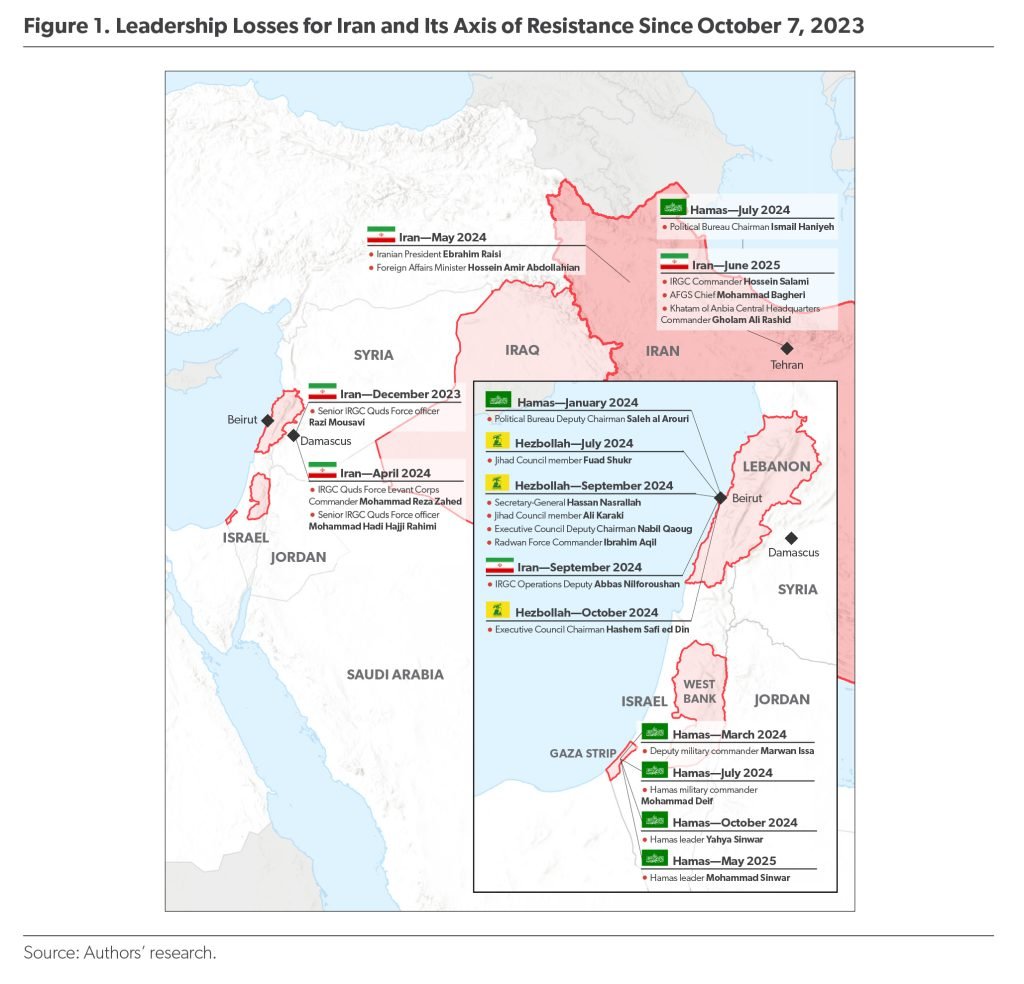
All these individuals had been prominent figures and influential voices in the Axis of Resistance for years—in some cases, decades. Supreme Leader Khamenei had relied on these individuals to help manage crises. These individuals performed unique and hard-to-replace functions due to the Axis of Resistance’s heavily personalized nature. Nasrallah, for instance, was one of the key founders of Hezbollah and oversaw the group’s evolution from a paramilitary gang into a professional military and transnational crime syndicate that eagerly subordinated itself to Tehran. Nasrallah, moreover, replaced Qassem Soleimani as a central leader in the Axis of Resistance, as has been already noted, fostering coordination among and mediating between its parties.70 He is only one example of the critical gaps that Tehran and its militia allies have needed to rapidly fill, leading to broader disruptions across their ranks.
This disruption is temporary, of course; competent leaders will fill this void in time. But the large leadership gap will likely still plague Iran and its proxy and partner militias to some extent over the next few years—much in the same way that Soleimani’s absence still occasionally burdens them.
Implications for Iranian Strategy
The events described in this report amount to the Axis of Resistance losing critical ground and much of its ability to fight and sustain high-intensity warfare. The alliance’s western portion has functionally collapsed, since Hamas and Hezbollah are severely weakened and Assad is gone. This weakening, coupled with the damage to Iranian missile forces and air defenses, has hampered Iran’s ability to project force and directly confront the United States and Israel. And many of the key individuals on whom Supreme Leader Khamenei had long relied to defend and stabilize his regime are now absent.
Iran and the Axis of Resistance still pose a significant military threat to the United States and its partners. But they are also much weaker and more vulnerable than they were before the October 7 war.
These losses should prompt Iranian leaders to rethink their strategy fundamentally, as many of the core ideas and assumptions that have long underpinned that strategy are now invalid or in question. Iran shifted from a primarily defensive strategy to an offensive one around 2014–16.71 The defensive strategy derived from the sentiment in Tehran that the regime was relatively weak and at risk of entering and then losing an overt war with the United States. These anxieties were particularly pronounced after the United States invaded Afghanistan and Iraq in 2001 and 2003, respectively, as Iranian leaders grew concerned that Washington would next turn to their regime.
They thus focused their strategy on three key functions: (1) developing anti-access and area-denial capabilities, (2) tempering political conflict with the United States, and (3) increasing regime survivability in the event of war.72 This strategy involved, among other things, Iran militarizing the Persian Gulf, engaging diplomatically, and preparing the IRGC for irregular warfare against invading forces. This strategy, despite being primarily defensive, still involved extensive investment in proxy and partner militias across the Middle East. Those extraterritorial activities were meant to export the revolutionary Iranian ideology while, at a more practical level, preparing external forces to attack US positions across the region in case a war erupted.
Iranian leaders adopted a more offensive strategy around 2014–16, working more aggressively to expand their control across the Middle East. This strategy emphasized investing in force-projection capabilities, such as expeditionary ground units and drone carrier ships, while strengthening the Axis of Resistance.73 Khamenei first alluded to this shift in August 2016, when he said that Iran must enhance its offensive capabilities to secure its “population, country, and future.”74 He then summarized the offensive strategy in a meeting with IRGC leadership in October 2019, saying,
We should not be satisfied with our region. It should not be the case that we choose [our] home and then ignore the threats that exist beyond its walls. A broad transnational perspective and the expansion of strategic depth are sometimes more important than the most urgent [domestic] issues.75
Khamenei expounded further in February 2022, saying that Iran “cannot remain in a defensive position forever, because the enemy is attacking, and [Iran] must attack too in various areas, including the fields of media, economics, and security.”76
Khamenei’s rhetoric and the increased investment in force projection coincided with Iran intervening in the civil wars in Iraq, Syria, and Yemen, highlighting this offensive strategy in practice.77 These interventions were meant to secure key Iranian allies in the Axis of Resistance and establish these countries as bases for extending Iranian influence farther abroad. There is no evidence that Iran directed Hamas to attack Israel in October 2023, but the offensive Iranian strategy enabled the attacks. The October 7 war and its expansion across the Middle East was the direct and mostly intentional by-product of Iran’s embrace of a more offensive approach to the region.
The first reason for this shift to an offensive strategy was that Iranian leaders had become increasingly confident in their defensive capabilities and thus no longer felt the need to limit their strategic objectives. Senior Iranian officials had boasted regularly in recent years that their improved capabilities had deterred the United States and its partners from attacking.78 These officials are likely responding in particular to their advancements in missile technology and acquisition of S-300s (which at the time of their procurement seemed capable of at least somewhat challenging advanced US and Israeli aircraft).
The second reason was that Iranian leaders came to see the US threat as hybrid in nature rather than conventional. They have asserted in recent years that the primary threat that the United States posed was no longer an invasion or direct strike but rather a hybrid warfare campaign that worked to destabilize the Iranian regime and the Axis of Resistance.79 Senior Iranian officials argued that Washington, given its resource constraints and the challenges posed by China and Russia, sought to control the Middle East through nonmilitary means and was accordingly using diplomacy, sanctions, cyberattacks, and clandestine operations, among other tools, to contain Tehran and its militia allies.80
This Iranian conclusion has been fueled further by the protest activity that has fluctuated across Iran since 2009. Iranian leaders have asserted that the United States and its partners have fomented internal unrest to further pressure their regime.81 This thinking combined with the Islamic Republic’s growing confidence in its defensive capabilities led it to focus more outwardly on consolidating and expanding its control across the Middle East.
But the October 7 war has demonstrated that Iran’s defensive capabilities remain deficient and that conventional war is still possible if not probable. Military planners know they must rethink their plans entirely when their underlying assumptions are invalidated; Iranian leaders should know this too. Therefore, Tehran will likely conduct a fundamental strategic rethink in the months and years ahead. It will almost certainly retain its hostility toward the United States and West more broadly and continue developing its partnerships with key US adversaries, such as China, North Korea, and Russia. But Iranian leaders will likely interrogate at a more practical level why their strategy failed and what to do next.
They will likely ask themselves how they would defend against future US and Israeli strikes and how to rebuild deterrence (and whether to do so via conventional means or with nuclear weapons). They will probably explore how to conduct more effective missile-drone campaigns or whether there are better ways to threaten enemy targets abroad. They may consider whether to fundamentally revise how they approach their proxy and partner militias. They will have to contemplate whether to invest more heavily in information warfare, covert operations, and counterintelligence measures. And they will need to examine whether even greater changes to their military doctrine, training, investment priorities, and force structure are necessary. These questions are especially pressing for Iranian leaders given that they have insisted repeatedly since the war with Israel that more fighting is likely.82
Tehran has shown that it is already thinking about what it must do differently. The regime established a new security body known as the Defense Council after the war with Israel to address shortcomings and prepare for the next round of conflict.83 The council consists of senior political and military officials and is subordinate to the Supreme National Security Council (SNSC), which is the country’s senior-most foreign and military policy body. The regime has asserted that the newly created Defense Council will improve military readiness, streamline wartime decision-making, and facilitate faster responses and greater intra-regime coordination in conflict.84 The council could become a central forum wherein Iranian leaders debate the major questions facing them.
It remains unclear, however, exactly how much the Defense Council will matter, since its membership overlaps heavily with that of the SNSC. The real implications of the change will likely emerge as the shape and capabilities of the new structure’s staff, which is where the energy for real change would likely originate, become clearer.
Down but Not Out
Iran and its Axis of Resistance remain formidable despite their losses. They retain key pillars of strength, many of which played prominent roles in the October 7 war and emerged largely intact. The following discussion reviews these remaining sources of strength and their roles in the war. These pillars will be increasingly critical to Iranian strategy for the foreseeable future, especially as Tehran tries to constitute a new foundation for its deterrent power.
Iraqi Militias
Iranian-backed Iraqi militias launched strike campaigns targeting US forces and Israel throughout the October 7 war. The militias declared at the beginning of the war that they were coordinating with one another to support Hamas and the rest of the Axis of Resistance.85 They proceeded to conduct around 200 attacks targeting US positions in Iraq, Jordan, and Syria, using missiles, rockets, and drones, from October 2023 to February 2024.86 They claimed most of these attacks under the “Islamic Resistance in Iraq” moniker. The most notable occurred on January 28, 2024, when the militias launched one-way attack drones targeting US personnel at a military site in Jordan near the Syrian border. The attack killed three US soldiers and injured another 40 service members.87
The Iranian-backed Iraqi militias likely meant for these attacks to coerce the United States into pressuring Israeli leaders to halt their military operations in the Gaza Strip. The attacks also supported the militias’ long-standing effort to expel US forces from the region by eroding American leaders’ willingness to sustain deployments there. The United States conducted numerous airstrikes targeting the militias in Iraq and Syria during this period—in some cases as retaliation for their attacks and in others to preemptively stop imminent attacks.88
IRGC Quds Force Commander Brigadier General Esmail Ghaani traveled to Baghdad shortly after the attack that killed three US soldiers in Jordan and reportedly ordered the militias to halt their attacks.89 Ghaani was likely concerned that the United States would escalate the conflict significantly in response.
The militias separately launched regular missile and drone attacks on Israel from November 2023 to November 2024. The tempo of militia attacks increased significantly after the militias paused their attacks on US forces in February 2024.90 The attacks appeared to inflict little damage overall, especially given that the IDF intercepted most projectiles launched. The most notable attack occurred on October 2, 2024, when the militias launched one-way attack drones into the Golan Heights, killing two Israeli soldiers and injuring another 24 service members.91 These militia attacks—like the ones targeting US forces—were meant to coerce Israeli leaders into halting their military operations in the Gaza Strip. The militias claimed they conducted some of their strikes in coordination with the Houthis, which this report discusses next.92 The militia attacks stopped around when the HTS-led coalition launched its lightning offensive against the Assad regime, likely because the militias prioritized returning their members from Syria to Iraq and recalculating after Assad’s fall.
The militias thus emerged from the October 7 war only slightly injured. Assad’s fall deprived them of their forward presence in Syria, and US airstrikes killed some members, including a mid-ranking commander. But the militias have sustained no other serious damage and remain influential in Baghdad.
Western media reported in April 2025 that the IRGC had transferred new ballistic and cruise missiles to the Iraqi militias, highlighting continued Iranian investment in the Axis of Resistance despite losses elsewhere. The missiles reportedly included surface-to-surface systems with a larger range than anything the IRGC had previously granted the militias.93 The upgrade to their strike capabilities was likely meant to help rebuild the Iranian retaliatory capacity in light of the defeats of Hamas, Hezbollah, and Assad. The general collapse of Iranian power and influence in the region is generating political effects, however, that could threaten the position of the militias and the political leaders who support them. The United States is reportedly pressuring the Iraqi government to take advantage of this dynamic and constrain the militias’ future power even as militia leaders work to consolidate and expand their role.94
Houthis
The Houthis conducted their own strike campaigns during the October 7 war, reflecting their evolution into a major international security threat. The Houthis—like Hezbollah and the Iraqi militias—began firing on Israel at the beginning of the war to help save Hamas. The Houthis conducted their first missile-drone attack on Israel in October 2023 and have continued conducting such strikes regularly to the present.95 Israel has in turn conducted numerous retaliatory strikes against the Houthis in Yemen.96
The Houthis waged a separate campaign against global commerce from November 2023 to the present. They appeared to be responding to Supreme Leader Khamenei, who in November 2023 called for an economic blockade on Israel, saying that “the paths of oil and food exports to the Zionist regime should be closed.”97 The Houthis have proceeded to launch repeated missile and drone attacks targeting commercial vessels around the Red Sea and Gulf of Aden. They also boarded and hijacked a commercial vessel on at least one occasion.98
Houthi analysts have implicitly compared their attacks to the Egyptian blockade of the Bab al Mandeb during the Yom Kippur War in 1973, arguing that the Egyptian blockade was essential to the war’s relative success and that a similar effort to blockade Israel could help the Houthis achieve their objectives.99 Houthi attacks have led to the regular traffic around the Bab al Mandeb dropping and dramatic increases in international shipping prices, further pressuring the Israeli economy when it was already contending with the disruption to its agricultural industry due to Hezbollah attacks around the Lebanese border.100
The United States launched an air campaign against the Houthis in January 2024 to deter Houthi attacks on global commerce.101 US strikes targeted Houthi assets, infrastructure, and personnel, often to preempt imminent Houthi attacks. The United States intensified this air campaign in March 2025, increasing the rate of strikes and targeting more senior Houthi leaders.102 US President Donald Trump later announced the cessation of strikes on the Houthis in May 2025, despite international shipping firms remaining reticent to traffic the Bab al Mandeb.103
Though these strikes certainly disrupted Houthi operations, the Houthis have continued to threaten and attack international shipping off the coast of Yemen. They remain a serious threat to the freedom of navigation around these strategically significant maritime choke points and are demonstrating a surprising willingness to continue attacking Israel even as the IDF continues to expand its military responses.
A Strategic Framework to Move Forward
The United States should work proactively to solidify the setbacks that Iran and its Axis of Resistance have suffered and use that momentum to further contain them across the Middle East. A US failure to capitalize on this opportunity would grant Tehran and its militia allies the space and time to reconstitute their forces and reestablish the threat they pose to US interests in the region.
Iran and its Axis of Resistance are already working to slow and reverse their losses. These efforts will take extraordinary effort and time, to be sure, but will likely succeed if left unimpeded. The following discussion examines what Iranian and Iranian-backed forces are doing to rebuild and then provides recommendations for how Washington should proceed.
Palestinian Territories
Hamas retains significant political influence in the Gaza Strip and is using that influence to rebuild its military strength. Mohammad Sinwar assumed control of Hamas in the strip after the IDF killed his brother and former Hamas leader Yahya Sinwar in October 2024. Mohammad proceeded to oversee efforts to recruit and train a new generation of Gazan fighters and reconstitute the al Qassem Brigades.
Hamas has attracted many new recruits by promising them food, medicine, and other forms of aid—resources that are badly needed in the war-torn strip.104 Hamas has focused especially on recruiting the friends and family of Gazans who have died throughout the war. US intelligence reportedly determined in January 2025 that Hamas has recruited around 15,000 fighters, rivaling—if not exceeding—its prewar strength of 30,000 to 40,000 fighters.105 These new recruits lack the competencies of the combat-hardened veterans whom Hamas had been developing for decades. But many of those veterans are now dead, meaning Hamas must rely on its newer members.
Beyond manpower, Hamas retains around 75 percent of its underground tunnel network and some limited capability to fire rockets into Israel.106 It has also repurposed some unexploded Israeli ordnance to produce improvised explosive devices for use against the IDF.107 These points highlight the foundation that Hamas has to rebuild its military strength despite its severe losses.
The IDF struck and killed Mohammad Sinwar in Khan Younis in May 2025, which will disrupt this reconstitution at least slightly.108 However, other Hamas leaders, such as longtime brigade commander Izz al Din al Haddad, have likely already filled Mohammad Sinwar’s role. Hamas will continue its efforts to reconstitute and reextend its influence over the Gazan population so long as there is no political actor in the strip that challenges Hamas’s rule.
The United States should therefore support an international effort to establish a new Palestinian governing authority that opposes Hamas and can rebuild the Gaza Strip. Such an authority could manage the distribution of aid, housing of displaced Gazans, and administration and reconstruction of the strip. This authority could supplant Hamas as the primary political power in the strip and gradually erode Hamas’s influence. This is the most effective way to create long-term peace in the Gaza Strip; military operations cannot achieve this effect alone, because they challenge Hamas at the military level but not the political one.
The international community would, of course, need to support a new governing authority with financial and security assistance, especially as that authority works to destroy the remaining Hamas remnants. Egypt and the Gulf states are well poised to assist here.
Any alternative approach that involves displacing thousands of Palestinians to neighboring countries would risk undermining Israeli security in the long term. Hamas and other extremist Palestinian actors would almost certainly try to infiltrate these communities abroad and use them to establish military networks outside the Gaza Strip and around the Israeli periphery. Those networks would have easier access to external backers, such as Iran, than Hamas has in the Gaza Strip. Those networks could in time perform subversive activities in the countries where they are based. These risks outweigh the costs of investing now in Palestinian self-governance in the Gaza Strip.
Lebanon
The United States should aggressively support the full implementation of the Israel-Lebanon ceasefire agreement. The agreement that ended the recent fighting between Israel and Hezbollah requires that the Lebanese government and military remove Hezbollah forces from southern Lebanon and prevent the group from rearming. The agreement also emphasized the need to uphold UN Security Council Resolution 1701, which ended the 2006 Israel-Lebanon war and similarly required Hezbollah forces to leave southern Lebanon.109
Of course, Hezbollah ignored that resolution and spent the years after the 2006 war strengthening its political and military hold over southern Lebanon. That entrenchment enabled the group to launch its attack campaign into northern Israel during the October 7 war. The United States cannot allow Hezbollah to rearm and again ignore its international obligation to remain out of southern Lebanon.
The United States should likewise support the Lebanese government and military in enforcing the ceasefire and support the Israeli right to respond with force to any Hezbollah violation. Newly elected Lebanese President Joseph Aoun and Prime Minister Nawaf Salam have voiced their desire to disarm Hezbollah promptly.110 Hezbollah has responded characteristically with threats to the government, underscoring the risk inherent in trying to declaw the group.111 But Hezbollah is weaker now than at any point in decades, highlighting the rare window of opportunity that Washington has to defeat a terror group that has long antagonized the United States and killed many Americans.
The United States should also explore how to collaborate with regional partners and whether to use sanctions to impede Iranian efforts to help Hezbollah reconstitute. Iran has tried to smuggle funds and weapons into Lebanon via air and sea transit in recent months.112 Lebanese authorities have demonstrated their desire to prevent that smuggling to Hezbollah.113 Washington should back their efforts to keep Hezbollah weak.
Syria
Iran has tried to reestablish its presence in Syria since the Assad regime fell. Iranian leaders have openly discussed in recent months their desire to return to Syria. Senior officials, including Supreme Leader Khamenei, have called repeatedly since Assad’s fall for Syrian youth to arm themselves and fight to liberate their country.114 A senior IRGC officer went further in a private meeting, saying that Tehran is already working to develop new proxy and partner militias in Syria.115
Western media reported in April 2025 that Iran has engaged unspecified Sunni extremists to destabilize the transitional Syrian government and facilitate smuggling into the country.116 Other militant and criminal networks tied to Assad have reemerged in Syria as well. Some, such as the former National Defense Forces in eastern Syria and Hezbollah-linked smugglers in western Syria, likewise have links to the IRGC and have a vested interest, like Iran, in destabilizing the new government to enable their own agendas.117 Iran could use those connections to gradually rebuild its networks in Syria.
The United States must support long-term Syrian stability that integrates all ethno-religious minorities, reconciles rival political factions, and destroys Assad-era militant and criminal networks that seek to destabilize the country. Promoting this kind of stability requires maintaining the US force presence in Syria as part of the international coalition to defeat ISIS.
A myopic focus on ISIS is insufficient, however. The United States should also pressure the transitional government and its backer, Turkey, to build a broad-based and fully representative political system in Syria. The United States should similarly press the transitional government to pursue fair and transparent justice against former Assad regime officials who committed crimes against the Syrian people. Doing so should minimize the appeal to some Syrian elements of supporting anti-government networks tied to Assad and potentially aligned with Iran.
Iraq and Yemen
The Axis of Resistance members in Iraq and Yemen have emerged from the October 7 war largely intact and remain a significant threat to US interests, personnel, and partners in the Middle East. The United States must thus use the positive momentum it has to weaken these groups.
The United States should increase support for—rather than abandon—Iraqi leaders who wish to see their country independent of Iranian domination. In doing so, the United States should retain its force presence in Iraq, as it empowers those Iraqi leaders, and collaborate with them to constrain and marginalize Iranian-backed forces.
Washington must also be prepared to use force against Iranian-backed Iraqi militias should they again threaten US service members. The militias stopped attacking US personnel after the United States threatened their key leaders, many of whom are designated terrorists.118 The United States can maintain this deterrence while exploring political options with Iraqi leaders to minimize Iranian influence there.
The United States should also seek to render the Houthis unwilling to attack international shipping and US partners. The Houthis remain willing to attack both. Airstrikes alone cannot deter the Houthis. And the United States cannot tolerate a future wherein the Houthis have veto power over what transits the Red Sea and Gulf of Oman. That would imperil US sailors and vessels transiting the area and keep shipping prices high. Specifically, the United States should support local partners in conducting offensive ground operations against the Houthis. A committed US effort to back partners challenging Houthi control is the most straightforward—and perhaps only—path to render the Houthis unwilling to conduct attacks outside Yemen.
The Nuclear Angle
US and Israeli strikes on the Iranian nuclear program have set it back materially and will likely delay Iran’s ability to field a nuclear arsenal. But it was never possible to destroy the program completely through airstrikes alone. And Iran has shown its determination to continue its nuclear advancements despite setbacks and the threat of international sanctions—especially because Iran has few other realistic ways of rebuilding its deterrent power.
Negotiations are a perfectly viable way to prevent nuclear proliferation in principle. But the United States must remain prepared to use force—as it has already to tremendous effect—to prevent Tehran from becoming a nuclear power.
The United States must collaborate closely with its European allies to prevent Iran from acquiring a nuclear weapon and rebuilding its offensive capabilities. European allies triggered the UN “snapback” mechanism, which reimposed international sanctions on Iran for its failure to comply with its international obligations. Those sanctions include an international arms embargo that will hinder Iranian efforts to rebuild its military via imports from China, North Korea, Russia, and others.
Building on Progress
Adopting the proactive measures described here and using them as the foundation to build a long-term strategy to contain Iran and its Axis of Resistance is the most effective path to stabilizing the Middle East. US policymakers will undoubtedly find the prospect of adopting these measures and then building on them to be daunting. But the alternative is that Washington remains passive to the dangers that Tehran and its militia allies pose and again suffers a strategic surprise, as it did in the days and months following Hamas’s attack on Israel in October 2023.
The United States cannot afford such risk, especially since it would jeopardize US efforts to compete with China and Russia and secure American interests elsewhere. The success of US grand strategy thus rests partly on implementing and developing this approach in the Middle East.
About the Authors
Nicholas Carl is the assistant director of the Critical Threats Project at the American Enterprise Institute. His work focuses on political and security issues in the Middle East and trends in modern warfare. He has written extensively on Iranian security policy in the AEI reports Pivot to Offense: How Iran Is Adapting for Modern Conflict and Warfare, Whatever It Takes to End It: Iran’s Shift Toward More Oppressive Governance, and Iran’s Reserve of Last Resort: Uncovering the Islamic Revolutionary Guard Corps Ground Forces Order of Battle. Follow him on X @NicholasACarl.
Brian Carter is the research manager of the Critical Threats Project at the American Enterprise Institute. He focuses on the activity of Iran and its proxies and partners across the Middle East. Carter received his MA in international affairs from American University’s School of International Service. He graduated from Wake Forest University with a BA in politics and international affairs. Follow him on X @brian_cartr.
Acknowledgments
We would like to express our deep gratitude to the many individuals who were instrumental in the production of this report. Frederick W. Kagan has been a consistent source of insight, feedback, and encouragement. We also benefited from the superlative work done by the Middle East research staff from the Critical Threats Project and Institute for the Study of War (ISW). We would like to acknowledge in particular Annika Ganzeveld, Ria Reddy, Andie Parry, Johanna Moore, Adham Fattah, Ben Rezaei, Katherine Wells, Zahra Wakilzada, Avery Borens, Ben Schmida, Carolyn Moorman, Kelly Campa, and Nidal Morrison. Their excellence and dedication are what has enabled AEI and ISW to publish daily (and sometimes twice-daily) updates on Middle Eastern political and security dynamics since the October 7 war began. We would lastly like to thank Danielle Porter and Frances North, who kept the project on track and magnificently handled the vital support functions that we needed.
About AEI’s Critical Threats Project
The Critical Threats Project at the American Enterprise Institute equips policymakers, opinion leaders, and the military and intelligence communities with detailed and objective open-source analysis of America’s current and emerging national security challenges. Through daily monitoring, in-depth studies, graphic presentations, private briefings, and public events, the project is a unique resource for those who need to fully understand the nuance and scale of the threats to America’s security to effectively develop and execute policy. Follow the Critical Threats Project on X @criticalthreats.
About Our Technology Partners
The conclusions and assessments in this report do not reflect the positions of our technology partners.
Neo4j is a highly scalable native graph database that helps organizations build intelligent applications that meet today’s evolving connected data challenges including fraud detection, tax evasion, situational awareness, real-time recommendations, master data management, network security, and IT operations. Global organizations like MITRE, Walmart, the World Economic Forum, UBS, Cisco, HP, Adidas, and Lufthansa rely on Neo4j to harness the connections in their data.
Babel Street provides the most advanced identity intelligence and risk operations platform for the world’s most trusted government and commercial organizations. The AI-enabled platform helps them stay informed and improves around-the-clock decision-making. Teams are empowered to rapidly detect and collaborate on what matters in seconds by transforming massive amounts of multilingual, enterprise and publicly available data into actionable insights so they can act with confidence. Babel Street is headquartered in the U.S. with offices near Washington, D.C., and Boston, along with Tokyo, Tel Aviv, London, Canberra, and Ottawa.
Ntrepid is a mission-driven provider of cutting-edge managed attribution technology solutions that allows organizations to discreetly and safely conduct sophisticated cyber operations in the most hostile online environments. We leverage our deep experience in the national security community to anticipate our customers’ needs and provide solutions before the requirements are expressed. Our heavy investment in R&D allows us to stay ahead of the rapidly changing internet landscape. Ntrepid’s innovative solutions empower advanced online research, analysis, and data collection, while obscuring organizational identity and protecting your mission.
Linkurious’ graph visualization software helps organizations detect and investigate insights hidden in graph data. It is used by government agencies and global companies in anti–money laundering, cybersecurity, or medical research. Linkurious makes today’s complex connected data easy to understand for analysts.
BlackSky integrates a diverse set of sensors and data unparalleled in the industry to provide an unprecedented view of your world. They combine satellite imagery, social media, news and other data feeds to create timely and relevant insights. With machine learning, predictive algorithms, and natural language processing, BlackSky delivers critical geospatial insights about an area or topic of interest and synthesizes data from a wide array of sources including social media, news outlets, and radio communications.
Sayari is a search company, not a traditional data vendor. They build search products that allow users to find corporate, financial, and public records in hard-target countries. Sayari products cover emerging, frontier, and offshore markets, and include corporate registries, official gazettes, litigation, vital records, customs data, and real property. They collect, structure, normalize, enrich, and index this data, often making it searchable for the very first time.
The Institute for the Study of War (ISW) advances an informed understanding of military affairs through reliable research, trusted analysis, and innovative education. ISW is committed to improving the nation’s ability to execute military operations and respond to emerging threats in order to achieve US strategic objectives. ISW is a nonpartisan, nonprofit, public policy research organization.