
Documentary photographer Philip Gould has traveled the world, captured numerous landscapes and a rich variety of people, but nowhere compares to the soul connection he feels in south Louisiana.
At the age of 20, San Francisco Bay Area native Gould found his future behind the lens of a camera when his mom bought one that, as he says, “wasn’t half bad.”
“It was 1971. I commandeered it and started taking pictures like crazy,” said Gould.
The new hobby led him to study journalism at a local community college and a photojournalism degree from San Jose State, knowing that he needed to make photography his career.
“It spoke to me loudly,” he said.

Photographer Philip Gould testing out a drone for his photography.
Colin Gould
Right out of college in 1974, Gould landed a job in New Iberia taking pictures for The Daily Iberian. The assignment turned out, for Gould, to be “the best first job a photographer could hope for.”
In a town where there was little news, he had free rein to photograph anything as long as readers enjoyed the pictures.
Cypress knees in Stephensville, Louisiana from “Louisiana from the Sky.”
Philip Gould
Gould says the opportunity in New Iberia made all the difference in a career that has spanned five decades, multiple countries, several museum exhibitions and more than 20 books.
After a year and a half in New Iberia, in 1976, Gould moved to Dallas to work at the Dallas Times Herald. In 1978, the oak trees, Spanish moss, waterways, music and people lured him back to Acadiana.
“I found that Louisiana had a wonderful sense of rootedness,” Gould said, “in that people are from here — and not only that, their ancestors are from here.”
He says he liked that it was a French speaking area and that people had a wonderful sense of humor here.
“I just somehow viscerally connected to Cajun culture,” he said.
That connection led to his first book, “Les Cadiens D’Asteur: Today’s Cajuns,” which was released in 1980, and it became a traveling exhibit.
Since then, Gould’s work has been exhibited in the Field Museum of Natural History, the Hilliard University Art Museum, the Louisiana Art & Science Museum, the New Orleans Museum of Art and the Virginia Museum of Fine Arts.
Gould has created and co-authored 16 books that range from “Ghosts of Good Times,” about abandoned dance halls in south Louisiana to “Bridging the Mississippi,” a conclusive look at every bridge that crosses the Mississippi River — and contributed to many more.
Over 380 explosive charges detonate in tandem causing the old Savanna-Sabula Bridge in Illinois to drop into the Mississippi River.
Philip Gould
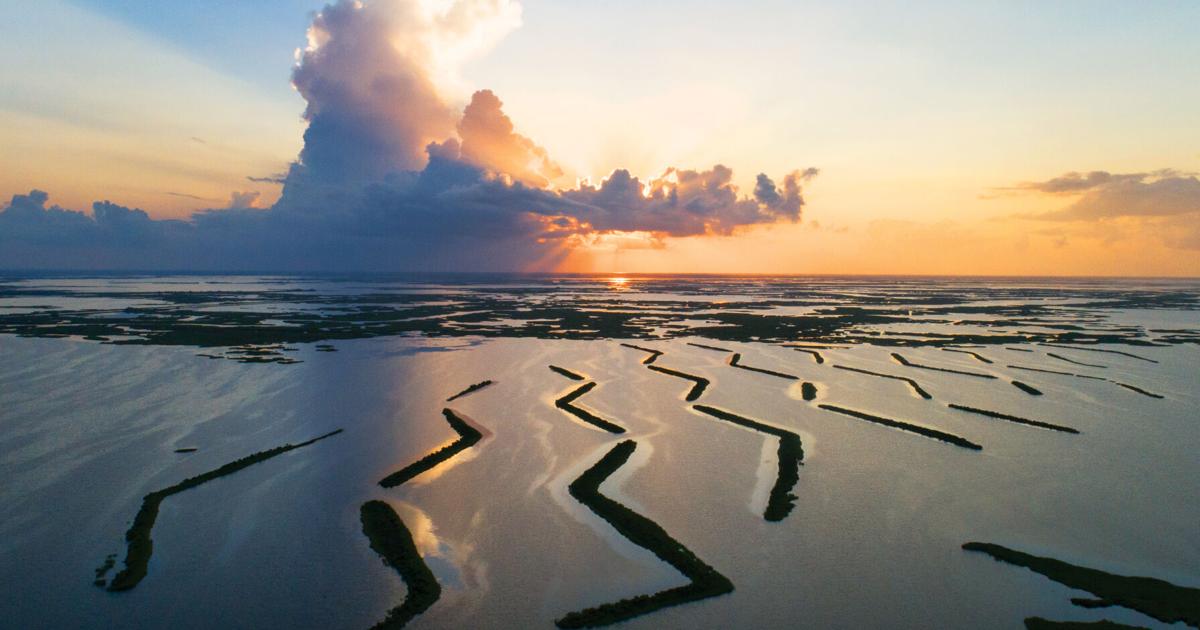
His most recent project is “Louisiana from the Sky,” which will be published by UL Press and available Dec. 9.
The book offers a distinct perspective on the Bayou State as seen from overhead with drone photography. This idea for the collection of overhead photos grew from his childhood in California, where he was used to seeing mountains and more dynamic landscapes.
The flatness of Louisiana had always lacked that kind of drama, or so he thought.
“I felt this void,” Gould said. “My premise has been that you really can’t see Louisiana in its full glory and potential from the ground. You have to put something up in the air — so the whole flat landscape spreads out before you, and you can see its true drama.”
When asked about his favorite subject to capture, Gould said that he loves photographing people living in amazing architecture.
He also said that he’s often inspired by unusual concepts that become full-scale projects — like his early 2000s series on train stations in France, “Les Plus Belles Gares de France.”
‘He’s like our memory’
Mark Tullos, executive director at the LSU Museum of Art, met Gould in 2002 when in Lafayette. The first time he saw Gould, the photographer was standing on top of a 14-foot ladder at a festival, documenting Louisiana’s joie de vivre. Tullos was worried for Gould’s safety, but the photographer was undeterred.
“I remember meeting him soon after that,” Tullos said, “and I was having a conversation about the lengths he will go to get a marvelous capture, a marvelous image. And he’s a master of that. He’s a real visionary. He’s in that same family of great artists like Fonville Winans and C.C. Lockwood.”
Tullos in his role back then as director of the Hilliard Art Museum in Lafayette, used to take visitors to nearby zydeco clubs to hear local music, where he would often see Gould taking pictures.
“I remember so clearly going to festivals or different events that were important in Louisiana, and seeing Philip like this sort of ghost walking around with his camera,” said Tullos. “He’s like our memory, he goes through gathering all these images — and then you go back to an exhibition (at a museum) later, and you see an image. You go, ‘I remember that, and I remember that day.'”
UL history professor Michael Martin says that Gould’s work goes beyond documenting.
Raymond Manson prays under the Crescent City Connection.
Philip Gould
He says Gould’s photographs evoke and convey things that are easy to identify with even for those not from Louisiana or the United States, for that matter.
“He’s going beyond documenting. You can hear the music. You can feel the dance floor kind of bouncing up and down. You can see the dust coming up off of the floor,” Martin said of Gould’s work. “You can look at his photographs and say, ‘You know what, I can kind of sense what it would be like to be there.'”
Five decades in, Gould’s photographs often do more than record a moment — they remind the people of south Louisiana who they are.
Through his lens, the ordinary becomes luminous, and the familiar turns timeless.