
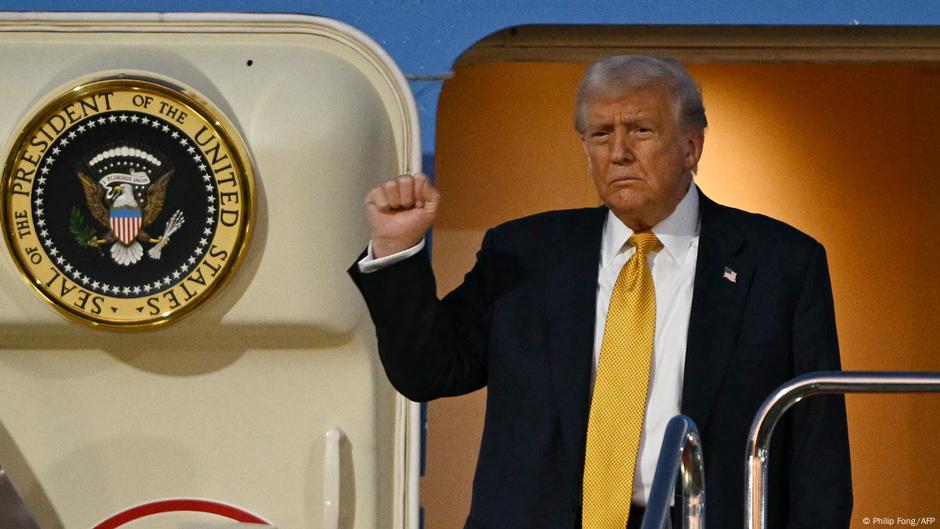
US President Donald Trump arrived in Japan on Monday, the second stop of his five-day tour of Asia — his longest journey abroad since taking office in January.
His first stop was the Association of Southeast Asian Nations (ASEAN) summit in Kuala Lumpur, Malaysia, where he oversaw the signing of a peace agreement between Thailand and Cambodia.
Dubbed the Kuala Lumpur Peace Accords, it built on a ceasefire reached after Trump intervened in July, after the decades-long Thailand-Cambodia border dispute erupted into five days of deadly clashes.
After the border deal was inked, Trump said that the Thai Prime Minister Anutin Charnvirakul and Cambodian Prime Minister Hun Manet were courageous, adding that the truce he brokered saved “millions of lives.”
“This is a momentous day for all the people of Southeast Asia as we sign a historic agreement to end the military conflict between Cambodia and Thailand,” Trump said.
Both contries confirmed their “unwavering commitment to peace and security,” as well as agreeing to organize de-mining efforts along their border, withdraw heavy weapons and allow access to ceasefire monitor teams organized by ASEAN.
Thailand agreed to release the 18 Cambodian soldiers it has held in captivity since July.
Trump also signed reciprocal trade deals with Malaysia and Cambodia. Vietnam pledged to increase its purchase of US products to reduce a trade surplus of $123 billion (€106 billion) in 2024.
The US president left Malaysia earlier on Monday for Japan. The country’s new prime minister, Sanae Takaichi, only took office last week and is banking on building a friendly personal relationship with Trump to ease trade tensions.
While on Air Force One on Monday, Trump said he planned to talk in Tokyo about the “great friendship” between the US and Japan.
Trump joins ASEAN leaders for key summit talks
To view this video please enable JavaScript, and consider upgrading to a web browser that supports HTML5 video
Why is Trump getting all the attention?
Since Trump was sworn in as president, his administration claims to have solved eight wars in eight months.
“We are averaging one a month — there is only one left,” Trump told the Kuala Lumpur summit.
Phil Robertson, director of the Asia Human Rights and Labor Advocates, says Trump is out for himself.
“Presiding over Thailand and Cambodia signing their accord is all about Trump continuing his narcissistic pursuit of next year’s Nobel Peace Prize,” he told DW.
Cambodia nominated Trump for the coveted peace award in July after he intervened to halt five days of deadly clashes over disputed borders.
Trump had threatened to increase trade tariffs on US exports to both Thailand and Cambodia to 49% should they not resolve the border issue. A deal was reached so that both Bangkok and Phnom Penh would only pay 19%.
“Both Thailand and Cambodia are hugely dependent on the American market for their exports so there was really no chance they would refuse Trump’s demands that they hurry up and make peace, and actually sign an accord with Trump literally looking over their shoulders,” Robertson added.
Trade pressure drives influence
Despite the United States having the largest economy in the world, Trump wants to shrink US trade deficits with many of its trade partners. He has used executive orders to hike tariffs in order to do so.
This has puts pressure on Southeast Asian economies, Ian Chong, a political analyst in Singapore, told DW.
“Tariffs, trade — including transshipments — are a big component of US leverage. Southeast Asian economies are conduits in the global supply chain,” Chong said, adding that several [countries] supply key minerals, such as nickel, to China “for manufacturing into … products that find their final market in the United States.”
“Trade restrictions from the United States mean that Southeast Asian states will have to find alternative final markets, which is not easy. This puts further pressure on their economies,” added Chong.
Trump’s ASEAN visit yields Thai-Cambodian truce, trade deals
To view this video please enable JavaScript, and consider upgrading to a web browser that supports HTML5 video
Trade between the US and ASEAN nations was estimated to be worth $475 billion in 2024, according to the Office of the US Trade Representative — a vital two-way cog for the economies in Southeast Asia.
Trump said that his administration had worked on how to prevent the Thai-Cambodia conflict from escalating, and they were surprised by the timeframe of it all happening.
“Everybody was sort of amazed that we got it done so quickly,” Trump said.
Trump courts regional loyalty
It was also a chance for Malaysian PM Anwar to get a face-to-face with Trump, with a reciprocal trade agreement already announced between Washington and Kuala Lumpur.
Chong says that leaders in the region are eager to keep on the good side of Trump, to maintain their trade relationships with the US, without accepting demands from the world’s second biggest economy, China.
“Historically, the United States has helped maintain stability and easy access to the sea and air, which are also crucial to trade,” Chong told DW, noting that Washington is not a claimant in territorial disputes in Southeast Asia and has historically seen such access and stability in the region as consistent with its economic and strategic interests.
“A less committed United States could create a destabilising power vacuum or force Southeast Asian states to accept PRC terms,” Chong said, addressing China by the abbreviation of its official name, the People’s Republic of China.
“Southeast Asian leaders may believe that engaging with President Trump directly may enable them to make their case, or at least avoid being shut off by the United States.”
Trump revives US-China trade war with new tariffs
To view this video please enable JavaScript, and consider upgrading to a web browser that supports HTML5 video
But Thitinan Pongsudhirak, a political scientist and professor at Chulalongkorn University in Bangkok, says Trump is more interested in quick wins and thrashing out a deal with China.
“The ASEAN meetings are a sideshow to Trump,” said Thitinan.
“He wants quick wins while what Southeast Asia is looking for are slow win-win outcomes. Trump also has turned the ASEAN-US summit into a working dinner, but Southeast Asian leaders have no choice but to go along,” he said.
“Japan and South Korea are bigger fish as Trump tries to induce investments into the US. But the biggest agenda item will be his meeting with President Xi,” Thitinan added.
“Unlike the Trump first term, China is ready to deal with the US measure for measure. It’s a geoeconomic brinkmanship.”
Trump said he was hopeful of a deal when he sees Chinese President Xi Jinping Thursday, while also indicating he was willing to extend his trip to meet North Korean leader Kim Jong Un.
“I have a lot of respect for President Xi and we are going to I think… come away with a deal,” Trump told reporters on Air Force One.
Edited by: Keith Walker