
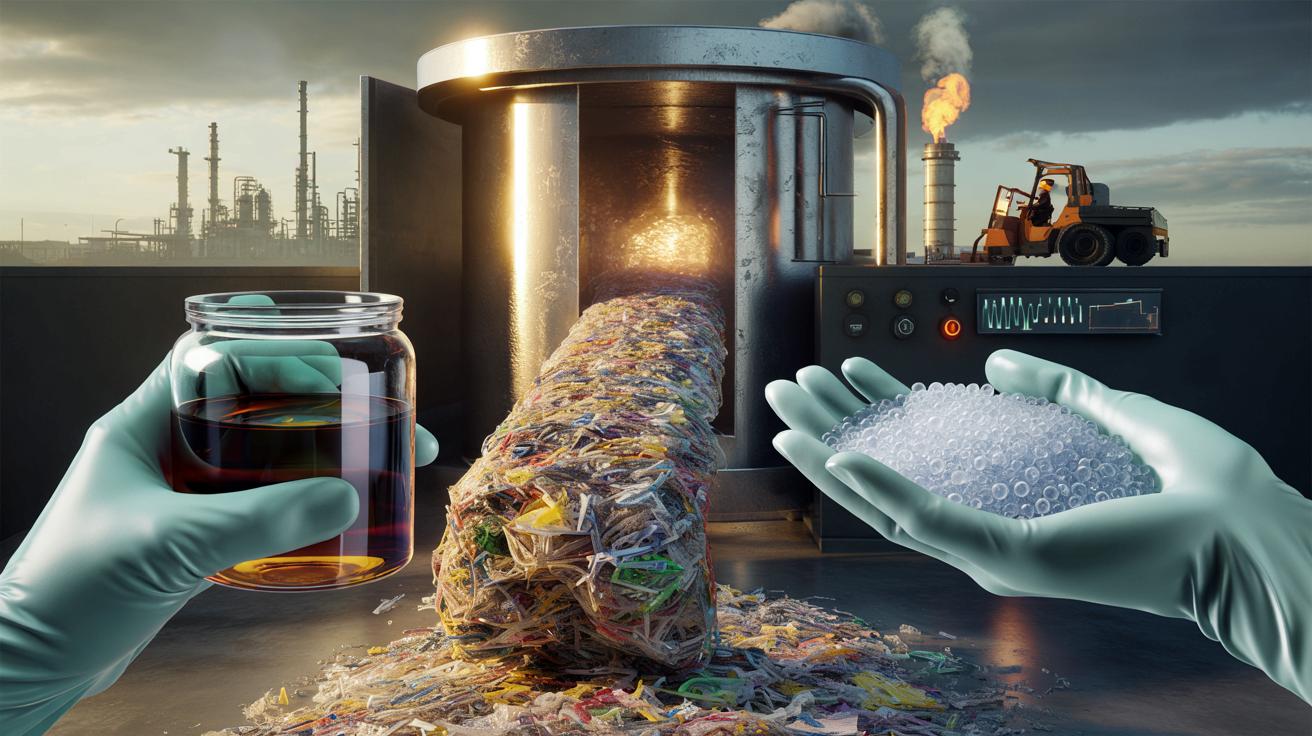
Plastic keeps piling up, and the climate clock keeps ticking. Chemical recycling is pitched as a fix for both: turn hard‑to‑recycle waste into virgin‑grade feedstock, cut emissions, close the loop. Industry loves the promise. Campaigners smell spin. Regulators sit in the middle, pen hovering. The stakes aren’t small — billions of pounds, and the story we tell about “circular”.
The forklift sets down a bale of crinkled snack wrappers with a thud, and the air in the pilot hall carries a faint, warm, tarry sweetness. Operators in orange helmets watch a ribbon of mixed plastics ease into a steel throat, screens blinking yields and temperatures. On a wall, a laminated sign reads “From waste to value,” as if that’s the whole plot. A local councillor leans close and asks quietly where the carbon ends up. Nearby, a young engineer grins and points to a pipe heading to a co‑processing unit at the refinery next door. Someone else coughs. The steel hum grows louder. The future smells like oil.
What “chemical recycling” really does — and what it doesn’t
Chemical recycling is not one thing. It’s a family: pyrolysis and gasification that break plastics into oils or syngas, and depolymerisation that snaps PET or nylon back to monomers. The idea is elegant — rebuild quality where mechanical recycling struggles. The reality rides on energy, chemistry, and what you call a “loop”.
Take a UK trial that feeds low‑grade films into a pyrolysis unit. Out comes 60–70% liquid oil by mass, plus gas to keep the unit hot, and a char that needs handling. The oil is sent to a steam cracker, blended with fossil naphtha, and turned into ethylene and propylene again. Sounds circular, and parts of it are — in practice it’s a tightrope.
Here’s the hard bit. **Follow the carbon.** If the oil mostly replaces fossil feedstock and the plant runs on low‑carbon power, emissions can drop. If the oil ends up burned as fuel, or the unit gulps gas‑fired heat, climate gains shrink fast. Accounting rules like “mass balance” spread recycled claims across products — which can hide a lot of nuance behind a neat label.
How to tell hope from hype in three checks
Start with the life cycle, not the press release. Ask for an independent LCA that shows net greenhouse gases per tonne of waste, with and without co‑processing at a refinery. Look for yields to naphtha or monomers, the energy source that powers the reactor, and where the char goes. Then ask what fraction becomes plastic again — not fuel.
Brands love a shiny badge and a ribbon‑cut photo. We’ve all had that moment when a label promises “advanced recycling” and it just feels… solved. It’s easy to slip into that glow. Let’s be honest: nobody reads a 200‑page LCA before buying a shampoo bottle. So lean on simpler tells: is the claim third‑party certified, does the plant run beyond pilot scale, and is the recycled content tracked at product level, not just across a whole site?
When experts talk straight, they end up saying the same thing with different accents — show the numbers, show the flows, show the power mix.
“If you can’t trace where the molecules go, you can’t call it circular.”
Net GHG per tonne, cradle‑to‑gate
Yield to plastic, not fuel
Energy source and uptime
Mass‑balance rules used
Independent audit, not marketing
Experts weigh in on the climate maths — and the politics
Ask five specialists and you’ll hear one broad refrain: chemical recycling can help, yet it’s not a silver bullet. *Real decarbonisation lives in the mix of less plastic, better design, clean energy, and smarter loops.* Mechanical recycling handles the easy streams cheaply. Chemical routes target the gnarly stuff — multilayer films, contaminated packaging — and only deliver climate gains when powered clean and looped back into materials. Policy decides how honest the loop feels. If mass balance allows broad claims on tiny inputs, trust erodes. If markets reward turning waste into fuels, plastic becomes a proxy oil field. And yes, there’s a justice angle: siting plants near refineries concentrates impacts in the same neighbourhoods that bear the brunt of heavy industry. The most credible vision is narrow, precise, and frankly less sexy: smaller volumes, higher quality, transparent accounting, and **plastic to plastic, not plastic to petrol**.
Key points
Details
Interest for reader
Chemical recycling is multiple technologies
Pyrolysis, gasification, depolymerisation — different inputs, outputs, and energy needs
Helps decode marketing claims and match tech to waste streams
Climate benefit hinges on energy and end use
Clean power and “plastic‑to‑plastic” yields drive gains; fuel use erodes them
Shows when a claim is credible or drifting into greenwash
Mass balance can blur the picture
Accounting spreads recycled content across products; auditing quality varies
Teaches you how to read labels and demand real transparency
FAQ :
What exactly is chemical recycling?It’s a set of processes that break plastics into smaller molecules — oils, gases, or monomers — that can be turned back into new plastics or, less ideally, burned as fuels.
Is it better for the climate than mechanical recycling?Not usually for clean, single‑polymer streams. Mechanical wins on energy and cost there. Chemical routes matter for hard‑to‑recycle waste, and only deliver climate gains with clean energy and high “plastic‑to‑plastic” yields.
Why do some groups call it greenwashing?Because some facilities co‑process small volumes, claim big “recycled content” via mass balance, or sell the output as fuel. That can look like branding, not circularity.
What should I look for in a credible claim?Independent LCA, audited mass‑balance standard, clear yield to new plastic, plant running at commercial scale, and disclosure of the energy mix. **Mass balance isn’t magic — it’s accounting.**
Does this mean we can keep using the same plastics?No. Redesign, reduction, and reuse still cut emissions fastest. Chemical recycling is a specialist tool, not a hall pass for business‑as‑usual.