
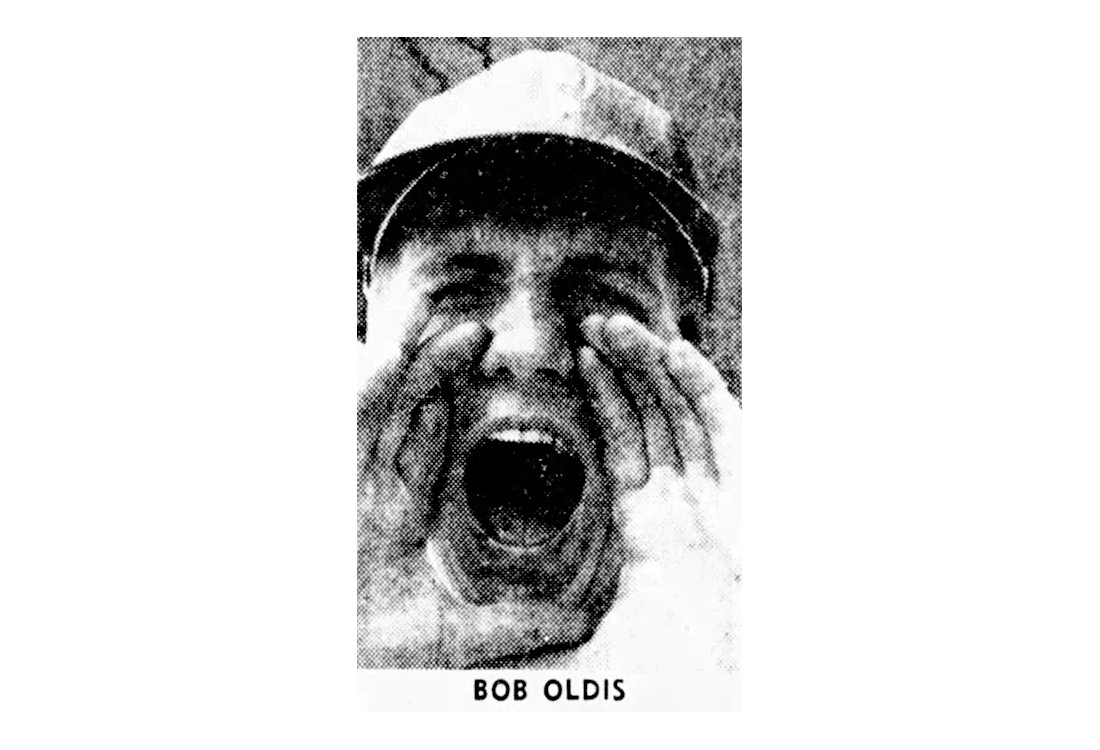
Among those ballplayers whose major-league experience consists of just a handful of games (i.e. a “cup of coffee”), Bob Oldis stands above them all. Oldis, a catcher and occasional third baseman, played in parts of 7 seasons in the majors in the 1950s and 1960s, without ever appearing in more than 50 games in a single season. Even in instances where he stayed with a ballclub for an entire year, he never had so much as 100 at-bats in any given year. But he was a valued teammate whose skills beyond the traditional baseball tools earned him roster spots, if not necessarily a starting role. Oldis died in Gilbert, AZ, on September 21, at the age of 97. He played for the Washington Senators (1953-55), Pittsburgh Pirates (1960-61) and Philadelphia Phillies (1962-63).
Robert Carl Oldis was born in Preston, IA, on January 5, 1928. He was an avid baseball player, but Iowa City High didn’t start a baseball program until he was a junior, in 1944. He was a catcher for American Legion teams throughout his youth, and he was active in City High’s other sports as a trainer. “Oldy,” as the players called him, was able to tape up most any body part for the school’s football and basketball teams, and he doubled as a trainer/catcher when baseball season started. After he graduated in 1946, Oldis continued to play ball on local teams around Iowa City. He was also involved with other sports in a non-playing capacity, whether it was keeping score for a local basketball league or coaching a softball team. Oldis earned a living working as a milkman at a local dairy, and that job proved more dangerous than all his athletic interests. He was sidelined from baseball for 6 weeks after an accident at the dairy severed part of the index finger on his right hand. He was back in action in August to help lead the Iowa City Cardinals of the National Softball League into the playoffs.
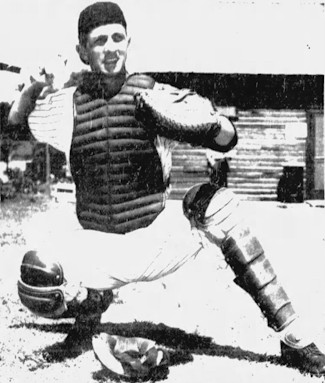 Source: The Charlotte Observer, June 21, 1955.
You may notice that none of the above athletic accomplishments had anything to do with professional baseball. Oldis didn’t sign a pro contract until he inked a contract with the Washington Senators in February 1949. He attended Jack Rossiter’s Baseball School in Cocoa, FL, in the winter and was one of 12 players signed by the club. “I took a bus from Iowa City to Florida and rode it for three days and four nights,” Oldis later explained. “The six-week course cost me $175, including my bus fare, but it paid off. It got me a job in baseball.” Washington assigned him to the Emporia Nationals of the Virginia League. Oldis was just 21 years old, so while he may have lacked some of the experience of the other players in the league, he adapted quickly. In an August 7 game against Lawrenceville, Oldis homered twice as part of a 13-run first inning. It was the first time in league history that anyone had accomplished that feat. He batted .285 on the year with 5 home runs and 33 RBIs. He returned to Emporia in 1950 and helped lead the team to a championship as the team’s regular catcher. He drove in 74 runs, though he homered just 3 times. He also won a bejeweled watch after being named the team’s most popular player by fan vote. The season took its toll on him. “We had a lot of rain and, because of postponements, had to play a lot of doubleheaders at the end,” he told Press-Citizen sports editor Al Schmaul. “We played 14 games in 11 days, and I caught all of them. I lost 16 pounds during the season, most of them at the end of the year.”
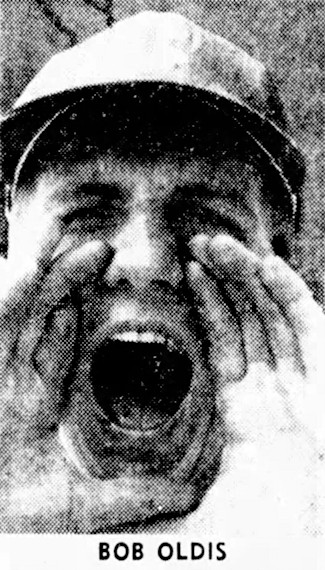 Oldis was a part-time third base coach in the minors, and his antics rivaled those of some famous baseball clowns like Max Patkin. Source: The Charlotte News, June 8, 1951.
As Oldis moved up the ladder of the Senators’ farm system, he continued to be a steady hitter, but without much power. He didn’t homer at all between 1951 and 1953, in which he played for Class-B Charlotte and Double-A Chattanooga. What he lacked in power, he made up for in other skills. His defense as a catcher was excellent, and he had a powerful arm that wasn’t the least bit impacted by his stub of an index finger. He also was a popular draw as a third base coach, waving his arms, shouting to the players and contorting his body in odd pantomimes that reminded fans of famed baseball clown Max Patkin. “Half the people who sit down that way come out to see him, not the club,” said Charlotte general manager Phil Howser.
Washington decided to bring the catcher to the majors in 1953. He was a 25-year-old rookie, although the odds are decent that the Senators didn’t know his true age. Several newspaper articles about Oldis in the preceding years listed him as 2 or 3 years younger than he actually was. Oldis debuted as a defensive replacement in Chicago on April 28 and caught 1 inning before being removed in the ninth inning for a pinch-hitter. Senators manager Bucky Harris used Mickey Grasso, Ed FitzGerald and Les Peden as starting catchers to start the year. Oldis didn’t start a game until the second game of a May 10 doubleheader against Philadelphia. He grounded out in his first 3 at-bats before lining a single to left field off Charlie Bishop in the eighth inning, scoring Jim Busby from second base. He went 3-for-3 and drove in Washington’s only run in a 3-1 loss to St. Louis on June 25. It was Oldis’ first appearance in a game in nearly a month, and one of his final games of the season. Washington sent him to the minors in July. In 7 games, he had 4 hits in 16 at-bats for a .250 batting average, and he drove in 3 runs. Oldis demonstrated his skills behind the plate, throwing out 2 of 5 baserunners. He returned to Chattanooga but played just a handful of games before he broke his right thumb on a foul tip on July 25. He was out of action until September, returned to the Lookouts and promptly got hit by another foul tip. That one ended his season with torn ligaments in his hand. Oldis spent all of 1954 with Washington but appeared in 11 games. Two of those came in September when he was the starting third baseman for Washington against New York on the 22nd and Boston on the 24th. In each case, he led off the first inning and was replaced in the second inning by Eddie Yost, who was in turn replaced by Wayne Terwilliger a batter or two later. Yost had a consecutive games streak of more than 800 games, so the token appearances allowed him to extend the streak. It also gave Oldis a rare opportunity to get into a game. He was stuck as a bullpen catcher behind FitzGerald and Joe Tipton, despite 8 hits in 24 at-bats for a .333 batting average. His playing time decreased even further in 1955. He started the season with Washington but appeared in 6 games, going hitless in 6 at-bats with a walk, and he was sent to the minors in June.
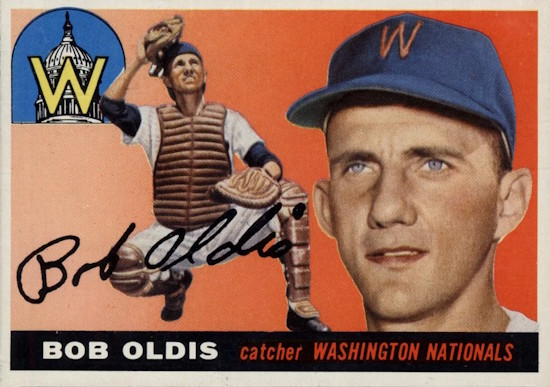
Oldis spent one more season in the Senators organization, playing for Chattanooga in 1956. He batted .286 with 13 doubles and 41 RBIs and was named to the Southern Association All-Star Team. Over the offseason, the New York Yankees told Bob Howsam, general manager of the team’s affiliate in Denver, that he could secure his own backup catcher. He acquired Oldis from Chattanooga to support starting catcher Johnny Blanchard. However, he hit so well that he shared equal time with Blanchard and batted .294 in 85 games. He also smacked 4 home runs for Denver. “No question about it, that Oldis has been one of our most consistent hitters all year,” said Denver manager Ralph Houk. There was never going to be a chance for Oldis to make the majors with the Yankees, with Yogi Berra, Elston Howard and Blanchard all ahead of him. He played regularly and hit well, with a .294 average for Denver in 1959. He also continued to be popular with the fans. He was known to engage in wild arguments with umpires and occasionally break into his clown act in blowouts. Well, not everyone was a fan. Once while playing in Birmingham, a fan grabbed Oldis’ glove as he moved near the stands to catch a pop foul, causing him to miss the ball. “I lowered the boom on him,” he admitted. “I broke his glasses to bits.”
The Pittsburgh Pirates spent $25,000 to purchase Oldis’ contract from Denver in December 1959, and he returned to the majors with the Bucs in 1960. Not that his chances for playing time had improved. Smokey Burgess and Hal Smith were a formidable tandem behind the plate, so Oldis was limited to 21 plate appearances in 22 games for the entirety of 1960. In one of those games, Oldis had the distinction of being ejected after the game was already over. The Pirates and Philadelphia Phillies took a 5-5 tie into the 10th inning on July 8. Oldis, who had entered the game in the eighth inning after Dick Schofield had pinch-run for Burgess, was behind the plate when Ruben Amaro doubled and Turk Farrell singled to right. He got the throw from right fielder Roberto Clemente and slapped the tag on Amaro as he tried to score, but umpire Ed Vargo called the runner safe, ending the game. Oldis was one of a host of angry Pirates who descended on the rookie umpire, but he was the only one thrown out of the game (which had just ended), and he was later fined and suspended two games for his actions. Mostly, Oldis used his words for good and acted as the Pirates’ unofficial nickname-giver and cheerleader. He commented during an early game where the Pirates were losing, “We gotta shake some kind of bush,” meaning they had to do something to start a rally. The comment became a rallying cry for the team as it clinched the NL pennant and stunned the Yankees by winning the 1960 World Series. Oldis made two appearances in the Series as a late-inning defensive replacement, without coming to bat. He returned to Pittsburgh for 1961 but was 0-for-5 in 4 games before he was sent to Triple-A Columbus in June. He batted a career-worst .224 there, but his work behind the plate and his unofficial coaching were important roles as Columbus won the International League pennant.
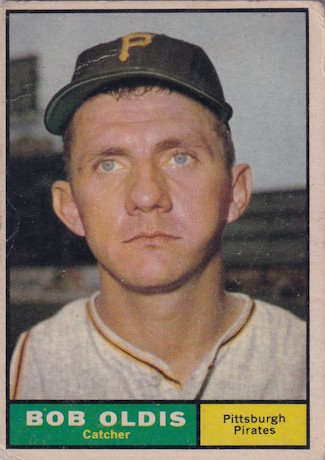
Over the offseason, the Phillies purchased Oldis’ contract from Pittsburgh. And the team did something unusual. They put Oldis on the major-league roster — and played him! In 5 seasons in the major leagues to that point, Oldis had a grand total of 71 at-bats in 50 games. In 1962, as a backup to starting catcher Clay Dalrymple, Oldis appeared in 38 games and had 80 at-bats. They were productive ones, too, as he slashed .263/.366/.313 on the year. He drove in a career-best 10 runs, and he hit his only major-league home run off Los Angeles Dodgers pitcher Pete Richert on August 9, 1962. It put the Phillies ahead 2-0 before the Dodgers scored 8 runs over the next two innings to win 8-3. Defensively, he had a .987 fielding percentage in 207-1/3 innings, and he threw out 42.9% of baserunners — 9 runners caught stealing in 21 attempts. Two of those outs came on June 4 against Los Angeles, and Maury Wills was the victim each time. Wills was the NL MVP that year and stole 104 bases, and that game was the only one all year where he was thrown out twice. Oldis later joked to MLB.com — I think he was joking — that he and Wills had dinner the night before the game and he got Wills drunk.
Oldis was promoted to second-string catcher behind Dalrymple in 1963, and Phillies manager Gene Mauch appreciated the catcher for all his skills. “He’s learned how to handle a bat pretty well, and he helped win quite a few games last year,” Mauch noted. “He can bunt, hit and run, move a runner along and he can still run pretty well… If I put on the squeeze, he’ll get the bat on the ball.” Oldis, naturally, was happy with more playing time, but he understood his value was as a cheerleader and unofficial coach. “I like to play, but just because you’re sitting on the bench doesn’t mean you can’t help a club. At least, that’s the way I look at it. Mental attitude is so important in this game.” Oldis got into a career-high 47 games, and he slashed .225/.250/.259. Twice in the span of three games during July, he delivered an extra-inning walkoff hit.
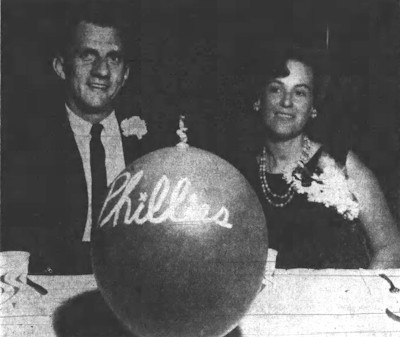 Oldis and his late wife Rosemary were honored by his friends in Iowa City after the 1963 season. During the banquet in his honor, the Oldis’ were presented with the gift of an automatic garage door opener. Source: Iowa City Press-Citizen, October 16, 1963.
All things must come to an end. For Oldis, the end of his playing career came when the Phillies brought in veteran Gus Triandos to serve as the backup to Dalrymple. Mauch opted not to keep three catchers on the roster, and the 35-year-old Oldis didn’t want to return to the minor leagues. He retired, but immediately transitioned to a coaching role as the team’s bullpen catcher. Oldis spent the year watching the Phillies make an improbable run for the National League pennant before an infamous September swoon. He actually spent part of that month as an active player; he was placed on the roster when Dalrymple tore ligaments in his knee, but he never made it into a game. Oldis’ career was officially over, but the second half of his baseball career was just getting started.
In Oldis’ 7 major-league seasons, he appeared in a total of 135 games, with 262 plate appearances. He slashed .237/.297/.275, and his 56 hits included 6 doubles and 1 home run. He drove in 22 runs and scored 20 times. He spent 617-2/3 innings behind the plate, and he had a .983 fielding percentage and threw out 33.8% of baserunners.
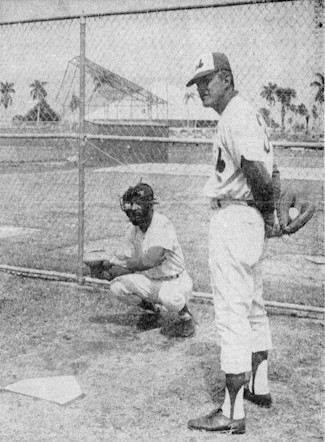 Oldis watched the development of Expos catchers during his run as a coach. Source: The Montreal Star, April 16, 1969.
Oldis remained with the Phillies until 1967, as a coach and scout. He then served as a bullpen coach for the Minnesota Twins in 1968 and joined the new Montreal Expos organization as bullpen coach in ’69. He was following in the footsteps of the team’s first manager, Gene Mauch. Before long, he transitioned to the role of an Expos scout. He worked for the team into the 1980s and signed several future major-leaguers, including Bill Gullickson, Warren Cromartie, Scott Sanderson, Dan Schatzeder and Casey Candaele. Oldis also continued to contribute to sports programs back in his native Iowa. For years, he was a basketball referee and worked on the University of Iowa “chain gang” during football games. He was inducted into the National High School Sports Hall of Fame in 2000. Outside of sports, Oldis raised money for Muscular Dystrophy, a disease that afflicted his late sons, Bobby Jr. and John. He also, through his work with the Iowa Highway Commission or his own charitable initiatives, tried to make life better for Iowans.
Oldis was named Scout of the Year in 2002. By then, he had moved to the Florida Marlins, and he scouted for the team into his 80s before his retirement. And while his baseball career may look like nothing more than a string of cups of coffee, he was much more valuable than the numbers show. Joe L. Brown, general manager of the 1960 champion Pirates, spoke very highly of Oldis during a retrospective about the team in 1985. “I can’t tell you how important he was to that team,” Brown said. “He was a funny guy, but through his wit, he got a lot of truths across. Every team needs a Bob Oldis.”
In addition to his sons Bobby, John, and William, Oldis was predeceased by his first wife Rosemary. He is survived by his wife Mary Pat, daughter Susan, and two granddaughters.
For more information: Iowa City Press-Citizen
Follow me on Instagram: @rip_mlb
Follow me on Facebook: ripbaseball
Follow me on Bluesky: @ripmlb
Follow me on Threads: @rip_mlb
Discover more from RIP Baseball
Subscribe to get the latest posts sent to your email.