
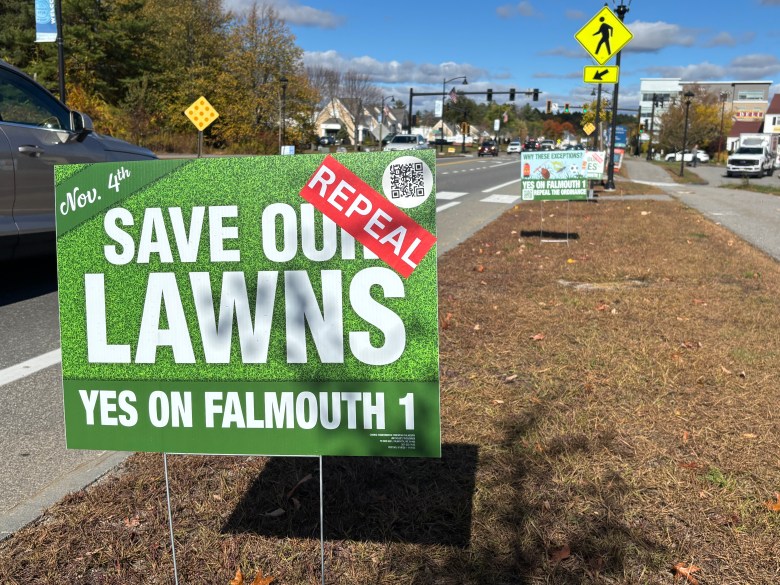
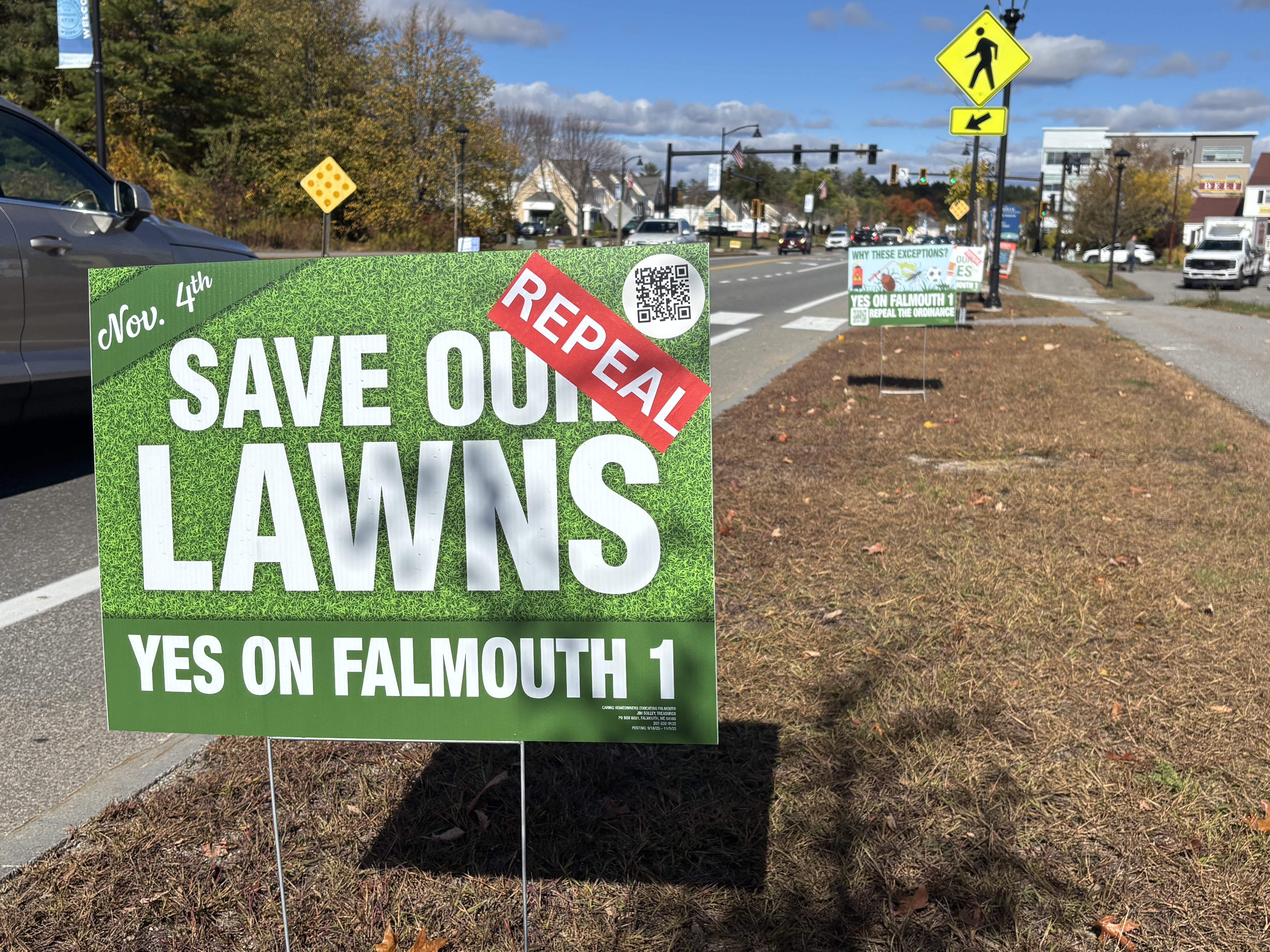
 Signs in favor of repealing Falmouth’s pesticide and fertilizer ordinance line Route 1 on Oct. 21. Town voters will decide Nov. 4 whether to repeal changes that strengthened the ordinance or to restore them. (Sophie Burchell/Staff Writer)
FALMOUTH — Across the lawns of Falmouth, political signs reflect a battle over the very ground they stand on.
“Save our lawns, Yes on Falmouth 1” and “Save our trees” read signs with the banner of “Repeal.”
Other signs encourage the opposite vote: “Vote No on 1. Save Our Waters.” and “Limit Pesticides. Protect Falmouth. No on Article 1.”
Bonny Rodden, 70, has several “Vote No” signs on her lawn, which she said has never been treated with chemicals. An organizer of the campaign to save the pesticide and fertilizer ordinance, she wants to make sure everyone in Falmouth is aware of the issue before they head to the polls.
“It’s democracy. All these things are part of democracy,” she said.
On Election Day, Falmouth voters will be asked whether amendments to a regulatory pesticide and fertilizer ordinance should be repealed. The battle over the ordinance is likely a familiar one to town residents, given its divisive history over the past three years.
“I made the commitment up front that we were going to see this through to the end,” said Dave Andrews, who is leading the campaign for the ordinance to be repealed.
The debate arose in 2022, when the Falmouth Conservation Commission proposed regulating pesticides and fertilizers more strictly. The proposal mirrored many other Maine municipalities’ pesticide rules but had stronger regulations on specific substances, such as neonicotinoid insecticides. It also bans certain nonsynthetic substances, with fertilizer containing nitrogen and phosphorus only allowed to be applied to lawns in limited quantities twice a year.
Pushback from some residents prompted public forums, a survey and multiple rounds of edits and public hearings on the amendments. After a February Town Council vote to pass the amendments was ruled invalid, the council in May again approved the changes. Soon after, over 1,200 Falmouth residents signed a petition calling for a repeal referendum.
Once the repeal effort qualified for the ballot, the town charter dictates that the ordinance is suspended until votes are cast. If voters decide to keep the ordinance, it would go back into effect April 1.
Many pro-ordinance advocates view the debate as a choice between environmental health and well-manicured lawns, while those for repealing the ordinance view it as local government overreach that disregards state and federal scientific standards and infringes on property rights.
A spring 2024 survey of the community found that 57.5% of the 600 Falmouth residents who responded were opposed to the ordinance.
‘A FULL-COURT PRESS’
Proponents on both sides say the past five months have been a sprint to connect with Falmouth voters ahead of the election.
“To put it in basketball terms, it’s a full-court press,” said Dennis Brown, who was involved in the development of the ordinance amendments and is campaigning for them to stay.
The Protecting Falmouth Committee, advocating for “no” votes to keep the ordinance in place, is organized primarily by four Falmouth residents who have set up headquarters at Rodden’s dining room table. According to the Maine Ethics Commission, the pro-ordinance campaign has raised $11,107 from individual donors, of which $7,710 had been spent on 200 signs and various mailers as of Oct. 27. One of the group’s targeted efforts to spread its message involved mailing information about pesticides’ negative effects on pets to about 1,000 Falmouth dog owners, based on a public dog registration list.
 Protecting Falmouth Committee organizer Bonny Rodden looks at a map of Falmouth that she uses to coordinate distributing signs with other campaign volunteers in her dining room. (Sophie Burchell/Staff Writer)
“We had to be strategic,” Rodden said. “We’re the underdogs. They’ve got the money, they got the people to sign the petition.”
Brown said the “no” campaign has worked hard to make sure all the information it shares about the ordinance is “dead on,” and to not demonize the opposition.
He also acknowledged that the suspended ordinance is not perfect but says it is worth passing now.
“I think it comes down to perfect lawns or a healthy environment,” he said.
On the other side, Caring Homeowners Educating Falmouth is campaigning for residents to vote to repeal the ordinance. As of Oct. 27, the group had raised $20,929; it hired a marketing company to create mailers and 300 signs for $17,875. While the top donor is Falmouth Center LLC, which could not be reached for comment, lawn care companies Mainely Grass and Atlantic Turf Care LLC are the next-highest donors, each contributing $2,000 to the campaign.
Atlantic Turf Care owner and operator Patrick Bucklin, a Falmouth resident, said he has seen negative impacts on his customers’ lawns in towns with stricter regulations. He emailed his company’s roughly 300 Falmouth customers telling them to vote “yes.”
 A sign from the Protecting Falmouth Committee stands on Shoreline Drive. (Sophie Burchell/Staff Writer)
“I have customers in South Portland, Cape Elizabeth, and I’ve seen the progression of the lawns since each municipality has passed their ordinance,” he said. “The lawns are going down the tubes, unfortunately.”
Bucklin also said some of his Falmouth customers have told him that they would just apply pesticides and fertilizers to their lawns themselves without a licensed applicator if the ordinance is put back in place.
Both campaigns have reported signs missing or stolen. While two incidents remain under investigation, Falmouth police Chief John Kilbride said town staff collected 25 signs last week because they weren’t in compliance with the town’s rules, which caused some confusion among the campaigns about whether they had been stolen.
As Election Day approaches, both campaigns hope that the rest of the town cares about the ordinance’s future as much as they do.
“It’s a bipartisan issue, so it’s just hard to predict,” Andrews said. “It’s just going to be a matter of who decides to learn about the issue and then get energized enough to get out and vote.”