

Developers behind the proposed Wood Avenue megawarehouse are requesting a special exception from Easton Zoning Hearing Board tied to one piece of the project.
Residents are concerned that it could increase flood risks.
Scannell Properties, the developer of the warehouse, is looking to relocate a watercourse, retention basin and access road within a designated floodplain. This is part of a greater construction of a 1-million square-foot warehouse along Wood Avenue.
The warehouse needs approval from Easton, which rests in the hands of The Easton Planning Commission. The commission is continuing to hear testimony from both the developer and the opposition during its monthly meetings.
The Zoning Hearing Board held a special hearing Sept. 18 to hear testimony from Scannell’s team, which included project manager Donald Haas and environmental consultant Jeff Smith.
On Monday evening, residents opposing the plan presented their own expert witness. Dozens filled the room, including several attorneys.
Opponents are concerned that the plan would cause environmental issues, increased flooding, and affect connecting bodies of water such as the Bushkill Creek.
Attorney Edward Shaughnessy, representing nearby residents, called David Brandes, a professor of civil and environmental engineering at Lafayette College, to testify about his review of the project’s stormwater and channel design plans.
Brandes told the board that his main concern is the adequacy of the proposed flood channel and runoff modeling.
“So the main point is that the channel is not correctly designed,” he said.
He explained that the development would increase impervious surface area from about 2.7 acres to 54 acres, which would result in an additional 6 million gallons of runoff during a 10-year storm and about 10 million gallons during a 100-year storm.
“That increased volume is also basically extending the high flows from the site, and so that’s going to tend to cause some downstream erosion,” Brandes said.
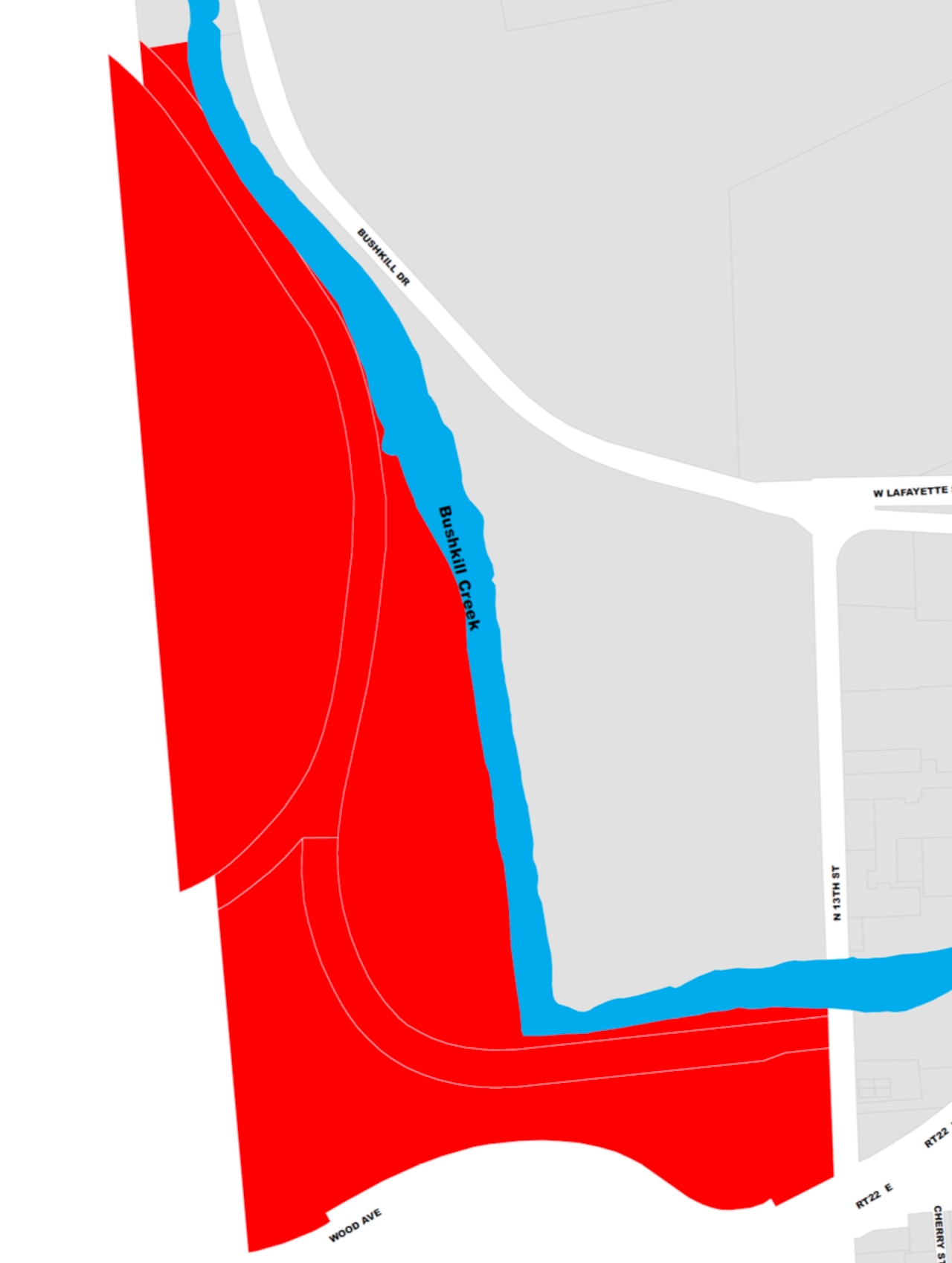 Developers of the 1525 Wood Ave Warehouse are seeking a special exception to relocate an existing tributary that will daylight into the Bushkill Creek, a retention basin, and a 40-foot-wide access road.Courtesy of the Easton Planning Commission.
He also questioned the hydrological models used by the developer’s engineers. He said they relied on scaled data from Bushkill Creek rather than site-specific measurements from Spring Brook, which he argued have different characteristics.
Brandes said that approach may have led to underestimating potential flood flows and runoff.
“We’re going to have more overbank flows and more localized flooding, because that channel is not designed to contain the flows that are likely to be coming downstream,” he said.
Brandes added that the soil type assumptions used in the analysis could be inaccurate and that regulatory approvals do not necessarily ensure safety or compliance with local conditions.
He recommended that Scannell install a stream gauge on Spring Brook and develop a runoff model specific to the site.
During a heated cross-examination, Scannell’s attorney, Mark Kaplan, challenged Brandes’s conclusions, pointing out that he had not conducted field measurements or submitted findings to state regulatory agencies.
Kaplan emphasized that the project met required engineering and environmental standards.
“We have done everything that we are required to do, and other than sitting here and showing us pictures and drawing conclusions, you have not done a study, and that’s what the law requires. You can’t come in here and just criticize what was done,” Kaplan said.
Several other residents spoke to the board in opposition. Xavier Garcia-Molina, a resident who lives 85 feet from the Bushkill Creek, said he has observed high water levels firsthand after various rain events and has documented those conditions through photos and videos.
He said the project’s hydrologic study might underestimate the real flood risk, noting how quickly the creek rises even after modest rainfall.
He argued that Easton’s zoning board and city officials should not rely solely on external agencies such as the Pennsylvania Department of Environmental Protection or the U.S. Army Corps of Engineers when determining approval.
“The Zoning Hearing Board opens up this hearing so that you and I can both talk about our differences of opinion and our interpretation of the study,” Garcia-Molina said.
Bruce McCutcheon, a city resident representing the 131-member Delaware Chapter of Trout Unlimited, also spoke at the hearing. He said the creek is a “treasured resource,” home to a Class A wild trout population that draws anglers from across the region.
McCutcheon warned that stormwater runoff from the proposed warehouse could raise stream temperatures and carry pollutants like road salt and oil into the creek, harming trout habitats and water quality.
He said such impacts could violate state regulations that protect high-quality cold-water fisheries and conflict with Easton’s stormwater permit obligations.
“It is this board’s responsibility to protect Easton residents, reduce long-term municipal liability and safeguard the Bushkill for decades to come,” he added.
The Easton Zoning Hearing Board will continue the hearing at a later, unannounced date.
If you purchase a product or register for an account through a link on our site, we may receive compensation. By using this site, you consent to our User Agreement and agree that your clicks, interactions, and personal information may be collected, recorded, and/or stored by us and social media and other third-party partners in accordance with our Privacy Policy.